Most offices in Niagara Falls, St. Catharines, and Welland get a daily wipe-down. Someone empties the bins, vacuums the main walkways, and wipes the boardroom table before the morning meeting. That’s routine cleaning, and it matters. But it isn’t the same thing as deep cleaning, and a lot of business owners don’t realize the difference until something goes wrong – a client comments on the smell in the lobby, three people on the same floor catch the same cold in the same week, or someone finally looks behind the filing cabinet and wishes they hadn’t.
Regular cleaning handles what you can see. Deep cleaning handles what you can’t – the bacteria living in carpet fibers, the dust packed into air vents, the grease film building up behind the breakroom microwave, the grime coating doorknobs that 40 people touch every day. None of that shows up on a quick visual check, but all of it affects how healthy, productive, and professional your workplace actually is.
This guide walks through the 10 clearest signs that your office is overdue for a deep clean, the spots most cleaning routines miss entirely, and how often Niagara Region businesses should realistically be scheduling this kind of work. By the end, you’ll know exactly what to look for next time you walk through your own space.
Why Deep Office Cleaning Is Essential for Every Workplace
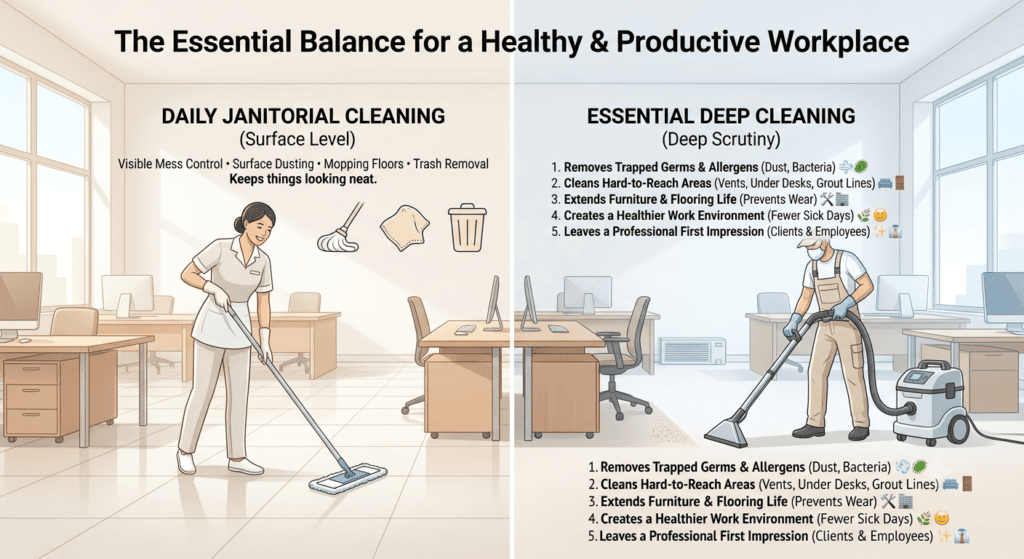
Daily janitorial work and office deep cleaning aren’t competing services – they’re two different jobs that both need to happen. Daily cleaning keeps the visible mess under control. Deep cleaning gets into the parts of the building that daily cleaning physically can’t reach: under furniture, inside vents, deep into carpet pile, behind appliances, and into grout lines that a mop glides right over.
Here’s what consistent deep cleaning actually does for a workplace:
- It improves day-to-day hygiene. Surfaces that get touched dozens of times a day – door handles, light switches, shared keyboards – need more than a once-over with a damp cloth to stay sanitary.
- It cuts down on germs and allergens. Dust, pollen, and bacteria settle into carpets, upholstery, and air vents over time. Deep cleaning physically removes them instead of just moving them around.
- It extends the life of your furniture and flooring. Ground-in dirt acts like sandpaper on carpet fibers and tile sealant. The longer it sits, the more it wears down the surface underneath.
- It creates a genuinely healthier environment to work in. Less dust and bacteria in the air and on surfaces means fewer triggers for allergies, headaches, and fatigue.
- It leaves a better impression on anyone walking through the door. Clients, vendors, and job candidates notice cleanliness within seconds of stepping inside, whether they say anything or not.
The catch is that none of this happens through routine cleaning alone. A vacuum picks up surface dirt, not what’s embedded three layers down in the carpet pad. A wipe-down disinfects what’s visible, not what’s hiding in a vent that hasn’t been touched since the building opened. That’s the gap deep cleaning is built to close – and it’s also why most offices don’t notice they need it until one of the ten signs below shows up.
10 Signs Your Office Needs Deep Cleaning Immediately
1. Persistent Unpleasant Odors
If a smell keeps coming back no matter how often someone takes out the trash or sprays air freshener, that’s not a trash problem. That’s a sign something is trapped somewhere your regular cleaning routine doesn’t reach.
A few common culprits:
- Bacteria buildup in carpets. Spilled coffee, food crumbs, and tracked-in moisture create the perfect environment for bacteria to grow inside carpet fibers, and that’s where musty or sour smells usually come from.
- Lingering kitchen smells. Microwaves, fridges, and sink drains hold onto food odors long after the food itself is gone, especially if grease has built up inside them.
- HVAC odors. If your air system smells stale or musty when it kicks on, there’s likely dust, mold, or debris sitting inside the ductwork.
A spray can mask a smell for an hour. It can’t fix what’s actually causing it. If the odor returns within a day or two of “cleaning” it, that’s the clearest sign you need a deep clean rather than another can of air freshener.
2. Dust Keeps Returning Almost Immediately
Every office collects dust. But if your desks, shelves, and electronics are visibly dusty again within a day or two of being wiped down, that points to a much bigger source somewhere in the building.
Watch for dust buildup in these spots specifically:
- Desks and shelving that need re-dusting constantly
- Air vents and HVAC returns, which recirculate dust right back into the room every time the system runs
- Window blinds, where dust collects in layers between slats and rarely gets touched during routine cleaning
- Electronics like monitors, keyboards, and printers, which generate static that pulls dust toward them
When dust keeps reappearing fast, it usually means your HVAC system is recirculating particles that a surface wipe-down can’t address. That’s a direct hit to indoor air quality, and it’s one of the more common reasons employees report stuffy noses, headaches, or general fatigue by mid-afternoon without knowing why.
3. Carpets and Floors Look Dull, Stained, or Worn
Carpet is one of the biggest investments in an office fit-out, and it’s also one of the first things to show neglect. Foot traffic from employees, clients, and deliveries grinds dirt deep into carpet fibers over time – far past where a vacuum can reach.
Signs your flooring needs more than routine care:
- Visible traffic lanes near doorways, hallways, and high-use walkways
- Stains that didn’t come out with spot cleaning
- A dull, flattened look even right after vacuuming
- Hard flooring that looks gray or hazy instead of clean, even after mopping
The Carpet and Rug Institute has noted that embedded soil causes carpet fibers to split and break down faster, which means neglected carpet doesn’t just look bad – it wears out years ahead of schedule. Hot water extraction and deep carpet cleaning pull out the dirt that’s settled into the carpet backing, restoring both the appearance and the lifespan of the flooring.
4. Employees Are Getting Sick More Often
This one shows up in your absenteeism numbers before it shows up anywhere else. If it feels like the same cold is bouncing around the office every few weeks, your workspace might be part of the problem.
A few reasons this happens:
- Germ buildup on shared surfaces that don’t get disinfected as often as they’re touched
- Shared workstations, where multiple people use the same desk, chair, or equipment across a day
- High-touch surfaces like phones, keyboards, and door handles that act as transfer points for bacteria and viruses
- Allergy and respiratory flare-ups triggered by dust and allergens trapped in carpet, upholstery, and air vents
A University of Arizona study found that a typical office desk carries roughly 400 times more bacteria than a toilet seat – which sounds dramatic until you consider how rarely the average desk actually gets disinfected compared to a washroom. Research on workplace hygiene has also linked consistent professional cleaning to absenteeism reductions of up to 46%, which is a meaningful number once you put a dollar figure on lost productivity. For a 50-person office, preventing even ten sick days in a quarter can save roughly $20,000 in lost output – money that almost always outweighs the cost of a deep cleaning program.
If your team’s sick days have been trending up lately, it’s worth asking whether the office itself is part of the cycle.
5. The Restrooms Never Feel Truly Clean
Restrooms get cleaned daily in most offices, yet they’re often the first place clients and employees notice when something’s off. If yours never quite feels fresh no matter how often someone runs through it with a mop, the issue is below the surface.
Common signs include:
- Soap scum building up around taps and dispensers
- Hard water stains on faucets, toilets, and mirrors that don’t wipe away
- Lingering odors that return within hours of cleaning
- Germ hotspots around handles, taps, and stall locks that get touched constantly and cleaned only briefly
Restroom cleanliness carries more weight than most business owners realize. Research from the International Sanitary Supply Association found that 94% of people would avoid returning to a business after encountering a dirty restroom – making it one of the highest-stakes areas in the entire building. Deep cleaning addresses grout lines, fixture seals, and drain buildup that a quick daily wipe-down was never designed to handle.
6. The Breakroom Has Grease and Food Residue Buildup
Breakrooms see constant use and minimal deep attention. Most daily cleaning covers the counters and maybe the table, but the appliances and cabinets quietly collect grime week after week.
Look for:
- Microwave stains baked onto the interior walls and ceiling
- Refrigerator spills that have hardened on shelves or pooled in the bottom drawer
- Sticky cabinet exteriors from hands touching them after eating
- Food residue tucked into corners, behind appliances, and under the sink
Grease and food residue don’t just look unpleasant – they attract pests and create a breeding ground for bacteria in one of the few rooms where employees are actually eating. A breakroom that smells faintly of old food, even after the trash has been emptied, is telling you the appliances and surfaces need a proper degreasing, not just a wipe.
7. High-Touch Surfaces Feel Sticky or Dirty
This is the sign most people notice physically before they notice it logically – you reach for a door handle or grab a shared mouse and it just feels off. That residue is a buildup of skin oils, dust, and bacteria that daily cleaning often skips because these surfaces seem “too small” to prioritize.
Common high-touch surfaces that get overlooked include:
- Door handles and push plates
- Light switches
- Elevator buttons
- Shared phones
- Keyboards and mice
- Shared desks and hot-desking stations
Research from Kimberly-Clark Professional, which collected nearly 5,000 surface swabs from office buildings, identified break room faucet handles, microwave door handles, keyboards, refrigerator handles, and water fountain buttons as the most consistently contaminated spots in any office. About 80% of common infections spread through contact with surfaces like these, which makes regular, thorough disinfection of high-touch points one of the highest-impact things a deep cleaning service can do for employee health.
8. Clients Notice the Cleanliness
Sometimes the clearest sign isn’t something you see yourself – it’s something a client or visitor mentions, or doesn’t have to mention because their body language says it for them.
A few things worth thinking about:
- First impressions form fast. Research out of the University of Wolverhampton describes a “halo effect,” where people who notice one positive trait – like a clean, well-kept space – tend to assume other positive traits follow, including professionalism and reliability.
- Reputation rides on small details. A scuffed floor or a stained chair in the waiting area can undercut a sales pitch before anyone says a word.
- Customer confidence builds or breaks in seconds. Most people form a first impression within a fraction of a second of walking in.
- A clean space signals a well-run business. It tells clients you pay attention to the details they can’t see in your work either.
If a client has ever paused, glanced around, or seemed distracted during a meeting in your space, it’s worth asking whether the office itself played a part in that.
9. Mold, Mildew, or Water Stains Are Appearing
This sign deserves more urgency than the others on this list. Mold and mildew aren’t just a cosmetic issue – they’re a health and air-quality problem that gets worse the longer it’s left alone.
Watch for these warning signs:
- Discoloration or dark spots around sinks and plumbing fixtures
- Persistent dampness or staining in washrooms
- Brown rings or sagging on ceiling tiles
- Musty smells near HVAC vents and ductwork
- Any visible moisture buildup in corners, around windows, or near exterior walls
Mold thrives anywhere there’s moisture and poor airflow, which makes restrooms, kitchenettes, and HVAC systems the most common places it shows up in office buildings. Left untreated, it can spread into wall cavities and ceiling tiles, which turns a cleaning issue into a repair issue. If you spot any of these signs, this isn’t something to schedule for “next quarter” – it’s worth addressing right away.
10. It’s Been More Than Six Months Since Your Last Deep Clean
Sometimes there’s no dramatic sign at all – just time passing. Daily janitorial work, however good it is, was never designed to replace deep cleaning. It’s built to manage visible mess on a day-to-day basis, not to extract carpets, clear vents, or scrub behind furniture that hasn’t moved in months.
A few things worth knowing:
- Routine cleaning has a ceiling. No matter how consistent your daily cleaner is, certain tasks – carpet extraction, vent cleaning, behind-furniture detailing – simply aren’t part of a standard daily scope.
- Seasonal buildup is real. Niagara winters track in salt, slush, and grit; spring and summer bring pollen and humidity. Each season leaves its own residue behind.
- Industry guidance points to quarterly deep cleaning for most offices. Commercial cleaning standards commonly recommend carpet extraction, high-dusting of vents and fixtures, and floor detailing on a quarterly basis for standard office environments, with more frequent service for higher-traffic spaces.
If you genuinely can’t remember the last time your office had a proper deep clean, that’s the same as it being overdue. Six months is a reasonable outer limit for most office environments – and for busier, higher-traffic spaces, that window should be even shorter.
Areas Most Offices Forget to Clean
Even offices with a solid daily cleaning routine tend to miss the same handful of spots, simply because they’re not part of a typical day-to-day scope. A genuine deep clean should cover:
- Air vents and HVAC returns – dust and allergen reservoirs that get recirculated constantly
- Baseboards – low-traffic, low-visibility, and almost always skipped
- Behind and under office furniture – desks, filing cabinets, and shelving rarely get moved
- Upholstery – office chairs and waiting room furniture absorb dust, oils, and odors over time
- Window tracks and sills – collect grit, dead insects, and moisture that’s easy to miss at a glance
- Ceiling fans and light fixtures – accumulate dust that eventually drops back down into the room
- Computer equipment – keyboards, towers, and monitor vents trap dust and bacteria
- Storage rooms and supply closets – out of sight, and usually out of the cleaning rotation entirely
- Under desks – crumbs, dust, and debris build up where nobody’s looking
None of these areas are hard to clean. They’re just easy to forget, which is exactly why they need to be a defined part of a deep cleaning checklist rather than left to chance.
What You Actually Get From Professional Office Deep Cleaning
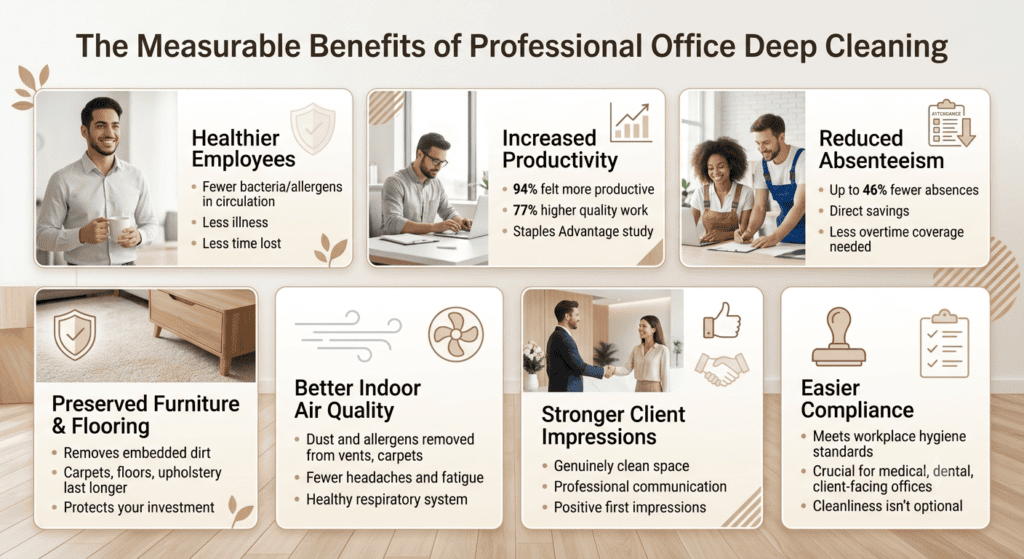
Scheduling a professional deep clean isn’t just about checking a box. It produces results that show up in measurable ways across the business:
- Healthier employees. Fewer bacteria and allergens in circulation means fewer colds, less seasonal flare-up, and less time lost to illness.
- Better day-to-day productivity. A Staples Advantage Workplace Index survey found that 94% of workers felt more productive in a clean workspace, and 77% reported producing higher-quality work in one.
- Reduced absenteeism. Studies on workplace hygiene have linked consistent deep cleaning programs to absenteeism drops of up to 46%, with direct savings on lost productivity and overtime coverage.
- Longer-lasting furniture and flooring. Carpets, upholstery, and hard floors all wear out faster under embedded dirt. Removing that buildup protects the investment you’ve already made in your space.
- Better indoor air quality. Removing dust and allergens from carpets, vents, and upholstery cuts down on the headaches, fatigue, and respiratory irritation that come with poor air circulation.
- Stronger impressions on clients and visitors. A genuinely clean space backs up everything else you’re trying to communicate about your business.
- Easier compliance with workplace hygiene expectations. Particularly relevant for medical, dental, and client-facing offices where cleanliness isn’t optional.
How Often Should a Niagara Office Be Deep Cleaned?
There’s no single answer that fits every office, but there are reasonable benchmarks depending on size and traffic:
- Small offices (under 10 employees, low visitor traffic): every 6–12 months
- Medium offices (10–50 employees, moderate traffic): every 3–6 months
- High-traffic offices (50+ employees, frequent visitors or shared workstations): quarterly
- Medical, dental, or healthcare offices: monthly, or as required by your regulatory body
Niagara businesses have an extra factor to plan around: the seasons here are genuinely tough on a building. Winter brings road salt, slush, and grit tracked in on every pair of boots from Niagara Falls to Welland. Spring and early summer bring pollen and humidity that settle into carpets and HVAC systems. A deep cleaning schedule that accounts for these seasonal shifts – rather than running on a flat, one-size-fits-all calendar – tends to keep offices in noticeably better shape year-round.
If you’re not sure where your office falls, a quick walkthrough with a commercial cleaning provider can usually tell you within a few minutes based on traffic patterns, square footage, and what’s already showing wear.
Why Niagara Businesses Choose NLLC for Office Deep Cleaning
NLLC has spent years handling commercial cleaning for businesses across Niagara Falls, St. Catharines, Welland, Fort Erie, Niagara-on-the-Lake, Thorold, Port Colborne, and the wider Niagara Region. Office deep cleaning is one of our core commercial services, alongside the residential cleaning, Airbnb turnovers, and property maintenance work we handle throughout the region.
Here’s what businesses can expect when they work with us:
- Experienced cleaning professionals who understand the difference between a surface wipe and a genuine deep clean, and treat every space accordingly
- Flexible scheduling built around your business hours, so cleaning happens without disrupting your team’s workday
- Customized cleaning plans based on your office’s size, traffic, and specific trouble spots – not a generic checklist
- The right equipment for the job, from carpet extraction to high-dusting tools that reach vents, fixtures, and ceiling fans safely
- Reliable, consistent service you can actually plan around, season after season
- Local commercial cleaning expertise, with a genuine understanding of how Niagara winters and humid summers affect office buildings differently than they do elsewhere
We’re not a national call centre dispatching whoever’s available. We’re a Niagara Region company that knows the area, knows the seasonal challenges, and builds cleaning plans around what your specific office actually needs.
Final Thoughts
If even two or three of these ten signs sound familiar, your office is likely overdue for a deep clean – and that’s worth acting on rather than putting off. Lingering odors, returning dust, stained carpets, frequent sick days, restrooms that never quite feel clean, greasy breakroom appliances, sticky high-touch surfaces, client comments, signs of mold, or simply too much time since the last proper clean: each one points to the same underlying issue. Routine cleaning alone isn’t reaching everything your workplace needs.
The businesses that stay ahead of this don’t wait until hygiene becomes a visible problem. They book deep cleaning on a schedule that matches their traffic and their season, and they treat it as a normal part of running a healthy, professional workplace – not an emergency fix.
If your office in Niagara Falls, St. Catharines, Welland, or anywhere across the Niagara Region is showing any of these signs, NLLC can help. Contact us today for a free, no-obligation quote, and we’ll build a deep cleaning plan around exactly what your space needs.
8. FAQ
What is included in an office deep cleaning?
A typical office deep clean covers carpet extraction, high-dusting of vents and light fixtures, disinfection of high-touch surfaces, restroom detailing, breakroom degreasing, baseboard and window track cleaning, and cleaning behind and under furniture – all the areas a daily cleaning routine usually skips.
How often should an office be professionally deep cleaned?
Most small offices do well with deep cleaning every 6–12 months, medium-sized offices every 3–6 months, and high-traffic offices quarterly. Medical and healthcare offices typically need monthly deep cleaning to meet hygiene standards.
What is the difference between regular office cleaning and deep cleaning?
Regular cleaning manages day-to-day visible mess – emptying bins, vacuuming traffic areas, wiping down desks. Deep cleaning goes further, targeting carpets, vents, behind furniture, and other areas that build up bacteria, allergens, and grime over weeks or months without daily attention.
How long does an office deep cleaning take?
This depends heavily on office size and condition, but most small to mid-sized offices can expect a deep clean to take anywhere from a few hours to a full day. Larger or heavily neglected spaces may take longer, especially if carpet extraction or mold remediation is involved.
Does deep cleaning help reduce employee sick days?
Yes. Studies on workplace hygiene have linked consistent professional cleaning programs to absenteeism reductions of up to 46%, largely by removing the bacteria and allergens that build up on shared surfaces and in carpets between routine cleanings.
Can deep cleaning improve indoor air quality?
Yes. Carpets, upholstery, and HVAC vents trap dust, pollen, and other airborne particles over time. Deep cleaning physically removes these reservoirs instead of just disturbing them, which noticeably improves the air employees are breathing all day.
Is professional office deep cleaning worth the investment?
For most businesses, yes. Beyond the health and air quality benefits, deep cleaning protects the lifespan of carpets and furniture, reduces absenteeism-related costs, and creates a stronger first impression for clients – all of which tend to outweigh the cost of the service itself over time.