If your lawn looks a little tired by the middle of July, you’re not imagining it. Summer is genuinely the hardest season for grass to survive in the Niagara Region and across most of Southern Ontario. The combination of intense heat, patchy rainfall, humidity, and heavy foot traffic from backyard barbecues and kids playing outside puts more stress on your lawn than any other time of year.
Most homeowners deal with the same handful of problems every summer: brown patches that won’t green back up, weeds that seem to multiply overnight, grass that crunches underfoot by August, and a nagging feeling that they’re doing something wrong even when they’re watering “enough.” This is one of the most common frustrations in Canadian lawn care, and the truth is that summer lawn care isn’t about doing more work. It’s about doing the right things, at the right time, in the right order.
A lawn that’s cared for properly through the summer isn’t just nicer to look at. It’s one of the simplest ways to protect your property’s curb appeal and its resale value. Real estate agents will tell you that a lush, well-kept front lawn is one of the first things buyers notice, and it’s one of the cheapest upgrades a homeowner can make compared to renovations or landscaping overhauls.
In this guide, we’re walking through 12 proven summer lawn care tips that actually work in the Niagara Region’s climate, from Niagara Falls to St. Catharines, Welland, Fort Erie, Niagara-on-the-Lake, Thorold, and Port Colborne. Good summer lawn maintenance comes down to a handful of consistent habits rather than any single trick, and you’ll learn how to water smarter, mow correctly, manage weeds without cosmetic pesticides (which are restricted province-wide in Ontario), spot pest and disease problems early, and know when it’s simply worth calling in a professional crew. By the end, you’ll have a clear, actionable checklist you can follow all season long.
Understand What Your Lawn Needs During Summer
Before you touch a hose or a mower, it helps to understand what’s actually happening to your grass when the temperature climbs. Most lawns in the Niagara Region are made up of cool-season grasses, and cool-season grass behaves very differently in July than it does in May.
How Heat Affects Grass
Cool-season varieties like Kentucky bluegrass, perennial ryegrass, and fine or tall fescue grow best when air temperatures sit between roughly 15°C and 24°C. Once daytime highs push consistently past 27-28°C, these grasses shift into a kind of self-preservation mode. Growth slows down, the plant redirects energy toward its roots instead of new leaf blades, and in extended heat waves the lawn may go dormant and turn a dusty brown colour on purpose. This is a survival mechanism, not a sign that your lawn is dying. Grass can typically survive four to six weeks in a dormant state and bounce back once cooler, wetter weather returns.
Understanding this single fact changes how you should approach the rest of the season. Pushing a stressed, heat-dormant lawn with heavy fertilizer or aggressive mowing does more harm than good – it’s a bit like asking someone who’s exhausted to run faster instead of letting them rest.
Signs of Drought Stress
Catching drought stress early lets you intervene before real damage sets in. Watch for:
- Grass blades that fold or curl lengthwise instead of lying flat
- A dull, blue-grey tint across the lawn instead of a healthy green
- Footprints or mower tracks that stay visibly pressed into the grass for more than a few minutes
- Patchy thinning, especially on slopes, near driveways, or in spots that get full afternoon sun
If you notice these signs, it’s time to adjust your watering approach – but more water isn’t always the answer, and neither is watering every single day.
Different Grass Types Commonly Found in Canada
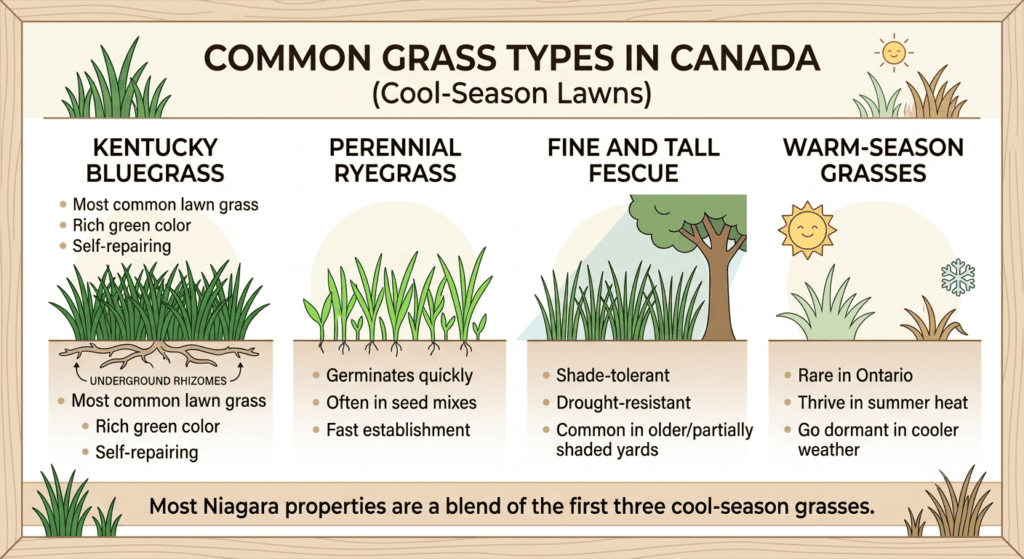
While cool-season grasses dominate most Ontario lawns, it helps to know what you’re actually working with:
- Kentucky bluegrass – the most common lawn grass in the region, known for its rich colour and ability to self-repair through underground rhizomes
- Perennial ryegrass – germinates quickly and is often blended into seed mixes for fast establishment
- Fine and tall fescue – more shade-tolerant and often more drought-resistant than bluegrass, common in older or partially shaded yards
- Warm-season grasses – rare in Ontario but occasionally found in small pockets; these actually thrive in summer heat and go dormant in cooler weather, the opposite pattern of cool-season lawns
Most Niagara Region properties are a blend of the first three, which is why the advice in this guide is built around cool-season lawn care.
Water Smarter, Not More
Watering is where the most well-meaning homeowners go wrong. Watering your lawn in summer is less about volume and more about timing and consistency – more water is not automatically better, and the way you water matters just as much as how much.
Best Time of Day to Water
Early morning, ideally before 10 a.m., is the best window for watering your lawn. At this time of day, temperatures are cooler and winds are typically calmer, so less water is lost to evaporation and more of it actually reaches the roots. Morning watering also gives grass blades time to dry out before evening, which matters a lot in humid Niagara summers because wet grass sitting overnight creates ideal conditions for fungal disease.
Watering in the evening isn’t the disaster some homeowners assume it is, but it does carry a higher disease risk than morning watering. Midday watering, on the other hand, is the least efficient option – a large share of that water simply evaporates before it soaks in.
If your municipality has a watering bylaw in place (more on that below), your assigned watering window may override the “ideal” time anyway, so always check your local schedule first.
How Much Water Your Lawn Actually Needs
Most lawns need about 2.5 to 4 centimetres (roughly 1 to 1.5 inches) of water per week, including rainfall, to stay healthy through summer. Watering lawn in summer conditions is easiest to get right with a simple measuring trick: place an empty tuna can or a similar shallow container on your lawn while the sprinkler runs. Once it collects about 2.5 cm of water, you’ve delivered a solid weekly watering – track how long that takes and you’ll know your sprinkler’s output for future reference.
Deep Watering vs Frequent Shallow Watering
This is arguably the single most important watering principle for a healthy lawn in summer. Deep, infrequent watering – two to three times a week – is far better than a quick daily sprinkle. When you water deeply, moisture penetrates further into the soil, which encourages roots to grow downward in search of it. Deep roots make a lawn naturally more resistant to drought and heat stress.
Frequent shallow watering does the opposite. It keeps moisture near the surface, so roots have no reason to grow deep. The result is a lawn with a shallow root system that’s far more vulnerable the moment watering restrictions kick in or a heat wave stretches on longer than expected.
Mistakes That Waste Water
- Watering on windy days, when much of the spray drifts onto pavement instead of grass
- Running sprinklers on a fixed timer without checking whether it actually rained that week
- Letting sprinklers run onto driveways, sidewalks, or the street due to poor aim or a leaky system
- Watering lightly every single day “just in case,” which trains roots to stay shallow
- Ignoring your municipality’s watering restrictions, which can result in warnings or fines
It’s also worth knowing that watering rules vary quite a bit by municipality across Ontario, and they can change from year to year depending on water supply conditions. Some regions, like the Region of Waterloo, run a structured seasonal bylaw from late May through the end of September limiting sprinkler use to one assigned day per week based on your address. Municipalities that draw water from Lake Ontario or Lake Erie, which includes most of the Niagara Region, tend to have far more relaxed rules since the Great Lakes hold an enormous, stable freshwater supply that isn’t meaningfully affected by a dry summer. Even so, it’s worth checking your local municipality’s current outdoor water use bylaw each season, since rules are reviewed and occasionally tightened.
Mow Your Lawn the Right Way
Mowing feels like the simplest task on this list, and yet it’s one of the most common places homeowners accidentally damage their own lawn. A few basic lawn mowing tips make the difference between a mower that helps your grass and one that quietly works against it.
Ideal Mowing Height
For cool-season lawns in Southern Ontario, the general rule is to raise your mower height during summer rather than cutting grass short. Most experts recommend keeping cool-season grass between 7.5 and 10 centimetres (about 3 to 4 inches) tall during the hottest stretch of the year, with tall fescue and perennial ryegrass tolerating the higher end of that range comfortably. Taller grass shades the soil underneath it, which keeps roots cooler, slows moisture loss, and can meaningfully reduce how often you need to water.
Cutting grass too short, sometimes called scalping, exposes soil to direct sun, stresses the plant, and opens the door for weed seeds to germinate in the bare patches that result. If your lawn already looks a bit shaggy heading into a heat wave, resist the urge to bring it back down to a short spring height all at once.
Never Cut More Than One-Third of the Grass
This is the golden rule of mowing, and it applies year-round, not just in summer. Removing more than a third of the blade’s total height in a single cut shocks the plant, forces it to spend energy on emergency leaf regrowth instead of root development, and can leave grass looking pale or stressed for days afterward. If your lawn has gotten away from you, it’s better to mow it down gradually over two sessions spaced a few days apart than to scalp it in one pass.
Keep Mower Blades Sharp
A dull mower blade tears grass instead of cutting it cleanly, leaving ragged, frayed tips that turn brownish within a day or two and become easier entry points for disease. Most residential mower blades need sharpening once or twice per mowing season, depending on how much lawn you’re covering and how often you mow. If your lawn has a slightly whitish or brown-tinged look shortly after mowing even though you watered properly, a dull blade is often the culprit.
Leave Grass Clippings or Bag Them?
For most summer mowing, leaving clippings on the lawn (a practice sometimes called grasscycling) is the better option. Short clippings break down quickly and return nitrogen and organic matter to the soil, effectively acting as a light, free fertilizer application. The exception is when your lawn has gotten unusually long and clippings come out in thick clumps – in that case, bag or rake them so they don’t smother the grass underneath and create dead patches.
Feed Your Lawn Without Overdoing It
Fertilizing feels like the obvious fix for a lawn that’s looking pale, but summer is actually the season where more homeowners over-fertilize than under-fertilize. Getting lawn fertilization timing right matters more than the product you choose.
Whether Summer Fertilizing Is Necessary
Cool-season grass slows or stops active growth during the hottest weeks of summer, particularly if it’s gone dormant from heat or drought stress. Feeding a dormant or heavily stressed lawn with a standard nitrogen-heavy fertilizer doesn’t help it recover – it can actually push the plant to try to grow new leaf tissue at exactly the moment it doesn’t have the water reserves to support that growth, which adds stress rather than relieving it. For most Niagara Region lawns, the two most important fertilizer applications of the year happen in spring and fall, when grass is actively growing and can put nutrients to good use.
Slow-Release Fertilizers
If your lawn genuinely needs feeding during summer – for example, if it’s actively growing without heat stress and simply looks thin or pale – a slow-release, low-nitrogen fertilizer is the safer choice over a fast-release product. Slow-release formulas deliver nutrients gradually over several weeks instead of all at once, which reduces the risk of fertilizer burn and won’t force a sudden growth spurt that outpaces the lawn’s summer water supply.
When to Avoid Fertilizing During Extreme Heat
Skip fertilizing entirely during active heat waves, drought conditions, or any period when your lawn shows visible signs of dormancy or stress. A good rule of thumb: if you wouldn’t want to be doing strenuous exercise outside that day, it’s probably not a great day to fertilize your lawn either. Wait for a stretch of milder temperatures and adequate soil moisture before applying anything.
Stop Weeds Before They Take Over
Weeds seem to explode in summer, and there’s a simple reason: any bare, thin, or stressed patch of lawn is an open invitation for opportunistic weed seeds to take root. Effective weed control starts long before you ever spot a dandelion.
Why Weeds Thrive in Summer
Weeds like crabgrass, dandelion, and clover are often more heat- and drought-tolerant than cultivated turfgrass, which means they can keep growing and spreading in conditions where your lawn is struggling. A thin or scalped lawn gives weed seeds direct access to sunlight at the soil surface, which is exactly what they need to germinate.
Natural Weed Prevention
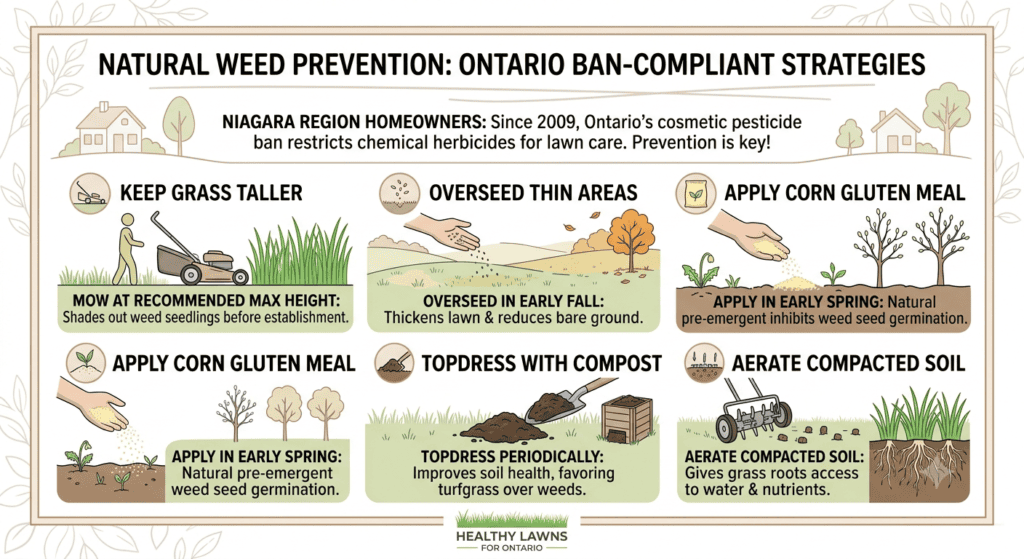
It’s important for Niagara Region homeowners to know that Ontario has had a province-wide cosmetic pesticide ban in place since 2009, which restricts the use of most chemical herbicides and pesticides for purely appearance-based lawn and garden care. This makes prevention even more valuable than in provinces or countries without similar rules. Effective, ban-compliant prevention strategies include:
- Keeping grass at the taller end of its recommended mowing height so it shades out weed seedlings before they can establish
- Overseeding thin areas in early fall to thicken the lawn and reduce bare ground
- Applying corn gluten meal in early spring as a natural pre-emergent that inhibits weed seed germination
- Topdressing with compost periodically to improve soil health, which naturally favours turfgrass over weeds
- Aerating compacted soil so grass roots (not weed roots) have easier access to water and nutrients
Spot Treatments vs Full-Lawn Treatment
For a handful of weeds scattered across an otherwise healthy lawn, hand-pulling remains one of the most effective and lowest-impact options, especially right after rain or watering when the soil is soft and the full root system comes out cleanly. For larger infestations, low-risk or biopesticide products included on Ontario’s list of pesticides authorized for cosmetic use can be used, but always check that a product is legally approved for residential lawn use in Ontario before applying anything – many older or imported products are not.
Healthy Grass Is the Best Weed Defense
If there’s one takeaway from this section, it’s that a thick, well-fed, properly mowed lawn is naturally weed-resistant simply because there’s no bare soil or weak turf for weed seeds to exploit. Every tip in this guide, from mowing height to deep watering, is also indirectly a weed prevention strategy.
Protect Your Lawn from Heat Stress
Beyond watering and mowing, a few simple habit changes during heat waves can make a noticeable difference in how well your lawn holds up. Good grass care during hot weather is really about reducing extra stress wherever you can.
Reduce Foot Traffic
Grass that’s already under heat or drought stress is far more vulnerable to physical damage from foot traffic. Blades that would normally spring back after being walked on can snap or bruise instead when they’re dehydrated. If you can, redirect regular foot traffic – kids playing, a well-worn path to the garden – away from stressed areas until conditions improve.
Avoid Mowing During Heat Waves
Mowing during extreme heat adds another layer of stress on top of what the lawn is already dealing with. If possible, mow during the cooler morning hours and consider skipping a mowing session entirely during a multi-day heat warning, especially if the grass has slowed its growth and doesn’t actually need cutting.
Watch for Dry Patches
Check your lawn periodically for early, isolated dry patches rather than waiting until the whole yard looks stressed. Catching a small dry area early – often caused by uneven sprinkler coverage, compacted soil, or a sprinkler head that’s clogged or misaligned – lets you fix the underlying cause before it spreads.
When to Let the Lawn Go Dormant
Sometimes the healthiest choice is to do less. If a serious heat wave hits and watering restrictions or personal water-conservation goals make it impractical to keep the lawn fully green, it’s genuinely fine to let cool-season grass go dormant. Brown, dormant grass isn’t dead grass – it’s grass conserving resources. Once temperatures moderate and rainfall returns, most lawns green back up within one to two weeks without any special intervention.
Watch for Lawn Pests and Diseases
Summer heat and humidity create ideal conditions for several pests and fungal issues that are common across Southern Ontario.
Common Summer Insects
The two insects Niagara Region homeowners run into most often are white grubs and hairy chinch bugs. Grubs are the larval stage of beetles and feed on grass roots, which causes irregular brown patches that lift up easily, almost like a loose carpet, because the root system has been eaten away. Hairy chinch bugs are tiny, difficult to spot with the naked eye, and cause damage by sucking sap from grass blades while injecting a toxin that blocks the plant’s ability to take up water – damage that’s often mistaken for simple drought stress, particularly from late June through September when chinch bug activity peaks.
A simple way to check for chinch bugs is the flotation test: cut both ends off a large metal can, push it a couple of centimetres into the soil at the edge of a suspicious patch, fill it with water, and wait about ten minutes. If chinch bugs are present, they’ll float to the surface.
Fungal Diseases Caused by Humidity
Warm, humid nights are the perfect breeding ground for fungal lawn diseases like brown patch and dollar spot. These typically appear as circular or roughly rounded discoloured patches, sometimes with a darker ring around the outer edge. Reducing evening watering is usually the first and most effective step in managing fungal outbreaks, since it cuts down on the extended leaf wetness that fungi need to spread.
Early Warning Signs
Watching for a few early clues can help you tell insect damage apart from disease or simple drought:
- Grass that pulls up easily with no resistance often points to grub damage
- Irregular, spreading patches with a wilted, yellowing appearance in hot, sunny spots often suggest chinch bugs
- Rounded patches with a darker outer ring, appearing after a stretch of humid weather, usually indicate fungal disease
- Grass that resists pulling but individual blades snap off is more often a sign of drought or heat stress than pests
When Professional Help Is Needed
If damage covers a significant portion of your lawn, keeps spreading despite your efforts, or you’re not confident diagnosing the cause, it’s worth bringing in a professional. Misapplying a treatment for the wrong problem – say, treating a grub infestation like a fungal issue – wastes time, money, and can allow the actual problem to spread further while you wait to see results.
Don’t Forget Lawn Edging and Cleanup
Mowing and watering get most of the attention, but the finishing details are what separate a lawn that looks maintained from one that looks merely mowed.
Why Edging Improves Appearance
Crisp edges along driveways, walkways, and garden beds create clean visual lines that make the entire property look noticeably sharper, even if the lawn itself hasn’t changed at all. Edging is one of the fastest, lowest-cost ways to boost curb appeal in a single afternoon.
Remove Debris Regularly
Leaves, sticks, grass clippings left in clumps, and other yard debris block sunlight and trap moisture against the grass beneath them, which can smother patches of lawn and create the same humid conditions that encourage fungal disease. A quick weekly walk-through to clear debris pays off over the course of the season.
Trim Around Sidewalks, Driveways, and Fences
Grass and weeds growing up against hard surfaces tend to grow unevenly and can look unkempt even on an otherwise well-maintained property. A simple trim along these edges every mowing cycle keeps the whole property looking consistently tidy.
Quick Reference: Your Summer Lawn Checklist
Use this lawn care checklist to stay on top of the season:
- ✓ Water deeply, two to three times per week, rather than daily
- ✓ Mow high – 7.5 to 10 cm for most cool-season lawns
- ✓ Sharpen mower blades at least once per season
- ✓ Control weeds with prevention-first, ban-compliant methods
- ✓ Inspect regularly for grubs, chinch bugs, and fungal disease
- ✓ Remove debris and clippings that could smother the grass
- ✓ Edge along driveways, walkways, and garden beds
- ✓ Avoid over-fertilizing, especially during heat waves
When It’s Time to Call in the Professionals
Even with the best intentions, summer lawn care can quietly become a second part-time job. Between busy work schedules, family commitments, and Niagara’s own unpredictable mix of heat waves and sudden storms, it’s easy for a watering schedule or a mowing cycle to slip – and once a lawn falls behind, it takes real effort to catch back up. This is exactly the kind of gap that professional property maintenance is built to close.
Larger properties add another layer of difficulty. What takes twenty minutes on a small urban lot can take hours on an acreage property or a multi-unit residential site, and consistency matters just as much as effort. A lawn that’s mowed perfectly one week and neglected the next tends to look worse overall than one that’s maintained on a steady, professional schedule.
This is where a seasonal maintenance package from a local landscaping team makes a real difference. Rather than juggling mowing, watering, edging, weed prevention, and pest monitoring on your own, a professional crew handles it as a coordinated system – timed to your lawn’s actual needs rather than whatever weekend happens to be free. The result is more consistent results week over week, and a lawn that holds up through the toughest stretch of Niagara’s summer instead of playing catch-up every August.
Conclusion
A healthy summer lawn isn’t the result of one big weekend project – it’s built from small, consistent habits repeated week after week. Watering deeply instead of often, mowing a little taller, holding off on fertilizer during heat waves, and catching weed and pest problems early all add up to a lawn that can genuinely handle whatever a Niagara summer throws at it.
Preventive care is also simply more affordable than repair. Reseeding a large dead patch, treating a full-blown grub infestation, or fixing soil compacted by drought stress all cost more – in time, money, or both – than staying ahead of these problems in the first place.
Consistent summer lawn care pays off in more than appearance. It protects your property value, keeps your outdoor space genuinely enjoyable for the people who use it, and sets your lawn up to recover quickly once fall arrives. If your summer schedule doesn’t leave room for a proper watering, mowing, and maintenance routine, NLLC’s seasonal lawn care packages are built to take that off your plate – reach out today to schedule a free quote and let our Niagara Region team keep your lawn green, healthy, and low-stress all season long.
Ready for a lawn that thrives all summer without eating up your weekends? Contact NLLC today for a free lawn care quote across Niagara Falls, St. Catharines, Welland, Fort Erie, Niagara-on-the-Lake, Thorold, Port Colborne, and the surrounding Niagara Region.
FAQs
1. How often should I water my lawn during summer?
Most lawns need about 2.5 to 4 centimetres of water per week, delivered in two to three deep watering sessions rather than daily light watering. Always factor in recent rainfall before turning on the sprinkler.
2. What is the best mowing height during hot weather?
For cool-season grass common across the Niagara Region, aim for 7.5 to 10 centimetres (roughly 3 to 4 inches) during summer. Taller grass shades the soil, retains moisture better, and holds up to heat stress more effectively than a short cut.
3. Is summer a good time to fertilize grass?
Generally, no – not during hot or dry stretches. Cool-season lawns slow or stop growing in summer heat, and fertilizing a stressed or dormant lawn can add pressure rather than help it recover. Spring and fall are the more effective times to fertilize.
4. How do I prevent my lawn from turning brown?
Water deeply and consistently, mow at the taller end of the recommended range, and avoid cutting more than a third of the blade height at once. Some browning during extreme heat is a normal dormancy response, not necessarily a sign of a dying lawn.
5. What are the most common lawn problems during Canadian summers?
Drought stress, white grubs, hairy chinch bugs, and fungal diseases like brown patch and dollar spot are the most frequent issues homeowners in Southern Ontario deal with each summer.
6. Can professional lawn maintenance save time and money?
Yes. A consistent, professionally managed maintenance schedule tends to prevent the kind of neglect-driven damage – thinning, weed spread, pest infestations – that ends up costing far more to repair than to avoid through steady care.