Look around your garage, basement, or spare room right now. Chances are there’s a broken lamp, a mattress nobody sleeps on anymore, a stack of flattened boxes, and maybe a paint can from a project you finished three summers ago. None of that happened overnight. It builds up in small, forgettable moments – a delivery box you meant to break down, a kid’s toy that got replaced, an appliance that finally gave out.
That’s the thing about junk. It rarely shows up all at once. It creeps in one item at a time until a weekend cleanout feels like a full-day job.
Before you start hauling everything to the curb or renting a truck, it helps to know one simple fact: not everything can just be picked up and thrown away. Junk removal companies in Ontario – including here in the Niagara Region – follow provincial waste regulations and municipal landfill rules. Some materials need special handling. Some need a certified technician. A few can’t go anywhere near a regular load at all.
This junk removal guide walks through exactly what’s usually fine to remove, what needs extra care, and what’s off-limits, so you can plan your cleanout without any surprises on pickup day.
Ontario’s waste rules have also been shifting lately. As of January 1, 2026, the province’s Blue Box recycling program moved fully under a producer-responsibility model, meaning the companies that make packaging now fund its collection instead of municipalities alone. That change doesn’t directly affect what a junk removal company can haul away, but it’s a reminder that waste rules in this province are far from static. Staying current matters, whether you’re a homeowner tackling a garage or a business owner clearing out a storage room.
Why Knowing Removal Guidelines Matters
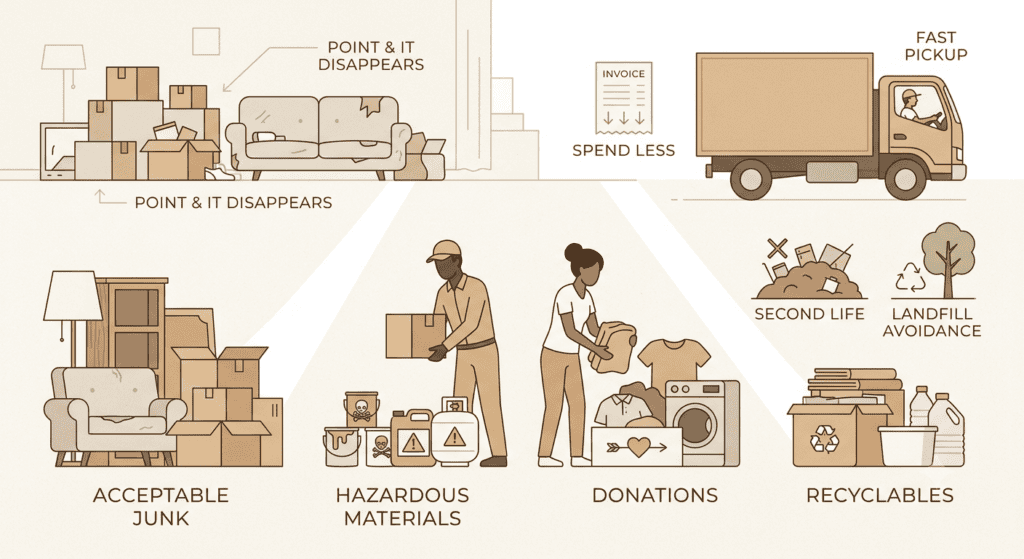
It’s tempting to assume junk removal is as simple as “point at the pile, and it disappears.” In practice, a little bit of planning goes a long way. Here’s why this junk removal guide is worth reading before you book anything.
You avoid last-minute surprises. Nothing derails a cleanout faster than a crew showing up, loading half your pile, and then telling you the rest can’t go with them. Knowing what’s acceptable ahead of time means no awkward conversations on the day of your appointment.
Your pickup goes faster. When items are already sorted – hazardous stuff set aside, donation items bagged, recyclables separated – a crew can load a truck in a fraction of the time. That matters if you’re paying by the hour or working around a tight schedule.
You spend less on disposal. Certain materials cost more to process than others. Concrete and roofing shingles are heavy. Electronics need certified recycling. Freezers need refrigerant removed by a licensed technician. Understanding these categories ahead of time helps you budget accurately instead of getting a surprise on your invoice.
Hazardous materials get handled safely. Old paint, pesticides, and propane tanks aren’t just inconvenient – they’re genuinely dangerous if mishandled. A junk removal guide like this one helps you recognize what needs a hazardous waste depot instead of a garbage bag.
More of your stuff gets a second life. A big chunk of what people throw out is still usable. Furniture, working appliances, and clothing can often be donated instead of landfilled. Knowing the difference between “junk” and “still useful” means fewer things end up buried for good.
Picture a common scenario: a homeowner in St. Catharines is clearing out a late family member’s house. The pile includes furniture, a chest freezer, a few cans of old paint, and a propane tank left over from a barbecue that broke years ago. Without a junk removal guide like this one, it’s easy to assume all of it goes in one truck. In reality, the freezer needs refrigerant recovery, the paint needs a hazardous waste depot, and the propane tank can’t travel with a standard load at all. Sorting that out ahead of time, rather than during an already emotional and exhausting cleanout, makes the whole process far less overwhelming.
Household Items That Can Usually Be Removed
Most of what fills up a home falls into a handful of straightforward categories. Here’s what a junk removal crew can typically take without any special preparation.
Furniture
Old furniture is one of the most common reasons people book a junk removal appointment in the first place. This usually includes:
- Sofas and loveseats
- Chairs and recliners
- Dining and coffee tables
- Bed frames and box springs
- Dressers
- Cabinets
- Bookshelves
A bulky item pickup for furniture is usually the most straightforward part of a cleanout. The main challenge is usually getting it out of the house – through hallways, down stairwells, or around tight corners – which is exactly the kind of heavy lifting a professional crew is built for.
Condition matters more than most people realize. A sofa with a broken frame or heavy water damage is destined for disposal, but a couch that’s simply outdated or no longer matches your decor might still have plenty of life left in it. Local shelters, resale shops, and community reuse groups across the Niagara Region are often glad to take gently used pieces, and a good junk removal crew can flag which items in your load are strong donation candidates before they’re loaded onto the truck.
Appliances
Household appliances are generally acceptable for pickup, though a few require extra steps because of the materials inside them:
- Washing machines
- Dryers
- Dishwashers
- Microwaves
- Ovens and stoves
- Water heaters
- Refrigerators, where properly handled
Refrigerators, freezers, and air conditioners deserve a quick note here, since they contain refrigerant. Under federal and Ontario rules, only a technician with an Ozone Depletion Prevention certificate is legally allowed to recover and dispose of that refrigerant. A reputable junk removal company either has this covered in-house or partners with a certified recycler, so the appliance is decommissioned properly instead of just crushed with the gas still inside.
Stoves and ovens are usually simple to remove, but gas models need to be disconnected from a supply line beforehand – that’s a job for a licensed technician, not something to attempt on pickup morning. Electric models are far more straightforward, since they just need to be unplugged and cleared of any remaining food debris or grease before the crew arrives. Either way, appliances are typically among the heaviest single items in a load, so let the company know roughly how many you’re getting rid of when you book.
Electronics
E-waste recycling Canada-wide has become a much bigger deal in the last few years, and for good reason. Items typically accepted include:
- TVs
- Computer monitors
- Printers
- Laptops and desktops
- Small electronics, depending on local recycling requirements
Here’s some context worth knowing: Canadians are replacing electronics faster than ever. Research out of the University of Waterloo estimates the country will generate roughly 2.3 million tonnes of electronic waste between 2025 and 2030, and per-person e-waste generation has tripled since the early 2000s. A large share of that comes from people replacing devices that still technically work. Responsible electronics recycling keeps heavy metals and other hazardous components out of landfills and recovers valuable materials like copper and gold instead of sending them to a hole in the ground.
This isn’t just a household issue, either. Businesses across Niagara regularly cycle through old monitors, office phones, and networking equipment during upgrades or office moves, and that equipment falls under the same e-waste guidelines as anything from a home. Bundling electronics into a single scheduled pickup, rather than letting them pile up in a storage closet for years, makes the eventual cleanout far more manageable and keeps that equipment out of general commercial waste bins where it doesn’t belong.
Household Clutter
This is the catch-all category, and it’s often where the bulk of the pile actually comes from:
- Toys
- Clothing
- Boxes
- Decorations and seasonal items
- Kitchenware
- General old household goods
A good chunk of this clutter doesn’t belong in a landfill at all. Gently used toys, clothing in decent shape, and kitchenware that’s simply “not our style anymore” can usually be donated or recycled instead of hauled straight to disposal. Ask your junk removal company whether they route reusable items to local charities – many do, and it’s a small step that keeps perfectly good stuff in circulation.
Clothing and textiles deserve special mention, since they’re one of the easiest categories to divert away from disposal entirely. Many communities across Ontario run dedicated textile donation and recycling programs, accepting everything from worn-out t-shirts to old linens, even items that are too damaged to donate as wearable clothing. Bagging textiles separately from general household clutter before your appointment makes it much easier for these materials to end up recycled into insulation, rags, or other products instead of taking up landfill space.
Outdoor Junk That Can Be Removed
Yard and exterior cleanouts come with their own list of common items. Most outdoor junk is straightforward to remove, though a few categories depend on your municipality’s specific rules:
- Patio furniture
- Lawn equipment, if drained and prepared as required
- Fencing
- Lumber
- Scrap metal
- Yard waste – branches, leaves, shrubs, where accepted
- Sheds
- Deck materials
Gas-powered equipment like lawn mowers, trimmers, and snowblowers usually needs to be drained of fuel and oil before it can be loaded, since leftover fuel is treated as hazardous material. Ask ahead of time so you’re not stuck disposing of gasoline separately.
Scrap metal – old fencing, railings, gutters, and similar materials – is one of the more valuable categories in an outdoor cleanout, since metal recyclers pay for it by weight. A junk removal crew will typically separate metal from a mixed outdoor load automatically, since it’s worth their time to recycle rather than landfill it. Sheds and deck structures are a bigger undertaking; depending on size and construction, they may need to be partially disassembled before removal, so it’s worth mentioning these upfront rather than as an afterthought on pickup day.
Curbside collection Ontario schedules for yard waste vary quite a bit from one municipality to the next. In the Niagara Region, for example, curbside branch collection only runs during two set windows each year – typically early May through late May, and again from late October into November – with residents required to have branches at the curb by 7 a.m. on their regular collection day. Outside those windows, yard waste often needs to go through a private junk removal service or a regional drop-off depot instead.
Renovation & Construction Debris
Construction debris removal covers a completely different kind of junk than a household cleanout – heavier, denser, and often bulkier. Materials commonly covered include:
- Drywall
- Flooring
- Tiles
- Cabinets
- Doors
- Windows
- Wood
- Concrete, with some limitations
- Roofing materials
Weight is the key factor here. A truckload of drywall or old flooring weighs far more than the same volume of furniture and clutter, and disposal facilities typically charge by weight rather than by the item. That’s why heavier renovation debris often comes with additional fees compared to a standard household load. Concrete in particular can be tricky – many drop-off depots only accept “clean” concrete, meaning no rebar, no mesh, no attached brick or tile, and no leftover soil mixed in. If your concrete debris includes any of that, expect either an extra sorting step or a different disposal path altogether.
If you’re planning a bigger renovation, it’s worth telling your junk removal company the rough scope of the project in advance – square footage of flooring, number of rooms being gutted, that sort of thing – so they can quote accurately and bring the right size truck.
One more thing worth flagging: older homes, particularly those built before the early 1990s, can sometimes contain asbestos in insulation, flooring, or popcorn ceiling texture. Asbestos isn’t something a standard junk removal crew can legally handle – it requires a licensed abatement contractor, full stop. If you’re renovating a home built decades ago and you’re not certain what’s in the walls or ceilings, it’s worth having it tested before demolition begins rather than after debris is already piled at the curb.
Items That Usually Cannot Be Removed
This is the section people appreciate most, because it saves an awkward conversation on pickup day. These categories are restricted under Ontario’s waste management regulations, and legitimate junk removal companies won’t take them in a standard load.
Hazardous Waste
- Paint
- Chemicals
- Pesticides
- Solvents
- Gasoline
- Motor oil
Pressurized Items
- Propane tanks
- Fire extinguishers
Medical Waste
- Needles and syringes
- Biohazard materials
Toxic Materials
- Asbestos
- Certain industrial chemicals
Automotive Waste
- Fuel
- Oil filters
- Batteries, which often require specialized recycling
Each of these categories exists for a specific reason. Paint, solvents, and pesticides are liquid or semi-liquid, which means they can leak, mix with other waste, and seep into soil or water long before they ever reach a landfill liner. Pressurized items like propane tanks and fire extinguishers can rupture or explode under the force of a garbage compactor, putting collection workers at real physical risk. Needles and biohazard materials carry infection risk for anyone who handles them without the right protective equipment, which is why they need a dedicated medical waste stream rather than a household bin. Automotive batteries contain lead and acid, both of which are toxic if they leach out, so they’re routed through specialized recyclers who can safely reclaim the materials inside.
Why the hard line on these items? Landfill regulations Ontario-wide, along with the province’s Environmental Protection Act and Regulation 347, govern how hazardous and liquid industrial waste is stored, transported, and disposed of, and for good reason. Materials like solvents, pesticides, and old paint can contaminate soil and groundwater if they end up in a regular landfill cell. Propane tanks and fire extinguishers are pressurized, which makes them a genuine safety risk in a garbage truck or transfer station. Needles and biohazard materials carry infection risk for anyone handling them by hand. None of this is red tape for its own sake – it’s there to protect the people processing the waste and the environment it eventually touches.
The good news is that household hazardous waste disposal has a proper home for nearly all of these materials. Most municipalities, including Niagara Region, operate household hazardous waste depots where residents can drop off paint, batteries, oil, oil filters, and propane tanks year-round, often at no charge. It’s worth a quick search for your local depot before your junk removal appointment so these items don’t end up sitting in the garage indefinitely.
Items That May Require Special Handling
Some items aren’t outright banned, but they don’t fit neatly into a standard load either. These usually need advance notice, extra labour, or a specific disposal pathway:
- Mattresses
- Refrigerators
- Freezers
- Air conditioners
- Large commercial equipment
- Hot tubs
- Pianos
- Tires
Mattresses are a good example of why this category exists. Ontario doesn’t currently have a province-wide mattress recycling program, unlike tires, electronics, or batteries, which all fall under established provincial stewardship rules. That means mattress disposal costs and rules vary depending on where you live – some regions charge a flat surcharge per unit, while others charge by weight. A mattress is also awkward to break down, since it’s built from a mix of steel coils, foam, and fabric all bonded together, so it typically gets handled as its own line item rather than tossed in with general furniture.
Tires fall under a different system entirely. Ontario runs a producer-funded tire stewardship program through the Resource Productivity and Recovery Authority, which means old tires are meant to be routed through approved collectors rather than a general landfill load.
Pianos and hot tubs are less about regulation and more about sheer size and weight – they often need a specific crew size, equipment, or a heads-up so the right team shows up. A piano can weigh several hundred pounds and needs careful maneuvering to avoid damaging floors, walls, or door frames. Hot tubs are typically bulky, filled with insulation and equipment, and may need to be partially broken down before they can be hauled out of a backyard.
Large commercial equipment falls into this category too. Old office furniture in bulk, retired restaurant equipment, or industrial machinery often needs a larger crew, specialized lifting equipment, or coordination with a scrap metal recycler rather than a standard residential-style pickup. If you’ve got any of these items on your list, mention them when you book so there are no surprises about pricing or scheduling.
Eco-Friendly Junk Removal Practices
A responsible junk removal guide wouldn’t be complete without talking about where your stuff actually goes after it leaves your driveway. Choosing eco-friendly junk removal means the best companies don’t treat every load as a straight trip to the landfill. Instead, they sort and route materials through several channels:
- Recycling metals – scrap metal from appliances, fencing, and furniture frames has real recycling value and rarely needs to be landfilled.
- Electronics recycling – TVs, computers, and small electronics go through certified e-waste processors that recover metals and safely handle hazardous components.
- Furniture donations – couches, tables, and other pieces in good condition can go to local charities or reuse programs instead of a transfer station.
- Appliance recycling – old washers, dryers, and stoves are often broken down for scrap metal after any hazardous components are removed.
- Reducing landfill waste – every item diverted to recycling or donation is one less thing taking up space in a landfill that has a finite lifespan.
- Supporting local reuse programs – many communities, including areas across the Niagara Region, run textile donation and reuse programs that keep usable goods circulating locally.
This kind of sorting takes more effort than dumping everything into one bin, but it’s the difference between “junk removal” and genuinely responsible waste management. If sustainability matters to you, it’s a fair question to ask any company you’re considering: what happens to the items after pickup?
It’s a fair question because the answer varies more than people expect. Some companies default to landfill for anything that isn’t obviously recyclable, simply because sorting takes extra time and labour. Others build diversion into their process from the start, weighing loads, separating materials on-site, and tracking what gets recycled versus landfilled. Over a year, that difference adds up to a meaningful amount of material kept out of the ground – which matters in a region where landfill capacity, like everywhere else in Ontario, isn’t unlimited.
How to Prepare for a Junk Removal Appointment
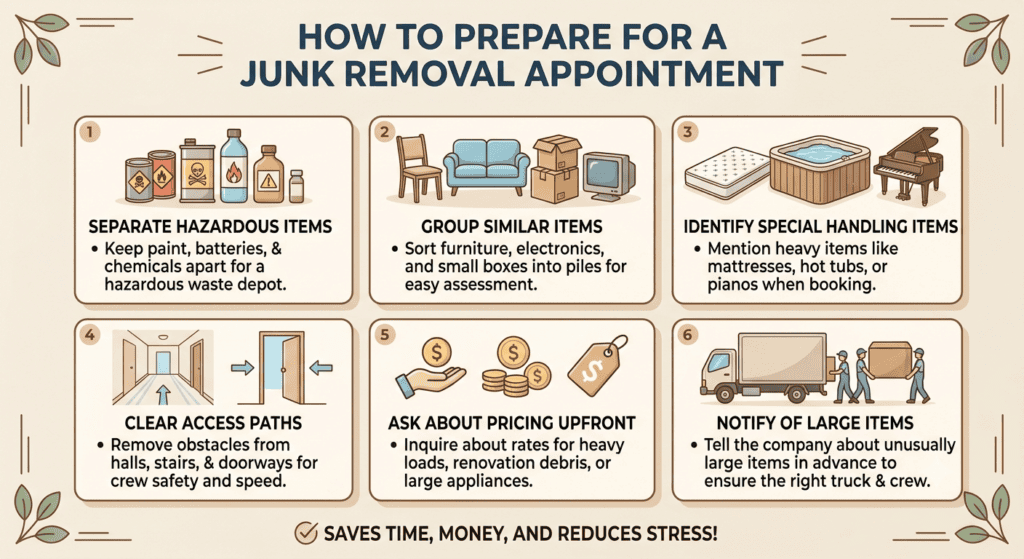
A little prep work makes pickup day faster, cheaper, and a lot less stressful. Here’s what actually helps:
- Separate hazardous items in advance, and set them aside for a hazardous waste depot rather than the general pile.
- Group similar items together – furniture in one area, electronics in another – so the crew can assess the load quickly.
- Identify anything requiring special handling, like a mattress, hot tub, or piano, and flag it when you book.
- Clear access paths through hallways, doorways, and stairs so the crew isn’t navigating obstacles while carrying heavy items.
- Ask about pricing for heavy or oversized loads upfront, especially for renovation debris or large appliances.
- Tell the company about unusually large items in advance, so they arrive with the right truck size and enough people for the job.
None of this takes more than twenty or thirty minutes, but it can shave real time off your appointment and help you avoid unexpected charges.
Why Choose Professional Junk Removal Instead of DIY?
Renting a truck and doing it yourself is always an option, but it’s worth weighing against hiring a professional crew.
Time savings. Loading, hauling, unloading, and driving back and forth to a depot eats up an entire day for most people. A professional crew handles all of it in a single visit.
Safety. Heavy furniture, awkward staircases, and bulky appliances are a recipe for a strained back or worse. Trained crews know how to lift and move items without injury.
Proper disposal. Professionals already know which depot or facility each type of material needs to go to, so nothing ends up in the wrong place by accident.
Heavy lifting, handled. You don’t have to figure out how to get a couch down a narrow stairwell or a washing machine into the back of a pickup truck.
Environmental responsibility. As covered above, established junk removal companies sort materials for recycling and donation rather than defaulting to landfill for everything.
Convenience. One phone call or online booking, and the job gets done on your schedule – no truck rental, no gas, no return trip.
Reduced stress. Cleanouts are already emotionally and physically draining, especially after a move, a renovation, or clearing out a family member’s home. Handing the physical labour off to someone else takes one major task off your plate.
For a lot of homeowners and business owners considering Niagara Region junk removal in Niagara Falls, St. Catharines, Welland, Fort Erie, Niagara-on-the-Lake, Thorold, and Port Colborne, the deciding factor usually comes down to time. A weekend spent hauling junk to the dump is a weekend not spent on literally anything else.
There’s also a cost side to consider that people often overlook. A DIY approach means truck rental fees, fuel, landfill tipping fees charged by weight, and – if anything gets damaged along the way – potential repair costs on top of it all. Multiple trips are common too, since a single pickup truck load rarely clears an entire garage or basement in one go. When you add up the rental, the gas, the dump fees, and the hours spent, professional junk removal often ends up costing about the same or less, without the physical toll or the wasted weekend.
Current Trends Shaping Junk Removal in Ontario
Waste management rules don’t stay still for long, and a few recent shifts are worth knowing about if you’re planning a cleanout this year.
The biggest change is the completion of Ontario’s Blue Box transition. As of January 1, 2026, producer-responsibility organizations took over funding and operating residential recycling collection across the province, following a multi-year phase-in that began in 2023. For everyday households, curbside recycling looks about the same, but it’s now funded by the companies that make the packaging rather than municipal budgets alone.
E-waste is another area getting more attention. With Canadians replacing electronics at a record pace, and roughly two-thirds of those replacements happening while the old device still works, certified electronics recycling is becoming a bigger part of both household and business cleanouts. Expect more junk removal companies to highlight their e-waste partnerships as this trend continues.
Mattress disposal is a category still catching up to the rest of the system. Unlike tires, electronics, and batteries – which all fall under established Ontario stewardship programs – mattresses currently have no province-wide recycling framework. That means costs and rules differ from one municipality to the next, and it’s a gap that’s been discussed for future regulation but hasn’t been finalized yet.
Conclusion
Junk accumulates quietly, and clearing it out doesn’t have to be complicated once you know the ground rules. Most household items, furniture, appliances, electronics, and outdoor junk can be removed without any issues. Renovation debris usually just needs a heads-up about weight. Hazardous materials, pressurized containers, and medical waste need a dedicated depot instead of a standard pickup. And a handful of items, like mattresses, tires, and large equipment, fall somewhere in between and just need a little extra planning.
Understanding what can and cannot be removed before you book a pickup saves time, prevents unexpected costs, and makes sure everything ends up disposed of the right way. If you’re planning a cleanout anywhere in the Niagara Region, The N LLC offers fast, reliable, and eco-conscious junk removal for both residential and commercial properties. Reach out today for a free quote, and let us handle the heavy lifting.
FAQ Section
1. Does junk removal include hazardous waste like paint or chemicals?
No. Hazardous materials such as paint, pesticides, solvents, and chemicals need to go through a household hazardous waste depot rather than a standard junk removal pickup, since they require special handling under Ontario’s waste regulations.
2. Can I get a refrigerator or freezer removed with regular junk?
Yes, but it needs to be handled by a company that either has certified technicians or works with one, since refrigerant recovery from appliances legally requires an Ozone Depletion Prevention certificate in Ontario.
3. Will a junk removal company take my old mattress?
Most will, though mattresses are often treated as their own category with a separate fee, since Ontario doesn’t currently have a province-wide mattress recycling program and disposal costs vary by municipality.
4. Do I need to separate recyclable and donatable items before pickup?
It’s not required, but pre-sorting furniture, clothing, and kitchenware that’s still in good shape helps ensure those items get donated instead of landfilled, and it can speed up your appointment.
5. How far in advance should I book a junk removal appointment?
For standard household loads, a few days’ notice is usually enough. For larger jobs involving renovation debris, hot tubs, or commercial equipment, booking a week or more ahead gives the company time to schedule the right crew and truck size.
6. Is construction debris more expensive to remove than household junk?
Often, yes. Materials like concrete, drywall, and roofing shingles are heavy, and disposal facilities typically charge by weight, so a load of renovation debris can cost more than a similarly sized load of furniture and clutter.
7. What happens to electronics after they’re picked up?
Reputable junk removal companies route TVs, computers, and other electronics to certified e-waste recyclers, who recover valuable metals and safely process hazardous components instead of sending them to a landfill.
8. Do you offer junk removal for businesses, not just homes?
Yes. Commercial cleanouts, including office furniture, old equipment, and renovation debris, are a regular part of junk removal work across the Niagara Region.