If you have ever stood in the middle of your living room wondering where to even begin, you are not alone. Most homeowners clean reactively – wiping counters when guests are coming, vacuuming when the dust bunnies become visible from across the room. But a home that actually stays fresh, healthy, and easy to maintain needs something more deliberate: a seasonal house cleaning checklist that follows the rhythm of the year instead of fighting it.
This is especially true if you live in the Niagara Region. Between humid summers, wet springs, colourful but messy falls, and long, salt-heavy winters, your home goes through four very different environments every single year. Each one leaves its own residue – pollen in spring, humidity and barbecue grease in summer, damp leaves in fall, and road salt and dry heat in winter. A single generic cleaning routine simply cannot keep up with all of that.
In this guide, you will find a complete, room-by-room, season-by-season house cleaning checklist you can actually follow – not a vague list of “declutter your home” advice, but specific, actionable tasks with a clear order of operations. Whether you are a busy homeowner, a landlord managing several properties, or someone who runs a short-term rental, this checklist will help you protect your investment, your indoor air quality, and your sanity.
Why a Seasonal House Cleaning Checklist Matters More in Niagara
Niagara’s Climate Creates Unique Cleaning Challenges
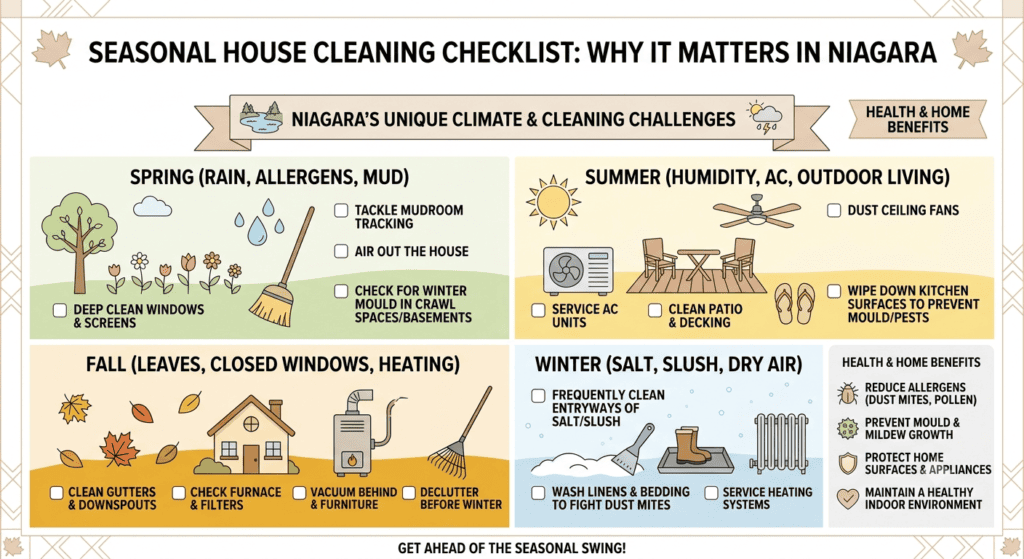
The Niagara Region sits between Lake Erie and Lake Ontario, which gives it a moderate but genuinely four-season climate. Winters bring real cold and heavy snowfall, with February typically being the snowiest and most humid month of the year, while summers push well into the high 20s and occasionally the 30s Celsius with noticeably higher humidity. Spring arrives with a burst of rain, and by mid-April temperatures are already climbing past 12°C, warming rapidly through May. Autumn, meanwhile, tends to be the most pleasant stretch of the year, but it also means falling leaves, cooling temperatures, and the return of indoor heating systems that have been sitting dormant for months.
That kind of seasonal swing is exactly why a one-size-fits-all cleaning routine falls short here. Winter in Niagara means road salt, slush, and dry indoor air from constant furnace use. Spring means allergens, mud, and humidity climbing back up after the driest month of the year. Summer means air conditioning condensation, higher humidity, and more outdoor living. Fall means damp leaves, gutter debris, and the return of closed windows that trap dust and allergens indoors. A seasonal house cleaning checklist lets you get ahead of each of these shifts instead of scrambling to fix problems after they have already taken hold.
The Health Case for Seasonal Deep Cleaning
There is also a real health argument behind seasonal deep cleaning, not just an aesthetic one. Roughly four out of five homes in North America have detectable dust mite allergen in at least one bed, and dust mites feed largely on the dead skin cells that humans naturally shed every day. On top of that, mould does not actually die off in winter – it simply goes dormant, waiting for warmer, more humid conditions in spring and summer to start growing again. Since mould generally cannot establish itself below about 4°C, but thrives as soon as temperatures and humidity rise, the transition seasons in Niagara are exactly when mould problems tend to take root if they are not caught early.
Homes with elevated dust, mildew, or pest allergens have also been linked to higher rates of allergy and asthma symptoms in the people living there. None of this means you need to panic about your home – it simply means that a predictable, seasonal deep-cleaning rhythm does real work behind the scenes, catching small issues (a damp basement corner, dust building up behind an appliance, pollen tracked in from outside) before they turn into bigger, more expensive ones.
How to Use This Seasonal House Cleaning Checklist
Before diving into the season-by-season breakdown, it helps to understand the structure. This house cleaning checklist is organized into four seasonal blocks – spring, summer, fall, and winter – followed by a room-by-room deep-cleaning guide that applies year-round. You do not need to complete every single task in one exhausting weekend. Many professional cleaners recommend spreading seasonal tasks across several weekends, tackling one room or zone at a time so the work stays manageable rather than overwhelming.
A simple approach that works well:
- Pick one weekend at the start of each season to declutter and reset.
- Break the checklist into daily, weekly, monthly, and seasonal tasks so nothing feels like a single enormous project.
- Keep a basic toolkit on hand so you are never stalling out because you are missing a supply.
- Know when a task is worth handing to professionals instead of doing it yourself – more on that later in this guide.
Spring Cleaning Checklist: Waking Your Home Up After Winter
Spring cleaning is the most well-known seasonal ritual, and for good reason. After months of closed windows, running furnaces, and salt-tracked floors, your home needs a genuine reset. Spring cleaning is different from your regular weekly tidying – it is a thorough deep clean that reaches the areas your everyday routine skips, removing months of accumulated dust, allergens, and grime from places that rarely get attention.
Indoor Spring Tasks
- Declutter first, clean second. Go room by room and remove anything you no longer need before you start scrubbing – it is far easier to clean an empty shelf than a cluttered one.
- Wash windows inside and out. Winter grime and salt spray build up on glass and screens; clean windows also let in more natural light as the days lengthen.
- Deep clean floors. Steam clean or shampoo carpets, and strip and reseal hard flooring if it has gone dull over winter.
- Wipe down baseboards, vents, and light fixtures, where dust tends to accumulate unnoticed for months.
- Launder or dry-clean heavy winter bedding, comforters, and curtains before storing them for the season.
- Sanitize kitchen and bathroom surfaces, including inside cabinets, behind appliances, and under sinks where moisture can collect.
- Check and replace HVAC filters. A fresh filter improves indoor air quality right as pollen season ramps up.
- Organize storage spaces like closets, the pantry, and the garage, donating or discarding what you have not used in over a year.
Outdoor Spring Tasks
- Inspect your roof and gutters for winter damage, leaks, or debris left behind by melting snow.
- Check exterior drainage to make sure spring rain is moving away from your foundation, not pooling against it.
- Clear dead plants, mulch, and debris from garden beds and the front of the house.
- Wash down siding, decks, and walkways to remove the grime that built up over winter.
- Schedule HVAC maintenance before the summer cooling season puts real demand on the system.
Common Spring Cleaning Mistakes
Homeowners often start spring cleaning by attacking the most visible mess first – usually the living room – rather than following a logical order. Skipping the decluttering step, ignoring less obvious areas like dryer vents or under large furniture, and forgetting to check for mould in bathrooms and basements are among the most common oversights. A rushed, unorganized approach to spring cleaning tends to leave the hardest, most time-consuming jobs half-finished.
Summer Cleaning Checklist: Managing Heat, Humidity, and Guests
Summer in Niagara means longer days, more time outdoors, and – if you host guests, run a short-term rental, or simply entertain often – significantly more foot traffic through your home. It is also the region’s most humid stretch, which changes what your home needs from a cleaning standpoint.
Indoor Summer Tasks
- Focus on high-touch surfaces. Door handles, light switches, and countertops need more frequent disinfecting when the household is busier and doors are opening and closing constantly.
- Address air conditioning condensation. Check around window units and vents for moisture buildup, which can quietly encourage mould growth if ignored.
- Deep clean one major appliance per month – the oven, refrigerator coils, or dishwasher filter – rather than letting them all pile up at once.
- Rotate mattresses and wash pillows to manage summer sweat and allergens.
- Vacuum upholstery and rugs more frequently, since open windows and screen doors bring in more outdoor dust and pollen.
Outdoor Summer Tasks
- Pressure wash your driveway, patio, and siding to remove the pollen and grime that built up in spring.
- Clean and inspect outdoor furniture and grills regularly, since food residue attracts pests quickly in warm weather.
- Sweep patios and walkways weekly to stop dirt from being tracked indoors.
- Check window screens for tears that let in insects during the warmest months.
Airbnb & Rental Property Summer Prep
Summer is peak tourist season across the Niagara Region, which means short-term rental hosts and property managers are dealing with far more turnovers than usual. A rushed clean between guests is one of the fastest ways to earn a bad review, so a consistent, checklist-driven turnover routine matters just as much here as it does in a private home – fresh linens, disinfected high-touch surfaces, spotless bathrooms, and a quick outdoor tidy before every single check-in.
Fall Cleaning Checklist: Preparing for the Cold
Fall is when Niagara’s climate turns quickly. Autumn is widely considered the most pleasant season in the region, but underneath the pleasant weather, your home is preparing for a very different set of conditions. This is the season to shift from cooling to heating, seal up gaps, and clear away the organic debris that built up over the warmer months.
Indoor Fall Tasks
- Deep clean and test your heating system before you need it – a dirty furnace filter is both an efficiency problem and an air-quality problem once you are running it daily.
- Wash window treatments and heavier fabrics that will be in near-constant use through the colder months.
- Check weatherstripping around doors and windows, cleaning tracks and sills where dust and dead insects tend to collect.
- Deep clean the basement, inspecting for any dampness before it gets sealed in by winter.
- Rotate seasonal clothing, cleaning storage bins before moving summer items out and winter items in.
Outdoor Fall Tasks
- Clear gutters of leaves and debris to prevent ice dams and water damage once temperatures drop.
- Rake and remove fallen leaves promptly, since a wet leaf layer left on grass or walkways becomes slippery and can smother your lawn.
- Store or cover outdoor furniture, cushions, and grills to protect them through winter.
- Wash and inspect decks and driveways for cracks before freeze-thaw cycles make any existing damage worse.
Preventing Mould Before Winter
Fall’s cooler temperatures naturally slow mould growth, but that does not mean the risk disappears – it means any existing dampness gets sealed into your home for the winter once windows close for good. This is the ideal window to inspect basements, bathrooms, and window sills for early signs of mildew and address them before your house is buttoned up for months of minimal ventilation.
Winter Cleaning Checklist: Comfort, Safety, and Salt Season
Winter in Niagara is genuinely cold, with January typically bringing the lowest temperatures of the year and February bringing the heaviest snowfall. Understandably, this is the season when most people want to clean the least – but a few targeted tasks now prevent bigger headaches come spring.
Indoor Winter Tasks
- Tighten cabinet knobs, handles, and racks, and check locks and deadbolts on doors and windows while you have the time indoors.
- Remove and clean showerheads of mineral buildup, which tends to worsen with heavier indoor water use in winter.
- Dry clean or wash comforters and heavy bedding at least once during the season.
- Manage dry indoor air. Constant furnace use dries out both your home and your skin – dusting more frequently helps offset the static and dry air that makes dust cling to every surface.
- Deep clean your basement, since this is often the coldest, most neglected part of the home during winter.
Outdoor / Entryway Winter Tasks
- Set up a dedicated boot and coat zone near your entryway to contain salt, slush, and snow before it spreads through the house.
- Sweep and mop entryways frequently, since road salt left on flooring can damage hardwood and tile over time.
- Clear snow and ice from walkways promptly for safety, and keep an eye out for ice dams forming on the roofline.
- Inspect for drafts around doors and windows, since winter is the easiest time to actually feel where your home is losing heat.
Room-by-Room Seasonal Deep Cleaning Guide
While the seasonal breakdown above covers what to prioritize and when, it helps to also think in terms of rooms, since some spaces need more frequent attention regardless of season.
Kitchen
The kitchen is the hardest-working room in most homes and needs the most consistent seasonal attention. Beyond daily wiping and weekly appliance cleaning, a proper seasonal deep clean should include pulling out the refrigerator and stove to clean behind and underneath them, degreasing cabinet fronts and range hoods, deep cleaning the interior of the oven and microwave, and disinfecting small-appliance surfaces that rarely get touched, like the coffee maker and toaster exterior.
Bathrooms
Bathrooms combine high moisture with high touch, making them a priority every season, but especially in humid summer months when mould and mildew grow fastest. A seasonal bathroom deep clean should include scrubbing grout lines, descaling showerheads and faucets, cleaning behind the toilet base, washing shower curtains or liners, and checking under the sink for any signs of a slow leak.
Bedrooms & Living Areas
These are the rooms where dust and allergens quietly accumulate the most, since fabric, carpet, and upholstery all trap particles that hard surfaces do not. A seasonal reset should include rotating and vacuuming mattresses, washing all bedding (including pillow protectors and mattress pads), dusting behind and underneath furniture, vacuuming upholstered furniture with an attachment, and wiping down baseboards, blinds, and ceiling fan blades.
Basement & Storage
Basements deserve their own seasonal check regardless of how finished or unfinished they are, since they are usually the first place moisture problems show up. A seasonal basement check should include looking for any musty smell or visible dampness, vacuuming and dusting storage shelving, checking for pest activity, and making sure any dehumidifier is emptied and functioning correctly.
Essential Tools and Products for Every Season
Having the right supplies on hand removes one of the biggest barriers to actually finishing a seasonal cleaning list. A solid, reusable toolkit includes microfiber cloths, a quality HEPA-filter vacuum, an all-purpose cleaning spray, white vinegar and baking soda for natural cleaning tasks, an extendable duster for high or hard-to-reach areas, and a few dedicated scrub brushes for grout and tile. Having proper tools on hand, rather than improvising with whatever is under the sink, meaningfully cuts down both the time and physical effort a deep clean requires.
Eco-friendly and low-toxicity cleaning products have also become far more mainstream, giving households an easy way to maintain a spotless home without relying as heavily on harsh chemicals – a shift worth considering if anyone in your household deals with allergies or sensitivities.
DIY vs Professional Cleaning: When to Call in the Experts
Signs You Need a Deep Clean
Not every seasonal task needs to be a DIY project, and knowing when to bring in help saves both time and frustration. Signs that it is time to call in professionals include persistent musty odours that do not resolve with normal cleaning, visible dust buildup under large appliances you cannot easily move, ongoing allergy symptoms that seem tied to being indoors, or simply the reality of a busy schedule that keeps pushing your cleaning list further down your priorities. A seasonal deep clean is also a smart move before hosting a major event or listing a property for sale or rent.
Benefits of Hiring Professionals in Niagara
A house cleaning checklist is a genuinely useful framework, but time constraints, the absence of specialized equipment, and grime that has settled into hard-to-reach spots can all make a truly thorough deep clean difficult to pull off on your own. This is exactly where professional cleaning fits in – not as a replacement for your everyday routine, but as the piece that turns an intimidating seasonal project into a manageable, thoroughly finished job.
This is the gap NLLC was built to fill for homeowners, landlords, and businesses across the Niagara Region. As a locally based property care company, NLLC handles residential cleaning, commercial cleaning, Airbnb turnover cleaning, move-in and move-out cleaning, post-construction cleaning, window cleaning, and specialized disinfection services – alongside lawn care, landscaping, garbage removal, and snow removal for the outdoor side of seasonal property care. Rather than juggling several different companies throughout the year, many Niagara property owners find it easier to lean on one trusted, local team that already understands how the region’s seasons affect a property, inside and out.
If any part of this checklist feels like more than you want to take on yourself this season, you can request a free quote through NLLC’s contact page and have a local team walk you through exactly what your property needs.
Common Seasonal Cleaning Mistakes Homeowners Make
Even motivated homeowners tend to fall into a few predictable traps. Tackling the most visible mess first instead of following a logical, room-by-room order wastes time and energy. Skipping the decluttering step before cleaning makes every other task harder than it needs to be. Ignoring less obvious problem areas – dryer vents, the space behind the fridge, basement corners – lets small issues grow into expensive ones. And treating “spring cleaning” as the only seasonal reset of the year leaves summer humidity, fall debris, and winter salt completely unmanaged for the other three-quarters of the year.
Breaking seasonal cleaning into smaller, scheduled tasks rather than one overwhelming weekend also tends to produce far better, more consistent results – deep cleaning one appliance a month and rotating mattresses quarterly spreads the workload evenly instead of creating a single dreaded annual project.
2026 Cleaning Trends Worth Knowing
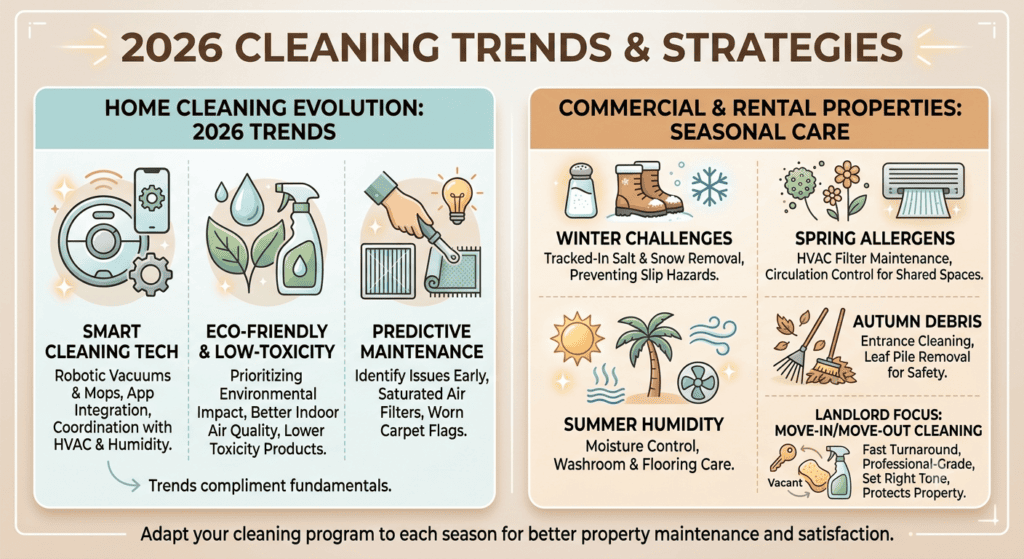
Home cleaning has evolved well beyond a mop and bucket in recent years, and a few trends are genuinely worth knowing about as you plan your seasonal routine. Smart cleaning technology – robotic vacuums and mops that can be scheduled around your household’s routine – has become mainstream rather than a novelty, and many newer systems can now coordinate with your home’s HVAC and humidity levels to time deep cleans more effectively. Eco-friendly, lower-toxicity products continue to gain ground as more households prioritize both environmental impact and indoor air quality. And predictive maintenance – tools and habits that flag issues like a saturated air filter or worn carpet before they become bigger problems – is increasingly part of how well-maintained homes are managed year-round. None of this replaces the fundamentals in this checklist, but it is worth keeping an eye on as you build your own seasonal system.
Seasonal Cleaning for Commercial & Rental Properties
If you manage a business, office, or rental property in Niagara Falls, St. Catharines, Welland, or elsewhere in the region, seasonal cleaning is not optional – it directly affects tenant satisfaction, guest reviews, and the long-term condition of the property itself. Commercial spaces face their own seasonal pressures: winter salt and snow tracked in by every visitor, spring allergens circulating through shared HVAC systems, summer humidity affecting flooring and washrooms, and autumn leaves piling up at every entrance. A property that adapts its cleaning program to each season, rather than running the same routine year-round, tends to hold up better and cost less to maintain over time.
For landlords specifically, move-in and move-out cleaning deserves its own mention. A thorough, professional-grade clean between tenants protects your property’s condition, supports a faster turnaround, and sets the right tone for a new tenant from day one – something that becomes especially important during Niagara’s busiest rental turnover periods in spring and fall.
Frequently Asked Questions
How often should I deep clean my house each year? Most homes benefit from a full seasonal deep clean four times a year – once at the start of each season – supplemented by weekly and monthly maintenance tasks in between. This keeps any single deep clean manageable instead of letting a full year of grime build up at once.
What is the difference between regular cleaning and seasonal deep cleaning? Regular cleaning covers the surface-level upkeep you do weekly, like dusting, vacuuming, and dishes. Seasonal deep cleaning goes further, targeting the areas that get missed in your everyday routine – behind appliances, inside vents, baseboards, grout lines, and storage areas – and is typically done every few months rather than every few days.
Do I really need a different checklist for each season, or is one list enough? A single list can work as a baseline, but Niagara’s distinct seasons each bring different challenges – pollen in spring, humidity in summer, damp leaves in fall, and salt in winter – so adjusting your priorities each season genuinely produces better results than repeating the exact same tasks year-round.
When is the best time to schedule professional cleaning services? Many homeowners schedule professional deep cleaning at the start of spring and fall, since these transition seasons tend to reveal the most buildup from the previous months. That said, ongoing services like regular residential or commercial cleaning can be scheduled on a weekly, biweekly, or monthly basis depending on your household or business needs.
How can I prevent mould in a humid Niagara summer? Keep humidity in problem areas like bathrooms and basements in check with proper ventilation or a dehumidifier, address any dampness immediately rather than waiting, and make sure bathroom exhaust fans are actually venting outside rather than into an attic space.
What should Airbnb hosts prioritize during turnover cleaning? Beyond visibly clean surfaces, prioritize disinfecting high-touch points, fully laundering all linens and towels between every guest, checking bathrooms and kitchens closely, and doing a quick outdoor tidy so the property makes a strong first impression from the moment guests arrive.
Is it worth hiring professionals for just one seasonal deep clean, or should it be ongoing? Both are common. Some homeowners bring in professionals purely for the tougher seasonal deep cleans – like a spring reset or a pre-winter basement check – while handling regular upkeep themselves. Others prefer ongoing scheduled service. Either approach is reasonable; the right choice depends on your time, your home’s specific needs, and your budget.
How do I keep up with cleaning if I have a busy schedule? Break tasks into daily, weekly, monthly, and seasonal categories so nothing feels overwhelming, keep your cleaning toolkit stocked and accessible, and do not hesitate to outsource the more time-consuming seasonal jobs to a local professional team so your everyday routine stays manageable.
Final Thoughts
A seasonal house cleaning checklist is not about achieving a picture-perfect home every single day – it is about building a rhythm that keeps pace with what each season actually demands, protecting both your property and your family’s health along the way. Spring calls for a genuine reset after winter. Summer asks for more frequent attention to high-touch surfaces and humidity. Fall is your window to prepare before the cold sets in. And winter is about containment, comfort, and staying ahead of salt and dry air. Follow this checklist season by season, and you will spend far less time firefighting messes and far more time simply enjoying a home that works with the calendar instead of against it.
Of course, some seasons – or some properties – call for more than a DIY effort can realistically cover. If you would rather hand off the deep cleaning, lawn care, snow removal, or property maintenance side of seasonal upkeep to a team that already knows the Niagara Region inside and out, NLLC is ready to help. From residential and commercial cleaning to Airbnb turnovers, garbage removal, and snow clearing, NLLC covers the full picture of seasonal property care across Niagara Falls, St. Catharines, Welland, and the surrounding area.
Contact NLLC today for a free, no-obligation quote and let a trusted local team help you tackle your next seasonal cleaning checklist – or better yet, take it off your plate entirely.