Walk into any workplace and you can tell within about ten seconds whether the people running it care about the details. A sticky breakroom counter, an overflowing bin by reception, dusty blinds in the boardroom – none of it is a huge deal on its own, but together it tells a story. And that story affects everything from how long a client trusts you to how many of your own staff call in sick this month.
That’s exactly why a well-built office cleaning checklist has become one of the most practical tools a business owner can put in place this year. It isn’t glamorous. It won’t show up on a pitch deck. But it quietly protects your team’s health, your brand’s reputation, and your bottom line – every single day, whether anyone’s watching or not.
This guide breaks down exactly what belongs on your checklist, how often each task should happen, and how to adapt it whether you’re running a two-person startup office in downtown Niagara Falls or a 15,000-square-foot facility in St. Catharines. We’ll also look at where office cleaning is heading in 2026, the mistakes most businesses make without realizing it, and when it makes sense to bring in a professional team instead of handling it in-house.
By the end, you’ll have a practical, ready-to-use system – not just a vague sense that “someone should probably clean that” – along with a clear sense of which tasks genuinely need a professional touch and which ones a small in-house routine can handle on its own.
Why This Matters More Than Ever for Your Business
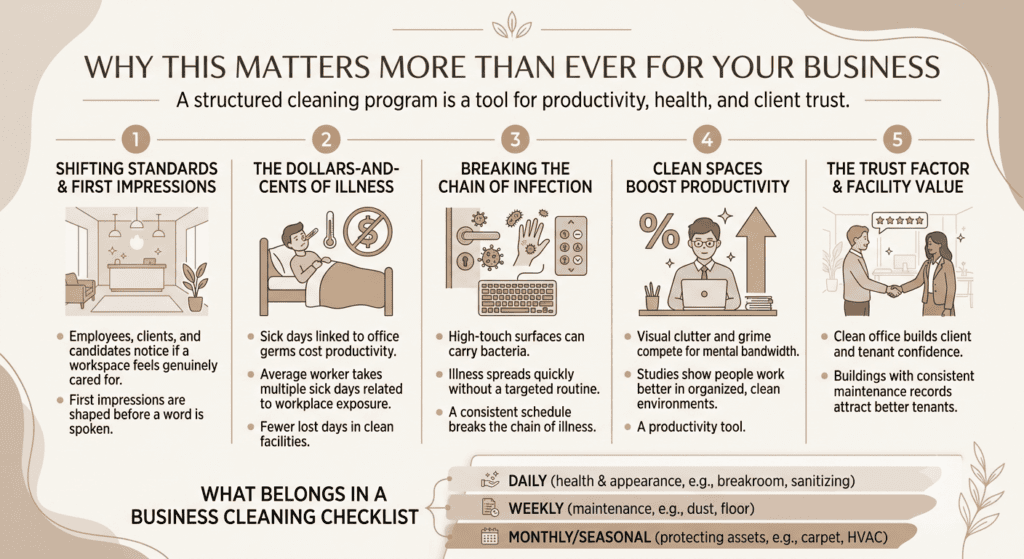
A few years ago, “cleaning the office” mostly meant emptying bins and running a vacuum before the weekend. That bar has moved, and so has the standard for workplace hygiene across nearly every industry. Employees, clients, and job candidates now notice – consciously or not – whether a workplace feels genuinely cared for or just tidied up around the edges.
There’s also a harder, dollars-and-cents reason to take this seriously. Sick days linked to office germs cost Canadian businesses a real amount of lost productivity every year, and the average worker takes several sick days annually that trace back at least partly to workplace exposure. Facilities that run a structured cleaning program consistently report fewer of those days lost. One widely cited workplace study found that employees in cleaner, better-maintained environments were noticeably more productive and reported fewer symptoms of illness than those in neglected spaces.
The connection isn’t abstract. High-touch surfaces – door handles, shared keyboards, elevator buttons, coffee machine buttons – get touched by dozens of people a day and can carry far more bacteria than most people assume. Without a routine that specifically targets those spots, illness moves through a team quickly, especially during Ontario’s cold and flu season. A consistent cleaning schedule breaks that chain before it starts, rather than reacting to it after half the office is out sick.
There’s a productivity angle beyond illness, too. Research from environmental psychology consistently shows that visual clutter and grime quietly compete with focused work for the same mental bandwidth. A University of Arizona study on office environments found that people working in clean, organized spaces performed measurably better than those in cluttered ones. In other words, a clean office isn’t just about appearances – it’s a productivity tool your business is currently either using or leaving on the table.
Finally, there’s the trust factor. When a potential client walks into a Niagara Falls office for the first time, the state of the reception area and washrooms shapes their first impression before a single word is spoken. Property managers know this well – buildings with strong, consistent maintenance records attract better tenants and higher confidence from the people who use them. The same logic applies to any customer-facing business.
What Belongs in a Business Cleaning Checklist
A genuinely useful office cleaning checklist isn’t a single list – it’s layered, with tasks grouped by how often they need doing. Daily tasks protect health and appearance. Weekly tasks maintain the space. Monthly and seasonal tasks protect your assets – the carpets, the HVAC system, the furniture – from long-term wear.
Below is a complete framework you can adopt as-is or adjust to fit your business. Whoever owns this checklist should also own accountability for it – a task with no name attached to it is a task that eventually gets skipped.
Daily Office Cleaning Tasks
These are the non-negotiables. Skipping daily tasks even for a few days is when offices start to feel – and function – noticeably worse.
Reception and Common Areas
- Wipe down the reception desk, counters, and any glass entry doors
- Vacuum or sweep entryway mats and flooring (this is where the most outside dirt and salt enters, especially in winter)
- Straighten seating, magazines, and any client-facing materials
- Empty and reline visible trash bins
- Check and clean glass doors and windows near the entrance for smudges and fingerprints
Workstations and Shared Desks
- Wipe down desks, especially in hot-desking or shared-seating environments
- Disinfect keyboards, mice, and phones – items that are touched constantly but cleaned rarely
- Empty individual trash and recycling bins
- Dust monitors, shelving, and visible surfaces
High-Touch Surfaces
This category deserves its own line item because it’s the one most offices miss. Every day, someone should be disinfecting:
- Door handles and push plates
- Light switches
- Elevator buttons
- Handrails and stair rails
- Shared equipment like printers, copiers, and coffee machines
- Breakroom microwave handles and fridge door handles
Kitchen and Break Room
- Wipe down countertops, tables, and chairs
- Clean the sink and remove any dishes left in it
- Empty trash and recycling, and wipe down bin lids
- Spot-clean the microwave interior and exterior
- Restock paper towels, soap, and coffee supplies where applicable
Restrooms
- Clean and disinfect toilets, sinks, and countertops
- Restock toilet paper, soap, and paper towels
- Empty trash and sanitary bins
- Mop floors and spot-check for spills throughout the day
- Wipe down mirrors
Trash and Recycling
- Empty every bin in the building, not just the visible ones
- Replace liners
- Take waste to the designated collection area
Weekly Office Cleaning Tasks
Weekly tasks maintain the deeper cleanliness that daily wiping doesn’t reach.
- Vacuum carpets thoroughly, including under desks and in corners
- Mop hard flooring throughout the office, not just high-traffic zones
- Dust higher surfaces – shelving tops, picture frames, light fixtures, and vents
- Clean interior glass partitions and conference room walls
- Disinfect shared equipment more thoroughly, including phone handsets and remote controls
- Wipe down baseboards in high-traffic corridors
- Clean the inside of the refrigerator and toss expired food
- Sanitize doorknobs, handrails, and elevator panels at a deeper level than the daily wipe-down
H3: Boardrooms and Meeting Spaces
Boardrooms deserve a specific weekly pass since they’re often used for client meetings:
- Wipe down the conference table and chairs
- Clean whiteboards fully, including frames
- Check and clean video conferencing equipment
- Vacuum or spot-clean chairs and carpet
Monthly and Quarterly Deep Cleaning Tasks
This is where a basic tidy-up becomes real deep cleaning – the tasks that protect your space and your equipment over the long run.
- Shampoo or professionally clean carpets to remove embedded dirt and allergens
- Strip and wax hard flooring where applicable
- Clean air vents and replace HVAC filters to support better indoor air quality
- Wash interior and exterior windows
- Deep-clean upholstered furniture
- Dust and wipe down light fixtures and ceiling fans
- Clean behind and underneath large furniture and appliances
- Disinfect all touchpoints at a facility-wide level, not just the obvious ones
- Inspect and clean exhaust fans in kitchens and restrooms
Why Deep Cleaning Can’t Be Skipped
Daily and weekly tasks manage what’s visible. Deep cleaning manages what isn’t – the dust inside vents, the allergens trapped in carpet fibers, the buildup behind a filing cabinet nobody’s moved in two years. Skipping this layer doesn’t just make the space feel less fresh; it shortens the life of your flooring, furniture, and HVAC system, all of which cost far more to replace than to maintain.
Seasonal and Annual Cleaning Tasks
Niagara businesses deal with a specific seasonal challenge most cleaning checklists ignore: winter. Road salt, slush, and de-icing chemicals get tracked into entryways for months at a time, and they’re abrasive on flooring if left unaddressed.
- Post-winter deep clean: Strip salt residue from entryway flooring, deep-clean mats, and inspect for water damage near doors
- Pre-summer refresh: Clean windows thoroughly to maximize natural light, deep-clean patios or outdoor seating areas
- Pre-holiday deep clean: A full facility deep clean before client-heavy periods like the December holidays
- Annual HVAC servicing: Beyond filter changes, a full system clean supports year-round air quality
- Annual carpet and upholstery deep clean: Even in low-traffic offices, a full annual clean extends the life of soft furnishings
Customizing Your Checklist by Business Type
Not every workplace has the same cleaning needs. A generic checklist is a good starting point, but the details should shift based on what actually happens in your space.
Corporate and Professional Offices
Focus on workstations, boardrooms, and shared equipment. These spaces tend to have predictable hours, which makes scheduling around business hours or after-hours service straightforward.
Medical and Dental Offices
These require stricter protocols, more frequent disinfection of high-touch surfaces, and careful attention to waiting areas where patient turnover is constant. Cleaning here isn’t optional polish – it’s part of patient safety.
Retail Stores and Showrooms
Customer-facing floors, fitting rooms, and checkout counters need constant attention throughout business hours, not just before or after opening. First impressions form in seconds on a retail floor.
Restaurants and Food Service
Kitchens, prep areas, and dining spaces need cleaning protocols that meet food safety standards, with particular attention to grease buildup and sanitation logs.
Warehouses and Industrial Spaces
The priority shifts toward dust control, break areas, restrooms, and safety-related cleanliness like clear walkways, rather than polished aesthetics.
Office Cleaning Trends Shaping 2026
The office cleaning checklist you build today should reflect where the industry is actually heading, not just how things were done five years ago.
Green cleaning is now the default, not the upgrade. Businesses increasingly expect low-VOC products, safer disinfectants, and processes that protect the air quality inside the building without sacrificing hygiene standards. This isn’t just an environmental preference – employees are less exposed to harsh chemical residue, and surfaces last longer without aggressive treatments.
Cleaning is being measured, not assumed. More facilities are moving toward documented cleaning logs and quality checks rather than trusting that a task got done because it was on a list. This shift toward accountability is one of the biggest changes in commercial cleaning this year.
Health outcomes matter more than shine. The standard for a “clean” office in 2026 has less to do with how surfaces look and more to do with what’s actually been removed at a microbial level – a shift from cosmetic cleaning toward genuine hygiene outcomes.
Specialized services are growing. Businesses in healthcare, hospitality, and post-construction spaces increasingly seek out specialized cleaning rather than one-size-fits-all packages, recognizing that different environments carry different risks.
Technology supports – but doesn’t replace – trained people. Scheduling software and digital checklists help cleaning teams stay consistent, but the actual quality still comes down to trained staff following a well-designed plan.
Common Mistakes Businesses Make With Office Cleaning
Even well-intentioned businesses fall into a handful of predictable traps:
No one owns the checklist. A cleaning list with no assigned responsibility quietly turns into a list of good intentions. Every task needs an owner, whether that’s an in-house staff member or a cleaning company.
High-touch surfaces get forgotten. Desks and floors are obvious. Light switches, elevator buttons, and shared equipment are not – and they’re often the biggest source of germ transfer in the building.
Deep cleaning gets pushed indefinitely. Daily tasks feel urgent; deep cleaning feels optional – until carpets, air quality, and furniture all show the wear at once.
Cleaning products aren’t matched to the space. Using the wrong product on the wrong surface can damage flooring or furniture over time, or fail to actually disinfect the surface it’s meant to protect.
The checklist never gets updated. A checklist built for a five-person office doesn’t work for the same company two years later at twenty people. Review and adjust it as your space, headcount, or layout changes.
Inconsistent scheduling. Cleaning sporadically – heavy one week, skipped the next – undoes the benefit of having a system in the first place. Consistency is what actually protects employee health and building condition over time.
Treating cleaning as an afterthought during growth. Businesses that add staff, move to a larger space, or extend their operating hours often forget to scale their cleaning plan alongside those changes. A checklist built for ten people quietly stops working once headcount doubles, even if nobody notices right away.
DIY vs. Professional Office Cleaning: What’s Right for Your Business
Small teams sometimes handle basic daily tidying in-house, and that can work fine for very small offices with light foot traffic. But most businesses eventually hit a point where DIY cleaning stops making sense:
- Staff time spent cleaning is staff time not spent on actual work
- Deep cleaning tasks (carpets, HVAC, upholstery) require equipment most offices don’t own
- Consistency suffers when cleaning is squeezed in around everyone’s real job
- Larger or multi-use spaces are difficult to maintain thoroughly without a trained team
This is where a professional cleaning company and dedicated janitorial services earn their cost back quickly. A professional team brings trained staff, the right equipment, and – critically – consistency, since cleaning is their actual job rather than an afterthought squeezed into someone else’s day.
The Real Benefits of Hiring a Professional Cleaning Company
- Consistency you can count on. A professional crew follows the same checklist every visit, so quality doesn’t depend on who happens to be free that day.
- Access to proper equipment. Carpet extractors, HEPA vacuums, and commercial-grade disinfectants aren’t things most offices own – or need to own.
- Time back for your team. Employees focus on their actual roles instead of splitting attention with cleaning duties.
- Healthier air and fewer sick days. Trained crews know how to address dust, allergens, and germs at a level daily tidying can’t match.
- A stronger first impression. Clients and job candidates notice a genuinely well-maintained space, and it reflects directly on how they perceive your business.
- Flexibility. Most providers offer daily, weekly, or custom schedules built around your actual operating hours, including after-hours service so cleaning never disrupts your workday.
Why Niagara Businesses Choose NLLC for Office and Commercial Cleaning
At Niagara Landscaping, Lawn Care & Cleaning (NLLC), we’ve built our commercial cleaning services around exactly the kind of structured checklist this guide walks through – because we know a one-size-fits-all approach doesn’t actually work for real businesses.
Here’s what that looks like in practice:
- A real site assessment first. Before we clean anything, we walk your space to understand your layout, foot traffic, and specific needs.
- A customized plan, not a generic package – built around your operating hours, industry, and how your team actually uses the space.
- Trained, fully insured staff who follow the same detailed checklist on every visit, so results stay consistent.
- Flexible scheduling, including daily, weekly, and after-hours options, so cleaning never gets in the way of your business.
- Full-service coverage across St. Catharines, Niagara Falls, Welland, and the surrounding Niagara Region, with janitorial services, disinfection services, and garbage removal all available as standalone or bundled services.
You can see what other Niagara Falls businesses and property owners have experienced working with us on our testimonials page, and browse more practical guides like this one on our blog.
If your business is ready to move from an ad-hoc approach to a real system, get in touch with our team for a free, no-obligation quote built around your space.
How to Build and Roll Out Your Own Cleaning Checklist
If you’re managing this in-house for now, here’s a practical path to actually implementing everything above:
- Walk your space with fresh eyes. Note every area – reception, desks, restrooms, kitchen, boardrooms – and list what each realistically needs.
- Sort tasks by frequency. Use the daily, weekly, monthly, and seasonal structure above as your starting template.
- Assign clear ownership. Every task needs a name attached, whether that’s a staff rotation or a cleaning company.
- Pick the right products for each surface. Not every disinfectant belongs on every material – check manufacturer guidance for flooring, furniture, and electronics.
- Put it somewhere visible. A checklist in a shared drive nobody opens doesn’t get followed. Post it where the work actually happens.
- Review it quarterly. As headcount, layout, or business type shifts, your checklist should shift with it.
- Track what’s working. If sick days, complaints, or wear-and-tear issues persist despite following the checklist, it’s a sign to bring in professional support for the tasks your team can’t realistically maintain alone.
A Sample Weekly Cleaning Rotation
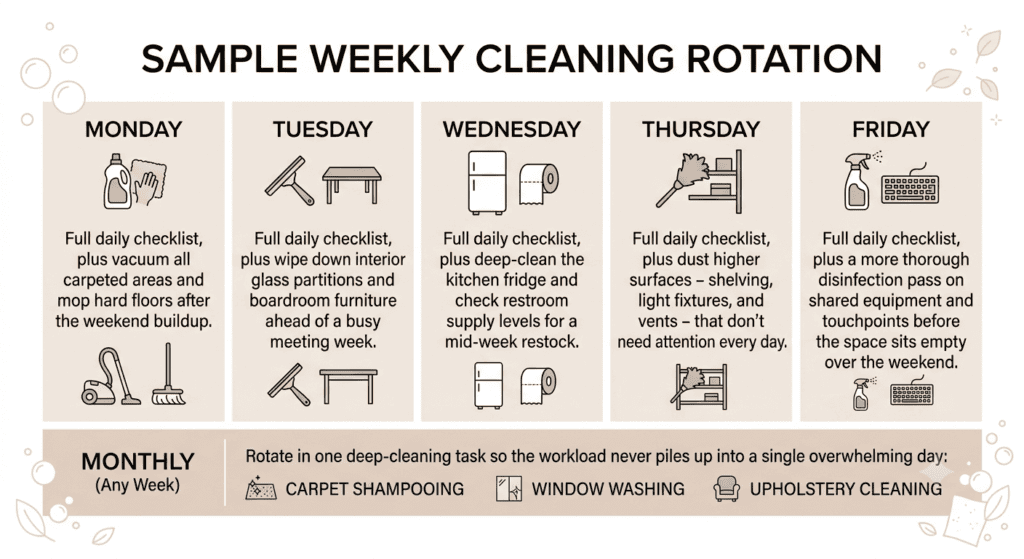
It helps to see how daily, weekly, and monthly tasks actually fit together across a real week rather than as three separate lists. Here’s a simplified example of how a mid-sized office might structure its rotation:
Monday: Full daily checklist, plus vacuum all carpeted areas and mop hard floors after the weekend buildup.
Tuesday: Full daily checklist, plus wipe down interior glass partitions and boardroom furniture ahead of a busy meeting week.
Wednesday: Full daily checklist, plus deep-clean the kitchen fridge and check restroom supply levels for a mid-week restock.
Thursday: Full daily checklist, plus dust higher surfaces – shelving, light fixtures, and vents – that don’t need attention every day.
Friday: Full daily checklist, plus a more thorough disinfection pass on shared equipment and touchpoints before the space sits empty over the weekend.
Monthly (any week): Rotate in one deep-cleaning task – carpet shampooing, window washing, or upholstery cleaning – so the workload never piles up into a single overwhelming day.
This kind of rotation spreads the heavier tasks evenly across the week instead of trying to cram everything into a single “cleaning day,” which is where a lot of informal, in-house efforts start to break down.
A Note on Ontario Workplace Standards
Ontario businesses have an added reason to keep cleaning documented and consistent: workplace health and safety expectations under provincial guidelines generally expect employers to maintain a reasonably clean and hazard-free environment for staff. While cleaning specifics aren’t always spelled out task-by-task in legislation, a documented checklist gives a business a clear, defensible record that it’s taking reasonable steps to protect employees – something that matters if an incident, inspection, or insurance question ever comes up. For regulated environments like food service or healthcare, the bar is even higher, with sector-specific sanitation expectations layered on top of general workplace standards.
This is one more reason a checklist shouldn’t just live in someone’s head. A written, dated record of what was cleaned and when is a simple form of protection for the business as well as the people working in it.
Final Thoughts
A clean office isn’t a luxury line item – it’s infrastructure, in the same category as reliable internet or a functioning HVAC system. The businesses that treat it that way, with a real office cleaning checklist and a consistent schedule behind it, tend to see it pay off in fewer sick days, better first impressions, and a workplace people actually want to spend their day in.
Whether you’re refining an in-house routine or ready to hand it off to a team that does this every day, the structure in this guide gives you everything you need to build a workplace that stays consistently clean, healthy, and welcoming – not just the week before a big client visits.
Ready to put this into action without adding it to your own to-do list? Contact NLLC today for a free, customized quote and let our team build a cleaning plan around your business, so you can get back to running it instead of scrubbing it.
Frequently Asked Questions
How often should an office be professionally cleaned?
Most offices benefit from daily cleaning of high-touch areas and common spaces, with weekly deep cleaning of floors and shared equipment. Deep cleaning tasks like carpet shampooing or HVAC servicing typically happen monthly or quarterly, depending on foot traffic.
What is the difference between janitorial services and commercial cleaning?
Janitorial services typically refer to ongoing, scheduled daily or weekly maintenance – trash removal, restrooms, and general tidying. Commercial cleaning is a broader term that can include janitorial work plus deep cleaning, disinfection, and specialized tasks tailored to a specific business type.
How much does office cleaning typically cost?
Pricing varies based on square footage, frequency, and the scope of work involved, ranging from a few hundred dollars per visit for smaller offices to monthly contracts for larger facilities. The best way to get an accurate number for your space is to request a customized quote.
Can a small office skip professional cleaning and just do it in-house?
Very small offices with light foot traffic can often manage daily tidying internally. But deep cleaning tasks – carpets, HVAC, upholstery – usually require equipment and expertise most in-house teams don’t have, which is where professional support makes the biggest difference.
What cleaning products should offices avoid using on shared surfaces?
Harsh, undiluted chemicals can damage certain flooring, furniture finishes, and electronics, and some can leave residue that isn’t actually effective against the germs it’s meant to remove. Matching the right product to each surface – and increasingly, choosing green cleaning products where possible – protects both health and your assets.
How does office cleaning affect productivity?
Research consistently links cleaner work environments to better focus, fewer sick days, and higher reported job satisfaction. Visual clutter and buildup compete for mental attention the same way background noise does, so a clean space removes one more obstacle between employees and their actual work – which is why so many operations leaders now treat cleanliness as a direct lever for employee productivity rather than a cosmetic afterthought.
Does NLLC offer commercial cleaning outside of Niagara Falls?
Yes. NLLC serves businesses across St. Catharines, Welland, Niagara Falls, and the surrounding Niagara Region, with flexible scheduling built around each business’s operating hours.
Should a cleaning checklist be different for a small office versus a large facility?
Yes, though the core categories stay the same. A small office might handle daily and weekly tasks with one dedicated person or a light service package, while a larger facility usually needs a full rotation of staff, more frequent restroom and kitchen servicing, and a more detailed sign-off process to track that every zone was actually completed. The framework in this guide scales in either direction – it’s the frequency and staffing behind it that changes.
How do I get started with a professional office cleaning plan?
The process starts with a site walkthrough to understand your space and needs, followed by a customized cleaning plan and schedule. You can request a free quote here to get the process started.