If you own a home or manage a property anywhere in the Niagara Region, you already know the feeling. One week you’re raking leaves, the next you’re scraping ice off the front steps, and by the time spring rolls around, you’re staring at a lawn that looks like it survived a war. It’s easy to treat property upkeep as something you deal with when it becomes a problem. The gutter gets fixed after it overflows. The driveway gets sealed after the cracks widen. The lawn gets aerated after it turns into a patchy mess.
But here’s the thing: properties that only get attention when something breaks almost always cost their owners more money, more stress, and more time than properties that are cared for consistently, season after season. That’s the entire idea behind year-round property maintenance – and it’s why more homeowners, landlords, and business owners across Niagara Falls, St. Catharines, Welland, Fort Erie, Niagara-on-the-Lake, Thorold, and Port Colborne are shifting away from reactive fixes toward planned, ongoing care.
This guide breaks down exactly why year-round property maintenance matters, what it should include in each season, how local rules are changing what’s expected of property owners, and how to build a maintenance plan that actually protects your investment instead of draining your wallet.
Why Property Maintenance Can’t Be a “When I Get to It” Job
The Real Cost of Reactive Maintenance
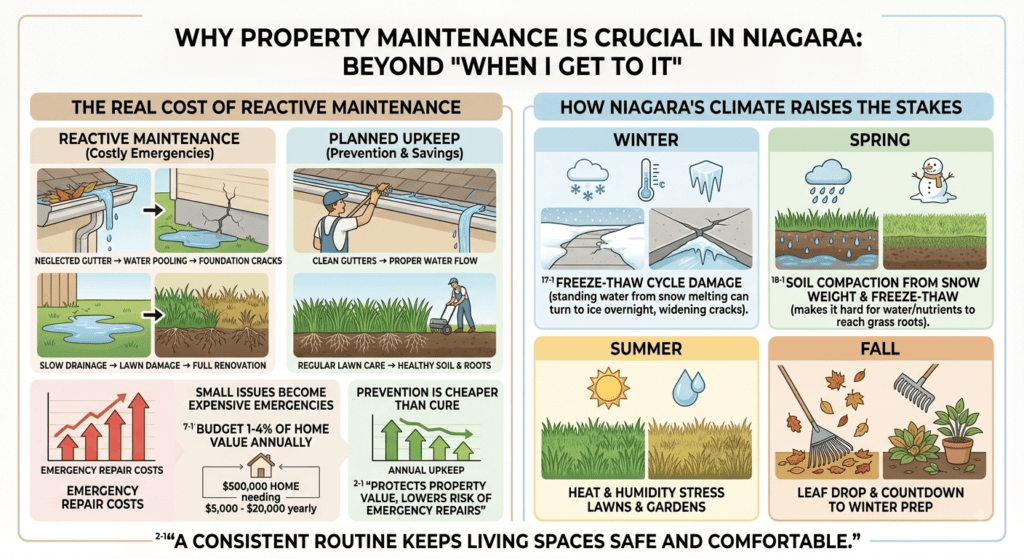
Think about the last time you ignored a small problem around your property. Maybe it was a gutter that seemed fine, or a hairline crack in the driveway that didn’t look urgent. Small issues rarely stay small. A clogged gutter left unattended for a season can lead to water pooling against your foundation, which eventually causes cracking, basement leaks, and even structural damage that costs thousands of dollars to repair. A slow drainage issue in your lawn can drown root systems and require a full landscape renovation instead of a simple regrade.
This pattern – small neglected issue becomes expensive emergency – is the core argument for planned upkeep. Industry guidance on home maintenance consistently points to the same principle: <cite index=”2-1″>a consistent maintenance routine protects property value, lowers the risk of expensive emergency repairs, and keeps living spaces safe and comfortable through every season</cite>. That single idea is really the foundation of everything else in this article.
There’s also a budgeting angle that’s easy to overlook. Financial guidance around home ownership commonly recommends <cite index=”7-1″>budgeting one to four percent of a home’s value annually for maintenance</cite>, which means a property valued at $500,000 should realistically set aside somewhere between $5,000 and $20,000 a year for upkeep and repairs. When maintenance is planned and spread across the year, that budget goes toward prevention – inspections, seasonal care, minor repairs. When maintenance is reactive, that same budget (and often far more) gets swallowed by emergencies: a burst pipe, a collapsed retaining wall, a roof that needed attention two winters ago.
How Niagara’s Climate Raises the Stakes
Niagara Region property owners deal with a genuinely demanding climate cycle. Winters bring heavy snow, ice, and repeated freeze-thaw swings. Spring brings snowmelt, saturated soil, and rapid temperature changes. Summer brings heat and humidity that stress lawns and gardens. Fall brings leaf drop, cooling temperatures, and the countdown to winter prep.
That freeze-thaw cycle deserves special attention because it’s one of the most damaging – and least talked about – threats to Ontario properties. As water seeps into small cracks in concrete, asphalt, or foundations and then freezes, it expands and widens those cracks. When it thaws, the water moves deeper, and the cycle repeats every time temperatures swing above and below zero. Landscaping professionals in Ontario point out that <cite index=”17-1″>standing water from melting snow can turn to ice overnight</cite>, and that walkways, parking areas, and hardscaping should be inspected specifically for damage caused by these freeze-thaw cycles. Left unaddressed over several winters, this is exactly how a minor crack in a driveway becomes a full resurfacing job.
Ontario lawns take a beating too. <cite index=”18-1″>Snow weight and freeze-thaw cycles compact soil, making it difficult for water and nutrients to reach grass roots</cite>, which is why so many Niagara lawns look thin, patchy, or spongy by the time April arrives. Left unmanaged, this compaction problem compounds every year, making recovery slower and more expensive each spring.
None of this is meant to be alarming – it’s meant to explain why a property in Niagara genuinely benefits from consistent, season-aware care in a way that a property in a milder, more stable climate might not need to the same degree.
What Year-Round Property Maintenance Actually Means
Beyond Mowing and Shoveling
When people hear “property maintenance,” they often picture lawn mowing in summer and snow shoveling in winter. That’s part of it, but year-round property maintenance is really a broader system. It typically includes:
- Lawn care (mowing, fertilizing, aeration, overseeding, weed control)
- Landscaping (pruning, mulching, seasonal planting, garden bed care)
- Exterior cleaning (power washing, gutter clearing, window cleaning)
- Snow and ice management (plowing, shoveling, salting)
- Structural and safety checks (walkways, lighting, railings, drainage)
- Debris and junk removal
- Seasonal transitions (spring cleanup, fall prep, winterization)
A property maintenance company like NLLC essentially becomes the connective tissue between all of these tasks, so nothing falls through the cracks between seasons.
The Four-Season Maintenance Cycle
Rather than thinking about maintenance as isolated jobs, it helps to think of it as a rotating cycle. Each season sets up the property for the next one. Spring cleanup determines how healthy your lawn looks in summer. Fall prep determines how well your property survives winter. Winter snow management protects the surfaces that spring will need to repair if neglected. It’s genuinely circular, which is exactly why a one-time service rarely delivers lasting results the way an ongoing plan does.
The Core Benefits of Year-Round Property Maintenance
Protecting and Increasing Property Value
This is usually the benefit property owners care about most, and for good reason. A property that looks cared for – trimmed hedges, a healthy lawn, clean walkways, no visible wear and tear – signals to buyers, tenants, and neighbours that the rest of the property is probably well looked after too. Property service professionals consistently note that <cite index=”1-1″>landscapes that are consistently maintained can significantly boost a property’s value, making it more appealing to potential buyers</cite>, and that ongoing care <cite index=”1-1″>promotes the health of plants, keeping them vigorous and beautiful all year long</cite> rather than requiring a rushed cleanup right before a listing goes live.
For rental and commercial properties in particular, this matters even more. Prospective tenants judge a property within seconds of arriving, and a maintained exterior is one of the simplest ways to justify higher rents or attract quality tenants in the first place.
Preventing Costly Emergency Repairs
Small Problems That Become Big Bills
We touched on this earlier, but it’s worth expanding on because it’s arguably the single strongest financial argument for year-round care. Regular inspections and upkeep let small issues get caught – and fixed – while they’re still cheap. Property management guidance describes this directly: <cite index=”4-1″>preservation of property value by preventing deterioration and costly repairs</cite> is one of the clearest benefits of a comprehensive maintenance plan, alongside <cite index=”4-1″>reduced emergency repair costs by addressing issues early</cite>.
A cracked downspout that gets caught in a routine fall inspection might cost $150 to fix. The same downspout, ignored through a Niagara winter, can direct meltwater straight into a foundation and turn into a $10,000+ waterproofing job. That gap – between “caught early” and “ignored until it fails” – is where year-round maintenance earns its keep.
Improving Safety for Residents, Tenants, and Visitors
Safety is often the most immediate, tangible benefit of consistent property care, especially in a region that deals with heavy winter weather. Uncleared ice on a walkway, a loose railing, or poor lighting around an entrance are all liability risks as much as they are maintenance issues. As one property maintenance resource puts it, year-round care provides <cite index=”4-1″>enhanced safety for occupants and visitors through well-maintained walkways, lighting, and structural elements</cite>. For landlords and commercial property owners, this isn’t just about avoiding accidents – it’s also about avoiding the legal and insurance exposure that comes with an unmaintained property.
Boosting Curb Appeal and First Impressions
Curb appeal isn’t just an aesthetic nicety – it’s functional. A well-kept exterior communicates pride of ownership, and that matters whether you’re welcoming guests, showing a home to buyers, or trying to draw customers into a storefront. Seasonal maintenance specialists note that consistent grounds care creates <cite index=”3-1″>enhanced aesthetic appeal that adds beauty to a property and creates a welcoming environment</cite> – something that’s much harder to achieve with a once-a-year cleanup than with ongoing attention.
Saving Time, Stress, and Mental Load
There’s a benefit here that doesn’t show up on a balance sheet but matters just as much: peace of mind. Homeowners juggling work, family, and everything else often don’t have the bandwidth to track every seasonal task their property needs. Handing that responsibility to a dedicated team means you’re not spending your Saturday mornings wondering whether it’s time to aerate the lawn or worrying about whether the walkway is safe for your kids. As one landscaping resource summarizes it, having a dedicated team manage upkeep <cite index=”1-1″>alleviates the burden from the homeowner, allowing them to enjoy their property instead of constantly worrying about upkeep</cite>.
Supporting Energy Efficiency
Property maintenance and energy costs are more connected than most people realize. Sealing gaps, maintaining HVAC systems, and keeping insulation in good shape all reduce the amount of energy a property wastes. In fact, government energy guidance notes that <cite index=”2-1″>sealing leaks and properly maintaining heating and cooling equipment can meaningfully cut household energy use</cite>. For commercial properties especially, HVAC uptime and building efficiency directly affect operating costs, which is one more reason maintenance shouldn’t be treated as optional overhead.
Seasonal Breakdown: What Your Property Needs Each Season in Niagara
Spring: Recovery and Renewal
Spring in Niagara is about undoing winter’s damage and setting the property up for a strong growing season. Priorities typically include:
- Spring cleanup: Clearing leaves, branches, and debris left behind by winter
- Lawn assessment: Checking for compaction, frost heave, salt damage, and bare patches
- Aeration and overseeding: Loosening compacted soil so water and nutrients can reach roots again
- Fertilizing: Applying a balanced spring fertilizer once active growth begins
- Hardscape inspection: Checking walkways, driveways, and patios for freeze-thaw cracking
- Drainage review: Making sure snowmelt isn’t pooling anywhere it shouldn’t
Timing matters here. Ontario lawn care guidance generally recommends waiting until <cite index=”19-1″>the ground has thawed and temperatures are consistently above freezing during the day</cite> before starting major lawn work, since starting too early can do more harm than good.
Summer: Growth and Upkeep
Summer maintenance in Niagara is largely about consistency – keeping the lawn, gardens, and property looking sharp through the region’s heat and humidity. This includes:
- Regular mowing at the correct height to encourage healthy root growth
- Deep, infrequent watering rather than frequent shallow watering
- Weed control and pest monitoring
- Pruning and shaping shrubs and hedges
- Mulching garden beds to retain moisture and suppress weeds
- Power washing driveways, siding, and walkways
Fall: Preparation and Protection
Fall is arguably the most important season to get right, because it directly determines how well a property handles winter. Fall tasks typically include:
- Leaf removal and yard cleanup
- Fall fertilization to strengthen root systems before dormancy
- Fall aeration and overseeding – widely considered more effective than spring seeding in Ontario’s climate
- Gutter cleaning to prevent ice dams and water damage
- Sealing driveway cracks before winter moisture gets in and freezes
- Winterizing irrigation systems and outdoor fixtures
- Scheduling snow removal service ahead of the first snowfall
Winter: Safety and Snow Management
Winter maintenance in Niagara centers on one priority above all others: keeping people safe. That means:
- Timely snow plowing and shoveling after every snowfall
- Ice management on walkways, steps, and parking areas
- Salting high-traffic and high-risk areas
- Monitoring for ice dams on rooflines
- Checking outdoor lighting, since shorter days increase reliance on it for safety
New Snow Clearing Rules Are Changing Responsibilities for Niagara Property Owners
If you own property in Niagara Falls, there’s a change coming that makes year-round planning more important than ever. In February 2025, <cite index=”8-1″>Niagara Falls City Council adopted a Snow Clearing Bylaw aimed at improving winter-time pedestrian accessibility and reducing the risks associated with snow and ice on sidewalks</cite>. <cite index=”8-1″>Enforcement begins October 1, 2026, following a public education campaign</cite>. In practical terms, this means <cite index=”10-1″>property owners will be required to keep the sidewalks in front of their homes clear of snow and ice</cite> – a responsibility that, until now, hasn’t been formally mandated citywide.
The city has acknowledged this could create hardship for some residents. <cite index=”8-1″>Staff have been directed to develop a financial assistance program specifically to help mitigate the impact of the bylaw on low-income seniors and people with physical disabilities</cite> who may struggle to clear sidewalks themselves.
St. Catharines already operates under a similar framework. Under that city’s Snow Removal By-law, <cite index=”12-1″>property owners with a sidewalk bordering their property must remove snow and ice within 24 hours of a snowfall and clear the pavement so it’s visible</cite>, and non-compliance can result in charges under the Provincial Offences Act.
What the New Bylaws Mean for Homeowners
If you’re in Niagara Falls, this is the moment to build snow removal into your regular routine rather than treating it as something you’ll figure out storm by storm. Missing the clearing window isn’t just a safety risk anymore – for many properties, it’s about to become a compliance issue with a real timeline attached to it.
Why a Maintenance Partner Matters More Than Ever
This is exactly the kind of seasonal obligation that’s far easier to manage with a maintenance plan already in place than by scrambling to book a one-off service the morning after a snowstorm. A property maintenance company that already handles your landscaping and exterior care in the warmer months can simply extend that relationship into winter snow and ice management, so you’re covered under the new rules without having to think about it every time the forecast changes.
Residential vs. Commercial: Why Year-Round Maintenance Looks Different
What Homeowners Should Prioritize
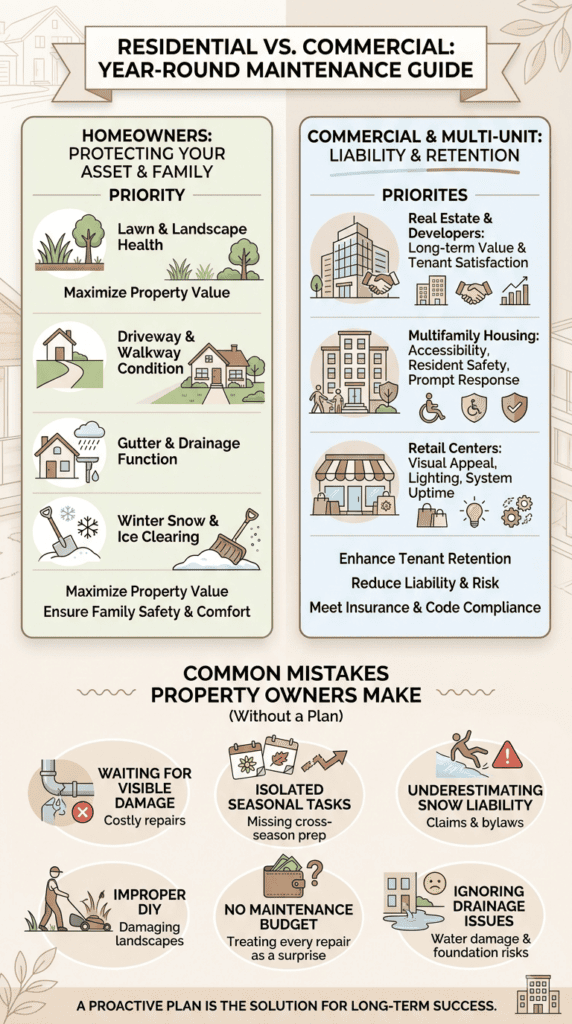
For homeowners, year-round maintenance is mostly about protecting the largest financial asset most people own, plus day-to-day safety and comfort for their family. The priority list usually looks like: lawn and landscape health, driveway and walkway condition, gutter and drainage function, and winter snow and ice clearing.
What Businesses and Property Managers Should Prioritize
Commercial and multi-unit properties carry different pressures. A property maintenance resource focused on commercial and multifamily buildings breaks it down well: <cite index=”5-1″>real estate and property developers focus on long-term property value and tenant satisfaction, multifamily housing managers emphasize accessibility, resident safety, and prompt maintenance response, and retail centers prioritize visual appeal, lighting, and uptime of core systems</cite>. For these property types, maintenance isn’t just about appearance or comfort – it’s directly tied to tenant retention, liability exposure, and, in many cases, insurance and code compliance.
Common Mistakes Property Owners Make Without a Year-Round Plan
Even well-intentioned property owners fall into a handful of predictable traps when they don’t have a structured maintenance plan:
- Waiting for visible damage before acting. By the time a problem is visible, it’s usually already expensive.
- Treating each season as a separate, unrelated task. Skipping fall prep almost always shows up as a harder, more expensive spring.
- Underestimating snow and ice liability. Especially with new bylaws taking effect, “I’ll get to it later” is no longer a safe approach.
- DIY-ing tasks that need professional timing or equipment. Fertilizing too early, aerating at the wrong soil temperature, or mowing too short can undo months of lawn health.
- Not budgeting for maintenance as a predictable annual cost. Treating every repair as a surprise expense, rather than planning for it, is one of the most common financial mistakes property owners make.
- Assuming a single seasonal visit covers the whole year. A one-time spring cleanup or a single fall gutter clean doesn’t replace ongoing attention. Grass keeps growing, weeds keep spreading, and debris keeps accumulating between visits, so gaps in the schedule show up quickly.
- Ignoring drainage until there’s standing water. Poor grading or blocked drainage rarely announces itself until water is already pooling against a foundation or icing over a walkway. By then, the fix is usually far more involved than it would have been if caught during a routine seasonal inspection.
- Overlooking hardscaping until it becomes a trip hazard. Cracked pavers, heaved walkways, and shifting retaining walls develop slowly, which makes them easy to dismiss year after year – right up until someone gets hurt or a insurance claim gets filed.
Each of these mistakes shares the same root cause: treating maintenance as a list of isolated, occasional tasks instead of a connected, ongoing system. That’s precisely the gap a year-round plan is designed to close.
DIY vs. Hiring a Professional Property Maintenance Company
When DIY Makes Sense
Not every task requires a professional. Simple mowing, light weeding, basic raking, and small cosmetic touch-ups are reasonable for hands-on homeowners with the time and physical ability to keep up with them consistently.
When Professional Help Pays for Itself
Where a professional property maintenance company earns its cost is in the tasks that require timing, equipment, or expertise – aeration, fertilization programs, drainage correction, snow and ice management under a legal deadline, and the kind of seasonal consistency that’s genuinely hard to maintain solo. It’s also worth factoring in the more intangible cost of DIY: the hours spent, the equipment purchased and stored, and the physical toll of tasks like shoveling heavy, wet Niagara snow, which carries real health risks for some homeowners.
There’s also a knowledge gap that’s easy to underestimate. Timing matters enormously in lawn care – applying fertilizer too early, aerating before the soil has thawed to the right depth, or treating weeds before they’ve actively emerged can all waste product and effort without producing results. A professional crew that works across dozens of Niagara properties every season develops a feel for exactly when conditions are right, which is difficult to replicate from a single property’s trial and error.
For snow and ice specifically, professional service also solves a timing problem that’s hard to manage alone: storms don’t wait for a convenient morning, and a property owner who works full-time or travels frequently may not be able to clear a sidewalk within a required window every single time it snows. A maintenance company with a standing snow removal contract handles that automatically, storm after storm, without the property owner needing to track the forecast themselves.
Cost is often the deciding factor, and it’s worth thinking about it as a comparison rather than a standalone expense. A single emergency callout for a burst pipe caused by a frozen, unmaintained exterior tap, or a full driveway resurfacing after years of unaddressed freeze-thaw cracking, frequently costs more than several years of routine professional maintenance combined. Framed that way, ongoing care isn’t really an added cost – it’s a way of spreading a cost you were always going to pay, just on much more favourable terms.
How to Build a Year-Round Property Maintenance Plan
Step 1: Walk the Property and Make a List
Start with an honest inventory. Walk the exterior and note the condition of the lawn, gardens, driveway, walkways, gutters, fencing, and lighting.
Step 2: Map Tasks to Seasons
Assign each item on your list to the season it belongs in – spring cleanup and aeration, summer mowing and watering, fall gutter cleaning and overseeding, winter snow removal.
Step 3: Decide What to DIY and What to Outsource
Be realistic about your available time, physical capacity, and equipment. There’s no penalty for outsourcing everything, and there’s no requirement to outsource everything either – most Niagara property owners land somewhere in between.
Step 4: Set a Budget
Rather than reacting to costs as they appear, set aside a predictable annual maintenance budget and treat it the same way you’d treat a mortgage or utility payment – a fixed, expected cost rather than a surprise.
Step 5: Partner with a Local Team
Working with a company that understands Niagara’s specific climate, soil, and bylaws – rather than a generic national provider – means your plan actually accounts for the freeze-thaw cycles, clay-heavy soil conditions, and local snow clearing rules that generic advice often misses.
Why Niagara Property Owners Choose NLLC
NLLC (Niagara Landscaping, Lawn Care & Cleaning) was built specifically around the idea that Niagara properties need consistent, season-aware care rather than one-off fixes. Serving Niagara Falls, St. Catharines, Welland, Fort Erie, Niagara-on-the-Lake, Thorold, Port Colborne, and the wider Niagara Region, NLLC brings lawn care, landscaping, residential and commercial cleaning, Airbnb cleaning, garbage and junk removal, snow removal, and full property maintenance under one roof. That means one team that already knows your property, rather than juggling multiple contractors and hoping nothing falls through the cracks between seasons.
Conclusion: Start Protecting Your Property Today
Year-round property maintenance isn’t about doing more work – it’s about doing the right work at the right time, so your Niagara property stays protected, safe, and valuable through every season instead of just looking good for a few weeks after a cleanup. Between Niagara’s demanding freeze-thaw winters and the new snow clearing rules taking effect across the region, having a consistent maintenance plan in place has never mattered more.
If you’re ready to stop reacting to problems and start protecting your property properly, NLLC is here to help. Request your free quote today and let our local Niagara team build a year-round maintenance plan tailored to your home or business.
Frequently Asked Questions
1. How much does year-round property maintenance cost in Niagara? Costs vary depending on property size, service scope, and how many services (landscaping, cleaning, snow removal) are bundled together. A local property maintenance company can walk your property and provide an accurate, itemized quote based on your specific needs.
2. Is year-round maintenance worth it for a small residential property? Yes. Even smaller properties benefit from consistent care, since freeze-thaw damage, drainage issues, and lawn compaction affect properties of every size – and small problems are always cheaper to fix early than late.
3. What’s included in a typical property maintenance plan? Most plans combine lawn care, landscaping, seasonal cleanups, exterior cleaning, and winter snow and ice management, with the mix adjusted to the property’s specific needs.
4. Do I really need to worry about the new Niagara Falls snow clearing bylaw? If you own property with an adjacent sidewalk in Niagara Falls, yes. Enforcement begins October 1, 2026, and property owners will be responsible for keeping those sidewalks clear of snow and ice.
5. What’s the difference between spring cleanup and full lawn maintenance? Spring cleanup is a one-time seasonal service focused on clearing winter debris and assessing damage. Full lawn maintenance is an ongoing program that includes mowing, fertilizing, aeration, and season-long care.
6. Can I mix DIY and professional maintenance? Absolutely. Many Niagara homeowners handle basic mowing or light yard work themselves while outsourcing aeration, fertilization, and winter snow removal to a professional team.
7. How far in advance should I book seasonal services like spring cleanup or snow removal? As early as possible. Landscaping and snow removal companies in Ontario routinely recommend booking spring services and winter contracts before their respective seasons begin, since schedules fill quickly.
8. Does year-round maintenance really increase property value? Yes. Consistently maintained landscaping and exteriors are widely recognized as a factor that improves buyer and tenant appeal, which supports both resale value and rental demand.