
If you’ve ever stood in your garage staring at an old couch, three broken lamps, and a mattress that’s been “temporarily” leaning against the wall for six months, you already know the real problem with household waste: it’s rarely just garbage. It’s a mix of things your city truck will take, things it won’t, things that are technically hazardous, and things that would probably still be useful to someone else. Sorting all of that out is exactly why garbage removal services exist – and why understanding how they work can save you money, time, and more than a few headaches.
For homeowners across Niagara Falls, St. Catharines, Welland, Fort Erie, Niagara-on-the-Lake, Thorold, and Port Colborne, 2026 has brought real changes to how waste gets handled. Ontario’s Blue Box program fully shifted to producer responsibility on January 1, 2026, curbside limits remain strict, and private junk removal pricing has continued to climb with fuel and labour costs. This guide walks through everything a homeowner needs to know – from what your regional garbage truck will and won’t take, to when it’s time to call in professional garbage removal services, to how much you should realistically expect to pay.
None of this is really about garbage in the abstract. It’s about the very specific, very physical problem of stuff taking up space in a home that’s supposed to feel manageable. A cluttered garage makes it harder to park. A basement full of old furniture makes it harder to finish a renovation. A house that won’t show well because of leftover junk can genuinely slow down a sale. Treating garbage removal as a planned, occasional task – rather than something you deal with only when it becomes unbearable – tends to save homeowners both money and stress over the course of a year.
What Counts as “Garbage Removal” Today
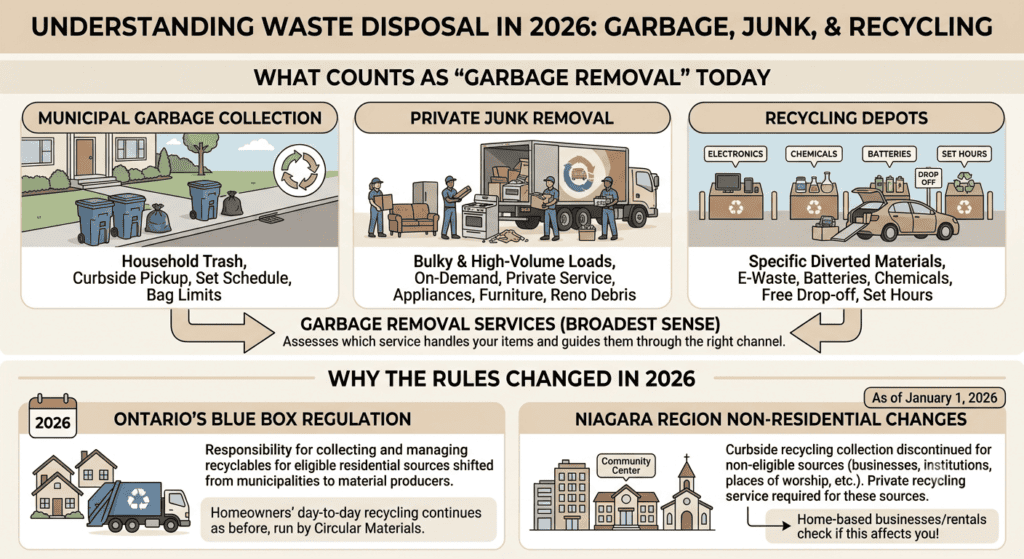
Most people use “garbage removal,” “junk removal,” and “waste disposal” interchangeably, but they aren’t quite the same thing, and knowing the difference will save you a wasted phone call or an unexpected fee.
Curbside garbage collection is the municipal service that picks up your household trash on a set schedule, usually with strict bag or bin limits. Junk removal is a private, on-demand service that hauls away bulkier or higher-volume loads – old furniture, appliances, renovation debris – that curbside pickup either won’t take or can’t handle in the quantity you need gone. Recycling depots handle specific diverted materials like electronics, batteries, and household chemicals, usually for free, but only during set hours and only for items on their accepted list.
Garbage removal services, in the broadest and most useful sense, cover the full spectrum: they help you figure out which bucket your unwanted items fall into and get them out of your house through the right channel, whether that’s the curb, a depot, or a truck that shows up at your driveway.
Why the Rules Changed in 2026
The waste management landscape in Ontario shifted meaningfully at the start of the year. Under Ontario’s Blue Box Regulation (O. Reg. 391/21), <cite index=”4-1″>responsibility for collecting and managing recyclables for eligible residential sources has fully shifted from municipalities to material producers</cite> – the companies that make the packaging in the first place. For homeowners, day-to-day recycling collection largely continues as before, now run through Circular Materials rather than the municipality directly.
The bigger change landed on non-residential properties. <cite index=”9-1″>As of January 1, 2026, Niagara Region discontinued curbside recycling collection for non-eligible sources such as businesses, institutions, places of worship, and community facilities</cite>, which now need to arrange private recycling service. If you run a home-based business or rent out a property that falls into this category, this is worth double-checking, since it can quietly change what your regular collection actually includes.
Understanding Niagara Region’s Curbside Garbage Rules
Before you call anyone for garbage removal services, it’s worth knowing exactly what your municipal pickup already covers, because a surprising amount of “junk” can leave your property for free if you time it right.
The Two-Bag Limit and Garbage Tags
Niagara Region keeps curbside garbage limits tight to encourage diversion into the Green Bin and recycling programs. <cite index=”11-1″>Residents may place out two bags or cans of garbage every other week, and additional bags require a purchased garbage tag</cite>. As of the most recent guidance, <cite index=”7-1″>that tag costs $3.30 for each extra bag or can</cite> beyond the standard limit, unless you qualify for an exemption.
Exemptions do exist. <cite index=”12-1″>Households with children under four still in diapers, eligible home daycares, and residents with a medical condition that generates unavoidable non-hazardous waste can apply for an increased limit</cite>, though medical exemptions require a physician’s signature and periodic renewal.
Collection Schedule: Area A vs Area B
Garbage collection across the region runs on an every-other-week schedule tied to two zones. <cite index=”7-1″>Area A and Area B alternate garbage weeks throughout the year according to the official municipal collection calendar</cite>, while <cite index=”6-1″>Green Bin organics and yard waste are collected weekly, with all materials required at the curb by 7 a.m. on your collection day</cite>. Materials can go out <cite index=”6-1″>no earlier than 5 p.m. the night before collection</cite>, and holiday weeks shift the schedule – <cite index=”6-1″>there is no collection on Christmas Day or New Year’s Day, with Friday routes shifting to Saturday during those weeks</cite>.
Getting this wrong is one of the most common (and preventable) reasons people end up calling a private garbage removal service in a panic: a missed pickup because bags went out on the wrong week can mean a two-week wait, which is a long time to have garbage sitting in a garage in July.
What Can (and Can’t) Go at the Curb
Regular curbside garbage is meant for household trash only, not construction debris, large appliances, or hazardous material. <cite index=”2-1″>Appliances and metal household items are not collected at the curb under the current regional guide</cite> – those need a drop-off depot or a private scrap metal option instead. Anything that feels “risky, sharp, heavy, electronic, flammable, oily, or chemical” is worth checking against the region’s item disposal tool before you set it out, since guessing wrong can mean it simply gets left behind on collection day.
It’s also worth understanding why a missed pickup happens in the first place, since it’s rarely a late truck. Bags get skipped because they went out too early or too late, because a bag was over the weight a collector can safely lift, because the container lacked handles or a lid, or because the load simply exceeded the two-bag limit without a tag attached. None of these are truck-scheduling problems – they’re set-out problems, and they’re avoidable with a five-minute check before bags hit the curb. If in doubt about a specific item, the Niagara Region Waste app and address-specific lookup tool are more reliable than guessing based on what a neighbour does.
When Curbside Isn’t Enough: Professional Garbage Removal Services
Curbside pickup works well for the steady drip of everyday household trash. It works far less well for the moments when you’re clearing out a garage, prepping a house for sale, cleaning up after a renovation, or dealing with a deceased relative’s belongings. That’s the gap professional garbage removal services are built to fill.
Signs You Need a Junk Removal Service
A few situations reliably signal that it’s time to bring in professionals rather than fight the two-bag limit for two months straight:
- You’re clearing an entire room, garage, or basement at once, not just tidying up
- You have large appliances, furniture, or a mattress that curbside won’t take
- You’re facing a moving deadline and don’t have time to spread disposal across several collection weeks
- The items are heavy, awkward, or located somewhere hard to access (a second-floor apartment, a walkout basement)
- You’re dealing with construction or renovation debris, which regular garbage limits were never designed to absorb
What Professional Garbage Removal Services Actually Include
A reputable service does more than throw everything into a truck bound for the landfill. Most full-service garbage removal companies will:
- Provide an upfront quote based on volume, weight, or item count before work begins
- Handle the physical labour of loading and hauling, including navigating stairs or tight spaces
- Sort items for donation or recycling where possible rather than sending everything to landfill
- Dispose of regulated items like appliances through the correct channel, including refrigerant removal where required
- Sweep up after the job, leaving the space genuinely clear rather than just emptier
That last point matters more than people expect. A cleanout that leaves dust, nails, or leftover packing material behind isn’t really finished – it just moves the mess from “big and obvious” to “small and annoying.”
There’s also a practical labour argument that’s easy to underestimate until you’re in the middle of a job. A queen mattress alone can weigh 60 to 100 pounds and is awkward enough that moving it down a staircase solo is genuinely risky. A furnished garage cleanout often means a dozen or more individually heavy items, each requiring careful lifting technique to avoid injury. Professional crews bring the right number of people, the right equipment (furniture dollies, moving blankets, straps), and the experience to move heavy loads without damaging floors, walls, or door frames along the way – something that’s much harder to guarantee with a rushed DIY effort and a couple of willing friends.
How Much Do Garbage Removal Services Cost in 2026?
Pricing for professional garbage removal services in Ontario has stayed fairly consistent in structure even as dollar figures have crept up with fuel and disposal costs. Understanding how companies price a job makes it much easier to spot a fair quote from an inflated one.
Volume-Based Pricing Explained
Most companies price by how much space your items take up in their truck rather than by weight or by the hour. <cite index=”24-1″>A typical half-truck load in the GTA and surrounding regions averages between $250 and $450</cite>, which is enough to clear an old bedroom set or the leftover boxes from a move. Across Ontario more broadly, <cite index=”22-1″>quarter-truck loads tend to start around $150, with full truckloads starting near $400</cite> and climbing higher depending on what’s included.
For a full truckload covering a larger project – a garage clean-out, an estate cleanup, or several rooms at once – <cite index=”24-1″>homeowners should expect the price to depend heavily on how much junk they have, what kind of items they are, and how easy the load is for the crew to access</cite>. Difficult access, such as narrow stairwells or a lack of nearby parking, routinely adds to the final bill.
Per-Item Pricing
If you only have one or two things to get rid of, per-item pricing is usually cheaper than booking a volume-based load. <cite index=”38-1″>Single large items like a mattress, refrigerator, or sofa are often priced individually regardless of truck volume, while two or more items typically move to fraction-of-a-truck pricing instead</cite>. On the lower end, <cite index=”26-1″>some national services start single bulky-item pickups around $60, inclusive of labour, transportation, and disposal</cite>.
Hidden Fees to Watch For
The number quoted over the phone isn’t always the number on the invoice. A few charges catch homeowners off guard most often:
- Fuel surcharges that adjust with current diesel prices and can meaningfully increase a base rate during periods of high fuel costs
- Heavy-lifting or stair fees, often an extra $50 to $100 when a crew has to carry large items down from an upper floor
- Same-day or after-hours premiums for weekend, holiday, or rush bookings
- Special handling charges for electronics, mattresses, or anything requiring separate disposal
- Overweight or overage charges when an estimate underestimates just how much a load actually weighs
The fix for most of these is simple: ask for a complete, itemized quote before the truck arrives, not just a ballpark figure over the phone.
It also helps to understand what’s driving prices upward in the first place, since it isn’t arbitrary. Rising diesel prices directly affect fuel surcharges on hauling jobs, landfill tipping fees have increased in several Ontario municipalities as capacity tightens, and labour costs for licensed, insured crews have climbed along with the broader cost of living. None of this means every quote is fair – some operators do pad estimates or add fees that were never mentioned upfront – but it does explain why prices for the same size of job can look noticeably different than they did even two or three years ago. Getting two or three quotes for anything beyond a single-item pickup remains the simplest way to confirm you’re paying a fair, current rate rather than an inflated one.
Special and Hazardous Items: What Needs Different Handling
Not everything you want gone can go in a regular garbage removal load, and this is where a lot of the 2026 regulatory changes actually matter to homeowners.
Household Hazardous Waste
Paints, solvents, pesticides, and similar chemicals need to go through a dedicated program rather than a standard junk haul. <cite index=”29-1″>Hazardous household waste including paints, solvents, pesticides, motor oil, and certain batteries cannot go through regular junk removal services, and each province manages its own hazardous waste programs, often through periodic collection events or permanent drop-off depots</cite>. Niagara Region residents can use the region’s household chemical drop-off depots year-round for this category rather than trying to sneak it into a curbside bag.
Electronics (E-Waste)
Ontario has one of the more established e-waste systems in the country. <cite index=”51-1″>Electronics recycling in Ontario is free for residents at hundreds of approved drop-off locations, operated through the Electronic Products Recycling Association and regulated by the Resource Productivity and Recovery Authority</cite>. Retailers selling similar products are generally required to accept your old electronics for recycling regardless of the original brand, which makes this one of the easier categories to divert responsibly – there’s rarely a good reason for an old laptop or television to end up in a landfill-bound truck.
Mattresses and Bulky Furniture
Mattresses sit in an odd regulatory gap that homeowners are often surprised by. <cite index=”42-1″>As of 2026, Ontario has no province-wide mattress extended producer responsibility program and no mandated recycling fee at the point of sale</cite>, which means disposal is handled municipality by municipality rather than through a standardized system. <cite index=”41-1″>A mattress cannot go in the Blue Box, cannot be left at the curb on recycling day, and cannot be taken to a depot that only handles paper and packaging</cite> – it needs bulky item pickup, a household hazardous waste depot that accepts oversized items, or a private garbage removal service.
Appliances with Refrigerants
Fridges, freezers, and air conditioners require special handling because of the refrigerants they contain. <cite index=”29-1″>Certain appliances in Ontario must have refrigerants properly removed by a certified technician before disposal</cite>, so when hiring a junk removal company for an old fridge, it’s worth confirming this is handled correctly and reflected in the quote rather than assumed.
Bulky Item and Large Item Pickup in Niagara
Between curbside garbage and hiring a private hauler sits a middle option a lot of homeowners forget about: the region’s own large item pickup program.
How to Book Large Item Collection
Niagara Region offers large item pickup alongside your regular garbage collection day, but it isn’t automatic. <cite index=”2-1″>Requests must be submitted at least two working days before your regular garbage collection day</cite>, either online or by phone, so this needs a bit of planning rather than a same-week decision.
Item Limits and Restrictions
<cite index=”2-1″>Niagara Region applies a four-item limit per garbage collection for large items, per eligible residential unit</cite>. Furniture and bulky household goods typically qualify, but there’s a catch worth remembering: <cite index=”2-1″>appliances and metal household items are specifically excluded from curbside large item pickup and need to go to a drop-off depot or a private scrap metal service instead</cite>. If you’re clearing out more than four large items, or any of them are appliances, that’s usually the point where a professional garbage removal service becomes the more practical option.
DIY vs Hiring a Professional Garbage Removal Company
Not every cleanup needs a truck and a crew. Knowing which category your situation falls into can save real money.
When DIY Makes Sense
If you have a small number of items, a vehicle capable of hauling them, and access to a depot or landfill site, doing it yourself is almost always cheaper. A single trip to drop off electronics, a couple of bags of yard waste, or one piece of furniture that fits in a hatchback rarely justifies a service call. This works especially well when the destination depot is free, which is the case for most electronics and many recyclable materials in Niagara.
When to Call in the Pros
The math flips once a job involves volume, weight, awkward access, or a tight timeline. Clearing an entire house, handling a renovation’s worth of debris, or dealing with items too heavy to lift safely (a queen mattress down a narrow staircase, an old washer in a basement) is where hiring a garbage removal service pays for itself in time saved and injuries avoided. It’s also the better call anytime hazardous materials are mixed into a pile, since a professional crew already knows which items need separate handling and which depot each one belongs at.
Choosing the Right Garbage Removal Company
Not all services are created equal, and the cheapest quote isn’t always the best deal once you factor in what actually happens to your stuff after it leaves your driveway.
Questions to Ask Before Booking
- Is the quote based on volume, weight, or per item, and does it include labour and disposal fees?
- Are you licensed and insured for residential work in this municipality?
- What percentage of items get donated or recycled versus sent to landfill?
- How do you handle appliances with refrigerants, and is a certified technician involved?
- Is there a fuel surcharge or after-hours fee that isn’t reflected in the initial estimate?
Red Flags to Avoid
Be cautious of companies that won’t give a written estimate before arriving, that pressure you to decide on the spot, or that can’t explain how they handle regulated items like refrigerant-bearing appliances or electronics. A trustworthy garbage removal service should be comfortable walking you through exactly where your items are going, not just how quickly they can get them off your property.
Common Mistakes Homeowners Make
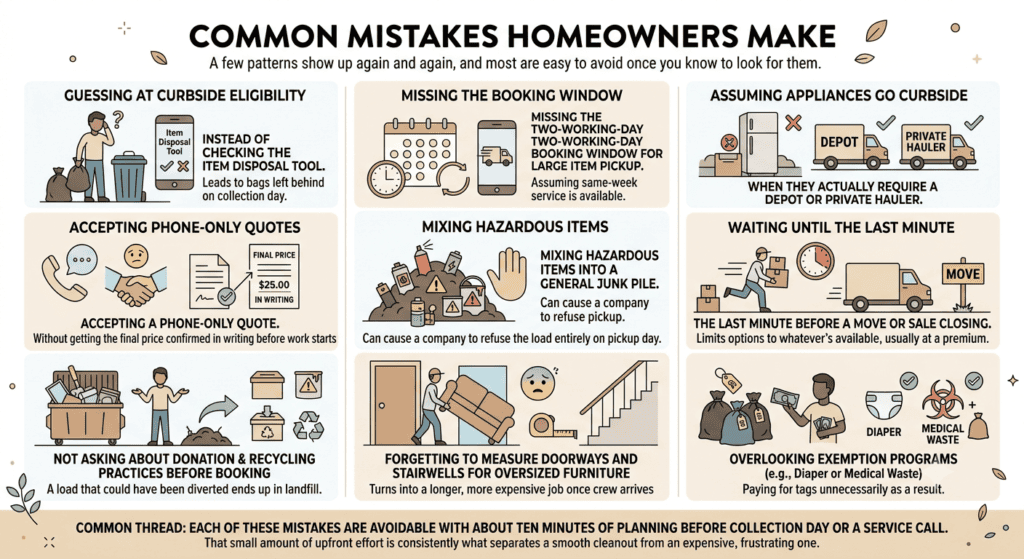
A few patterns show up again and again, and most are easy to avoid once you know to look for them:
- Guessing at curbside eligibility instead of checking the item disposal tool, which leads to bags left behind on collection day
- Missing the two-working-day booking window for large item pickup and assuming same-week service is available
- Assuming appliances go curbside when they actually require a depot or private hauler
- Accepting a phone-only quote without getting the final price confirmed in writing before work starts
- Mixing hazardous items into a general junk pile, which can cause a company to refuse the load entirely on pickup day
- Waiting until the last minute before a move or sale closing, which limits options to whatever’s available on short notice, usually at a premium
- Not asking about donation and recycling practices before booking, which means a load that could have been diverted from landfill ends up there anyway simply because nobody asked
- Forgetting to measure doorways and stairwells for oversized furniture, which can turn a straightforward pickup into a longer, more expensive job once the crew arrives
- Overlooking exemption programs that could have kept a household within the free two-bag limit, such as the diaper or medical waste exemptions, and paying for tags unnecessarily as a result
Each of these mistakes shares a common thread: they’re all avoidable with about ten minutes of planning before collection day or before a service call. That small amount of upfront effort is consistently what separates a smooth cleanout from an expensive, frustrating one.
Best Practices for Ongoing Waste Management
The homeowners who deal with clutter the least are usually the ones who treat waste management as a habit rather than an occasional crisis.
Seasonal Cleanouts
Spring cleaning isn’t just a tradition – it lines up naturally with the point in the year when yard waste collection resumes and it’s easiest to see what’s accumulated over winter. Scheduling a seasonal walkthrough of the garage, basement, and closets twice a year keeps items from piling up to the point where only a full truckload will solve the problem.
Reducing Waste Before It Piles Up
A little upstream thinking goes a long way. Donating usable furniture and clothing before they become “junk,” recycling electronics as soon as they’re replaced rather than storing them indefinitely, and keeping a small designated bin for household hazardous waste so it doesn’t get mixed into regular garbage all reduce how often you’ll need to call for bulk removal at all. It’s a lot easier to manage waste in small, steady amounts than to face it all at once.
Conclusion
Garbage removal doesn’t have to mean choosing between wrestling with the two-bag limit for months or paying full price for a truck you didn’t really need. Understanding what your municipal service already covers, what belongs at a specialized depot, and when a professional crew is genuinely worth it puts the decision back in your hands – and usually saves both money and a weekend.
If you’re staring down a garage full of items that don’t fit neatly into any single category, that’s exactly the kind of job professional garbage removal services are built for. The goal isn’t just an empty garage or a cleared basement – it’s knowing that everything that left your property went somewhere responsible, whether that’s a donation centre, a recycling depot, or a properly regulated disposal facility, rather than simply out of sight.
NLLC serves homeowners across Niagara Falls, St. Catharines, Welland, Fort Erie, Niagara-on-the-Lake, Thorold, and Port Colborne with straightforward, upfront pricing and responsible disposal practices. Reach out for a free quote and get your space back without the guesswork.
Frequently Asked Questions
How many garbage bags can I put out in Niagara Region? Eligible residents can place out two bags or cans of garbage every other week at no charge. Additional bags require a purchased garbage tag unless you qualify for a diaper, daycare, or medical exemption.
Do garbage removal services take appliances? Most professional garbage removal companies do, but appliances containing refrigerants legally require certified technician removal before disposal. Curbside collection generally does not accept appliances at all.
How much does junk removal cost for a full truckload? Full truckload pricing across Ontario typically starts around $400 and can run higher depending on item type, weight, and access difficulty, with some larger or more complex jobs reaching $700–$850.
Can I put a mattress out for regular garbage pickup? No. Mattresses aren’t accepted in the Blue Box or standard recycling and generally need to go through bulky item collection, a depot that accepts oversized items, or a private garbage removal service.
Is electronics recycling free in Ontario? Yes, for residents. Approved drop-off locations across the province accept most electronics at no cost through the province’s regulated electronics recycling program.
How far in advance do I need to book large item pickup in Niagara? At least two working days before your regular garbage collection day, submitted either online or by phone.
What happens if I put out too much garbage without a tag? Collection crews typically leave excess bags or cans behind, meaning they’ll sit at your property until the next collection cycle unless you purchase and apply a tag.
Are hazardous materials like paint accepted by junk removal companies? Generally not as part of a standard load. Paint, solvents, and similar chemicals need to go through a household hazardous waste depot rather than a curbside pickup or private hauling service.