Take a second and think about how much of your life happens indoors. Your kitchen, your bedroom, your office, your kid’s playroom – according to the U.S. Environmental Protection Agency, the average person spends about 90% of their time inside. That means the air circulating through your home isn’t just background noise. It’s what you and your family breathe, all day, every day, for years.
Here’s the part that surprises most homeowners: that indoor air can be two to five times more polluted than the air outside, and in some cases even worse than that. You can’t always see it. There’s no haze rolling through your living room most days. But dust, pet dander, mold spores, and chemical residue build up quietly, settling into carpets, couches, vents, and bedding until your home is working against you instead of for you.
Most people only think about air quality when something forces the issue-wildfire smoke rolling in from the north, a sneezing fit that won’t quit, or a musty smell that shows up out of nowhere in the basement. But by the time those signs show up, the underlying buildup has usually been happening for weeks or months already. The good news is that this isn’t a problem you need special equipment or a chemistry degree to fix. A lot of it comes down to how a home is cleaned, how often, and with what tools.
This is where professional cleaning earns its keep. It’s not just about a home that looks tidy for guests. Done right, professional cleaning improves indoor air quality by physically removing the particles and pollutants that a quick weekend tidy-up tends to miss. In this guide, we’ll walk through exactly what’s polluting your indoor air, how a trained cleaning team tackles it differently than a DIY clean, and what that means for your health, your sleep, and your home here in the Niagara Region.
Why Indoor Air Quality Deserves More Attention
The Air Inside Can Be Worse Than the Air Outside
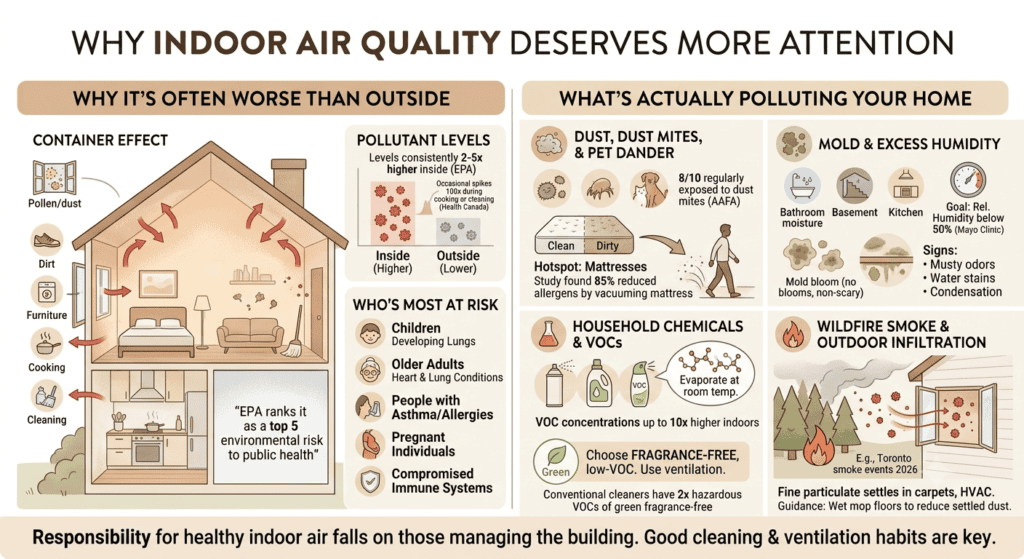
It sounds backwards. Outside, there’s traffic, industry, and in recent summers, wildfire smoke. Surely a house with a roof and walls is the safer bet. In reality, a house is more like a container. Once pollutants get inside-through open windows, on the bottoms of shoes, off-gassing from furniture, or generated by cooking and cleaning-they don’t have anywhere to go unless the home is well-ventilated or actively cleaned.
The U.S. EPA’s long-running research on household air found that levels of common organic pollutants are consistently two to five times higher inside homes than outside, regardless of whether the home sits in a quiet rural area or a busy city block. Health Canada echoes the same concern, noting that indoor contaminants can occasionally spike to 100 times outdoor levels during specific events, such as cooking without ventilation or using strong chemical cleaners in an unventilated bathroom.
Who’s Most at Risk
Poor indoor air affects everyone to some degree, but a few groups feel it faster and harder:
- Children, whose lungs are still developing
- Older adults, especially those with existing heart or lung conditions
- People with asthma or allergies
- Pregnant individuals
- Anyone with a compromised immune system
If you’ve ever noticed that your allergies feel worse at home than anywhere else, or that you wake up congested despite sleeping in your own bed, indoor air quality is a reasonable place to start looking for answers.
It’s also worth saying plainly that this isn’t a niche concern. The EPA’s Science Advisory Board has repeatedly ranked poor indoor air among the top five environmental risks to public health, right alongside outdoor pollution and contaminated drinking water. Unlike outdoor air, which is regulated under laws like the Clean Air Act, indoor air has no equivalent enforceable standard in either the United States or Canada. That means the responsibility for keeping it healthy largely falls on the people managing the building-which, for most of us, means the choices made in day-to-day cleaning and maintenance.
What’s Actually Polluting the Air Inside Your Home
Before getting into solutions, it helps to know what you’re actually up against. Indoor air pollution isn’t one single thing-it’s a mix of biological, chemical, and airborne particles that accumulate from everyday living.
Dust, Dust Mites, and Pet Dander
Household dust isn’t just dirt. It’s a mix of dead skin cells, fabric fibres, pollen, pet dander, and microscopic dust mites that feed on all of it. The Asthma and Allergy Foundation of America notes that roughly eight out of ten people in the United States are regularly exposed to dust mites, and six out of ten are exposed to cat or dog dander. These allergens don’t just float in the air-research shows there’s often more allergen sitting on furniture and floors than airborne at any given moment, and simply walking across a carpet or sitting on a couch can kick them back into the air you breathe.
Mattresses are a particular hotspot. A study published in the Journal of Asthma found that eight weeks of daily mattress vacuuming reduced total dust mite allergens by more than 85%, along with major reductions in bacterial and fungal contaminants. That’s a strong signal that where you sleep matters just as much as how often you dust the coffee table.
Mold and Excess Humidity
Mold needs three things to thrive: moisture, warmth, and a food source (which, unfortunately, includes drywall, wood, and even dust itself). Bathrooms, basements, and kitchens are classic trouble spots, especially in homes with poor ventilation or a humid microclimate. The Mayo Clinic recommends keeping indoor relative humidity at or below 50% specifically because hot, humid homes become breeding grounds for both mold and dust mites.
Mold doesn’t need to be visible to be a problem. Musty odours, water stains, or condensation on windows can all be early warning signs long before you see a colony forming on a wall.
Household Chemicals and VOCs
This is the one that catches most people off guard: the very products used to clean a home can pollute its air. Volatile organic compounds, or VOCs, are chemicals that evaporate at room temperature and drift into the air you breathe. They’re found in aerosol sprays, disinfectants, air fresheners, and many all-purpose cleaners. The EPA’s long-term research found VOC concentrations can run up to ten times higher indoors than outdoors, largely due to these everyday products.
It’s worth noting that green cleaning products and other eco-labelled options aren’t automatically free of these compounds. Peer-reviewed testing has found that even fragrance-free green products can emit hazardous compounds, just typically fewer and at lower concentrations than conventional cleaners loaded with synthetic fragrance. One widely cited comparison found conventional cleaners were tied to roughly twice as many hazardous VOCs on average as their fragrance-free green counterparts, but the gap narrowed considerably once fragrance was added back into the “green” formula. The safest approach is choosing fragrance-free, low-VOC formulas and using proper ventilation whenever cleaning chemicals are in use, rather than assuming a product is safe purely because of how it’s marketed.
Wildfire Smoke and Outdoor Infiltration
This is a newer and increasingly relevant issue for Ontario homeowners. The 2026 wildfire season has already brought multiple air quality events to the province, including a stretch in mid-July when smoke from fires in northwestern Ontario pushed Toronto’s Air Quality Health Index to 10+, the highest “very high risk” rating on the scale, with the city briefly registering some of the worst air quality readings in the world. Niagara Region households aren’t immune to this kind of smoke drift, and once fine particulate matter works its way indoors, it settles into carpets, upholstery, and HVAC systems, where it lingers well after the smoke outside has cleared.
Federal guidance issued during smoke events specifically recommends wet mopping floors and surfaces to reduce settled dust that could otherwise be kicked back into the air-another reminder that cleaning habits and air quality are directly connected, not separate concerns.
How Professional Cleaning Improves Indoor Air Quality
This is the core of it. Professional cleaning improves indoor air quality not through some secret formula, but through consistency, the right equipment, and techniques that go beyond what a quick surface wipe accomplishes. Here’s what separates a professional clean from a casual one.
HEPA-Filtered Vacuuming
Standard vacuums can actually make air quality worse in the short term by kicking fine dust back into the air through a weak filtration system. Professional cleaning teams typically use vacuums fitted with HEPA (High Efficiency Particulate Air) filters, which are built to capture at least 99.7% of particles as small as 0.3 microns-well below what a standard bag or filter can trap. A controlled study evaluating HEPA vacuuming on carpets found it reduced dust loading by over 55% and dust mite allergen loading by more than 80%, even without any additional steam cleaning.
Microfiber Dusting Instead of Dry Dusting
There’s a reason professional cleaners rarely use a dry rag or feather duster. Dry dusting tends to just relocate particles from one surface to another, or send them airborne temporarily before they resettle. Microfiber tools, particularly when lightly dampened, are designed to trap and hold particles rather than scatter them. This matters most on frequently missed surfaces: ceiling fan blades, window sills, baseboards, door frames, and the tops of picture frames, where dust quietly accumulates for months.
Targeted Mold and Mildew Removal
A professional clean doesn’t just spray and wipe visible mildew in the shower. It includes checking known moisture zones-under sinks, around window frames, behind appliances-for early signs of dampness before they turn into a larger mold problem. Addressing mold at the surface level, combined with recommendations around humidity control, tackles the issue at its source rather than just masking the smell.
Lower-VOC Cleaning Products
Because professional cleaners are in direct, repeated contact with cleaning chemicals, many companies have shifted toward lower-VOC, fragrance-reduced products, both for their own occupational health and for the air quality of the homes they clean. This is a meaningful trend across the industry: the low-VOC cleaning chemical market is projected to keep growing steadily through the next decade, driven largely by tightening health and environmental standards. Choosing a provider that’s thoughtful about product selection means a cleaner home without trading dust for chemical residue.
Deep Carpet and Upholstery Cleaning
Carpets and upholstered furniture act like sponges for dust, pet dander, and allergens, holding onto far more than hard flooring ever could. Research comparing cleaning methods found that HEPA vacuuming plus dry steam cleaning reduced carpet dust mite allergen loading by more than 85%, compared to roughly 81% with HEPA vacuuming alone. Both numbers are impressive, but the key takeaway is that regular, thorough attention to soft surfaces makes a measurable difference that a once-a-year vacuum simply can’t match.
Attention to Vents, Sills, and Overlooked Surfaces
Air vents, return grilles, and window tracks are some of the most overlooked dust collectors in a home, largely because they’re easy to ignore during a quick clean. Professional cleaning routines are built around checklists that specifically include these spots, since dust sitting directly in an airflow path gets redistributed through the entire house every time the heating and cooling system kicks on.
The Real-Life Benefits of Cleaner Indoor Air
Fewer Allergy and Asthma Triggers
The connection between cleaning and allergy relief isn’t just anecdotal. The American College of Allergy, Asthma and Immunology recommends professional deep cleaning of carpets specifically to cut down on pet dander and dust mites that trigger seasonal and year-round symptoms. For households managing asthma, reducing exposure to dust mites and mold is considered a core part of environmental control, alongside medication.
Better Sleep
Bedding and mattresses are where a lot of allergen exposure happens, simply because you spend six to nine hours a night in direct contact with them. A National Sleep Foundation poll found that 75% of people reported sleeping better on freshly laundered sheets. Combine that with regular mattress vacuuming and dust control, and the bedroom becomes a genuinely cleaner space to breathe in for a third of your day.
A Sharper, More Comfortable Home or Office
Poor indoor air quality has been linked to headaches, fatigue, and difficulty concentrating-symptoms that are easy to blame on stress or a bad night’s sleep when the real culprit might be sitting in the air itself. For business owners, this has a direct financial angle too. Recent building-health research estimates that poor indoor air costs tens of billions of dollars annually in lost productivity and increased sick time across commercial spaces. A consistently clean workplace isn’t just about appearances; it’s about people functioning at their best.
Professional Cleaning vs. DIY Cleaning: What Actually Changes
There’s nothing wrong with a weekly DIY tidy-up, and most households need one regardless of how often they book a professional visit. But there are real differences in outcome:
- Equipment: Professional-grade HEPA vacuums outperform most consumer models, especially older or budget units that lack sealed filtration.
- Technique: Professionals are trained to clean top-down, work in a consistent pattern, and hit the spots that get skipped in a rushed clean-vents, baseboards, light fixtures, behind furniture.
- Consistency: Allergens and dust rebuild quickly. A single deep clean helps, but the research on dust mite reduction is clear that repeated, scheduled cleaning is what keeps allergen levels down over time, not a one-off effort.
- Product knowledge: A professional service is more likely to know which products actually reduce VOC exposure rather than simply masking odours with fragrance.
- Time and thoroughness: DIY cleaning tends to prioritize visible surfaces. Professional cleaning is built around a checklist that includes the invisible stuff-the surfaces you don’t think about until someone points them out.
None of this means DIY cleaning is pointless. It’s the combination of both that keeps a home’s air quality consistently better, rather than swinging between deep-clean highs and dusty lows.
There’s also a time-and-energy factor that doesn’t get talked about enough. Genuinely thorough cleaning-the kind that actually moves the needle on air quality-takes hours per week when done properly: vacuuming slowly enough for a HEPA filter to do its job, wiping down every sill and vent, rotating cushions, and laundering bedding on a real schedule. Most households simply don’t have that time to spare consistently, which is exactly why allergen levels tend to creep back up between the occasional big cleaning pushes. Bringing in professional help on a set schedule removes that gap instead of hoping a busy week doesn’t turn into three.
Seasonal Air Quality Challenges for Niagara Region Homes
Humid Summers and Mold Risk
Southern Ontario summers bring the kind of heat and humidity that push indoor moisture levels up fast, especially in homes without strong air conditioning or dehumidification. That’s exactly the environment mold and dust mites prefer. Keeping humidity below 50%, paired with regular cleaning of bathrooms, basements, and kitchens, goes a long way toward keeping mold from getting a foothold.
Wildfire Smoke Season
As covered earlier, 2026 has already been an active wildfire year across Canada, with smoke events reaching well into southern Ontario and prompting Environment Canada air quality warnings in communities far from the fires themselves. Wildfire season in Canada typically runs from early April through October, meaning Niagara Region homeowners have a real window each year where outdoor smoke can work its way indoors. Keeping windows sealed during active air quality alerts, changing HVAC filters more frequently, and scheduling a deep clean after a smoke event to remove settled particulate matter are all practical, seasonally relevant steps.
Sealed-Up Winters
Winter flips the problem. Homes get sealed tight to hold in heat, which is great for your energy bill but not so great for air circulation. With windows closed for months, indoor pollutants-dust, pet dander, VOCs from indoor heating and holiday candles-have nowhere to go. This is often when households notice the most static, stuffiness, and dry-air irritation, making winter a smart time to lean on regular professional cleaning to compensate for reduced natural ventilation.
There’s also a practical overlap between these three seasons that’s easy to miss: whatever settles into carpets and upholstery during a humid summer or a smoky week in July doesn’t just disappear once the season changes. It sits there, gets stirred up every time someone walks across the room or a furnace vent kicks on, and carries straight through into the sealed-up months. A home that skips deep cleaning in summer often starts winter already behind, which is one more reason a seasonal rhythm-rather than a once-a-year push before the holidays-tends to work better for Niagara Region households.
Common Mistakes People Make When Trying to Improve Air Quality
- Relying only on air fresheners. Sprays and plug-ins mask odours with fragrance chemicals, which are themselves a VOC source. They don’t remove the underlying dust, mold, or pollutant.
- Skipping the vacuum bag or filter maintenance. A vacuum with a clogged or low-quality filter can push fine dust back into the air instead of trapping it.
- Dry dusting instead of using a damp microfiber cloth. This just relocates dust rather than capturing it.
- Ignoring humidity levels. Without a hygrometer or dehumidifier, it’s easy to have a home sitting well above the 50% humidity mark without realizing it.
- Forgetting HVAC filters. An air filter that hasn’t been changed in six months or more is no longer doing its job efficiently, no matter how clean the rest of the house looks.
- Assuming “natural” or “green” products are automatically VOC-free. As covered earlier, some green products still emit notable levels of fragrance-related VOCs.
- Treating cleaning as a one-time fix. Allergens and dust rebuild within days to weeks. Long-term air quality improvement depends on a consistent schedule, not a single deep clean before hosting guests.
How Often Should You Book Professional Cleaning for Air Quality
There’s no single answer that fits every household, but a few general guidelines help:
- Weekly to biweekly light cleaning for general dust, vacuuming, and surface maintenance, especially in homes with pets, children, or allergy sufferers.
- Every three to six months for deep cleaning, including carpets, upholstery, vents, and baseboards, matching what allergy specialists commonly recommend for carpet deep cleaning.
- After any wildfire smoke event or major renovation, a targeted clean helps clear settled particulate matter before it becomes part of the home’s regular dust cycle.
- Monthly HVAC filter checks, replacing as needed-typically every one to three months depending on filter type, household size, and whether pets are present.
Households managing asthma, severe allergies, or young infants often benefit from cleaning on the more frequent end of these ranges.
How to Choose a Cleaning Company That Actually Helps Your Air Quality
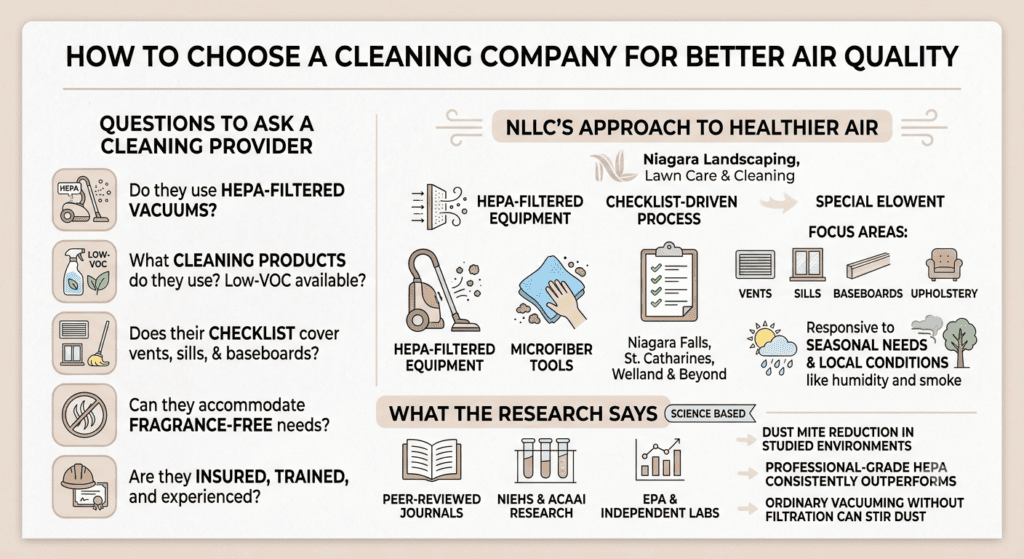
Not every cleaning service approaches indoor air quality the same way. When evaluating a provider, it’s worth asking:
- Do they use HEPA-filtered vacuums, or standard consumer-grade equipment?
- What cleaning products do they use, and are lower-VOC options available on request?
- Do their checklists include vents, sills, and baseboards, or only visible surfaces?
- Can they accommodate specific needs, like fragrance-free products for allergy-sensitive households?
- Are they insured, trained, and experienced with both residential and commercial spaces?
A company that can answer these clearly and confidently is generally one that treats air quality as part of the job, not an afterthought.
NLLC’s Approach to Healthier Air in Niagara Falls, St. Catharines, Welland, and Beyond
At NLLC (Niagara Landscaping, Lawn Care & Cleaning), residential and commercial cleaning is built around more than just appearances. Our teams use HEPA-filtered equipment, microfiber tools, and a checklist-driven process that covers the surfaces most homes miss-vents, sills, baseboards, and upholstery-alongside the everyday visible spaces. Whether it’s a family home in St. Catharines dealing with seasonal allergies, an Airbnb in Niagara-on-the-Lake that needs to feel genuinely fresh for every guest, or a commercial space in Welland aiming to keep staff comfortable and productive, our approach adjusts to the specific air quality concerns of each property.
We also factor in what’s happening locally and seasonally, whether that’s Niagara Region humidity in July or a wildfire smoke advisory drifting in from the north. Cleaning isn’t just scheduled by the calendar; it’s responsive to what a home or business actually needs.
What the Research Actually Says
It’s easy for cleaning companies to make broad claims about health benefits, so it’s worth being specific about where the numbers in this article actually come from. The dust mite allergen reductions cited earlier trace back to controlled studies published in peer-reviewed journals like the Journal of Asthma, along with research summarized by the National Institute of Environmental Health Sciences and the American College of Allergy, Asthma and Immunology. The VOC findings come from EPA research and independent laboratory testing comparing conventional and eco-labelled cleaners head-to-head. None of this is marketing language dressed up as science-it’s the underlying data that shaped the recommendations throughout this guide.
That distinction matters because not every cleaning claim holds up under scrutiny. For example, ordinary vacuuming with a weak or clogged filter can genuinely make short-term air quality worse by stirring dust into the air rather than removing it-which is exactly why the type of equipment used matters as much as the frequency of cleaning itself. A homeowner doing everything “right” with the wrong tools can still end up with disappointing results, which is part of why professional-grade HEPA equipment consistently outperforms consumer models in these studies.
Final Thoughts
Cleaner air isn’t something you can eyeball. A home can look spotless and still be circulating dust mites, mold spores, and VOC residue that quietly affect how you sleep, breathe, and feel day to day. The good news is that the fix isn’t complicated: consistent, well-equipped cleaning, done with the right products and the right attention to detail, measurably improves what you’re breathing in your own home.
If you’re in Niagara Falls, St. Catharines, Welland, Fort Erie, Niagara-on-the-Lake, Thorold, Port Colborne, or anywhere across the Niagara Region, NLLC’s residential and commercial cleaning teams are ready to help you breathe easier. Request your free quote today and find out what a genuinely thorough clean can do for your home’s air quality.
Frequently Asked Questions
1. Can professional cleaning really improve indoor air quality, or is that just marketing? It’s backed by measurable research. Studies on HEPA vacuuming and dry steam cleaning show dust and allergen loading in carpets can drop by 55% to over 85% with consistent, proper cleaning. The effect is real, though it depends on technique and consistency, not a single visit.
2. How often should I get my home professionally cleaned for allergy relief? Most allergy specialists suggest a deep clean of carpets and upholstery every three to six months, paired with lighter cleaning weekly or biweekly, especially in households with pets or dust mite sensitivities.
3. Do air purifiers replace the need for cleaning? No. Air purifiers with HEPA or carbon filters help capture airborne particles and some VOCs, but they don’t remove allergens already settled into carpets, bedding, or upholstery. Cleaning and purification work best together.
4. Are “natural” cleaning products always safer for indoor air quality? Not automatically. Peer-reviewed testing has found that some green-labelled products still emit meaningful levels of fragrance-related VOCs. Fragrance-free, low-VOC products tend to be the safer bet regardless of “green” branding.
5. Does wildfire smoke really affect indoor air even if I keep windows closed? Yes. Smoke particles can infiltrate through small gaps, ventilation systems, and normal door use. Once inside, fine particulate matter settles into carpets and furniture, which is why a clean after a smoke event helps clear residual particles.
6. What’s the single biggest thing a cleaning service does differently than a DIY clean? Consistency and equipment. HEPA filtration traps particles a standard vacuum recirculates, and a scheduled routine prevents the allergen rebound that happens between occasional deep cleans.
7. Can cleaning help with mold, or does that need a specialist? Regular cleaning helps prevent mold from taking hold by removing dust (a food source) and catching early moisture signs. Established mold colonies, especially anything beyond a small surface patch, may require specialized remediation beyond standard cleaning.
8. Is professional cleaning worth it for a small apartment or condo? Indoor air quality issues aren’t limited to large homes. Smaller, tightly sealed spaces can actually concentrate pollutants faster due to lower air volume, making regular cleaning just as relevant.