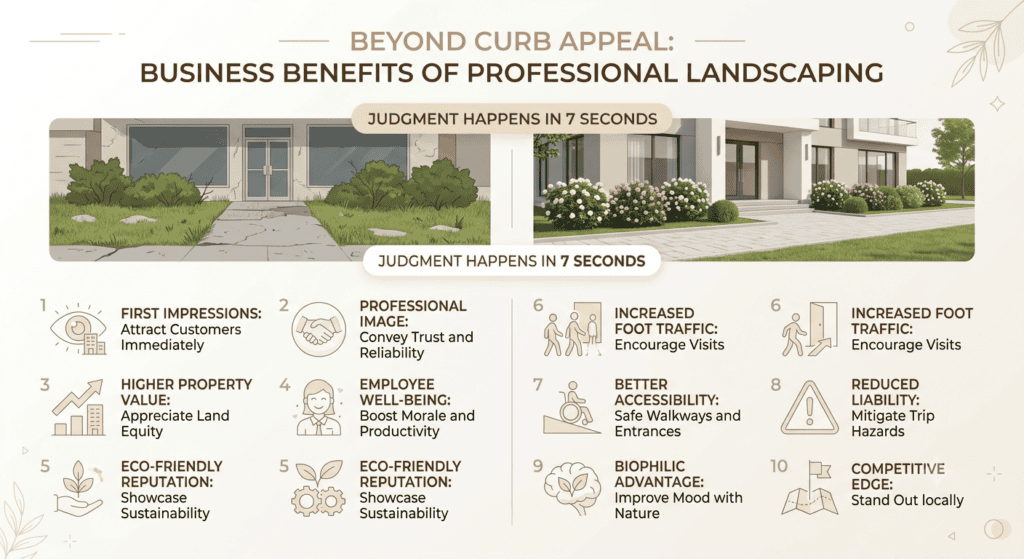
If you drove past two businesses today – one with a patchy lawn, cracked walkways, and overgrown shrubs, and another with a trimmed hedge, clean beds, and a lawn that actually looks cared for – which one would you trust with your money?
Most people don’t even realize they’re making that judgment. It happens in about seven seconds, the same amount of time it takes to form a first impression of a person you’ve just met. Your building could have the best product, the friendliest staff, and the most competitive prices in Niagara, and none of it matters if a customer decides you’re “not that kind of business” before they’ve even opened the door.
That’s the part most business owners miss about landscaping. It isn’t a nice-to-have that gets budgeted after everything else. It’s one of the few investments that touches almost every part of a business at once – how customers perceive you, how your team feels coming to work, how much your property is worth, and how exposed you are to liability every winter. Property owners across St. Catharines, Niagara Falls, Welland, and the wider Niagara Region are starting to treat their grounds the same way they treat their signage or their storefront: as a working part of the business, not decoration around it.
Why First Impressions Are Doing More Work Than You Think
Before a customer reads a single review or speaks to an employee, they’ve already looked at your parking lot, your entrance, and your lawn. Landscaping is the visual handshake of a business. It tells people, without a word being spoken, whether you pay attention to detail and whether you take pride in what you do.
This is exactly why professional landscaping for businesses has become a genuine growth strategy rather than a maintenance afterthought. It shapes perception before a sale ever happens, and it keeps shaping perception every single day a property sits in public view. A single unmowed lawn or dead flower bed can undo months of marketing spend in the time it takes someone to walk from their car to your door.
Let’s get into the ten benefits – and the numbers behind them.
1. Creates a Powerful First Impression That Builds Trust Instantly
Exterior appearance is one of the fastest, most reliable ways customers judge whether a business is trustworthy. A clean lawn, healthy plants, and a clear, well-edged walkway signal professionalism before a customer even reaches your door. Overgrown grass, weedy beds, or cracked and heaving pavement signals the opposite – even if what’s happening inside the building is excellent.
Think about the last time you visited a medical clinic, law office, or restaurant with a neglected exterior. Did it change how much you trusted the business, even slightly? Most people answer yes, and that instinct is backed by real research. Studies on green office environments have found that employees working around plants and greenery report noticeably better perceptions of air quality and overall environment – and customers form similar snap judgments about businesses. When your business curb appeal looks intentional, it tells visitors the same standard of care extends to everything else you do.
This is the foundation everything else on this list builds on. Landscaping is not the finishing touch on a business – it’s the introduction.
2. Attracts More Customers and Increases Foot Traffic
A property that looks appealing from the street doesn’t just create a good impression – it actively pulls people in. Well-maintained landscaping draws the eye, invites people to slow down, and makes a building feel like somewhere worth stopping.
For businesses that depend on walk-in traffic – retail plazas, restaurants, medical offices, salons – this matters directly to revenue. A tidy, colourful entrance with seasonal plantings gives people a reason to notice your business among several competitors on the same block. It also encourages visitors to linger longer once they’ve arrived, whether that means sitting on a landscaped patio, browsing longer near an attractive storefront, or simply feeling comfortable enough to come back. Commercial property research consistently shows that professionally maintained landscapes lease and sell faster than neglected ones, precisely because visibility and appeal drive interest before a single conversation happens.
If your business relies on people choosing you over the property next door, your landscaping is doing marketing work whether you’ve budgeted for it or not.
Consider a real-world example that plays out constantly in a tourism-driven region like Niagara: two similarly priced bed-and-breakfasts or restaurants sitting a few blocks apart. One has a trimmed hedge, a seasonal flower display near the entrance, and a lawn that’s clearly cared for. The other has patchy grass and an entrance that looks like an afterthought. Visitors comparing options online or walking past both storefronts will, more often than not, choose the one that looks cared for – not because the food or rooms are actually different, but because the exterior became a stand-in for quality before anyone had the chance to prove it in person. In a market where tourists and locals alike have dozens of comparable options within walking distance, that visual edge is a genuine competitive advantage, not a minor detail.
3. Boosts Employee Productivity, Morale, and Retention
Landscaping isn’t only for customers. The people who work at your business every day are affected by their surroundings just as much – arguably more, since they’re there for eight hours at a stretch, five days a week.
The Science Behind Green Spaces and Focus
Research from the University of Exeter found that employees working in offices with visible greenery reported roughly 15% higher productivity than those in plant-free “lean” spaces, along with better concentration, higher workplace satisfaction, and improved perceived air quality. Separate research on biophilic design in commercial environments has linked access to greenery with reduced stress, improved mood, and stronger engagement at work. Even something as simple as a landscaped courtyard, a view of trees from a break room window, or a walkable green space at lunch can measurably shift how employees feel about their day.
For businesses competing to attract and keep good staff – especially in a tight labour market – a pleasant, green, well-maintained property is a quiet but real advantage. It costs far less than a raise and delivers a daily, cumulative effect on morale that shows up in retention numbers over time.
4. Increases Property Value and Rental Income
This is the benefit that gets the most attention from property owners and investors, and for good reason – the numbers are substantial.
What the Research Actually Shows
Multiple industry studies point in the same direction: professionally landscaped commercial properties consistently command higher valuations and higher lease rates than comparable properties with basic or neglected grounds. Research cited by commercial property analysts puts the value uplift from quality landscaping in the range of roughly 5% to 15%, with mature trees and well-designed plantings pushing that figure even higher in some markets. Properties with strong landscaping have also been shown to lease measurably faster and maintain higher occupancy rates than properties with minimal outdoor investment, because tenants – like customers – factor exterior condition into their decision before they ever ask about square footage.
For a property in the Niagara Region, where commercial real estate competes not just locally but against nearby markets like Hamilton and the Greater Toronto Area, that difference matters. A property that shows well outperforms one that doesn’t, whether the goal is attracting tenants, preparing for a sale, or simply protecting the asset’s long-term worth. This is one of the clearest cases where commercial property landscaping functions less like an expense and more like an investment with a measurable, trackable return.
To put the scale of that return in perspective: industry analysis of larger commercial portfolios has found that properties with quality landscaping can command 5% to 10% higher lease rates than comparable properties nearby, and one documented case saw an office complex’s occupancy climb from 76% to 94% within 24 months of a landscape improvement program – nothing else about the building changed except how the grounds were maintained. Surveys of commercial tenants back this up directly: roughly 71% report that curb appeal factors into their leasing decision before they ever step inside. For a property owner, that means landscaping isn’t competing with other capital improvements for budget priority – it’s often one of the fastest, lowest-cost ways to move the needle on occupancy and rent.
It’s also worth framing what neglect actually costs. Property managers who let grounds maintenance slide don’t just lose the upside described above – they take on new expenses instead. Emergency drainage repairs after a neglected property finally floods a parking lot or foundation commonly run from $25,000 to $50,000. Tenant turnover driven by a property that looks tired or poorly kept can cost another $15,000 to $40,000 per vacant space in lost rent and re-leasing expenses. Looked at that way, a consistent, professionally managed landscaping budget isn’t really optional – it’s cheaper than the alternative.
5. Strengthens Your Brand Image Every Single Day
Every business communicates something about itself through its physical space, whether intentionally or not. A landscape that’s trimmed, weeded, and cared for tells customers your standards are high across the board. A landscape that’s ignored tells them the opposite, and that impression tends to generalize – people assume that if you don’t maintain what’s visible, you might not maintain what’s not.
This is especially important for businesses where trust is central to the sale: medical and dental offices, financial services, property management companies, and hospitality. Landscape maintenance for businesses in these categories isn’t cosmetic – it’s part of how credibility gets built before a client ever sits down with staff. Consistent seasonal care, rather than a one-time cleanup before a big event, is what actually earns that reputation over time. Customers notice consistency more than they notice a single grand gesture.
6. Improves Safety and Reduces Legal Liability
This benefit gets overlooked constantly, and it’s arguably the most financially significant one on this list – particularly for businesses operating in a climate like Niagara’s.
Overgrown shrubs blocking sightlines at a parking lot exit, tree roots heaving a walkway, or poor drainage pooling water near an entrance are all safety hazards that can lead directly to injury claims. And in winter, the stakes go up considerably.
What Ontario’s Occupiers’ Liability Act Means for Your Business
Under Ontario’s Occupiers’ Liability Act, business owners, landlords, and property managers have a legal duty to take reasonable steps to keep their property safe for anyone who enters it – including customers, delivery drivers, and employees. Since amendments to the Act took effect, anyone injured by snow or ice on private property must give written notice within 60 days, but that notice requirement doesn’t reduce a business’s underlying responsibility to maintain safe conditions in the first place. Slip-and-fall claims tied to snow and ice in Ontario have resulted in settlements and judgments ranging from the tens of thousands of dollars into the hundreds of thousands, depending on the severity of the injury, and courts routinely look at whether the property owner had a documented, consistent system for inspection and maintenance.
This is where professional grounds care becomes a genuine risk-management tool rather than a curb-appeal choice. Scheduled snow and ice management, clear pathways, trimmed sightlines near entrances and exits, and proper drainage all reduce the odds of an incident – and just as importantly, they create a documented service record that matters if a claim is ever filed. Reactive, “mow and go” arrangements without consistent documentation leave businesses far more exposed than a structured maintenance program with dependable service logs.
7. Supports Environmental Sustainability and Cuts Costs
Sustainable landscaping has moved from a niche preference to a mainstream expectation, and it also happens to save money.
Mature trees improve air quality and provide natural cooling that can meaningfully reduce energy costs for nearby buildings during summer months. Native and drought-tolerant plant selections need far less supplemental watering once established – landscaping research on xeriscaping principles shows water use reductions in the range of 30% to 50% or more for properties that shift toward native plantings, efficient irrigation, and reduced turf areas. Since outdoor irrigation makes up a substantial share of total water use at many commercial properties, that adds up to a real, ongoing utility savings, not just an environmental talking point.
Businesses that visibly invest in sustainable grounds care also send a message to increasingly eco-conscious customers and employees: this is a company that thinks about its long-term footprint, not just its short-term appearance.
Beyond water savings, sustainable landscaping choices tend to compound over time. Native plantings generally need less fertilizer and fewer pesticide applications once established, since they’re already adapted to local soil and rainfall patterns. That means lower chemical costs, less runoff into storm drains, and less ongoing labour spent managing plants that were never suited to the local climate in the first place. Reduced turf areas also mean less fuel spent on mowing equipment, which adds up across a full season of maintenance visits. None of these changes need to happen all at once – many businesses phase sustainable upgrades in gradually, replacing high-maintenance turf or plantings with lower-water alternatives as beds are refreshed each year.
8. Saves Time and Reduces Long-Term Maintenance Costs
It’s tempting to think of professional grounds care as an added cost rather than a way to avoid one, but the opposite is usually true. Preventative landscape maintenance catches small problems – a failing irrigation line, early-stage drainage issues, a tree root beginning to affect a foundation or walkway – before they become expensive repairs.
A trained crew notices things an untrained eye misses: early signs of plant disease, soil compaction, or irrigation inefficiency that, left unaddressed, can turn a small fix into a five-figure repair. Property maintenance services that include regular seasonal inspection essentially function as an early-warning system for your property, the same way regular equipment servicing prevents a bigger mechanical failure down the line.
There’s also the simple math of internal cost. Every hour an employee or owner spends mowing, trimming, or worrying about the state of the grounds is an hour not spent on the actual business. Outsourcing that work to a dedicated landscaping company frees that time back up, and it’s almost always more cost-effective than pulling staff away from revenue-generating work to handle outdoor maintenance inconsistently.
9. Keeps Your Property Beautiful Through Every Niagara Season
One of the biggest advantages of working with a professional provider rather than handling grounds care piecemeal is year-round consistency. Niagara’s climate swings from humid summers to genuinely harsh winters, and a property that looks sharp in June but falls apart by November isn’t getting the full benefit of its landscaping investment.
A properly structured seasonal program typically includes:
- Lawn mowing and edging on a consistent weekly or bi-weekly schedule through the growing season
- Shrub and hedge trimming to maintain sightlines, shape, and a tidy appearance
- Mulching to retain soil moisture, suppress weeds, and finish flower beds
- Weed control to keep beds, walkways, and turf looking clean
- Spring cleanup to clear winter debris and prepare beds for the new season
- Fall cleanup including leaf removal and bed preparation ahead of winter
- Snow and ice management, including salting and clearing to meet safety obligations
- Seasonal flower installation for color that changes with the calendar
- Irrigation system maintenance, including spring start-up and fall shutdown
Commercial lawn care is really only one piece of this picture – the properties that stand out are the ones treating landscaping as a twelve-month program, not a spring and summer task that gets forgotten once the leaves fall.
10. Gives Your Business a Competitive Advantage
In a region with as much retail, hospitality, and service competition as Niagara, differentiation matters. When two businesses offer similar products or services at similar prices, the one with the more inviting, better-maintained property often wins simply because it feels like the safer, more trustworthy choice.
A polished, well-cared-for exterior creates a subtle but real edge – it signals stability and attention to detail in a way that’s hard to fake and easy for customers to notice, even subconsciously. Businesses that invest consistently in their grounds tend to be remembered more favorably, which matters enormously for repeat customers, word-of-mouth referrals, and online reviews that increasingly mention “the place looked really well kept” as a reason for a five-star rating.
The True Cost of Handling Landscaping In-House or Ignoring It
Many small and mid-sized businesses start out handling their own grounds care – an employee mows the lawn on a slow afternoon, or the owner squeezes in trimming on a weekend. It feels like a cost saver at first, but the math rarely holds up once you account for everything that gets missed.
Untrained maintenance tends to be reactive rather than preventative. Irrigation leaks go unnoticed until a water bill spikes. Drainage issues aren’t caught until a section of parking lot starts pooling water every time it rains. Tree limbs aren’t checked for storm damage until one comes down on a walkway. None of these are dramatic on their own, but each one turns a small, cheap fix into an expensive emergency simply because nobody was looking for it early.
There’s also an opportunity cost that’s easy to overlook. Every hour spent by an owner or employee on mowing, trimming, or winter shoveling is an hour not spent serving customers, managing operations, or growing the business. For most companies, the hourly value of that time is worth more than the cost of outsourcing the work to a dedicated crew that can do it faster, more consistently, and with the right equipment for the job.
And then there’s the liability angle covered earlier. DIY winter maintenance in particular carries real risk – without a documented schedule, a business has far less to point to if a slip-and-fall claim is ever filed. A missed morning of salting after an overnight freeze can turn into a five- or six-figure claim in a way that a properly logged, professional service visit is specifically designed to prevent.
Common Mistakes Businesses Make With Commercial Landscaping
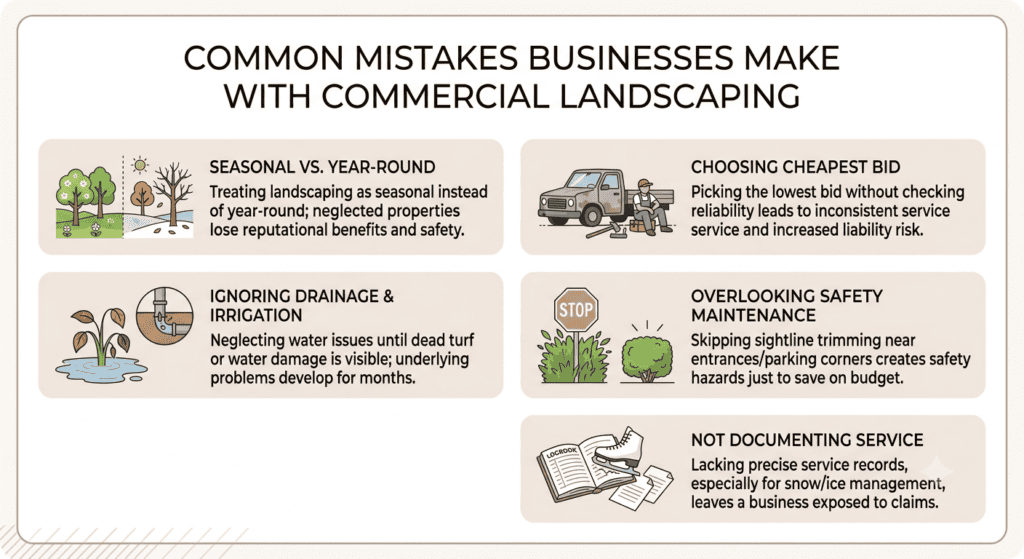
Even businesses that understand the value of landscaping often undercut their own investment with a few recurring mistakes:
Treating it as seasonal instead of year-round. A beautiful spring and summer property that gets neglected in fall and winter loses most of the reputational and safety benefits it built up.
Choosing the cheapest bid without checking reliability. An inconsistent crew that shows up late or skips visits during busy seasons – especially snow season – creates more liability risk than it saves in cost.
Ignoring drainage and irrigation until there’s a visible problem. By the time water damage or dead turf is obvious, the underlying issue has usually been developing for months.
Overlooking safety-focused maintenance. Sightline trimming near entrances, exits, and parking lot corners is as much about safety as it is about appearance, and it’s often the first thing skipped when budgets get tight.
Not documenting service. Especially for snow and ice management, a lack of service records can leave a business far more exposed if an incident ever leads to a claim.
How to Choose the Right Commercial Landscaping Partner
Not every provider offers the same level of reliability, and for a business, reliability matters more than almost anything else. When evaluating commercial landscaping services, look for:
- A track record with commercial and business properties specifically, not just residential lawns
- Documented, scheduled service – especially for winter snow and ice management
- The ability to handle the full seasonal calendar, from spring cleanup through fall leaf removal
- Clear communication and a single point of contact for scheduling and issues
- Familiarity with local Niagara Region conditions, soil, and climate patterns
- Transparent pricing and contracts that spell out exactly what’s included
A provider that checks these boxes turns landscaping from a recurring hassle into a dependable part of how your property runs.
Why Niagara Businesses Choose NLLC for Commercial Landscaping and Grounds Maintenance
At NLLC, we work with business owners and property managers across Niagara Falls, St. Catharines, Welland, Fort Erie, Niagara-on-the-Lake, Thorold, Port Colborne, and the wider Niagara Region who want their properties handled by a team that treats commercial grounds maintenance as a year-round responsibility, not a seasonal chore.
Our commercial services include:
- Reliable, scheduled commercial lawn maintenance
- Seasonal spring and fall cleanups
- Snow and ice removal with consistent, documented service
- Property maintenance built around your business’s specific needs
- Customized maintenance plans rather than one-size-fits-all packages
- An experienced local team that understands Niagara’s climate and growing conditions
Whether you manage a retail plaza, a medical office, an industrial property, or office landscaping for a corporate campus, our goal is the same: a property that looks sharp, stays safe, and never becomes a liability you have to think about.
Conclusion
Commercial landscaping isn’t an expense you absorb – it’s an investment that pays back through customer perception, employee wellbeing, property value, and reduced legal exposure, often all at once. A professionally maintained property enhances curb appeal, improves how customers and clients perceive your business, supports the people who work there every day, protects the value of your real estate, and helps you build a lasting impression that competitors with a neglected property simply can’t match.
Partnering with a trusted, experienced landscaping team ensures your property remains attractive, functional, and safe throughout every season – not just the ones when the weather cooperates. If your business’s exterior isn’t working as hard for you as the rest of your operation, it’s worth a conversation.
Frequently Asked Questions
Why is professional landscaping important for businesses?
It shapes first impressions, supports employee wellbeing, protects property value, and reduces safety and liability risk – all things that affect a business’s bottom line directly, not just its appearance.
How does commercial landscaping attract more customers?
An attractive, well-maintained property draws attention, signals trustworthiness, and encourages people to stop, stay longer, and return – all of which support foot traffic and sales.
Does landscaping increase commercial property value?
Yes. Industry research consistently shows landscaped commercial properties command higher valuations, higher lease rates, and faster leasing compared to properties with neglected grounds.
What services are included in commercial landscaping?
A full program typically includes lawn mowing, shrub trimming, mulching, weed control, seasonal cleanups, seasonal flower installation, irrigation maintenance, and snow and ice removal in winter.
How often should a business schedule landscape maintenance?
Most commercial properties benefit from weekly or bi-weekly service during the growing season, plus dedicated spring and fall cleanups and ongoing winter snow and ice management.
Is professional landscaping worth the investment for small businesses?
Yes. Even a modest, consistently maintained property can meaningfully improve customer perception and reduce liability risk, often at a lower cost than most businesses expect.
What happens if a customer is injured on my property due to snow or ice?
Under Ontario’s Occupiers’ Liability Act, property owners and occupiers have a legal duty to keep their property reasonably safe. A documented, professional snow and ice management program is one of the strongest ways to reduce that risk and demonstrate reasonable care if a claim is ever filed.
Can landscaping really improve employee morale?
Research on green office environments has linked visible greenery and outdoor access to higher reported productivity, better concentration, and improved workplace satisfaction, making landscaping a low-cost way to support staff wellbeing.