Walk into any office, retail store, or medical clinic in 2026, and you can usually tell within about ten seconds whether the place takes office cleaning and overall cleanliness seriously. Maybe it’s the smell in the air, or the streak-free glass at the entrance, or the fact that the restroom actually has soap in the dispenser. Whatever it is, people notice, and they remember.
That’s not a small thing anymore. Cleaning used to be treated as an afterthought, something you budgeted for once a year and forgot about the rest of the time. That mindset is gone. Business owners, facility managers, and property owners across Ontario are now asking sharper questions: Is this product actually safe? Is our air quality hurting productivity? Can our cleaning company keep up with a business that never stops changing?
This guide breaks down the cleaning trends shaping 2026, backed by current industry research, and shows you exactly how to apply them, whether you run a small retail shop in St. Catharines or manage a multi-unit commercial property in Niagara Falls.
Why This Shift Matters More Than Ever for Businesses in 2026
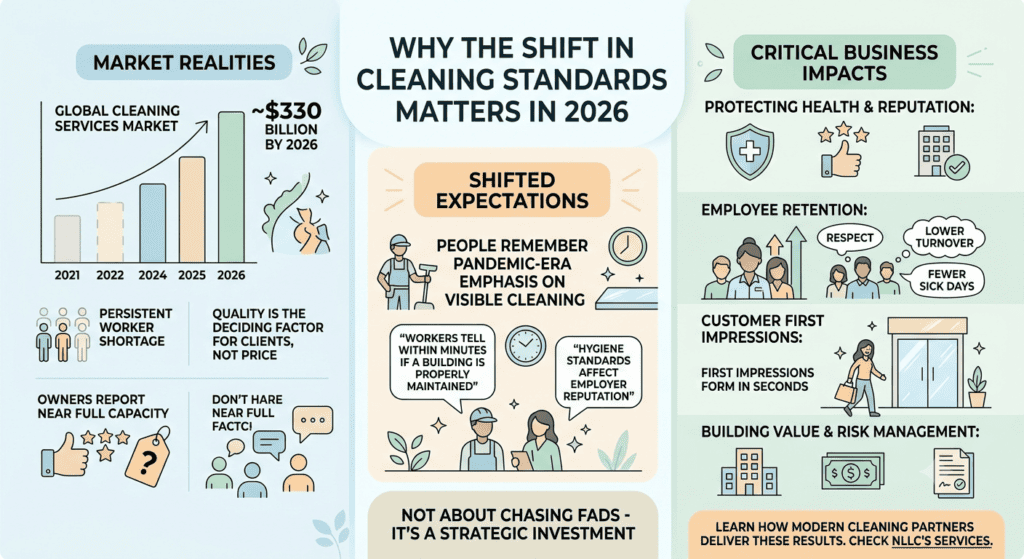
The numbers tell the story better than opinions can. The global cleaning services market is on track to reach roughly $330 billion by the end of 2026, and demand keeps climbing even as the industry deals with a persistent worker shortage. More than half of cleaning business owners report they’re near full capacity, and quality has become the deciding factor for clients, not just price.
At the same time, expectations from employees, customers, and tenants have shifted permanently. People remember the pandemic-era emphasis on visible cleaning, and even though the headlines have moved on, the habits stuck. Workers now say they can tell within minutes whether a building is properly maintained, and a large share say they’d think less of an employer who let hygiene standards slip.
For a business, that means cleanliness now touches almost everything: how long employees stay, how customers feel walking through the door, how well a building holds its value, and even how insurance and liability risk gets managed. Staying current with cleaning trends isn’t about chasing fads. It’s about protecting the health of your people, the reputation of your brand, and the return on your property.
There’s also a competitive angle that a lot of business owners underestimate. In a tight labor market, employees have options, and workplace conditions factor into whether they stay. Survey after survey shows that visible investment in comfort and safety, things like fresh air, tidy shared spaces, and well-stocked restrooms, makes staff feel more respected. That translates into lower turnover, fewer sick days, and a workplace people actually want to show up to. On the customer side, first impressions still form in seconds, and a spotless entrance or a streak-free storefront window can be the difference between a shopper walking in or walking past. None of this requires a massive budget. It requires knowing which changes actually move the needle, which is exactly what the trends below are meant to show.
If you want a full breakdown of what a modern cleaning partner should offer, NLLC’s services page is a good place to see how these trends translate into real, bookable services.
1. Sustainability Goes Mainstream: Eco-Conscious Cleaning Is the New Standard
For years, “eco-friendly” was a marketing word attached to a handful of premium cleaning brands. In 2026, it’s closer to a baseline expectation. Industry data shows that more than half of the cleaning market has already shifted toward sustainable products, and the trend keeps accelerating as businesses face pressure from clients, insurers, and employees who care about environmental impact.
Part of the shift is practical. Harsh chemical cleaners contribute to poor indoor air quality, and businesses are realizing that swapping to gentler, plant-based formulas doesn’t mean sacrificing results. Modern eco-friendly cleaning products use renewable surfactants, neutral pH levels, and biodegradable ingredients, and they perform just as well on stainless steel, tile, and sealed wood as older chemical-heavy options.
Part of the shift is also about pressure from outside the building. Clients, tenants, and investors are increasingly asking commercial operators to document their environmental commitments, and cleaning is one of the easiest, most visible places to show that follow-through. A business that can point to a documented, certified sustainability program has a genuine talking point in a bid, a lease renewal, or an ESG report, something that was almost never true a decade ago.
What Green Certifications Actually Mean
Here’s the catch: the word “eco-friendly” has no legal definition in Canada, so almost anything can carry that label whether it’s earned or not. That’s where certifications come in. Look for third-party verified labels like EcoLogo and Green Seal, which test products against strict standards for biodegradability, restricted ingredients, and packaging.
A legitimate eco-conscious program goes beyond the products themselves. It should also include microfiber systems that trap dust without excess chemical use, high-filtration vacuums that capture fine particulates, and documented procedures your provider can actually show you, not just claim.
Water-Saving and Waste-Cutting Practices
Sustainability isn’t only about what’s in the bottle. More companies are adopting sustainable cleaning practices like dry steam cleaning and other low-moisture methods to cut water waste, along with recycled and compostable packaging to reduce landfill contribution. For property managers pursuing LEED certification, a documented green cleaning program can directly contribute points under the Indoor Environmental Quality category, which is a detail that matters a lot more to commercial landlords than it used to.
2. Smart Technology Is Changing the Way Buildings Get Cleaned
Cleaning has traditionally run on fixed schedules: someone shows up Tuesday and Friday whether the building needs it or not. That’s starting to change. Research shows that a growing share of commercial cleaning companies are investing in IoT-enabled tools that adjust service frequency based on actual usage, not guesswork.
Sensors and Data-Driven Cleaning Schedules
Smart sensors can now track foot traffic, restroom usage, and supply levels in real time, feeding that data into scheduling software. Instead of cleaning every space on the same rigid rotation, a facility can direct attention to high-traffic zones more often and lighter-use areas less frequently. Industry forecasts suggest that a large majority of major contract cleaning firms will rely on digital platforms for quality audits and staff accountability going forward, which means clients get proof of work, not just a promise.
Robotic Cleaners Join the Team
Robotic floor scrubbers and vacuums have moved from novelty to normal in larger facilities. They’re not replacing cleaning staff. They’re taking over the repetitive, time-consuming tasks so human crews can focus on detail work, disinfection, and the judgment calls a machine can’t make. For a business owner, the takeaway is simple: a cleaning company that invests in smart cleaning technology is usually one that’s also investing in consistency and accountability, which is exactly what you want from a long-term partner.
This shift also changes what a service report looks like. Instead of taking a cleaning company’s word for it, clients are starting to receive digital logs showing exactly when a space was serviced, what was done, and how it compares against a checklist. For a smaller business, this might just mean a simple photo update after each visit. For a larger commercial property, it might mean a dashboard tracking every zone in the building. Either way, the direction is the same: less guesswork, more proof, and a lot less room for a provider to cut corners without anyone noticing.
3. The Air Inside Your Building Becomes a Bottom-Line Issue
If there’s one trend that’s moved from “nice to have” to “board-level concern” in 2026, it’s air quality. The Environmental Protection Agency has estimated that poor air quality inside commercial buildings costs businesses tens of billions of dollars a year in lost productivity and medical costs, and newer research is putting harder numbers behind that claim.
The Real Cost of Bad Air
Studies out of Harvard’s T.H. Chan School of Public Health found that employees working in well-ventilated, low-pollutant “green” office environments scored significantly higher on cognitive function tests than those in standard buildings. Separate 2026 survey data found that 57 percent of workers say temperature and airflow are the conditions that most affect their productivity, and 61 percent said they’d choose fresher air over flashier office amenities if they had to pick one. Elevated carbon dioxide and fine particulate levels have both been linked to slower reaction times and reduced focus, which adds up fast across a full workday.
Filtration, Monitoring, and Ventilation Upgrades
Businesses are responding by installing HEPA filtration, UV-C air treatment, and continuous air-quality monitoring that tracks CO2, VOCs, and particulate matter around the clock. This isn’t just for hospitals and labs anymore; offices, schools, and retail spaces are adding it too. A professional cleaning company plays a direct role here, since dust control, proper vacuuming with HEPA filters, and low-VOC product selection all feed straight into cleaner air. If your current provider doesn’t ask about ventilation or filtration at all, that’s worth a second look.
4. Hygiene Standards That Are Here to Stay
The heightened hygiene awareness that started years ago never really went away. It just became permanent. Employees, customers, and visitors now expect a consistent baseline of workplace hygiene, and they notice quickly when it slips. What used to be considered “extra” attention to disinfection, wiping down shared surfaces multiple times a day, stocking restrooms generously, and keeping sanitizer stations filled, is now simply the expected floor, not a bonus service worth bragging about.
This shows up in how commercial contracts are written, too. Where a service agreement might once have listed “general disinfection” as a single line item, more contracts in 2026 spell out exactly which surfaces get attention, how often, and with what products. That level of specificity protects both sides: the client knows what they’re paying for, and the cleaning provider has a clear standard to be measured against.
High-Touch Surfaces Get Constant Attention
Door handles, elevator buttons, light switches, and shared equipment now get cleaned far more often than they did before, and businesses are less forgiving of lapses. Smudged glass or a grimy counter can make an otherwise well-run business feel neglected in an instant, which is why many commercial contracts now specify high-touch disinfection multiple times per shift rather than once a day.
Touchless Fixtures and Antimicrobial Surfaces
Touchless faucets, soap dispensers, and hand dryers keep expanding beyond airports and hospitals into everyday offices and retail spaces. Self-disinfecting coatings and copper or silver-infused antimicrobial materials are also gaining ground on high-contact surfaces. The global market for antimicrobial coatings has been projected to more than double from where it stood a few years ago, which gives you a sense of how seriously facilities are taking this shift.
5. Subscription-Style Cleaning Contracts Are Replacing One-Off Jobs
One-time deep cleans still have their place, but 2026 has seen a clear move toward recurring, subscription-based service agreements. Businesses want predictable costs and consistent results, not a new quote and a new crew every time they book. For a cleaning contractor, this shift rewards reliability over one-off pricing wars, and for a business owner, it means fewer scheduling headaches and a provider who actually learns your space over time.
If you’re weighing whether a recurring plan makes sense for your office, retail location, or rental property, it usually comes down to volume and consistency. Daily or weekly foot traffic almost always justifies a standing contract over ad hoc bookings.
Recurring agreements also tend to work out better financially than they first appear. A standing contract usually locks in a lower per-visit rate than repeated one-off bookings, and it removes the administrative drag of requesting a new quote, comparing providers, and scheduling around availability every single time. For a business already stretched thin managing day-to-day operations, that predictability is worth almost as much as the cleaning itself.
6. Labor Shortages Are Pushing Companies Toward Better Training and Retention
The cleaning industry is dealing with a real staffing crunch. Roughly 40 percent of cleaning businesses cite staffing as their biggest constraint heading into 2026, and annual turnover in parts of the industry has been reported as high as 150 to 200 percent. That’s a brutal number for any business trying to deliver consistent quality.
The companies pulling ahead are treating cleaning less like an entry-level task and more like skilled work. That means real training programs, clearer career paths, and better pay and scheduling flexibility to keep good people around. It also means smarter use of technology, letting software and equipment absorb some of the workload so fewer hands are stretched thinner. When you’re evaluating a janitorial services provider, ask how they train and retain staff. A company with low turnover will almost always deliver more consistent results than one that’s constantly onboarding new crews. NLLC’s careers page reflects this approach, with a focus on building a trained, steady team rather than relying on short-term hires.
There’s a ripple effect here that’s easy to miss. When a cleaning company struggles to retain staff, the client feels it indirectly, through inconsistent quality, missed spots, rescheduled visits, or a revolving door of unfamiliar faces in the building. A stable crew that knows your property tends to work faster, catch small issues before they become big ones, and build the kind of familiarity that makes a workspace feel genuinely cared for rather than just wiped down. If a prospective provider can’t speak confidently about how long their average technician has been with the company, that’s a fair question to press on before signing a contract.
7. Specialized Cleaning Niches Are Growing Fast
General cleaning still makes up the bulk of the market, but specialized services are commanding premium demand in 2026 because fewer providers can do them well.
Post-Construction Cleanup
New builds and renovations leave behind dust, debris, and adhesive residue that standard cleaning tools aren’t built to handle. Businesses finishing a build-out increasingly want a provider who can turn a construction site into a move-in-ready space without a second visit.
Short-Term Rental and Airbnb Turnovers
The short-term rental market has created steady, recurring demand for fast, thorough turnover cleaning between guests. Hosts need a provider who can hit tight windows between checkout and check-in without cutting corners on hygiene, since a single bad review can hurt bookings for months.
Healthcare-Grade Sanitation
Clinics, dental offices, and healthcare-adjacent spaces need compliant, hospital-grade disinfection protocols that go well beyond a standard office clean. This is one of the fastest-growing specialty segments, driven by both regulation and patient expectations.
Why Specialization Pays Off for Clients
For a business owner, the practical upside of this trend is straightforward: a provider who already understands your specific type of space will get it right the first time, instead of learning on the job at your expense. A generalist cleaner might do a fine job on a standard office, but hand them a post-renovation unit full of drywall dust and adhesive residue, or a same-day Airbnb turnover with a five-star review on the line, and the gaps in experience show up fast. When you’re comparing quotes, it’s worth asking directly whether a provider has handled your type of job before, not just cleaning in general.
8. Property Care Now Means Year-Round Care
For businesses in the Niagara Region, “clean” doesn’t stop at the front door. A well-kept property in 2026 covers what’s happening outside just as much as what’s happening inside.
Winter Readiness: Snow and Ice Management
Niagara winters bring lake-effect snow and sudden freeze-thaw cycles that can turn a parking lot into a liability overnight. Businesses are increasingly pairing their interior cleaning contracts with proactive snow and ice management, so sidewalks, entrances, and parking areas stay safe and accessible all season without a scramble every time the forecast changes. NLLC’s snow removal services cover exactly this need across the region, keeping properties open for business regardless of what the weather does.
Landscaping and Curb Appeal
The exterior of a building sets the first impression before a single customer walks inside. Overgrown hedges, patchy lawns, or a neglected entrance undercut even the cleanest interior. That’s why more commercial clients are bundling landscaping and lawn care into the same relationship as their cleaning services, treating the whole property as one connected brand experience rather than separate maintenance line items. You can see the full scope of exterior services on NLLC’s landscaping site and check coverage areas on the locations page.
Garbage and junk removal rounds out the picture for a lot of commercial clients too, especially retail spaces and offices dealing with regular waste volume or the occasional bulk cleanout. NLLC’s garbage removal services are built to plug straight into a broader property care plan.
9. Businesses Expect Communication, Not Just a Clean Building
Consumer research shows a large share of clients now expect proactive communication from their service providers, not just results they have to notice on their own. That means status updates, photo confirmation, a real point of contact when something needs attention, and a provider who flags problems before they become complaints.
This is a quieter trend than robots or green certifications, but it might matter the most. A property manager juggling five vendors doesn’t have time to chase down a cleaning company for a status update. The companies winning contracts in 2026 are the ones who make communication part of the service, not an afterthought.
How Niagara Businesses Can Put These Trends to Work
You don’t need to overhaul everything at once. A few practical starting points:
- Ask your current provider about their products. Request the actual certification names, not just the word “green” on a flyer.
- Bundle interior and exterior care. Coordinating cleaning, landscaping, and snow removal under one relationship cuts down on scheduling gaps and finger-pointing when something falls through the cracks.
- Set a recurring schedule based on real usage. A high-traffic retail entrance needs more attention than a rarely used storage room. Talk to your provider about adjusting frequency by space, not applying one schedule to the whole building.
- Ask about air quality specifically. Find out what filtration your vacuums use and whether your cleaner is using low-VOC products near occupied workspaces.
- Build in a real communication channel. Whether it’s a shared checklist, photo updates, or a direct contact, make sure you’re not finding out about problems after a customer complains first.
Common Mistakes Businesses Make When Choosing a Cleaning Partner
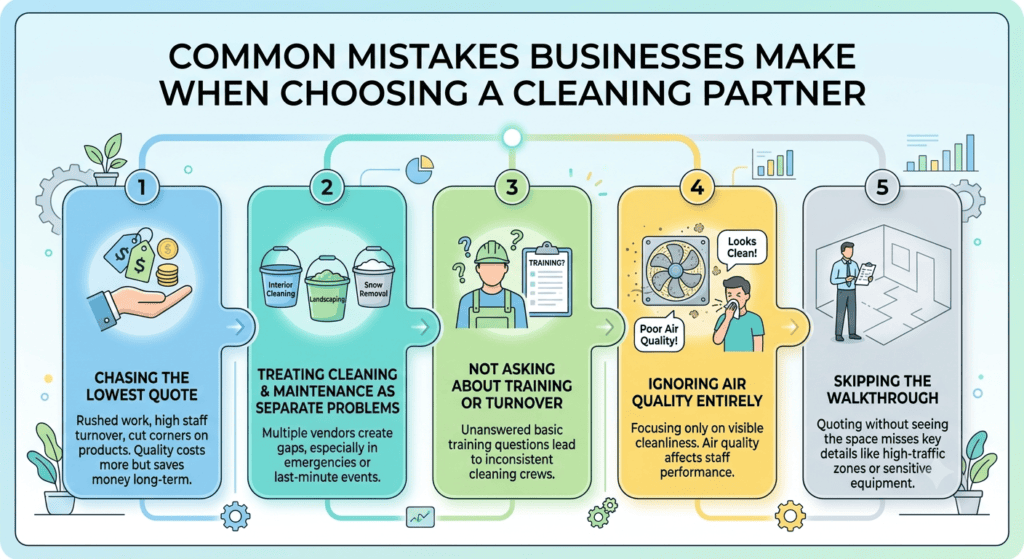
Even well-run businesses fall into a few predictable traps when hiring a commercial cleaning company:
- Chasing the lowest quote. Rock-bottom pricing usually means rushed work, high staff turnover, or corners cut on products. Quality and consistency tend to cost a bit more, and they save money in the long run through fewer complaints and less property wear.
- Treating cleaning and property maintenance as separate problems. Splitting interior cleaning, landscaping, and snow removal across three different vendors creates gaps, especially during a surprise snowfall or a last-minute event.
- Not asking about training or turnover. A provider that can’t answer basic questions about staff training is more likely to send inconsistent crews.
- Ignoring air quality entirely. Businesses focus heavily on visible cleanliness while overlooking ventilation, filtration, and product choice, even though air quality has a direct, measurable link to staff performance.
- Skipping the walkthrough. A provider who quotes a price without seeing your space first is far more likely to miss details that matter, from high-traffic zones to sensitive equipment.
Why NLLC Is Built for Where Cleaning Is Headed in 2026
NLLC, short for Niagara Landscaping, Lawn Care & Cleaning, was built around exactly the shift this article has been describing: businesses don’t want fragmented vendors anymore, they want one dependable partner who handles the whole property.
That means residential and commercial cleaning, Airbnb turnover service, landscaping, lawn care, snow and ice management, and garbage and junk removal, all coordinated through one team that knows your property instead of five separate companies who’ve never talked to each other. You can read more about how the company approaches this on the About page, and see what current and past clients have said on the testimonials page.
NLLC serves businesses and homeowners across Niagara Falls, St. Catharines, Welland, Fort Erie, Niagara-on-the-Lake, Thorold, Port Colborne, and the wider Niagara Region. If you want to see recent projects, tips, and updates, the NLLC blog is a good ongoing resource, and you can follow along on Instagram, Facebook, TikTok, and LinkedIn for behind-the-scenes looks at the work.
Whether you need a standing commercial cleaning contract, seasonal snow removal, or a full property care plan that covers everything in between, the team is ready to help you build it. Get in touch through the contact page to talk through what your property actually needs, no pressure, just a straightforward conversation about your space.
Conclusion
Cleaning in 2026 looks a lot different than it did even a few years ago. It’s more data-driven, more sustainable, more specialized, and a lot more connected to how a business actually performs, from employee focus to customer first impressions. The companies staying ahead aren’t necessarily doing more. They’re doing it smarter, with better products, better technology, and better communication.
If you’re ready to bring your property up to speed, whether that means switching to certified green products, setting up a smarter cleaning schedule, or finally combining your cleaning, landscaping, and snow removal under one dependable team, NLLC is ready to help. Reach out today for a straightforward conversation about what your business needs heading into the rest of 2026.
Frequently Asked Questions
1. What is the biggest cleaning trend for businesses in 2026? Sustainability is leading the pack, with more than half the market now using certified eco-friendly products. Close behind are smart automation and a sharper focus on the air employees breathe, both driven by hard data on how they affect performance.
2. Are eco-friendly products actually as effective as traditional cleaners? Yes, when they carry a genuine third-party certification like EcoLogo or Green Seal. Modern formulas use plant-based surfactants and balanced pH levels that clean just as effectively as older chemical-heavy products, without the same air quality trade-offs.
3. How often should a commercial space be professionally cleaned? It depends on foot traffic. High-traffic entrances, restrooms, and shared equipment typically need daily or even multiple-times-daily attention, while low-use storage or back-office areas can go longer between visits. A good provider will help you set a schedule based on actual usage rather than a flat, one-size-fits-all routine.
4. Does the air inside a building really affect employee productivity? Research from Harvard’s COGfx studies and multiple 2026 workplace surveys both point the same direction: better ventilation and lower pollutant levels are tied to measurably higher cognitive performance and fewer sick days. It’s no longer a soft argument, it’s backed by data.
5. Should I bundle cleaning with landscaping and snow removal? For most commercial properties in the Niagara Region, yes. Bundling reduces the number of vendors you’re managing, closes scheduling gaps between seasons, and means one team is accountable for how your whole property looks and functions year-round.
6. What should I look for in a cleaning provider besides price? Ask about product certifications, staff training and turnover, communication practices, and whether they offer flexible scheduling based on your actual traffic patterns. A provider who can answer these clearly is usually the one who’ll deliver consistent results.
7. Is robotic cleaning technology replacing human cleaning staff? Not really. Robots are mostly taking over repetitive tasks like floor scrubbing in large facilities, freeing up human crews for detail work, disinfection, and the judgment calls machines still can’t make.
8. How do I know if my building’s air quality is a problem? Common signs include frequent headaches or fatigue among staff, higher-than-usual sick days, stuffy air in certain rooms, or visible dust buildup. A cleaning provider using HEPA filtration and low-VOC products can help address the cleaning side, though persistent issues may also need an HVAC assessment.