If you run a business in Niagara Falls, St. Catharines, Welland, or anywhere else in the region, you’ve probably had this conversation with yourself at least once: should we hire our own cleaner, or should we bring in a professional cleaning company?
It sounds like a small decision. It isn’t. The choice you make affects your budget, your legal exposure, how your space looks to customers, and how much time you personally spend managing something that has nothing to do with running your actual business.
This is the commercial cleaning vs in-house cleaning debate, and in 2026 it matters more than ever. Labour costs are shifting, compliance rules are tightening, and customer expectations around cleanliness have quietly become a lot higher than they were even three or four years ago. Buyers now choose cleaning providers based on quality first, price second, and reviews third – which tells you cleanliness has become a brand issue, not just a maintenance task.
In this guide, we’re going to walk through everything a Niagara business owner or property manager needs to know before making this call. We’ll look at real costs, the risks nobody talks about, staffing headaches, compliance requirements specific to Ontario, and how to figure out which option actually fits your business – not just in theory, but in practice.
By the end, you’ll have a clear, honest answer to the commercial cleaning vs in-house cleaning question, tailored to how businesses in the Niagara Region actually operate.
What Is In-House Cleaning?
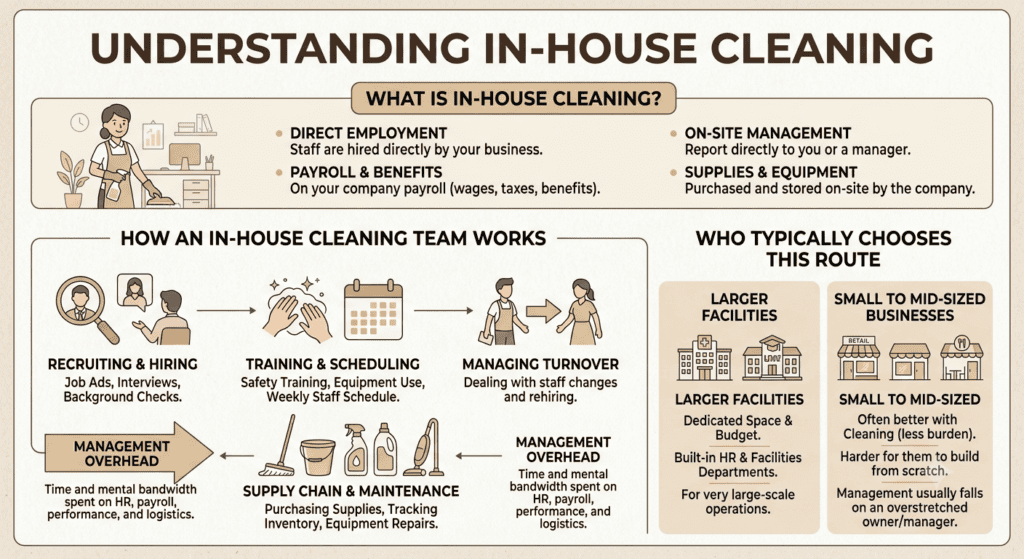
In-house cleaning means your business directly employs the person or people responsible for keeping your space clean. They’re on your payroll, they report to you or a manager, and cleaning supplies and equipment are typically purchased and stored on-site.
How an In-House Cleaning Team Actually Works
When you build an in-house cleaning operation, you’re not just hiring someone to run a vacuum. You’re taking on every responsibility that comes with employing a person in Ontario. That includes recruiting, interviewing, training, scheduling, paying wages, covering vacation and sick time, managing performance, and handling turnover when it happens – and in the cleaning industry, it happens often.
You’re also responsible for supplying and maintaining equipment: vacuums, mops, floor buffers, disinfectant sprayers, and consumables like paper towels, garbage bags, and cleaning chemicals. Someone on your team needs to track inventory and reorder before you run out.
Who Typically Chooses This Route
In-house cleaning tends to make more sense for very large facilities with dedicated space, budget, and management infrastructure already in place – think hospitals, universities, or large manufacturing plants that already have HR and facilities departments built for this kind of thing.
For most small and mid-sized businesses in Niagara – retail stores, medical offices, restaurants, professional offices, and small commercial buildings – building an in-house team from scratch is a much heavier lift than it initially appears.
It’s also worth thinking about who ends up managing that team day to day. In a small business, that responsibility usually falls on an owner, office manager, or operations lead who already has a full plate. Cleaning becomes one more thing to think about between customer calls, inventory, and everything else that actually grows the business. Over time, that management overhead is often the part owners underestimate most – not the wage itself, but the mental bandwidth spent scheduling, checking in, and stepping in when something goes wrong.
What Is Commercial Cleaning (Outsourced)?
Commercial cleaning, sometimes called outsourced cleaning or contract cleaning, means you hire a professional cleaning company – like NLLC – to handle cleaning on a scheduled basis. The cleaning company employs, trains, insures, and manages its own staff. You simply receive the service.
How a Commercial Cleaning Company Operates
A commercial cleaning company absorbs the entire operational burden that in-house cleaning puts on you. Wages, payroll taxes, insurance, background checks, training, supervision, and equipment all sit with the provider. You sign a service agreement that defines what gets cleaned, how often, and to what standard, and the company delivers against that agreement.
If a cleaner calls in sick, the company sends a replacement. If someone quits, the company handles the rehire. Your business never experiences a gap in service because staffing is the provider’s problem to solve, not yours.
Who Typically Chooses This Route
Small to mid-sized businesses, medical and dental offices, retail locations, restaurants, property management companies, real estate offices, and multi-unit residential buildings across Niagara Falls, St. Catharines, Welland, and the wider Niagara Region tend to be the best fit for outsourced commercial cleaning. These businesses need consistent, professional results without the overhead of running an internal cleaning department.
Property managers in particular tend to gravitate toward outsourced commercial cleaning because they’re often overseeing several buildings at once. Trying to hire, train, and supervise cleaning staff separately for each property would multiply the administrative burden several times over. A single commercial cleaning company can instead standardize service across an entire portfolio, which makes reporting, budgeting, and quality control far simpler to manage from one place.
Commercial Cleaning vs In-House Cleaning: The Real Cost Breakdown
This is where most business owners get surprised. On paper, hiring one part-time cleaner looks cheaper than paying a monthly contract. In practice, the math rarely works out that way once every cost is accounted for.
The True Cost of In-House Cleaning
Ontario’s general minimum wage sits at $17.60 per hour, with the next adjustment expected around October 2026. But wage is only the starting point. A full picture of in-house cleaning costs includes:
- Base wages for however many hours per week your space needs
- Payroll taxes and statutory deductions (CPP, EI)
- WSIB premiums, which averaged $1.23 per $100 of insurable payroll across Ontario businesses in 2026 – the lowest rate in 50 years, but still a real, ongoing cost
- Vacation pay and statutory holiday pay
- Sick days and coverage when your cleaner is unavailable
- Recruiting and training costs every time you need to replace someone
- Equipment purchases – a mid-tier commercial vacuum alone typically runs $400 to $800, and larger equipment like auto-scrubbers can run into the thousands
- Supplies and consumables, which someone has to manage and reorder
- Management time spent supervising, scheduling, and handling complaints
None of these costs show up on a job posting, but they all show up on your books eventually. And under new 2026 Occupational Health and Safety Act rules, employers must also maintain visible cleaning logs for washroom facilities – one more compliance task that lands on whoever manages your in-house team.
The True Cost of Outsourced Commercial Cleaning
With outsourced commercial cleaning, most of these costs collapse into a single predictable line item. Typical Ontario commercial cleaning pricing in 2026 looks roughly like this:
- Hourly rates: $25 to $50 per cleaner-hour, depending on facility type and whether service happens after hours
- Per-square-foot pricing: roughly $0.05 to $0.20 per cleaning visit for routine service
- Monthly contracts: commonly $400 to $1,200 for spaces under 5,000 square feet, $1,200 to $3,000 for 5,000 to 15,000 square feet, and $3,000 or more for larger facilities
That single price typically includes labour, supervision, insurance, equipment, and often supplies – meaning there’s no separate line for WSIB, no separate line for a vacuum replacement, and no separate line for training a new hire.
It’s also worth noting that outsourcing doesn’t eliminate cost variability entirely – larger facilities, specialized surfaces, or add-on services like window cleaning or disinfection will naturally shift the price. But the difference is that these costs are quoted and agreed upon upfront, rather than discovered gradually over months of running an internal program. For a business owner trying to build an accurate annual budget, that kind of predictability is worth a lot on its own, separate from whichever option ends up being marginally cheaper on paper.
A Side-by-Side Cost Comparison Table
| Cost Factor | In-House Cleaning | Outsourced Commercial Cleaning |
| Wages | Direct responsibility | Bundled into contract |
| WSIB and payroll taxes | Direct responsibility | Covered by provider |
| Equipment purchases | Direct responsibility | Usually included |
| Supplies and consumables | Direct responsibility | Usually included |
| Training | Ongoing, recurring cost | Provider’s responsibility |
| Coverage during absences | Falls on you | Guaranteed by provider |
| Liability insurance | Direct responsibility | Covered by provider |
| Management time | Significant | Minimal |
| Predictability of cost | Variable month to month | Fixed contract price |
Quality and Consistency: Which Option Delivers Better Results?
Cost is only half the equation. The other half is whether the space actually gets cleaned well, consistently, week after week.
Where In-House Teams Struggle
In-house teams have no built-in accountability structure beyond whatever internal supervision your business provides. When quality slips because of turnover, illness, burnout, or simply a bad hire, there’s no external standard forcing correction – it becomes your problem to notice, address, and fix.
Standards can also drift over time. Without a documented scope of work or measurable checklist, “clean” starts to mean whatever the current employee interprets it to mean, which can shift significantly between hires.
Where Commercial Cleaning Companies Have the Edge
A professional commercial cleaning company operates against a defined scope of work with a clear service standard attached to the contract. If quality drops, there’s a built-in mechanism – a quality assurance process, a response time commitment, or a re-clean guarantee – to correct it without you having to manage the correction yourself.
Because commercial cleaning companies work across many properties, they also bring broader experience. Their teams have already handled the kinds of stains, surfaces, and situations your space may only encounter once a year.
There’s also the question of accountability when something is missed. With an in-house employee, a missed task often gets resolved informally – a quiet reminder, a note left on a desk. With a commercial cleaning company, a missed task is a service issue tied to a contract, which tends to get corrected faster and more formally, since the provider’s reputation and repeat business depend on it. That structural difference in accountability is often what separates a cleaning arrangement that slowly declines in quality from one that holds steady year after year.
Staffing, Turnover, and the Hidden Labour Problem
This is one of the biggest reasons the commercial cleaning vs in-house cleaning decision has shifted so heavily toward outsourcing in recent years.
Why Cleaning Staff Turnover Is So High in 2026
The cleaning industry has one of the highest turnover rates of any sector. Recent hiring data shows an average hire rate of 10.8% against an average quit rate of 6.9% in the cleaning sector over a single measured period – numbers that reflect just how unstable staffing can be for anyone trying to run an in-house crew.
Several forces are driving this in 2026. Experienced cleaners are retiring, fewer younger workers are entering the field, and workers increasingly want steadier schedules and better pay – all while competing service industries pull from the same shrinking labour pool.
How Outsourcing Removes This Burden
When you outsource, staffing volatility becomes the cleaning company’s problem, not yours. If a cleaner leaves, the company replaces them, trains the replacement, and keeps your service running without a gap. You never have to post a job listing, screen a resume, or scramble to cover a shift because someone quit on short notice.
This matters more than it might seem at first glance. A single unfilled cleaning shift at a retail store or medical office isn’t just an inconvenience – it’s a visible sign to every customer or patient who walks through the door that day. Outsourcing effectively buys you a guarantee that this particular failure point simply won’t happen, because the responsibility for solving it sits entirely with a company whose core business is solving exactly that problem.
Liability, Compliance, and Insurance: What Business Owners Overlook
This is the part of the commercial cleaning vs in-house cleaning decision that rarely gets discussed upfront – and it’s often the most expensive to get wrong.
WSIB, OHSA, and Your Legal Exposure
If you employ a cleaner directly in Ontario, you’re generally required to register with WSIB within 10 days of hiring your first employee. You’re also responsible for reporting any workplace injury within three business days of becoming aware of it, maintaining accurate payroll records, and complying with Occupational Health and Safety Act requirements – including the newer rule requiring visible, dated cleaning logs for washroom facilities.
Cleaning involves real physical risk: slips, falls, chemical exposure, and repetitive strain injuries are all common in the industry. If an in-house cleaner is injured on the job, your business carries that liability directly, along with the WSIB premiums, the reporting obligations, and the potential impact on your future premium rate.
How Commercial Cleaning Companies Manage Risk for You
Reputable commercial cleaning companies carry their own general liability and workers’ compensation insurance covering every cleaner they send to your property. That means if an accident happens during a cleaning visit, it’s the provider’s insurance and reporting obligation – not yours. This alone is one of the strongest arguments for outsourcing if minimizing legal and financial exposure matters to your business.
Before signing with any provider, it’s worth asking directly for proof of insurance and WSIB clearance. A legitimate commercial cleaning company will have no hesitation providing this documentation, and it’s one of the simplest ways to confirm that the liability protection you’re paying for is actually in place. Skipping this step is one of the more common mistakes business owners make when comparing providers on price alone.
Flexibility and Scalability
In-House Cleaning and the Problem of Fixed Capacity
An in-house team is sized for your current needs. If your business grows, opens a second location, or simply has a busier season, you either overwork your existing staff or go through the hiring process all over again. If business slows down, you’re still paying full wages for capacity you don’t need.
How Outsourced Cleaning Scales With Your Business
Commercial cleaning companies can typically adjust service frequency, add locations, or scale hours up or down as your needs change – often with nothing more than a conversation and an updated agreement. This flexibility is particularly valuable for seasonal businesses, growing companies, and property managers overseeing multiple sites across the Niagara Region.
Niagara’s tourism-driven economy makes this especially relevant. Businesses near Clifton Hill, the falls, or other high-traffic tourist areas often see cleaning needs spike sharply during summer months and holiday weekends, then taper off in the quieter winter season. An in-house team sized for peak season sits underused for months; a team sized for the off-season gets overwhelmed every summer. A commercial cleaning company can flex service frequency up or down with the season, which is a far more efficient match for how demand actually moves throughout the year.
Equipment, Supplies, and Green Cleaning Trends in 2026
What In-House Teams Need to Buy and Maintain
Beyond the vacuum and mop, a properly equipped in-house cleaning operation needs floor buffers, auto-scrubbers, disinfecting equipment, and a steady, well-managed supply of chemicals and consumables. Equipment needs to be maintained, repaired, and eventually replaced – costs that rarely get tracked as a depreciating business asset but absolutely function as one.
Why Eco-Friendly Cleaning Has Become the Standard
Green cleaning has moved from a nice-to-have to an expectation. Eco-certified products and low-VOC cleaning methods are now the fastest-growing service preference among Canadian households, and increasingly a standard requirement written directly into commercial contracts. Businesses adopting green cleaning products are signalling environmental responsibility to employees, customers, and tenants alike – and eco-friendly formulations can reduce sick days and extend the life of surfaces and materials over time.
For an in-house team, sourcing, vetting, and consistently using certified green products is another task added to an already long list. A commercial cleaning company that has already built eco-friendly cleaning products into its standard offering saves you that research and procurement work entirely.
There’s also a growing awareness that “eco-friendly” claims need to hold up to scrutiny rather than simply appear on a label. Businesses evaluating any cleaning provider – in-house or outsourced – should look for recognized certifications, documented procedures, and a clear explanation of how a product or method actually reduces chemical exposure, rather than relying on vague marketing language. A provider that can speak specifically to what it uses and why tends to be a more trustworthy long-term partner than one that simply uses the word “green” as a selling point.
Technology and Modern Cleaning Practices
Smart Scheduling and Quality Assurance Tools
Professional cleaning companies increasingly use scheduling software, digital checklists, and quality assurance systems to track completed work and maintain consistency across visits. This kind of infrastructure is expensive and time-consuming to build internally, but it’s often already baked into what a commercial provider offers.
What This Means for Niagara Businesses
For a Niagara business, this translates into a service that’s easier to trust and easier to verify – you know what was cleaned, when, and to what standard, without having to build the tracking system yourself.
This kind of documentation also matters beyond day-to-day peace of mind. If you’re a property manager reporting to owners or a business preparing for a health and safety inspection, having a clear, dated record of cleaning activity – including the washroom cleaning logs now required under 2026 OHSA rules – can save significant time and stress. Rather than reconstructing a cleaning history from memory or scattered notes, you have a system that already tracks it for you.
Common Mistakes Businesses Make When Choosing Between the Two
- Only comparing hourly wage to hourly contract rate, without accounting for WSIB, equipment, supplies, and management time on the in-house side
- Assuming outsourcing means losing control, when a well-written service agreement actually gives you a documented standard to hold a provider to
- Ignoring liability exposure until an injury or complaint actually happens
- Choosing the cheapest cleaning service contract without checking insurance, references, or what’s actually included in the price
- Not accounting for seasonal or growth-related changes in cleaning needs before signing a long agreement
- Skipping a walkthrough before service begins, which often leads to mismatched expectations about scope
How to Decide: A Practical Framework for Niagara Business Owners
Questions to Ask Before You Choose
- How many hours of cleaning does your space realistically need each week?
- Do you have the internal management capacity to supervise a direct employee?
- How much does unpredictable staffing risk cost you if the space goes uncleaned for a day or two?
- Is your business seasonal, growing, or stable in size?
- How important is liability protection to your ownership or leadership team?
- Do you need eco-friendly cleaning products to meet a tenant, client, or corporate requirement?
When In-House Makes Sense
In-house cleaning tends to make sense when you have a very large facility, dedicated HR and facilities infrastructure already in place, extremely specific or specialized cleaning needs, and enough scale that the fixed cost of employment is genuinely lower than a contract price.
When Outsourced Commercial Cleaning Makes Sense
Outsourced commercial cleaning tends to be the better fit for small to mid-sized businesses, offices, retail spaces, medical and dental practices, restaurants, and property managers who want predictable costs, reduced liability, consistent quality, and zero staffing headaches – without having to build an internal department to get there.
In practice, most Niagara business owners who go through this decision honestly land on outsourcing, simply because the true cost of in-house cleaning – once wages, WSIB, equipment, supplies, and management time are all counted – rarely ends up cheaper than a well-structured commercial cleaning company contract. The exceptions tend to be businesses large enough to already have HR and facilities infrastructure in place, where the marginal cost of adding cleaning staff is genuinely lower than it would be for a smaller operation starting from zero.
Why Niagara Businesses Choose NLLC for Commercial Cleaning
At NLLC (Niagara Landscaping, Lawn Care & Cleaning), we’ve built our commercial cleaning services specifically around what small and mid-sized businesses in Niagara Falls, St. Catharines, Welland, Fort Erie, Niagara-on-the-Lake, Thorold, and Port Colborne actually need: reliable service, transparent pricing, and a team that shows up when they say they will.
What Sets Our Janitorial Services in Niagara Falls Apart
We offer flexible commercial cleaning, residential cleaning, Airbnb turnover cleaning, move-in and move-out cleaning, post-construction cleaning, window cleaning, and full janitorial services across the Niagara Region – all backed by a team that understands local businesses because we work with them every day. Whether you manage a small retail storefront or a multi-tenant commercial building, we build a cleaning plan around your actual space and schedule, not a generic template.
If you’re weighing commercial cleaning vs in-house cleaning for your own property, our team is happy to walk through your space, talk through your options honestly, and put together a plan that fits your budget and your standards.
Conclusion
There’s no universal right answer to the commercial cleaning vs in-house cleaning question – but for the vast majority of small and mid-sized businesses across Niagara Falls, St. Catharines, and the surrounding region, outsourced commercial cleaning delivers more predictable costs, stronger accountability, reduced liability, and far less day-to-day management burden than building an in-house team from scratch.
The right choice comes down to your space, your growth plans, and how much operational weight you want to carry yourself. If cleaning isn’t the business you’re actually trying to run, handing it to a team that specializes in it usually frees up more time, money, and peace of mind than doing it yourself.
Get a Free Quote – Let’s Talk About Your Property
If you’re ready to see what professional commercial cleaning could look like for your Niagara business, get in touch with NLLC for a free, no-obligation quote. You can also explore our full range of cleaning services, call us directly at +1 365 607 0015, or email enquiry@thenllc.ca. We’ll walk your space with you and build a plan that actually fits how your business runs.
Frequently Asked Questions
Is commercial cleaning cheaper than hiring an in-house cleaner?
In most small to mid-sized business cases, yes, once you account for wages, WSIB premiums, equipment, supplies, training, and management time. In-house cleaning can look cheaper on paper but often costs more once every expense is included.
Do commercial cleaning companies bring their own supplies and equipment?
Yes, in most cases. Reputable commercial cleaning companies include cleaning products, tools, and equipment as part of their contract price, though it’s always worth confirming exactly what’s included before signing an agreement.
What happens if my in-house cleaner quits or gets sick?
Coverage becomes your responsibility to arrange – either by asking another employee to fill in or scrambling to find temporary help. With outsourced commercial cleaning, the provider is responsible for ensuring your scheduled cleaning still happens.
Is outsourced commercial cleaning less flexible than having my own staff?
Not necessarily. A good commercial cleaning company works with you to build a schedule and scope that matches your needs, and most providers can adjust frequency or scope as your business changes.
Are commercial cleaning companies insured?
Reputable providers carry general liability and workers’ compensation insurance covering their cleaning staff, which shifts liability exposure away from your business.
How often should a small business get professional cleaning?
This depends on foot traffic, industry, and space size, but many small offices and retail spaces schedule cleaning two to three times per week, while higher-traffic spaces like restaurants or medical offices often need daily service.
Is green cleaning more expensive than traditional cleaning?
Eco-friendly products can carry a slightly higher upfront cost, but many businesses see that offset through fewer employee sick days and lower long-term maintenance costs on floors and surfaces.
How do I switch from in-house cleaning to a commercial cleaning company?
Most businesses start with a walkthrough and quote, agree on a scope of work and schedule, and transition on a set start date – often without any disruption to daily operations.