There’s a particular smell that shows up in Niagara homes every October. It’s not quite mustiness, not quite dust – it’s the smell of a house that’s been living with open windows, sandy shoes, and a summer’s worth of activity, and is now about to get sealed shut for the next five months. If you’ve smelled it, you already know what this article is about.
Deep cleaning before fall isn’t a Pinterest trend or an excuse to buy new cleaning products. It’s the last real opportunity you get, before the windows close and the furnace kicks on, to clear out everything summer left behind. Once the cold weather sets in across the Niagara Region, your home essentially becomes a sealed box for the better part of half a year. Whatever dust, pollen, pet dander, or grime is trapped inside when that happens is what you and your family will be breathing until spring.
This guide walks through exactly why deep cleaning before fall matters, what a proper fall deep clean actually involves, which rooms and spots need the most attention, and how homeowners, renters, landlords, and business owners across Niagara Falls, St. Catharines, Welland, and the surrounding area can get it done – whether that means rolling up your sleeves this weekend or calling in a professional crew.
What Is Deep Cleaning, and How Is It Different From Regular Cleaning?
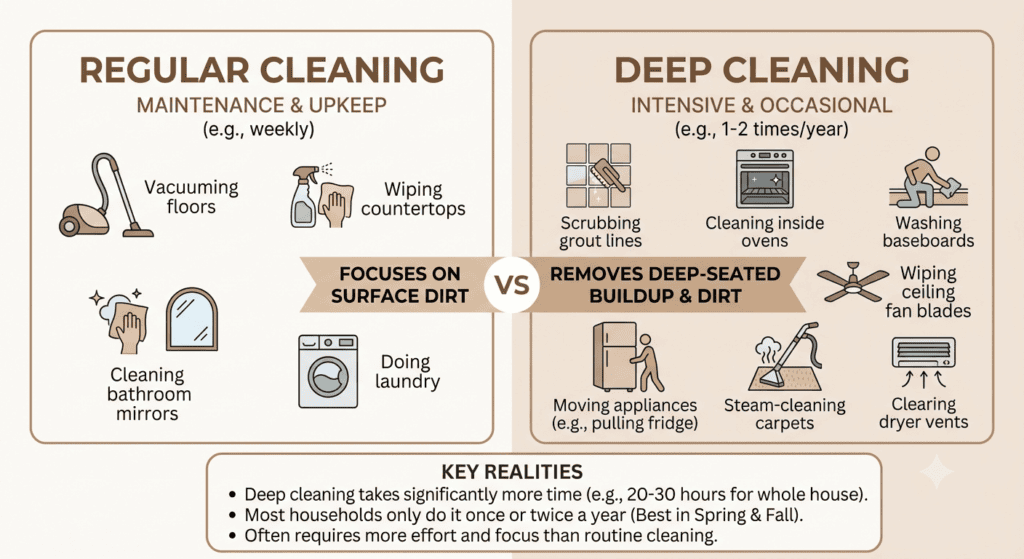
Regular cleaning keeps a home looking presentable. Deep cleaning is what happens underneath that – the stuff your weekly wipe-down never touches.
Think about your last “cleaning day.” You probably vacuumed the floors, wiped the counters, cleaned the bathroom mirror, maybe did a load of laundry. That’s maintenance. It keeps things from sliding backward, but it doesn’t actually remove the buildup that’s been quietly accumulating in places you don’t look at every day.
Deep cleaning goes into those places. It’s pulling the fridge away from the wall to vacuum the coils. It’s cleaning inside the oven, not just wiping the stovetop. It’s washing baseboards, scrubbing grout, steam-cleaning carpets, wiping down ceiling fan blades, and clearing out the dryer vent. It’s the kind of cleaning that most households realistically only have time for once or twice a year – and fall is one of the two best windows to do it, right alongside spring.
The difference matters more than people think. A 2026 whole-house deep cleaning guide from a professional cleaning company noted that a full deep clean typically takes 20 to 30 hours of focused labour when done properly, and that most homeowners who attempt it themselves stall out partway through because the intensity is hard to sustain room after room. That’s a useful reality check: deep cleaning before fall is a genuinely bigger job than people expect, which is exactly why so many households either put it off indefinitely or bring in help to get it done right.
Why Fall Is the Best Time for a Deep Clean in Niagara
Niagara’s Weather Gives You a Short, Specific Window
The Niagara Region sits between Lake Erie and Lake Ontario, and that positioning gives the area a fairly mild, gradual autumn compared to a lot of the country. September and early October typically bring daytime highs in the mid-teens Celsius, with the first real frost usually arriving in late October or early November. Humidity climbs steadily through the season too, sitting around 75% in October and creeping up toward 77% by November.
That combination – cooling temperatures, rising humidity, and a slow but definite countdown to winter – is exactly the window you want for a deep clean. It’s cool enough to work comfortably without the house turning into a greenhouse, but it’s still warm enough that you can open windows to air out cleaning fumes, dry out carpets after a shampoo, and let sunlight do some of the work drying damp areas before the truly cold, damp weather sets in. Wait too long, and you’re deep cleaning in a house that’s already closed up for winter, which makes the whole job slower and less effective.
You’re About to Seal the House Shut for Winter
Here’s the part that a lot of people don’t think about until it’s too late: once the temperature drops for good, most Niagara households don’t open a window again until April or May. Everything that’s in the house on that last warm day – dust, allergens, whatever tracked in on shoes and paws all summer – is what stays in the house.
Fall cleaning isn’t really about undoing summer. It’s about resetting the indoor environment before it gets locked in place for winter. That’s a fundamentally different job than a quick tidy-up, and it’s why deep cleaning before fall carries more weight than the equivalent task in, say, June.
The Holiday Hosting Season Is Coming Fast
There’s also a practical calendar reason. Thanksgiving lands in early October, and from there it’s a fairly short runway to Halloween, then Christmas and New Year’s. For a lot of Niagara families, fall is genuinely the last stretch of “normal” time before the house fills up with guests, kids’ school schedules, and holiday hosting duties. Getting the deep clean done in September or October means you’re not scrambling to scrub the guest bathroom the night before company arrives – you’re just doing light upkeep on a home that’s already been reset.
The Hidden Health Risks of Skipping a Fall Deep Clean
This is the part that turns “deep cleaning before fall” from a nice-to-have into something worth prioritizing.
Dust Mites and Indoor Allergens
Canadians spend roughly 90% of their time indoors, according to Health Canada research on residential air quality – and that number climbs even higher once winter sets in. Indoor air quality, then, isn’t a minor detail. It’s the air your household is actually breathing most of the year.
Dust mites are one of the biggest culprits. In Canada, close to 40% of people with allergic conditions are sensitized to one of the two common house dust mite species found in homes. These mites live in carpets, mattresses, upholstered furniture, curtains, and bedding, feeding on skin flakes and thriving in warm, humid conditions – exactly the environment a closed-up fall or winter home provides. According to Health Canada’s own guidance, mite exposure can even contribute to the development of asthma in genetically susceptible children, and the agency specifically recommends damp-mopping, vacuuming soft furnishings frequently, and using a HEPA filter vacuum to bring exposure down.
A deep clean that actually gets into mattresses, box springs, upholstery, and carpet fibres – not just a quick surface vacuum – is one of the most effective things a household can do heading into the season when everyone’s spending more time indoors with the windows shut.
Mold and Moisture Buildup
Rising humidity is a fall-specific problem in Niagara. As outdoor humidity climbs into the mid-70% range through October and November, indoor moisture tends to follow, especially in bathrooms, basements, and around windows where condensation collects. Left unaddressed, that moisture becomes the starting point for mold growth, which is consistently linked to increased respiratory symptoms in medical literature published in the Canadian Medical Association Journal.
Deep cleaning before fall is the natural checkpoint to catch this early – scrubbing bathroom grout and caulking, checking under sinks, wiping down windowsills where condensation pools, and running a dehumidifier in basements or other damp-prone areas before the problem has months to develop unseen.
Indoor Air Quality Once the Windows Close
Between dust, pet dander, mold spores, and the everyday chemical residue from cooking and cleaning products, indoor air quality tends to decline steadily once natural ventilation drops off for the winter. A fall deep clean – particularly one that includes HVAC vents, filters, and any accessible ductwork – directly reduces the pollutant load your household is breathing for the next several months. It’s a genuinely preventive, health-focused reason to treat this cleaning session differently than a normal week.
The Fall Deep Cleaning Checklist: Room by Room
This is the practical core of deep cleaning before fall – the actual tasks, broken down by room, that separate a deep clean from routine tidying.
Kitchen
The kitchen holds more hidden grease and buildup than any other room, and it’s about to get a workout with holiday cooking.
- Clean inside the oven, including racks, door glass, and the door seal
- Degrease the stovetop, range hood, and the wall or backsplash behind it
- Pull the refrigerator out and vacuum the condenser coils to improve efficiency
- Clean and defrost the freezer if needed, and wipe down interior shelves
- Run an empty dishwasher cycle with vinegar to clear odour and buildup, and clean the filter
- Wipe down cabinet fronts and interiors, tossing expired pantry items as you go
- Disinfect garbage and recycling bins, which get overlooked constantly
- Clean under and behind appliances where crumbs and grease collect
Bathrooms
- Scrub grout, caulking, and tile – this is where mold gets its start
- Deep clean the shower, tub, and showerhead
- Disinfect high-touch surfaces: faucet handles, light switches, cabinet pulls
- Clean the exhaust fan cover, which pulls in dust over time
- Wash bath mats, shower curtains, and towels
- Check under the sink for any early signs of leaks or moisture
Bedrooms
- Wash all bedding, including duvets, pillow protectors, and mattress covers
- Vacuum the mattress itself, ideally with a HEPA filter attachment
- Rotate or flip the mattress if the manufacturer recommends it
- Dust and wipe down furniture, headboards, and nightstands
- Vacuum under the bed and behind furniture, where dust and pet hair build up fastest
- Wash or vacuum curtains and blinds
Living and Common Areas
- Vacuum upholstered furniture, including cushions and underneath them
- Wash throw pillow covers and blankets
- Steam clean or professionally shampoo carpets and area rugs
- Dust electronics, remotes, and entertainment units
- Wipe down all surfaces, including shelves and picture frames
Laundry Room
- Clean the washing machine drum and gasket, which trap mildew and odour
- Clear the lint trap thoroughly and check the dryer vent for buildup – a genuinely important fire-safety task, not just a cleaning one
- Organize and wipe down shelving and supply storage
Entryways and Mudrooms
- Sweep and mop or scrub the entry floor
- Clean doormats
- Rotate summer gear out and organize fall coats, boots, and school bags
- Wipe down coat hooks, benches, and storage bins
Often-Overlooked Areas That Deserve Extra Attention
These are the spots that separate a genuinely thorough deep clean from a good-effort surface clean.
HVAC Vents, Filters, and Ducts
Before your furnace starts running daily, replace or clean the filter and wipe down vent covers throughout the house. Dust that’s settled inside vents over the summer gets blown directly into the air the moment heating season starts. This is one of the single highest-impact tasks on this entire list for indoor air quality.
Carpets and Upholstery
Carpets and soft furnishings act as reservoirs for dust mites, pet dander, and other allergens, according to research published in the CMAJ. A once-or-twice-yearly deep shampoo or steam clean – whether rented equipment or a professional service – does more for allergen reduction than weekly vacuuming alone ever will.
Windows, Sills, and Tracks
Clean glass inside and out, wipe down sills where condensation and grime collect, and clear out window tracks. While you’re there, check weatherstripping and seals – a task that pulls double duty as both a cleaning job and a winter energy-efficiency check.
Baseboards, Light Fixtures, and Ceiling Fans
These get skipped in weekly cleaning almost universally, which means a full season or more of dust has usually settled on them by fall. Wipe baseboards top to bottom, dust ceiling fan blades (a pillowcase trick works well to catch falling dust), and clean light fixture covers where dead bugs and dust tend to collect over summer.
Outdoor Fall Prep: Don’t Stop at the Front Door
A complete fall reset isn’t only an indoor job. Niagara’s first frost typically arrives by late October, which puts a hard deadline on a few outdoor tasks:
- Clean and thoroughly dry patio furniture before storing it, to prevent rust and mildew
- Clean gutters before leaves finish falling, since clogged gutters lead to ice damming and water damage later in winter
- Drain and store garden hoses before the first freeze
- Sweep decks, porches, and walkways
- Clear yard debris and prep garden beds
For Niagara homeowners who’d rather not spend an autumn weekend on a ladder clearing gutters or hauling patio furniture, this is exactly where NLLC’s landscaping and lawn care services and garbage removal services come in handy alongside the indoor deep clean – a genuinely full property reset rather than a half-finished one.
Fall Deep Cleaning for Businesses and Commercial Properties
Homes aren’t the only spaces that need a fall reset. Offices, retail spaces, and commercial buildings across Niagara Falls and St. Catharines deal with the same seasonal shift: increased foot traffic as people spend more time indoors, tracked-in leaves and mud, and HVAC systems switching from cooling to heating.
For businesses, a fall deep clean typically covers:
- Deep cleaning of carpets and high-traffic flooring
- Disinfecting shared surfaces – door handles, light switches, breakroom counters, shared equipment
- Cleaning HVAC vents and replacing filters before heating season
- Washing windows and entryway glass, which take a beating from fall rain
- Detailed cleaning of washrooms and break areas
Beyond the health and appearance benefits, a clean commercial space also does real work for a business’s image heading into the busiest retail and hosting season of the year. NLLC’s commercial cleaning services are built specifically around keeping Niagara businesses presentable and sanitary year-round, with fall as one of the key reset points.
Fall Cleaning for Airbnb and Rental Properties
If you manage a short-term rental in the Niagara Region – a hugely popular one given the area’s tourism draw – fall deep cleaning matters for a slightly different reason: guest turnover doesn’t pause for the seasons, but guest expectations around cleanliness never drop, either.
A fall-specific Airbnb deep clean should include everything in the standard turnover checklist, plus:
- Washing all linens and blankets guests will actually be using as temperatures drop
- Checking and cleaning heating vents and thermostats before colder-weather guests arrive
- A deeper carpet and upholstery clean to handle the season’s mud and leaves
- Restocking with fall-appropriate touches, like extra blankets or space heaters where applicable
Falling behind on this kind of seasonal reset is one of the fastest ways to pick up a bad review during the fall and holiday booking rush – a period when Niagara Falls sees some of its highest short-term rental demand of the year.
DIY vs. Professional Deep Cleaning: What’s the Real Difference?
Plenty of homeowners deep clean their own homes every fall, and there’s nothing wrong with that if you have the time and energy. But it’s worth being honest about what separates a DIY effort from a professional one.
Time and Effort
A full deep clean of an average home genuinely does take a full day or more of focused, physical work – moving furniture, scrubbing on your knees, reaching awkward corners. Most people don’t have a spare 20-plus hours sitting around in a single fall weekend, which is exactly why so many fall cleaning checklists end up half-finished by November.
Equipment and Products
Professional crews use commercial-grade equipment – HEPA-filter vacuums, steam cleaners, and degreasers – that outperform most household tools at pulling fine dust and grease out of carpets, upholstery, and kitchen surfaces. That’s not a knock on a good household vacuum; it’s just a different tier of equipment built for exactly this kind of job.
Results That Last
A rushed DIY deep clean often misses the same spots every year – behind the fridge, inside vents, under furniture – simply because those spots require moving heavy items or using specialized tools. A professional deep clean is built around a systematic room-by-room process specifically so nothing gets skipped.
Neither approach is “wrong.” The right call really comes down to your schedule, your home’s size, and whether allergy or air quality concerns in your household make a more thorough clean worth prioritizing this year.
How to Build a Realistic Fall Cleaning Schedule
One of the biggest reasons fall cleaning stalls out halfway through is that people try to tackle the entire house in a single day. A more realistic approach is to spread the work across two or three weekends, treating it like a short project rather than a marathon.
Weekend one: Kitchen and bathrooms. These are the rooms with the most buildup and the most health-relevant tasks – grease, grout, and moisture control. Getting them done first also means the rest of the house feels less overwhelming, since the two most labour-intensive rooms are already off the list.
Weekend two: Bedrooms and living areas. This is where allergen reduction really happens – mattresses, upholstery, carpets, and bedding. Because a lot of this involves waiting for things to wash, dry, or air out, it pairs well with lighter tasks like dusting and wiping surfaces done in between loads.
Weekend three: The overlooked spots and outdoor tasks. HVAC vents, baseboards, light fixtures, gutters, and patio furniture storage all fall into this last category – smaller individual tasks that add up but don’t need to happen in one continuous block. This is also the natural point to double-check anything weather-dependent, since Niagara’s first frost can arrive earlier than expected some years.
Breaking the job up this way also makes it far easier to keep up with normal life in between – work, school routines, and everything else fall brings with it – instead of losing an entire weekend to a single overwhelming cleaning sprint. For households that would rather skip the scheduling altogether, this is exactly the kind of job a professional crew can complete in a single visit, working through the same room-by-room process without it eating into anyone’s weekend at all.
It’s also worth building in a little flexibility. If a particular week gets busy with school events, work deadlines, or unexpected plans, pushing one weekend’s tasks back by a few days won’t undo the value of the rest of the schedule – the main goal is finishing before the windows close for winter, not hitting an exact date.
Common Mistakes People Make When Fall Cleaning
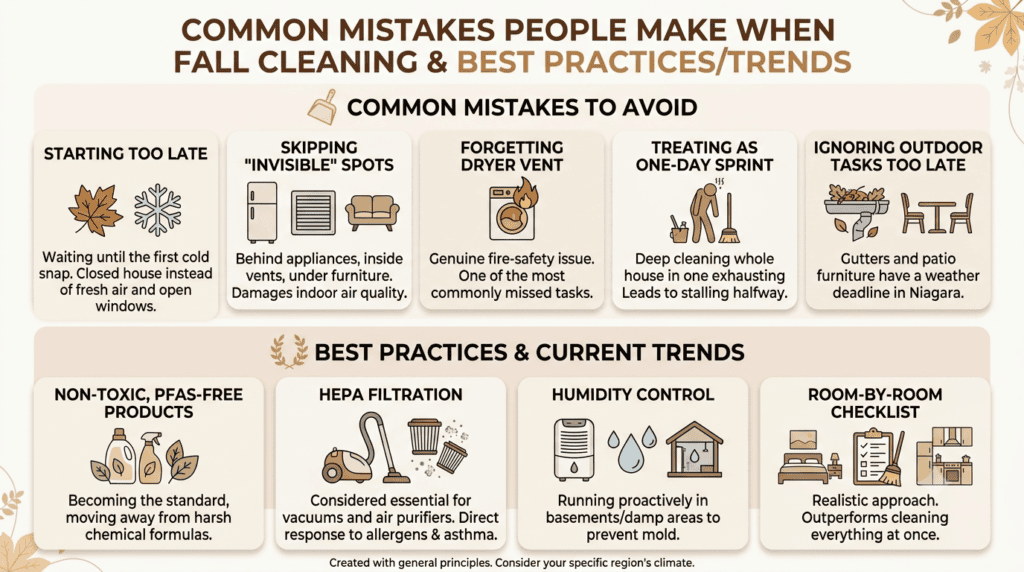
- Starting too late. Waiting until the first cold snap means doing the job in a closed-up house instead of one with open windows and fresh air moving through.
- Skipping the “invisible” spots. Behind appliances, inside vents, and under furniture are the areas most likely to get skipped – and they’re also the ones doing the most damage to indoor air quality.
- Forgetting the dryer vent. This one is a genuine fire-safety issue, not just a cleaning oversight, and it’s one of the most commonly missed tasks on any fall checklist.
- Treating it as a one-day sprint. Trying to deep clean an entire house in a single exhausting session is how most DIY attempts stall out halfway through.
- Ignoring outdoor tasks until it’s too late. Gutters and patio furniture have a real weather deadline in Niagara, unlike most indoor tasks.
Best Practices and Current Trends in Fall Cleaning
A few shifts worth knowing about heading into this season:
- Non-toxic, PFAS-free products are becoming the standard, not just a niche preference, as households and cleaning companies alike move away from harsh chemical formulas toward safer options that still perform.
- HEPA filtration is now considered essential, not optional, for both vacuums and air purifiers – a direct response to growing awareness around indoor allergens and asthma triggers.
- Humidity control is getting more attention, with more households running dehumidifiers proactively in basements and damp-prone areas rather than waiting for visible mold to appear.
- Room-by-room, checklist-driven cleaning continues to outperform the old “clean everything at once” approach, simply because it’s realistic to finish.
Why Choose NLLC for Your Fall Deep Clean in Niagara
NLLC – Niagara Landscaping, Lawn Care & Cleaning – has spent years handling exactly this kind of seasonal reset for homes and businesses across Niagara Falls, St. Catharines, Welland, Fort Erie, Niagara-on-the-Lake, Thorold, Port Colborne, and the wider Niagara Region.
What that means for a fall deep clean, specifically:
- A trained, reliable team that shows up on time and follows a consistent, room-by-room process
- Service options covering residential cleaning, commercial cleaning, and Airbnb turnover cleaning, all under one company
- The ability to pair an indoor deep clean with outdoor fall prep – gutter-adjacent landscaping cleanup and garbage removal – for a genuinely complete property reset
- Local knowledge of exactly how Niagara’s fall weather affects a home, from humidity-driven mold risk to the tight window before first frost
If your fall plan involves company visiting for Thanksgiving or the December holidays, a professional deep clean now means you’re not scrubbing grout the night before guests arrive.
Ready for a Fresh Start This Fall?
Deep cleaning before fall isn’t about chasing perfection – it’s about giving your home or business a genuine reset before it gets sealed up for the next several months. Cleaner air, fewer allergens, less mold risk, and a home that’s actually ready for holiday guests instead of a last-minute scramble: that’s what a proper fall deep clean buys you.
If your fall to-do list feels longer than your weekend does, NLLC is ready to help. Contact NLLC today for a free quote on residential, commercial, or Airbnb deep cleaning across Niagara Falls, St. Catharines, Welland, and the entire Niagara Region – and get your property genuinely ready for the season, not just tidied up around the edges.
Frequently Asked Questions
How often should I deep clean my home?
Most cleaning professionals recommend a full deep clean at least twice a year – once in spring and once in fall – with lighter maintenance cleaning in between. Households with pets, allergies, or higher foot traffic may benefit from a mid-season deep clean as well.
What’s the difference between fall cleaning and spring cleaning?
Spring cleaning is about airing a home out after a long winter of being closed up. Fall cleaning is the opposite process – it’s about sealing a clean, allergen-reduced home shut before winter arrives, rather than opening one up.
How long does a professional deep clean take?
For an average-sized home, a full deep clean typically takes a team several hours to complete in a single visit, compared to the 20-plus hours it can take one person working alone. Exact timing depends on the size of the property and the scope of work requested.
Do I need to deep clean before or after decorating for fall and the holidays?
Before. Cleaning first means you’re not moving decorations out of the way mid-clean, and it also means your home is genuinely clean underneath the seasonal décor, not just dressed up around existing dust and grime.
Is deep cleaning really necessary if I clean regularly?
Yes. Regular cleaning maintains surface-level tidiness but rarely reaches inside vents, behind appliances, deep into carpet fibres, or into grout and caulking – all places where dust mites, allergens, and mold tend to build up over time.
Can deep cleaning actually help with allergies?
Yes. Reducing dust mites, mold, and other allergens through thorough vacuuming, carpet cleaning, and HVAC maintenance is one of the most consistently recommended interventions in allergy and asthma health guidance, including from Health Canada.
Does NLLC offer both residential and commercial fall deep cleaning?
Yes. NLLC provides deep cleaning for homes, offices, commercial spaces, and Airbnb or rental properties throughout the Niagara Region, alongside outdoor property services like landscaping, garbage removal, and snow removal.