Walk up to almost any commercial building and the parking lot is the first thing you notice, long before you reach the front door. If it’s covered in leaves, littered with fast-food wrappers, or gritty with last winter’s sand, that’s the impression that sticks. A clean lot, on the other hand, tells visitors the whole property is looked after.
That’s really what this guide is about: figuring out how often should parking lots be swept so that yours stays safe, presentable, and protected from the kind of slow, expensive damage that neglected pavement always seems to develop. Whether you manage one plaza or a portfolio of properties, understanding local parking lot sweeping services and how their recommended schedules work will save you money and headaches down the road. Property managers in St. Catharines, Niagara Falls, Welland, and across the Niagara Region ask this question constantly, and the honest answer is “it depends” – but it depends on a fairly small set of factors that are easy to walk through.
Skipping regular sweeping doesn’t just make a lot look tired. Debris left sitting on asphalt traps moisture, breaks down the surface, and clogs storm drains, which can turn into a genuinely expensive problem after a few seasons. Sand, gravel, and grit also act like sandpaper under car tires, grinding away at the top layer of pavement every time someone pulls in or out. On the flip side, a lot that’s swept on a sensible schedule tends to have fewer potholes, fewer drainage headaches, and a noticeably longer lifespan before it needs resurfacing.
In the sections below, we’ll cover why sweeping matters, how frequency changes based on property type and Canadian seasons, the factors that push a schedule tighter or looser, what sweeping actually costs in this region, the warning signs that your lot is overdue, and how a company like NLLC builds a sweeping schedule that actually fits your property instead of a generic template.
It’s worth saying upfront: this isn’t a decision you make once and forget about. A schedule that worked perfectly for your lot last year might not fit this year if a new restaurant moved into the plaza next door, if a neighbouring site started construction, or if last winter was heavier on salt and sand than usual. Treat the guidance below as a starting point, then adjust based on what you actually observe happening on your property throughout the year. A well-built parking lot cleaning schedule should feel more like a living document than a set-it-and-forget-it contract line.
Why Parking Lot Sweeping Matters
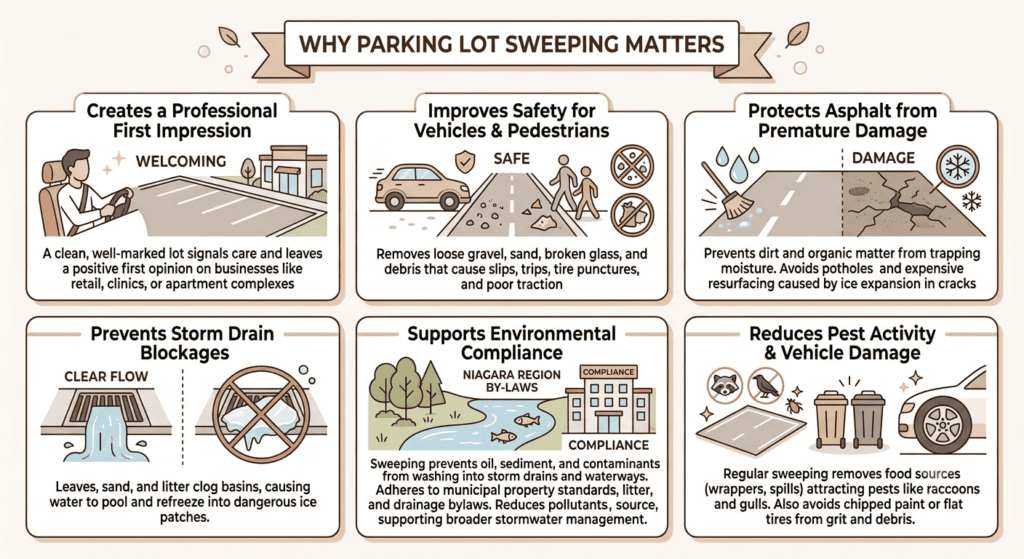
Creates a Professional First Impression
People form an opinion about a business within seconds of pulling into the lot. A clean, well-marked parking area signals that the same care extends inside the building – whether that’s a retail store, a medical clinic, or an apartment complex. A lot covered in trash and dead leaves sends the opposite message, even if the interior is spotless.
Improves Safety for Vehicles and Pedestrians
Loose gravel and sand reduce tire traction, which becomes especially dangerous during Niagara’s wetter months. Debris scattered across walkways and stalls also creates trip hazards for pedestrians, particularly older visitors or anyone carrying groceries or packages. Broken glass, nails, and other sharp debris left on the surface can puncture tires as well, turning a routine visit into an unplanned repair bill for a customer or tenant.
Protects Asphalt from Premature Damage
Dirt, sand, and organic matter hold moisture against the pavement surface. In a climate like Ontario’s, where freeze-thaw cycles are constant through winter and early spring, that trapped moisture seeps into small cracks, freezes, expands, and widens them. Left unaddressed, small cracks become potholes, and potholes become resurfacing projects that cost far more than routine sweeping ever would.
Prevents Storm Drain Blockages
Every parking lot has catch basins designed to move rainwater off the site and into the municipal storm system. Leaves, sand, and litter are the main culprits that clog those basins. Once a drain backs up, water pools across the lot, refreezes overnight in colder months, and creates ice patches that are a serious slip-and-fall risk.
Supports Environmental Compliance
Municipalities across the Niagara Region maintain bylaws around property standards, litter, and drainage that property owners are expected to follow. <cite index=”23-1″>Niagara Falls, for example, enforces a Property Standards By-law requiring proper yard drainage to prevent surface water ponding, alongside a separate Litter and Maintaining of Land By-law aimed at keeping properties free of debris.</cite> Regular sweeping also keeps oil, sediment, and other contaminants from washing into storm drains and eventually into local waterways, which matters both for compliance and for the surrounding environment.
Beyond municipal bylaws, the Niagara Region has broader stormwater management guidelines that shape how developed properties are expected to manage runoff before it leaves the site. <cite index=”19-1″>These guidelines include source controls at the lot level to reduce runoff and pollutants entering the drainage system, along with conveyance and end-of-pipe controls that filter out contaminants before stormwater reaches the receiving system.</cite> A parking lot that’s regularly swept is doing its part at the source: less sediment, oil residue, and litter means less pressure on the systems designed to filter it out downstream.
Reduces Pest Activity
Food wrappers, spilled drinks, and general litter don’t just look bad – they attract raccoons, gulls, rodents, and insects, especially around properties with restaurants or garbage enclosures. A lot that’s swept regularly removes the food source before it becomes a pest problem, which is a lot easier to manage than dealing with an established pest issue later.
Protects Vehicles from Damage
It’s not only the pavement that takes a hit from neglected debris. Loose gravel and grit kicked up by passing vehicles can chip paint and crack windshields, and sharp debris left on the surface – broken glass, nails, metal fragments – is a common source of flat tires in poorly maintained lots. None of that reflects well on the property, even when the damage technically happens to someone else’s vehicle.
How Often Should Different Parking Lots Be Swept?
There’s no single national standard – recommendations genuinely vary by property type, traffic volume, and location. What follows is a practical starting point based on how different commercial properties actually use their lots.
Retail Shopping Centers
Retail lots see the heaviest and most unpredictable foot and vehicle traffic of any commercial property type, so they typically need the most frequent attention. <cite index=”4-1,3-1″>Retail properties typically require the most frequent sweeping, and strip centers with heavy traffic often need weekly service, with some quick-service and food-tenant areas requiring twice-weekly attention.</cite> Litter accumulates fast – cups, receipts, flyers, packaging – and during the holiday shopping season, that pace only increases as more customers pass through.
Recommended frequency: Weekly, increasing to twice weekly during peak retail seasons or near food tenants.
Shopping centre managers in particular tend to underestimate just how much seasonal swings affect debris volume. A plaza that gets by comfortably on weekly sweeps in February can easily need twice-weekly service in November and December once holiday foot traffic ramps up. Building that seasonal bump into your contract ahead of time – rather than reacting to it after tenants start complaining – tends to be both cheaper and less stressful.
Office Buildings
Office parking lots see steadier, more predictable traffic, mostly concentrated around opening and closing hours. Debris tends to build up more slowly, but a professional appearance still matters for staff, clients, and visitors arriving for meetings.
Recommended frequency: Every two to four weeks, with more frequent sweeping during fall leaf drop.
Multi-tenant office parks are worth calling out separately, since they often combine several small businesses with different visitor patterns – a dental office, an insurance agency, and a coworking space, for example, all sharing one lot. In these cases it’s worth sweeping slightly more often than a single-tenant office building would need, simply because the combined foot traffic adds up faster than any one tenant would generate alone.
Apartment & Condominium Complexes
Residential properties have their own rhythm. Traffic is consistent throughout the day, and lots often double as informal gathering or play areas, which means safety matters just as much as appearance. Seasonal debris – leaves in fall, sand in spring – tends to accumulate faster near landscaped areas and building entrances.
Recommended frequency: Every two to four weeks, adjusted seasonally.
Property managers overseeing residential complexes also need to account for resident-generated debris that commercial lots don’t typically see – moving day cardboard, furniture pieces left curbside, and the general wear that comes with vehicles parked in the same spot day after day, which tends to leave oil stains and debris pooling around individual stalls rather than spread evenly across the lot.
Industrial Facilities & Warehouses
Industrial sites face a different debris profile entirely: dust, gravel tracked in by trucks, packaging material, and residue from loading and unloading operations. Heavy equipment traffic also means debris gets ground into the surface faster than in a typical retail or office lot.
Recommended frequency: Weekly, or more often around active loading docks.
Loading dock aprons and truck staging areas often need to be treated as their own zone within the broader sweeping plan. These sections take the heaviest abuse – tracked-in gravel, dropped pallets, spilled materials – and letting debris accumulate there increases the odds of forklift and truck tire damage, along with slower turnaround times for trucks trying to manoeuvre around scattered material.
Restaurants & Hospitality Businesses
Food service properties combine high customer turnover with food waste, grease, and packaging, which also tends to attract pests and wildlife if left unaddressed. <cite index=”3-1″>Parking areas near restaurants often require twice-weekly attention compared to once-weekly service for general retail sections.</cite>
Recommended frequency: Weekly, ideally twice weekly for high-volume locations.
Medical Facilities
Clinics, dental offices, and other medical facilities serve visitors who may have mobility challenges, so keeping entrances, drop-off zones, and accessible parking spaces free of debris is about more than curb appeal. <cite index=”2-1″>Healthcare facilities and medical office complexes need clear, accessible parking areas for patients, many of whom may have mobility challenges.</cite>
Recommended frequency: Weekly.
There’s an important theme running through all of this: recommendations vary by traffic volume and property use rather than a single universal schedule. Good commercial parking lot maintenance starts by recognizing that your property’s needs may not match the plaza down the street, even if the lots look similar in size. A five-unit strip plaza and a 300-unit condo complex simply don’t accumulate debris the same way, and a sweeping plan should reflect that instead of applying a one-size-fits-all rule.
Factors That Affect Sweeping Frequency
Traffic Volume
More vehicles and pedestrians mean more tracked-in dirt, more litter, and faster wear on the surface. A lot with 500 daily visits needs a very different schedule than one with 50.
Seasonal Weather in Canada
Canadian weather is arguably the single biggest variable in the whole equation. Rain washes debris toward drains and low points, wind blows leaves and litter across open areas, and freeze-thaw cycles make cracks and potholes worse if sand and grit are left sitting in them.
Nearby Trees and Landscaping
Properties surrounded by mature trees deal with heavier leaf drop in fall and pollen or seed debris in spring. <cite index=”4-1″>Leaves, pine needles, and organic debris can quickly pile up and clog drainage systems, and sweeping frequency should increase to weekly or multiple times per week depending on tree coverage.</cite>
Construction Activity
Nearby construction – whether on your property or a neighbouring site – tracks in dirt, concrete dust, and debris at a much faster rate than normal use. Sweeping frequency should temporarily increase whenever active construction is happening nearby.
Snow Removal and Winter Sand
Winter operations leave their own residue behind. <cite index=”4-1″>Winter storms often bring sand, gravel, and road debris into parking areas</cite>, and the sand applied for traction during icy conditions doesn’t disappear once the snow melts – it sits on the surface (and often in cracks) until it’s swept away.
Taken together, these variables are why parking lot cleaning frequency should be treated as a moving target rather than a fixed number written into a contract and never revisited.
Property Size
Larger lots naturally take longer to service and may need to be broken into sections or handled with different equipment depending on layout, obstacles, and the number of islands or curbs involved.
Lot Layout and Obstacles
A wide-open lot with few obstructions can be swept quickly and efficiently with a single mechanical pass. A lot full of islands, curbs, tight corners, and angled parking takes considerably longer per square foot, since much of that debris has to be dislodged manually or with edge-focused equipment before it can be collected. Two properties of identical size can need very different amounts of sweeping time purely because of layout.
Nearby Municipal Noise and Access Restrictions
Some municipalities and residential-adjacent properties restrict when sweeping equipment can operate, which affects how often and when service can realistically happen. <cite index=”9-1″>Some cities require battery-powered blowers to reduce environmental impact, while others restrict blower use entirely to limit noise near residential areas.</cite> Properties bound by these restrictions sometimes need to schedule sweeping in smaller, more frequent sessions rather than one longer visit.
Seasonal Parking Lot Sweeping Schedule
Ontario’s four distinct seasons each bring a different kind of debris challenge, which is why a smart maintenance plan adjusts throughout the year instead of running on autopilot.
Spring: As the snow melts, the accumulated winter sand, salt residue, and gravel left behind by plows and traction treatments become visible across the entire lot. This is one of the most important sweeps of the year – that sand grinds into asphalt every time a tire rolls over it, and it clogs drains just as the spring melt is sending the most water their way.
Summer: Dust, dry litter, and general debris are the main concerns. Traffic tends to peak in summer for retail and hospitality properties, so this is also when appearance matters most to visiting customers.
Fall: Leaf removal becomes the priority, especially before drains clog ahead of fall rains. Properties near mature trees may need weekly sweeping through peak leaf drop to keep up.
Winter: Full sweeping is harder between snow events, but clearing loose debris and sand when conditions allow helps reduce buildup before it gets buried under the next snowfall.
Spring and fall are especially important in Canadian climates because winter sanding materials and autumn leaves can damage pavement and block drainage if left in place – these two seasonal transitions do more long-term damage to neglected lots than almost anything else on this list.
What Professional Parking Lot Sweeping Actually Involves
It helps to know what you’re paying for. <cite index=”5-1″>Professional parking lot sweeping uses specialized equipment – typically industrial-grade sweepers mounted on trucks – to remove litter, leaves, dust, dirt, gravel, and other debris from paved surfaces, designed to clean thoroughly without damaging the asphalt or concrete underneath.</cite> A typical service visit usually includes:
- Mechanical sweeping of open areas – the main lanes and stalls, covered efficiently with a ride-on or truck-mounted sweeper
- Edge and curb detailing – corners, curb lines, and tight spaces where mechanical sweepers can’t fully reach, often finished by hand or with a smaller push unit
- Catch basin and drain clearing – removing leaves and debris piled against grates so water can actually drain
- Litter and debris collection – bagging or hauling away anything the sweeper picks up, rather than just relocating it
- Fine particulate and dust control – vacuum systems on modern sweepers capture fine dust rather than just stirring it into the air
Sweepers built for this work typically combine side brushes to pull debris away from curbs with a central vacuum or brush-and-pan system to lift material off the surface. This matters because a standard push broom or leaf blower mostly relocates debris rather than removing it – fine sand and grit in particular tend to just get pushed into cracks or blown into a neighbouring stall, which is part of why professional equipment produces such a different result than DIY cleanup.
Signs Your Parking Lot Needs Immediate Sweeping
Even with a set schedule, some properties need an unscheduled visit. Watch for:
- Overflowing garbage or litter accumulating around bins
- Leaves covering catch basins or drain grates
- Visible oil stains spreading across the surface
- Excessive dust kicking up when vehicles drive through
- Loose gravel collecting in corners or along curb lines
- Standing water that isn’t draining properly
- Tenant or customer complaints about cleanliness
- An overall unpleasant or neglected appearance
<cite index=”4-1″>Signs of an overdue lot typically include visible debris buildup, clogged drains, increased dust, or complaints from tenants or visitors</cite> – and any one of these is worth a call to your maintenance provider rather than waiting for the next scheduled sweep.
Benefits of Regular Parking Lot Sweeping
Extends Pavement Life
Removing grit and moisture-trapping debris slows the freeze-thaw damage that shortens asphalt lifespan, which means longer stretches between costly resurfacing projects.
Reduces Repair Costs
This is really the core of good asphalt maintenance: preventing small cracks from becoming potholes is dramatically cheaper than fixing them after the fact. Asphalt repairs typically run into the thousands of dollars, while routine sweeping is a fraction of that cost spread across the year.
Improves Customer Experience
Visitors notice a clean, well-maintained lot even if they can’t quite articulate why it matters. It shapes their overall impression of the property before they’ve stepped through the front door.
Enhances Property Value
For property owners planning to sell, lease, or attract new tenants, a well-maintained exterior – parking lot included – plays into how the whole property is valued and perceived.
Reduces Slip-and-Fall Risks
Clear walkways and stalls, free of loose gravel, ice patches from clogged drains, or scattered debris, reduce the odds of a liability claim.
Supports Positive Business Image
For retail, hospitality, and healthcare properties in particular, the parking lot is part of the brand experience. A consistently clean lot reinforces the same standards customers expect once they’re inside.
DIY vs Professional Parking Lot Sweeping
DIY Limitations
- Time-consuming, especially for larger lots
- Limited equipment compared to industrial sweepers
- Inconsistent results, particularly with fine dust and debris in cracks
- No system for tracking recurring problem areas over time
Professional Sweeping
- Industrial-grade sweepers built for pavement, not just push brooms or leaf blowers
- Significantly faster cleaning of large areas
- Better removal of fine debris, sand, and grit from cracks and curb lines
- A preventative maintenance mindset – catching drainage issues, cracking, and problem areas before they get expensive
For a small strip plaza with a handful of spaces, occasional DIY cleanup might be manageable. For anything larger, or for properties that need reliable, documented service for compliance purposes, professional sweeping is almost always the better investment.
There’s also a scheduling reliability factor that’s easy to overlook. DIY cleanup usually happens when someone remembers to do it or when a complaint forces the issue, which means debris sits on the lot longer than it should. A contracted sweeping schedule removes that guesswork – the visits happen on a set cadence regardless of whether staff are busy with other priorities that week, which is often the real difference between a lot that looks consistently clean and one that cycles between “fine” and “overdue.”
Choosing a Parking Lot Sweeping Provider in Niagara
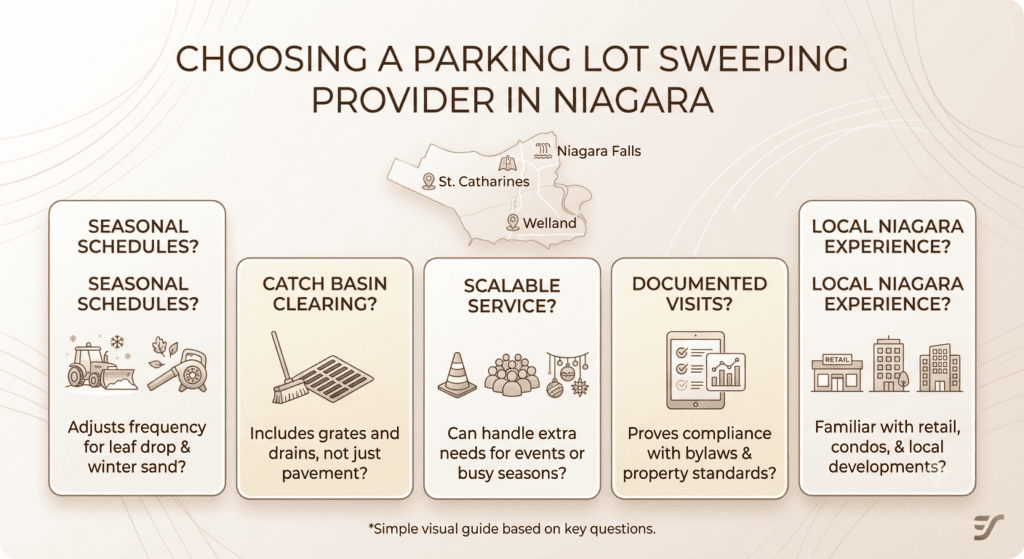
Not every sweeping company offers the same level of service, and a few questions can help separate a reliable long-term partner from a one-off crew:
- Do they adjust the schedule seasonally, or does the contract lock in the same frequency year-round regardless of leaf drop or winter sand?
- Do they clear catch basins and drain grates as part of the visit, or only the open pavement?
- Can they scale up temporarily for construction nearby, a special event, or a busy holiday season?
- Do they document service visits, which matters if you ever need to demonstrate compliance with local property standards or stormwater bylaws?
- Are they familiar with the property types common in this region – retail plazas, condo complexes, and mixed-use developments across Niagara Falls, St. Catharines, and Welland – rather than applying a generic national template?
A provider that can answer all of these confidently is generally going to save you more in avoided repairs and fewer complaints than the small difference in per-visit pricing between competing quotes.
How NLLC Helps Keep Commercial Properties Clean
NLLC (Niagara Landscaping, Lawn Care & Cleaning) works with commercial property owners and managers across Niagara Falls, St. Catharines, Welland, Fort Erie, Niagara-on-the-Lake, Thorold, Port Colborne, and the broader Niagara Region to keep parking lots and exterior spaces looking their best year-round. Our services include:
- Routine parking lot sweeping tailored to your property type and traffic
- Broader property maintenance to complement sweeping
- Commercial cleaning services for interior and exterior spaces
- Seasonal parking lot debris removal, including spring cleanup of winter sand and fall leaf management
- Flexible maintenance schedules built around your property’s actual usage patterns
- Reliable, consistent service across commercial properties throughout the Niagara Region
We don’t apply a one-size-fits-all schedule. Instead, we look at your property’s traffic, layout, surrounding trees and landscaping, and seasonal exposure to recommend a sweeping frequency that actually makes sense – and we adjust it as conditions change throughout the year.
Conclusion
There’s no single universal answer to how often should parking lots be swept – the right schedule depends on your property’s traffic, its surrounding environment, and Ontario’s shifting seasons. What stays consistent is the payoff: regular sweeping protects your asphalt investment, keeps visitors and tenants safer, reduces long-term repair costs, and leaves a genuinely good first impression on everyone who pulls into your lot.
If you’re not sure where your property fits – or your current schedule just isn’t keeping up – it’s worth building a customized maintenance plan with a professional service provider who knows your area’s seasonal patterns. Good property maintenance Canada-wide always accounts for the freeze-thaw cycles and seasonal debris that a lot further south simply doesn’t have to plan around. NLLC works with property owners across the Niagara Region to design sweeping schedules that match how each lot is actually used, so you’re never paying for more service than you need or falling behind on the service you do.
Ready to build a sweeping schedule that fits your property? Contact NLLC today for a free quote and let’s put together a maintenance plan for your Niagara Region commercial property.
Frequently Asked Questions
How often should a commercial parking lot be swept?
Most commercial lots benefit from sweeping somewhere between weekly and monthly, depending on traffic volume, property type, and season. High-traffic retail and food service properties typically need weekly or twice-weekly service, while lower-traffic office and residential lots can often go two to four weeks between sweeps.
Is monthly parking lot sweeping enough?
For lower-traffic properties with minimal debris sources – such as small office buildings away from major tree cover – monthly sweeping can be sufficient. Higher-traffic properties, or those near trees, restaurants, or construction, usually need more frequent service to stay ahead of debris buildup.
Does parking lot sweeping prevent pavement damage?
Yes. Removing sand, grit, and organic debris reduces the moisture retention and abrasive wear that accelerate cracking, especially through Ontario’s freeze-thaw winters. Regular sweeping is one of the most cost-effective ways to extend the life of asphalt.
What season is most important for parking lot sweeping?
Spring and fall tend to matter most in Canadian climates. Spring sweeping removes accumulated winter sand and salt before it grinds into the pavement, while fall sweeping clears leaves before they clog drains ahead of seasonal rains.
How much does professional parking lot sweeping cost in Canada?
Pricing varies by lot size, frequency, and location, but many providers price smaller commercial lots in the range of roughly $75 to $200 per visit, with larger properties priced by square footage or number of stalls. <cite index=”10-1″>One Ontario-based provider quotes roughly $75 for a 25-space lot up to around $165 for a 1,000-stall lot per sweep</cite>, though exact rates depend on debris levels, accessibility, and how often service is scheduled. Committing to a recurring maintenance plan generally brings the per-visit cost down compared to one-off cleanups.
Can sweeping frequency change throughout the year?
Yes, and it generally should. Most well-run maintenance plans build in seasonal adjustments – heavier sweeping in spring to clear winter sand, increased frequency during fall leaf drop, and lighter service during quieter winter stretches when snow limits access. A fixed year-round schedule usually ends up either overpaying in slow months or falling behind during peak debris seasons.
Does a small parking lot still need professional sweeping?
Smaller lots accumulate less debris overall, but they’re not exempt from the same underlying risks – trapped moisture, drain blockage, and slip hazards can affect a 20-space lot just as easily as a 500-space one, just on a smaller scale. Many providers offer reduced rates for smaller properties, which often makes professional service more affordable than expected.
What’s the difference between sweeping and power washing?
Sweeping removes loose debris, dirt, sand, and litter from the surface using mechanical or vacuum-based equipment. Power washing uses pressurized water to remove embedded stains, oil residue, and ground-in grime that sweeping alone can’t lift. Many properties benefit from both – regular sweeping to manage day-to-day debris, with occasional power washing to handle stains and deep cleaning.
Who is responsible for parking lot maintenance in a commercial lease?
This varies by lease agreement, but in many commercial and multi-tenant properties, common area maintenance (CAM) responsibilities – including parking lot sweeping – fall to the property owner or manager rather than individual tenants. It’s worth confirming the specific terms in your lease, since this affects who books and pays for the service.