Most homeowners don’t think about their roof until it leaks. They don’t think about their eavestroughs until water is pooling by the foundation, or their lawn until the neighbours start talking. That “I’ll deal with it later” mindset feels harmless in the moment, but it’s one of the most expensive habits a property owner can have.
Here’s the thing nobody tells you when you buy a home or take over a rental portfolio: maintenance isn’t an expense you’re trying to avoid. It’s insurance you’re paying yourself instead of a repair company. Skip it, and the bill doesn’t disappear – it just grows, compounds, and shows up later with interest.
This is especially true here in the Niagara Region, where freeze-thaw cycles, lake-effect snow, and humid summers put more wear on a property in a single year than milder climates see in three. If you own a home, manage rental units, or run a commercial property in Niagara Falls, St. Catharines, Welland, Fort Erie, Niagara-on-the-Lake, Thorold, or Port Colborne, understanding how property maintenance saves money in the long run isn’t just useful information – it’s the difference between predictable annual costs and unpredictable emergency ones.
In this guide, we’ll walk through the real numbers behind preventive care, a practical seasonal checklist built for our region, budgeting guidance for 2026, and the specific services that protect your property year-round. If you’ve ever wondered whether it’s really worth paying for regular lawn care, snow removal, or a cleaning schedule, the data below should settle the question.
What Property Maintenance Actually Means
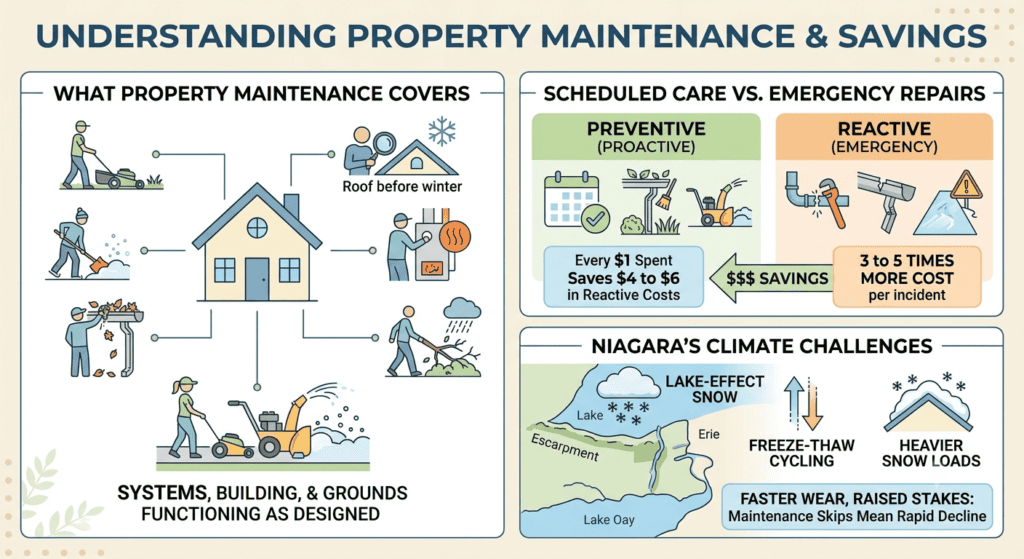
Property maintenance covers every task that keeps a building, its systems, and its grounds functioning the way they were designed to. That includes obvious things like mowing the lawn, clearing snow, and cleaning gutters, but it also includes less visible work: inspecting a roof before winter, checking a furnace before the first cold snap, or walking a property after a storm to catch damage before it spreads.
Broadly, maintenance falls into two categories, and the difference between them is where most of the money is won or lost.
Scheduled Care vs. Emergency Repairs
Preventive maintenance is scheduled, planned, and proactive. Think seasonal lawn treatments, routine eavestrough cleaning, or a snow removal contract that clears your driveway before ice has a chance to form. Reactive maintenance, on the other hand, happens after something has already broken – a burst pipe, a collapsed gutter, a driveway nobody cleared that turned into a liability claim.
The industry data on this is consistent and striking. Every dollar spent on this kind of scheduled care typically saves four to six dollars in reactive repair costs down the line. Reactive, emergency-driven repairs also tend to cost three to five times more per incident than the same work completed on a planned schedule, mostly because of rushed labour, after-hours call-out fees, and the cost of parts bought under time pressure rather than shopped around in advance.
Why Niagara’s Climate Raises the Stakes
Niagara sits in a demanding spot for building exteriors. The region catches lake-effect snow from both Lake Erie and Lake Ontario, and the Niagara Escarpment creates its own microclimate extremes. That combination means more freeze-thaw cycling, heavier snow loads, and faster wear on roofs, eavestroughs, and exterior surfaces than most of Ontario experiences. A property here that skips a season of maintenance doesn’t just fall a little behind – it falls behind faster than a similar property in a milder climate would.
The Real Cost of Neglecting Your Property
How Small Problems Turn Into Big Bills
Deferred maintenance rarely stays small. A hairline crack in a driveway left through a Niagara winter becomes a full resurfacing job after a few freeze-thaw cycles force water into the crack, freeze, expand, and split the concrete further. A gutter that isn’t cleaned before winter can back up, form an ice dam, and send meltwater under the shingles and into the attic – turning a $150 gutter cleaning into a $600–$2,500 ice-dam repair, and sometimes into thousands more in interior water damage and insulation replacement.
The pattern is the same across every part of a property: plumbing, roofing, HVAC, landscaping, and exterior surfaces. Left unaddressed, a small, cheap fix becomes a large, disruptive, and far more expensive one – and it usually happens at the least convenient time, like the middle of a snowstorm or a tenant turnover.
Reactive Repairs vs. Planned Maintenance – The 2026 Numbers
The financial gap between planned and emergency work has only widened heading into 2026. Structured maintenance programs typically cut a property’s overall operating costs by 12% to 18% across a portfolio. For a property generating $500,000 in annual gross rents, that translates into roughly $60,000 to $90,000 in avoided costs per year – before even factoring in tenant retention.
Well-maintained equipment, from HVAC systems to irrigation lines, also tends to run 15% to 25% more efficiently than neglected systems, which means lower utility bills on top of fewer breakdowns. And preventive care extends the useful life of building components and mechanical systems by an average of 20% to 35%, delaying the day you have to replace a furnace, roof, or driveway altogether.
For landlords specifically, there’s a second cost that rarely shows up in a maintenance budget but hits just as hard: tenant turnover. A property with a reputation for slow repairs and visible neglect loses tenants faster, and turnover is expensive – typically one to two months of lost rent per unit once you account for vacancy time, marketing, and re-leasing costs. On an $1,800-a-month unit, one preventable non-renewal can cost $1,800 to $3,600 before you even factor in the disruption of finding and screening a new tenant. Consistent maintenance isn’t just about the building; it’s one of the strongest tools a landlord has for keeping good tenants in place.
There’s also a compounding effect that’s easy to underestimate. A single deferred repair rarely stays isolated. A slow roof leak that goes unnoticed for a season doesn’t just damage shingles – it can soak insulation, stain drywall, encourage mould growth, and eventually affect indoor air quality. What started as a $200 fix can turn into a multi-thousand-dollar remediation project touching three or four different trades. Property maintenance saves money precisely because it interrupts that chain reaction while the fix is still small, contained, and inexpensive.
How Property Maintenance Saves Money in the Long Run
This is really the core idea behind everything in this guide: property maintenance saves money in the long run because it converts unpredictable, large expenses into small, predictable, budgeted ones. Insurance companies understand this. Lenders understand this. Experienced property managers understand this. It’s the same logic behind changing your car’s oil instead of waiting for the engine to seize.
The $1-In, $4-to-$6-Back Rule
This is one of the most consistently cited figures in the property management and facilities world: every $1 invested in planned upkeep saves an average of $4 to $6 in reactive repair costs. It holds up whether you’re talking about a single-family home, a rental property, or a commercial building, because the underlying mechanics are the same – catching a problem early is always cheaper than fixing the damage it eventually causes.
Longer-Lasting Systems and Assets
Roofs, HVAC systems, driveways, and lawns all have a natural lifespan, but that lifespan shrinks fast under neglect. A furnace that gets an annual tune-up can run reliably for 15–20 years. One that never gets serviced often fails years earlier, usually at the worst possible moment. The same logic applies outdoors: a lawn that’s aerated, fertilized, and weeded on schedule stays healthy and resists disease, while a neglected lawn requires a far more expensive full renovation to bring back.
Fewer Insurance Headaches
Insurers increasingly scrutinize maintenance history after a claim, particularly for water damage, ice dams, and slip-and-fall incidents. A documented maintenance schedule – records of snow clearing, gutter cleaning, and routine inspections – can be the difference between a claim being approved smoothly and a dispute over whether the damage was a “sudden event” or the result of neglect. Beyond claims, some insurers also offer better terms to properties that can show a consistent maintenance history, because the underlying risk profile is genuinely lower.
How Much Should You Budget for Property Maintenance?
The 1%–4% Rule Explained
The most common budgeting guideline used by homeowners and property managers alike is simple: set aside 1% to 4% of your property’s value every year for maintenance. A newer property in good condition, with recently updated systems, tends to sit at the lower end of that range. Older properties, larger properties, or those with aging roofs, plumbing, or HVAC systems should plan for the higher end.
Building a realistic home maintenance budget starts with this range and then adjusts for your property’s specific age and condition. For a property valued at $500,000, that works out to roughly $5,000 to $20,000 a year. It sounds like a lot until you compare it to the alternative: a single failed furnace can run $5,000 to $15,000 to replace, and a burst or failed sewer line can cost anywhere from $3,000 to $25,000 to repair. A dedicated, separate maintenance fund turns those numbers from financial emergencies into line items you already planned for.
A Sample Seasonal Budget for a Niagara Property
Because Niagara properties deal with more seasonal extremes than most, it helps to think about the annual maintenance budget in four seasonal buckets rather than one lump sum:
- Spring: Eavestrough cleaning, lawn dethatching and aeration, exterior inspection after winter, driveway crack sealing
- Summer: Lawn care and irrigation, landscaping upkeep, pressure washing, HVAC servicing before peak cooling season
- Fall: Gutter clearing before leaf-drop, furnace inspection, winterizing outdoor taps and irrigation, tree pruning
- Winter: Snow and ice management, roof snow-load monitoring, pipe insulation checks, emergency response readiness
Splitting the annual figure across these four seasons also makes it easier to plan cash flow, since Niagara winters typically demand a larger share of the budget than any other season.
A Seasonal Property Maintenance Checklist for Niagara Homeowners
Working from a written seasonal maintenance checklist, rather than relying on memory, is the simplest way to make sure nothing slips through the cracks between one season and the next.
Spring
Once the snow clears, walk the full exterior of the property. Check the roof and eavestroughs for winter damage, clean out anything that accumulated over the season, and look closely for signs of ice-dam damage along the roofline. This is also the right time to book lawn dethatching, aeration, and the first fertilizer application, since Niagara lawns coming out of a hard winter usually need a head start before summer heat arrives. Inspect the driveway and walkways for cracks caused by freeze-thaw cycling and get them sealed before they widen.
Summer
Summer is about consistency. Regular mowing, weed control, and irrigation keep a lawn healthy and resistant to the disease and bare patches that turn into costly renovations later. It’s also a good window for pressure washing siding, decks, and walkways, and for scheduling an HVAC check before the peak of summer heat puts real strain on an aging air conditioner.
Fall
Fall maintenance is where a lot of Niagara properties fall behind, and it’s the single most important season to stay on top of before winter arrives. Clear gutters after the leaves drop, have your furnace inspected and serviced, disconnect and drain outdoor hoses and irrigation lines, and prune trees and shrubs away from the roofline and power lines before ice and heavy snow put weight on overhanging branches.
Winter
Once the snow starts, the priority shifts to safety and damage prevention: consistent driveway and sidewalk clearing, monitoring for ice dam formation, and keeping an eye on any areas where snow load is building up on flat or low-slope roofing. This is also when having a reliable snow removal contractor – rather than relying on whoever’s available after a storm hits – pays for itself many times over.
Lawn Care and Landscaping: The Highest-Return Maintenance You Can Do
Exterior Appeal and Resale Value
If you’re looking for the single best-value maintenance category on a property, it’s the lawn. Industry research on real estate outcomes consistently shows that basic, routine lawn care – mowing, fertilizing, and weed control – delivers one of the highest returns of any home improvement category, often recovering well over double its cost in added home value. Landscaping more broadly, including healthy trees, clean garden beds, and a well-kept front yard, can lift a property’s perceived value by roughly 5% to 15%, and real estate professionals overwhelmingly agree that curb appeal directly affects how quickly a home sells and at what price.
Put simply, lawn care ROI is hard to beat compared with almost any other home improvement dollar you could spend. For rental property owners, the impact goes beyond resale. A well-maintained yard signals to prospective tenants that a property is cared for and professionally managed, which supports both faster leasing and better tenant retention.
Preventing Yard-Related Property Damage
Landscaping isn’t just cosmetic – it protects the building itself. Overgrown trees and shrubs pressed against siding trap moisture and invite pests. Poor grading and drainage around a foundation can direct water exactly where you don’t want it, leading to basement leaks and cracked foundations over time. Regular landscaping maintenance, including proper pruning and drainage checks, heads off these issues before they become structural repairs.
Snow and Ice Management: Protecting Your Property All Winter
The Hidden Cost of Ice Dams and Roof Damage
Ice dams are one of the most common – and most preventable – sources of winter property damage in our region. They form when heat escaping through the roof melts snow, which then refreezes at the colder eave edge, building a wall of ice that traps meltwater and pushes it back under the shingles. The result can be a leaking roof, damaged insulation, and interior water damage that costs far more to repair than the eavestrough cleaning and roof maintenance that would have prevented it in the first place. Full ice-dam repairs in Ontario typically run from several hundred to a few thousand dollars per incident, not counting any interior damage that follows – a bill that dwarfs typical seasonal snow removal costs for the same property.
Liability, Safety, and Slip-and-Fall Risk
Beyond the physical damage, uncleared snow and ice create real liability exposure. A slip-and-fall incident on an unshoveled walkway or icy parking lot can result in an injury claim against a property owner, along with the legal and insurance costs that come with it. Consistent, professional snow and ice management isn’t just about convenience – it’s a direct way to reduce risk and protect both tenants and visitors.
Cleaning as Part of a Maintenance Plan
Residential and Commercial Cleaning
Cleaning doesn’t always get filed under “maintenance,” but it should. Regular residential and commercial cleaning prevents the kind of buildup – grease, moisture, mold, dust in HVAC systems – that slowly damages surfaces and equipment over time. For commercial spaces, consistent janitorial service also protects flooring, fixtures, and finishes from premature wear, extending the time between costly replacements.
Airbnb and Rental Turnovers
For short-term rental owners, cleaning is rental property upkeep in its most direct form. A properly cleaned unit between guests protects furniture, appliances, and finishes from the accelerated wear that comes with high turnover, while also protecting your reviews and occupancy rate – both of which have a direct impact on income.
Junk and Garbage Removal – Small Service, Big Protection
It’s easy to overlook, but accumulated junk, construction debris, or overflowing waste on a property creates real risks: pest infestations, fire hazards, and in commercial or rental settings, potential code violations. Regular garbage and junk removal keeps a property compliant, safe, and presentable, and it prevents the kind of slow accumulation that eventually requires an expensive, large-scale cleanout.
DIY vs. Professional Maintenance: What Actually Saves You Money
When DIY Makes Sense
Some maintenance tasks are genuinely well-suited to doing yourself: changing furnace filters, basic gutter checks on a single-storey home, light weeding, or wiping down exterior surfaces. If you have the time, the right tools, and the task doesn’t involve height, electrical work, or specialized equipment, DIY can be a reasonable way to stay on top of small items between professional visits.
When Hiring a Professional Pays for Itself
For anything involving roofs, large trees, snow-covered driveways, HVAC systems, or properties with multiple units, professional service almost always saves money over time. Professionals catch problems a homeowner might miss, carry insurance that protects you if something goes wrong, and have the equipment to do the job faster and more thoroughly. For landlords and commercial property owners in particular, the time saved by outsourcing maintenance is itself worth real money, since it frees you up to focus on tenants, leasing, and growing your portfolio instead of spending weekends on a ladder.
There’s also a consistency argument that’s easy to overlook. A homeowner handling their own snow removal might get delayed by work, travel, or simply being unavailable when a storm hits – and a driveway or walkway left uncleared for even a day creates real liability exposure. A professional service with a set contract removes that variability entirely. The same logic applies to lawn care: a schedule that slips by a week or two here and there over a season adds up to a noticeably less healthy lawn by fall, which then requires more expensive corrective treatment the following spring. Professional maintenance isn’t just about skill – it’s about the discipline of a schedule that doesn’t depend on your calendar staying clear.
A simple way to think about it: if a task requires specialized equipment, carries real safety risk, or has to happen on a strict weather-driven timeline, professional service is almost always the more cost-effective choice once you account for your own time, the risk of a missed window, and the cost of doing it wrong the first time.
Common Maintenance Mistakes That Cost Niagara Homeowners
- Waiting for visible damage before acting. By the time you can see a problem, it’s often already caused secondary damage you can’t see yet.
- Skipping fall gutter cleaning. This is consistently the single most expensive maintenance task to skip in our region, given how directly it feeds into ice dam and roof damage.
- Treating snow removal as optional or “as needed.” Waiting until a storm has already hit to look for a contractor almost always means paying emergency rates – or not finding help at all.
- Ignoring the lawn until it’s already patchy or diseased. A full lawn renovation costs significantly more than the routine care that would have prevented it.
- Not budgeting separately for maintenance. Without a dedicated fund, maintenance costs compete with everyday expenses and get delayed – which is exactly how small issues become large ones.
- Hiring based on price alone. The cheapest quote often means corners cut on inspection quality, insurance coverage, or follow-through, which shows up later as repeat problems.
Property Maintenance Trends to Watch in 2026
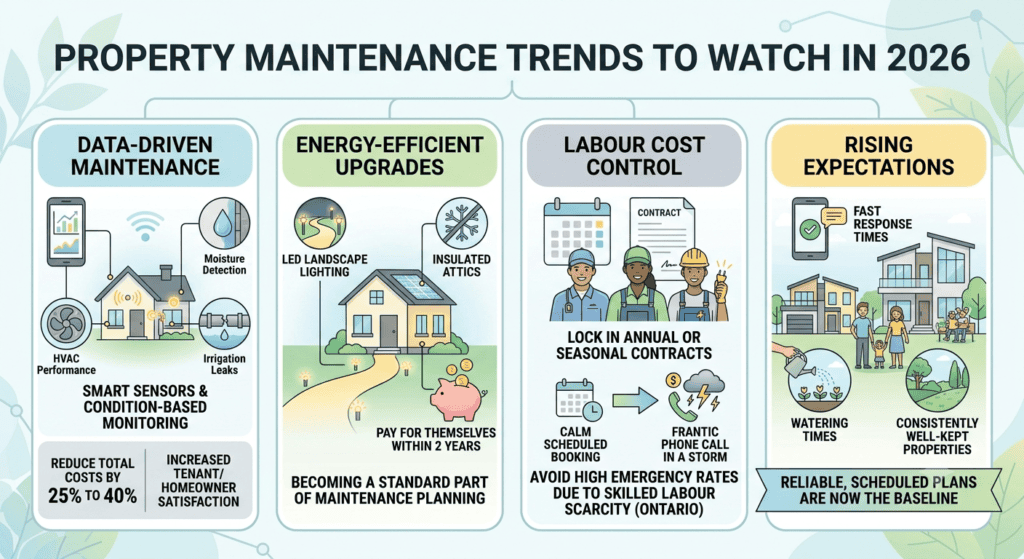
Property maintenance is becoming more data-driven. Smart sensors and monitoring tools are increasingly used to flag issues – moisture behind walls, HVAC performance drops, irrigation leaks – before they become visible problems, allowing repairs to be scheduled proactively rather than reactively. Properties using this kind of condition-based monitoring are reporting total maintenance cost reductions in the 25% to 40% range compared to a purely reactive approach, along with noticeably higher tenant and homeowner satisfaction, simply because fewer things break unexpectedly.
Energy-efficient upgrades, from LED landscape lighting to better-insulated attics that reduce ice dam formation, are also becoming a standard part of maintenance planning rather than an optional add-on, partly because they tend to pay for themselves within a couple of years through lower utility bills. Outdoor lighting upgrades in particular offer a nice combination of safety, street-level appeal, and energy savings, which is why more Niagara homeowners are including them in their annual landscaping plans rather than treating them as a one-off project.
Labour costs are another trend worth watching. Skilled trades and reliable seasonal crews are in high demand across Ontario, and that scarcity tends to push emergency, same-day service rates higher every year. Locking in a maintenance provider on a seasonal or annual contract – rather than searching for last-minute help during a storm or a heat wave – is becoming less of a convenience and more of a genuine cost-control strategy.
Finally, across the industry, tenant and homeowner expectations have shifted: fast response times and consistently well-kept properties are now considered the baseline, not a bonus, which puts even more weight behind having a reliable, scheduled maintenance plan rather than a reactive one.
How NLLC Helps Niagara Property Owners Protect Their Investment
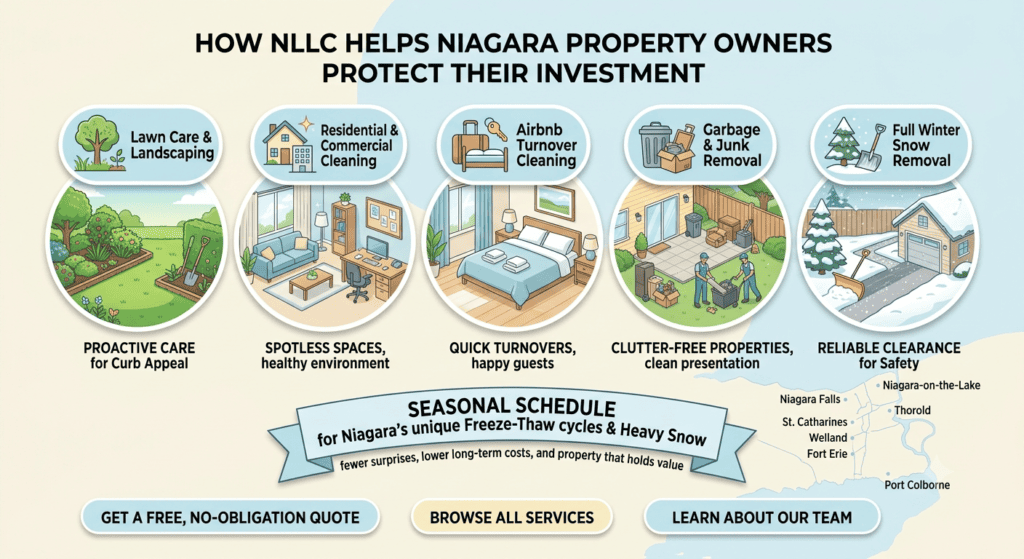
At NLLC (Niagara Landscaping, Lawn Care & Cleaning), this is the exact philosophy behind how we work with homeowners, landlords, and commercial property owners across Niagara Falls, St. Catharines, Welland, Fort Erie, Niagara-on-the-Lake, Thorold, Port Colborne, and the wider Niagara Region. We offer lawn care and landscaping, residential and commercial cleaning, Airbnb turnover cleaning, garbage and junk removal, and full winter snow removal – the exact set of services that make up a complete, proactive maintenance plan for a property in our climate.
Rather than waiting for a call after something has already gone wrong, our team works on a consistent, seasonal schedule designed specifically for the freeze-thaw cycles and heavy snow loads that define a Niagara winter. That’s the entire point of proactive care: fewer surprises, lower long-term costs, and a property that holds its value and its first impression all year round.
Whether you’re a single homeowner or you oversee a portfolio that needs professional property management-level consistency, if your property doesn’t currently have a maintenance plan in place, the easiest first step is a conversation about what your specific property needs. You can get in touch with our team for a free, no-obligation quote, browse our full range of services, or learn more about who we are on our About page.
Conclusion – Start Saving With a Maintenance Plan, Not a Panic Repair
The math is consistent no matter how you look at it: property maintenance saves money in the long run because it replaces large, unpredictable repair bills with small, planned, manageable ones. In a climate like Niagara’s, where freeze-thaw cycles and heavy snow put extra strain on every part of a property, that gap between reactive and preventive costs is even wider than in milder regions.
The properties that hold their value, avoid emergency repairs, and keep tenants and owners happy aren’t the ones that get lucky – they’re the ones with a consistent maintenance schedule behind them. If you’d rather budget for routine lawn care and snow removal than for a surprise roof repair in February, now is the right time to put a plan in place.
Ready to protect your property before the next season hits? Contact NLLC today for a free quote, or explore our full lineup of lawn care, landscaping, cleaning, garbage removal, and snow removal services built specifically for Niagara properties.
Frequently Asked Questions
How much should I budget for property maintenance each year?
A common guideline is 1% to 4% of your property’s current value annually, with older properties or those with aging systems landing toward the higher end of that range.
What’s the biggest maintenance mistake homeowners make in Niagara?
Skipping fall gutter cleaning and roof inspection before winter. It’s directly linked to ice dam formation, which is one of the most expensive and common sources of winter property damage in our region.
Does regular lawn care really affect my home’s resale value?
Yes. Routine lawn care is consistently shown to deliver one of the highest returns of any home maintenance category, and real estate professionals widely agree that a well-kept exterior directly influences how a home is perceived by buyers.
Is professional snow removal worth the cost compared to doing it myself?
For most properties, yes – especially larger driveways, commercial lots, or rental properties. Professional service reduces liability risk, protects against ice dam formation, and avoids the higher costs and safety risks of last-minute, self-managed snow clearing during a storm.
How often should gutters be cleaned in the Niagara Region?
At minimum, twice a year – once in spring after winter debris has settled, and once in fall before leaves finish dropping and before the first hard freeze.
Can a maintenance schedule really lower my insurance costs?
It can help. A documented maintenance history supports smoother claims processing and, in some cases, better terms, since it demonstrates a lower ongoing risk profile to insurers.
What’s the difference between planned and reactive maintenance?
Planned care is scheduled and proactive – routine inspections, seasonal service, and consistent upkeep. Reactive maintenance happens only after something has already broken, and it typically costs several times more per incident than the same work done on a planned schedule.
Should rental property owners budget differently than homeowners?
Rental owners often need to budget slightly higher, since neglected upkeep also risks tenant turnover, vacancy costs, and lease non-renewals on top of the direct repair costs.