You know that feeling when you drive past a house and your brain just… likes it? You can’t always say why. Maybe it’s the way the shrubs frame the front door, or how the walkway curves instead of running in a straight, boring line. That reaction happens in about seven seconds, according to real estate research, and it happens before anyone has stepped inside or seen a single square foot of the kitchen.
That’s curb appeal. And in 2026, the rules around it have shifted. Homeowners aren’t just tidying up a lawn to impress the neighbors anymore – they’re using their front yards as an extension of their personality, a low-risk way to try something bold, and, for a growing number of people, a genuinely smart financial move.
If you own a home anywhere in the Niagara Region – Niagara Falls, St. Catharines, Welland, Fort Erie, Niagara-on-the-Lake, Thorold, or Port Colborne – you’re dealing with a specific set of curb appeal landscaping ideas that need to survive our winters, handle clay-heavy soil, and still look sharp come July. This guide walks through what’s actually working right now, backed by current data, real plant recommendations for our climate zone, and practical steps you can start on this weekend or hand off to a professional crew.
Why Curb Appeal Landscaping Ideas Actually Pay Off
Before getting into specific ideas, it’s worth understanding why this matters so much – because the numbers are more convincing than most homeowners realize.
The “Halo Effect” Is Real
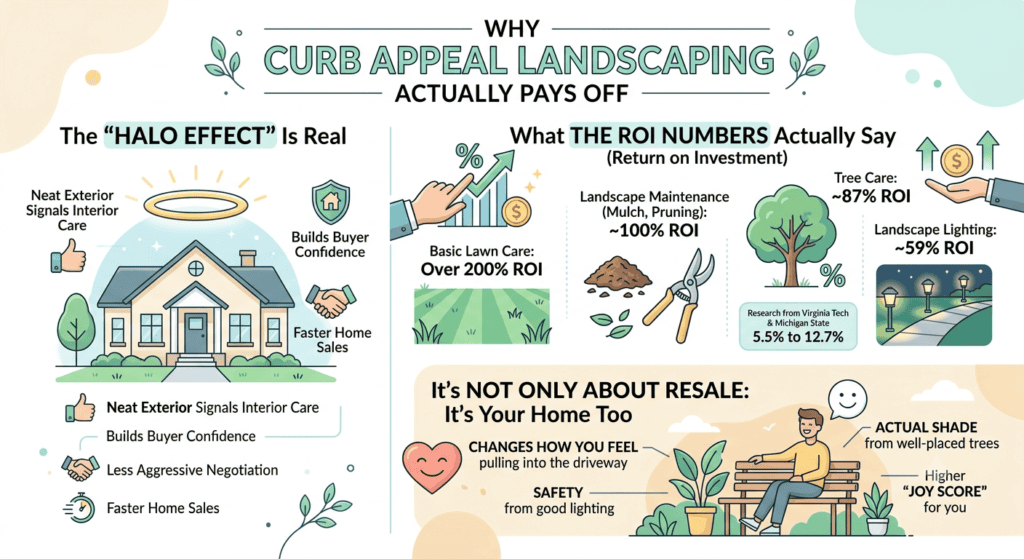
Appraisers and real estate agents talk about something called the halo effect. A neat, well-planted exterior signals to a buyer’s brain that the rest of the house has probably been cared for too. That assumption builds confidence, and confident buyers negotiate less aggressively and move faster. Nearly every real estate agent surveyed in recent industry research says curb appeal plays a meaningful role in attracting buyers, and the vast majority recommend that sellers address their landscaping before a home ever hits the market. Homes with strong curb appeal also tend to sell faster than comparable properties with a neglected yard, simply because buyers form their first opinion before they’ve even parked the car.
What the ROI Numbers Actually Say
This is where it gets interesting for anyone trying to decide where to spend their landscaping budget. Basic lawn care – mowing, fertilizing, weed control – can return well over 200% of its cost at resale, making it one of the single highest-return home improvements a person can make, outdoor or indoor. General landscape maintenance, things like mulching and pruning, tends to land around the 100% mark. Tree care recovers roughly 87% of its cost, and homes with mature, healthy trees consistently sell quicker. Even landscape lighting, while a lower-return item at around 59%, earns its keep through better evening curb appeal and added safety.
This connection between home value landscaping and buyer perception is backed by more than one study. Research from Virginia Tech Extension found that high-quality landscaping increases a home’s perceived value by somewhere between 5.5% and 12.7%, depending on the market. A separate study out of Michigan State backs up that upper range. On an average-priced Niagara home, that’s not pocket change – it can translate into tens of thousands of dollars in perceived value, and that’s before you even factor in how much more you’ll enjoy sitting on your own porch.
It’s Not Only About Resale
Here’s the part that gets left out of a lot of “boost your home value” articles: you live here too. A front yard that feels intentional rather than neglected changes how you feel pulling into the driveway after a long day. Good lighting makes your entryway feel safer on dark December evenings. A well-placed tree gives you actual shade in August. The return on investment isn’t purely financial – professionals sometimes call this the “Joy Score,” and it’s worth factoring into your decisions just as much as resale math.
2026 Curb Appeal Trends Worth Knowing
Trends move slower in landscaping than they do in home décor – plants take years to mature, after all – but there’s a clear shift happening this year that’s worth understanding before you start picking out shrubs. Watching the front yard landscaping trends 2026 has brought to the surface makes it much easier to plan a project that still looks current five years from now instead of dated in two.
Expressive, Personality-Driven Front Yards
For years, the safe move was a symmetrical foundation planting and a plain green lawn. That’s changing. Homeowners are increasingly treating the front yard like an extension of their living room – a space that reflects who they are rather than a generic, one-size-fits-all layout. Recent survey data shows a large share of homeowners are now using their outdoor space specifically to express their personality or values, and a similar number are making bold visual statements through color and design choices they wouldn’t have tried five years ago. The appeal here is that most of these updates cost under $500, which makes experimenting with a bold color or an unusual plant grouping feel low-risk instead of permanent.
Looser, More Organic Layouts Replace Rigid Lines
Straight concrete paths and perfectly symmetrical beds are giving way to something looser and more natural. This shift toward naturalistic hardscaping means winding flagstone pathways, gravel areas tucked around drought-tolerant grasses, and boulders placed the way they might occur in nature rather than lined up like soldiers. It reads as effortless, even though it takes real planning to pull off. A lot of designers are also mixing in artificial turf between stone features for spaces that need to look tidy without the mowing.
Smaller, More Intentional Spaces
The era of the sprawling, expensive hardscape overhaul is cooling off. In 2026, the bigger shift is toward smaller, cozy zones – a defined seating nook by the front porch instead of a full wraparound patio. This is genuinely good news if you’re working with a limited budget, because a well-built small feature gives you a strong visual return without the five-figure price tag of a full outdoor renovation.
Regenerative and Water-Smart Design
Sustainability has moved from a niche interest to a mainstream expectation. Regenerative landscape design – rain gardens, compost-enriched soil, bioswales that manage stormwater runoff, and plant choices that actively support pollinators – is showing up even in fairly modest residential projects. Pair that with water-smart elements like permeable pavers and drip irrigation, and you get a yard that holds up better during both heavy spring rain and dry summer stretches, which matters a lot in a region that sees both extremes.
Warmer, Grounded Color Palettes
The washed-out, all-white aesthetic that dominated exteriors for the last several years is softening into something warmer. Sand, limestone, clay, taupe, sage, olive, and deep bronze tones are showing up in everything from stone selection to planting palettes. It’s a subtler look, but it reads as more established and less like a builder-grade finish – which is exactly the impression most homeowners are after.
Hardscaping Ideas That Instantly Elevate a Front Yard
Hardscaping is often the fastest way to change how a front yard feels, because it doesn’t require years of growth to look finished.
Walkways and Pathways
If your current path to the front door is a straight strip of cracked concrete, this is one of the highest-impact upgrades you can make. Natural stone and interlocking pavers handle the freeze-thaw cycle far better than poured concrete does, which matters enormously here – our winters are hard on rigid materials, and a path that heaves and cracks every couple of years isn’t saving you money in the long run. A gently curving path, even a subtle one, reads as more inviting than a straight line and gives you room to plant along both edges.
Defined Garden Bed Edging
This sounds small, but it changes everything. Clean edging along sidewalk strips, porch beds, and mailbox areas signals that a space is deliberately designed rather than just… there. It’s one of the cheapest updates on this list and one of the most visible.
Retaining Walls and Raised Beds
A lot of Niagara properties, especially ones near the escarpment or on older subdivided lots, deal with slopes that make traditional flat planting beds awkward. A low retaining wall or a raised bed solves the drainage problem and adds structure and visual interest at the same time. It also gives you a chance to layer plant heights in a way that’s harder to pull off on flat ground.
Driveway and Entryway Upgrades
The driveway takes up more visual real estate than most homeowners give it credit for. Resurfacing with permeable pavers, adding a defined border, or simply power washing and sealing an existing surface can shift the whole first impression. Pair that with a refreshed front door – even just a bold new color and updated house numbers – and you’ve addressed two of the highest-visibility elements of the property in one weekend.
Small-Budget Hardscape Wins Under $500
Not every hardscape idea needs a contractor and a permit. A gravel border around an existing bed, a few strategically placed boulders, a small stepping-stone path through a side garden, or a fresh coat of paint on an existing retaining wall can all be done for a few hundred dollars and a Saturday afternoon. These are the exact kind of low-risk, high-visibility moves that current trend data shows homeowners gravitating toward.
Softscaping and Planting Ideas for Ontario’s Climate
Hardscaping sets the bones of a design, but plants are what make it feel alive – and in our climate, plant selection genuinely determines whether a design still looks good three years from now or needs to be redone.
Layering for Year-Round Interest
The strongest front yards use three layers. Evergreens – think juniper, dwarf spruce, or cedar – provide structure and color even in the middle of February when everything else is bare. Deciduous flowering shrubs, like hydrangea, lilac, or potentilla, bring bursts of seasonal color through spring and summer. Hardy perennials fill in with texture and bloom, and unlike annuals, they come back on their own every year without needing to be replanted.
The Best Plants for Niagara’s Climate
This is where a lot of generic landscaping articles fall short – they recommend native plants Ontario gardeners can’t actually rely on because they were written for a completely different climate. Niagara sits mostly in hardiness zones 5 to 6, meaning winters can drop to between -23°C and -29°C depending on how close you are to the lake’s moderating effect. The plants that hold up best under those conditions include purple coneflower, black-eyed Susan, and wild bergamot for sunny beds, along with catmint, sedum, yarrow, and Russian sage for spots that need to go longer between waterings during a dry August. Lilacs are practically a regional signature – you’ll see them blooming along country fences and front yards through mid-to-late May, and they actually need our cold winters to set their buds properly the following year. Hydrangeas, particularly the Limelight variety common around Niagara-on-the-Lake, hold big conical blooms that shift from greenish-white to pink and dry beautifully for winter interest even after the flowers fade.
For structural shrubs, ninebark and red-osier dogwood both offer four-season appeal – dogwood in particular shows off bright red stems that stand out against snow, which is a detail most planting guides never mention but that makes a real difference during a Niagara January.
Placement Principles That Actually Work
There’s a simple rule that professional designers rely on: put taller shrubs at the corners of the house and shorter plants and flowers underneath the windows. This frames the house without blocking it, and it creates a sense of scale that a scattered, unplanned layout never achieves. Grouping plants in odd numbers – three or five of the same species rather than an even, symmetrical pair – also reads as more natural and less like a builder’s afterthought.
Reducing Lawn Footprint Without Losing Curb Appeal
Lawn is, by a wide margin, the highest-maintenance element in most front yards. Every square foot you convert to a mulched bed, gravel feature, or ground cover reduces the amount of mowing, watering, and fertilizing you’re signing up for. Homeowners who cut their lawn area by even 30 to 40% often notice a real difference in their weekly time commitment, without the yard looking any less finished – arguably it looks more intentional.
Landscape Lighting for Evening Curb Appeal and Safety
A front yard that looks great at 2 p.m. and disappears into darkness by 6 p.m. is only doing half its job, especially through a Niagara winter when the sun sets before most people are even home from work. The landscape lighting ROI may be lower than lawn care on paper, but the everyday value it adds is hard to capture in a spreadsheet.
Where to Place Lights for Maximum Impact
Focus first on the front entry, the walkway, and any specimen trees or planting beds that are central to your design. Path lighting guides visitors (and delivery drivers) safely to the door. Uplighting on a mature tree or an architectural feature adds real drama after dark without much electrical work. Accent lighting tucked into planting beds highlights texture that would otherwise be invisible at night.
Smart, Energy-Efficient Options
Newer LED systems come with app-based control and programmable schedules, so lights can shift automatically as sunset times change through the seasons – a genuinely useful feature given how dramatically daylight hours swing here between June and December. LEDs also cost far less to run over the long term than older halogen fixtures, which matters if you’re lighting a full front yard.
Winter Lighting Considerations
During Niagara’s long, dark winter evenings, well-placed exterior lighting does double duty: it makes the property look cared for and lived-in, and it genuinely improves safety on icy walkways. This is one of the rare landscaping upgrades where the everyday benefit arguably outweighs the resale ROI.
Low-Maintenance Curb Appeal Strategies
There’s a clear shift happening in what buyers – and honestly, most homeowners – actually want from a front yard, and low-maintenance landscaping Niagara homeowners can realistically keep up with is at the center of it.
The Move Away From High-Upkeep Gardens
Intricate, labor-intensive plantings used to be a status symbol. Now, they’re often a turn-off. Buyers touring a home aren’t picturing themselves enjoying a garden that demands a second job’s worth of weeding and pruning – they’re picturing their own free weekends, and an overly fussy landscape works against that. The shift toward low-maintenance design isn’t about being lazy; it’s about being realistic.
Mulching Done Right
Fresh mulch does more than look tidy. It suppresses weeds, retains soil moisture during dry stretches, and gives even an otherwise plain bed a finished appearance. A yearly top-up each spring is typically enough to keep beds looking sharp through the whole growing season.
Perennials That Handle Dry Summer Stretches
Catmint, sedum, yarrow, and Russian sage are some of the most reliable drought-tolerant perennials for this region, handling longer gaps between waterings as summers trend hotter and drier. These plants also tend to be some of the most forgiving for anyone who’s new to gardening.
Seasonal Color Rotations
A rotating display of seasonal color – spring bulbs giving way to summer annuals, then fall mums – is one of the more affordable upgrades on this whole list, and one of the most visible. It signals ongoing care in a way a static, unchanging bed simply can’t replicate, which matters whether you’re selling this year or staying for the next decade.
Budgeting for Your Curb Appeal Project
One of the most common questions homeowners ask is simply: where do I start if I can’t do everything at once? The good news is that curb appeal landscaping ideas scale easily to almost any budget, and the highest-return projects tend to be the cheapest ones anyway.
Under $500: Start Here First
Fresh mulch, a rotation of seasonal flowers, clean bed edging, and a thorough lawn cleanup cover the bulk of what buyers and neighbors actually notice. This tier is also where most of the trend data points – low-cost, reversible changes that let you test a bold color or a new plant grouping without much financial risk.
$500 to $2,500: Mid-Range Upgrades
This range typically covers a small hardscape feature like a gravel seating nook or a short stone pathway, a handful of mature shrubs or a specimen tree, and a basic landscape lighting kit along the entry and walkway. It’s enough to noticeably change the character of the yard without committing to a full redesign.
$2,500 and Up: Larger Investments
Full front-yard redesigns, retaining walls, irrigation systems, and extensive hardscaping fall into this tier. These projects benefit the most from professional design, since mistakes here – poor grading, the wrong plant palette, materials that can’t handle our freeze-thaw cycle – are expensive to correct later. The research is consistent on this point: design quality and plant size drive most of the added value, so it’s worth spending a little more on getting the plan right rather than cutting corners on materials that will need replacing in a few years.
Spreading the Investment Over Time
Rather than trying to tackle everything in a single season, many homeowners get better long-term results by spreading improvements across several years. This lets trees and shrubs mature naturally, gives budgets room to breathe, and avoids the rushed, thrown-together look that often comes with a last-minute pre-listing overhaul.
Curb Appeal Ideas for Different Home Styles
Not every front yard should look the same, and matching your landscaping approach to your home’s architecture makes a noticeable difference in how polished the final result feels.
Century and Character Homes
Older homes throughout St. Catharines and Niagara-on-the-Lake tend to pair beautifully with cottage-style plantings – lilacs, hydrangeas, and layered perennial beds that echo a more traditional, established look. Natural stone pathways tend to suit these properties better than modern poured concrete or sharp geometric pavers.
Modern and New-Build Homes
Newer builds around Niagara Falls and Welland often benefit from cleaner lines: structured hedging, minimalist gravel beds, and a more restrained plant palette in the warmer, grounded tones that are trending this year. The organic, loose hardscaping style still works well here – it just tends to use straighter underlying bones with the plantings layered on top.
Bungalows and Ranch-Style Homes
Because these homes are typically low to the ground, taller foundation plantings can overwhelm the facade. Lower, layered beds with strategic height at the corners tend to frame these homes more successfully than a wall of tall shrubs along the entire front.
Seasonal Curb Appeal Checklist for Niagara Homeowners
Spring Refresh Tasks
Clear winter debris, cut back dead perennial growth, top up mulch, and get an early start on any bed edging that shifted over the winter. This is also the ideal window to plant new shrubs and perennials before summer heat sets in.
Summer Maintenance Priorities
Regular mowing, deadheading spent blooms, and consistent watering for anything newly planted keep the yard looking sharp through the peak curb-appeal season – the months when most home showings and neighborhood gatherings happen.
Fall Prep for Winter
Aerate and overseed the lawn, plant spring-flowering bulbs, and do a final mulch top-up before the ground freezes. Fall is also the best time to plant trees and shrubs in our climate, since roots get a head start before winter dormancy.
Winter Curb Appeal
Snow and ice change the whole equation. A driveway and walkway that are consistently and promptly cleared do more for curb appeal in January than almost any planting choice – a snow-covered path signals neglect fast, even if the rest of the property looks great. Exterior lighting, evergreen structure, and red-stemmed shrubs like dogwood carry the visual interest once everything else is dormant.
DIY vs. Professional Landscaping – What’s Worth Hiring Out
What Homeowners Can Reasonably DIY
Mulching, planting perennials, basic edging, and small gravel or stepping-stone features are all approachable weekend projects for most homeowners, even without prior landscaping experience.
Where Professional Design and Installation Pays Off
Anything involving drainage, retaining walls, irrigation systems, tree planting, or full front-yard redesigns tends to perform better – and last longer – with professional input. Grading mistakes in particular are expensive to fix after the fact, and they’re one of the most common issues professional crews get called in to correct.
Why Design Quality and Plant Size Matter More Than People Expect
The research on this is pretty consistent: it’s not just whether you landscape, but how well it’s done. Studies looking at perceived home value found that design quality and plant size were the two biggest factors driving the difference between a yard that added real value and one that didn’t move the needle at all. A thoughtfully designed bed with mature, healthy plants will outperform a scattered DIY effort every time, even if the total plant count is the same.
Common Curb Appeal Mistakes to Avoid
Overplanting or Choosing the Wrong Species
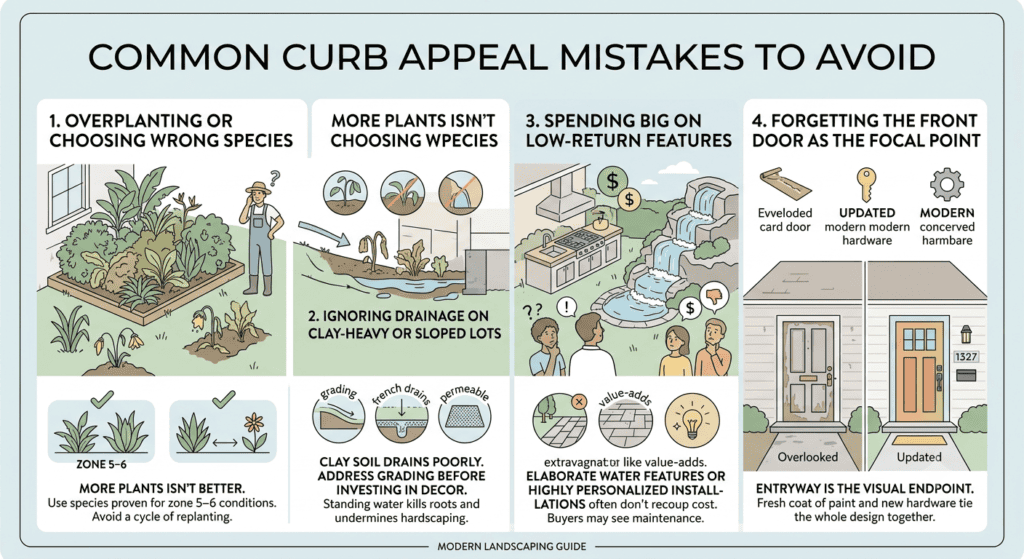
More plants isn’t automatically better, and a plant that thrives in a warmer zone will simply struggle or die here. Sticking to species proven for zone 5–6 conditions avoids a frustrating cycle of replanting every couple of years.
Ignoring Drainage on Clay-Heavy or Sloped Lots
A lot of Niagara soil is clay-heavy and drains poorly, which becomes a real problem on sloped properties without proper grading. Standing water kills plant roots and undermines hardscaping over time, so this is worth addressing before investing in anything decorative.
Spending Big on Low-Return Features
Elaborate water features, oversized outdoor kitchens, or highly personalized installations can feel exciting to design but often don’t recoup their cost, and some buyers actively see them as one more thing to maintain. It’s worth being deliberate about which projects are for your own enjoyment versus which ones are meant to add resale value.
Forgetting the Front Door as Part of the Landscape
The entryway is the visual endpoint of the whole design, and it’s easy to overlook. A tired, faded front door undercuts even a beautifully planted yard, while a fresh coat of paint and updated hardware ties the whole approach together.
Final Thoughts: Building Curb Appeal That Lasts
The best curb appeal landscaping ideas for 2026 share a common thread: they favor intention over excess. A well-placed native plant bed, a clean stone path, thoughtful lighting, and a lawn that’s actually maintained will outperform a rushed, expensive overhaul almost every time – and they’ll keep paying off in ROI, in daily enjoyment, and in how your home feels every time you pull into the driveway.
Whether you’re planning ahead for a future sale or just want your property to feel like the best version of itself, the ideas in this guide work across Niagara Falls, St. Catharines, Welland, Fort Erie, Niagara-on-the-Lake, Thorold, Port Colborne, and everywhere in between.
If you’d rather hand the planning, planting, and maintenance to people who do this every day, working with an established Niagara Falls landscaping company like NLLC takes the guesswork out of it – and once the snow flies, our snow removal services keep that curb appeal intact through the winter too. Contact us today for a free quote and let’s talk about what your front yard could look like this season.
Frequently Asked Questions
What’s the fastest way to improve curb appeal on a budget? Fresh mulch, clean bed edging, and a rotating display of seasonal color are the highest-visibility, lowest-cost updates you can make, often for well under a few hundred dollars.
Which landscaping projects add the most home value in Niagara? Basic lawn care, general maintenance, and tree care consistently deliver the strongest return, with lawn care alone often recovering well over 200% of its cost at resale.
What plants work best for Niagara’s climate? Look for species proven in hardiness zones 5–6, including coneflower, black-eyed Susan, catmint, sedum, lilacs, and hydrangeas, all of which handle our freeze-thaw winters well.
How much should I budget for front yard landscaping? A reasonable long-term guideline is investing gradually over several years rather than all at once, letting plants mature and the design develop naturally rather than rushing everything before a sale.
Do I need a professional or can I DIY my front yard? Simple tasks like mulching and planting perennials are DIY-friendly. Anything involving drainage, grading, retaining walls, or irrigation tends to hold up better with professional installation.
How often should mulch and garden beds be refreshed? A yearly top-up each spring is typically enough to keep beds looking finished and to keep weeds suppressed through the growing season.
Does landscape lighting really add resale value? Yes, though its financial ROI is more modest than lawn care – its bigger value is in extending how much you can actually enjoy and safely use your yard in the evening.
How does snow removal affect curb appeal in winter? A driveway and walkway cleared promptly after every snowfall has a bigger visual impact in winter than almost any other single factor, since a snow-covered path reads as neglect even on an otherwise well-landscaped property.