If you’ve driven through Niagara Falls, St. Catharines, or Welland lately, you’ve probably noticed something. The homes that catch your eye aren’t always the biggest or the newest. They’re the ones with a yard that just works – a tidy lawn, a patio you’d actually want to sit on, plants that look alive instead of struggling.
That’s not an accident. It’s a strategy, and more Niagara homeowners are catching on to it every season.
Here’s the number that should get your attention: outdoor entertaining space and landscaping can raise a property’s value by an average of 10%, according to a national survey of real estate professionals from Royal LePage. Other research puts the range even higher, between 5.5% and 12.7% depending on the quality of the design and the market. On a $650,000 Niagara home, that’s tens of thousands of dollars sitting in your front and back yard, waiting to be unlocked – or lost, if the yard is neglected.
This guide walks through the landscaping trends that increase property value right now, in 2026, with a specific focus on what actually works for homes in the Niagara Region. We’ll cover what’s worth your money, what to skip, and how to plan a project that pays you back at resale instead of just looking nice for a season. Whether you’re preparing to list your home or simply want a yard that earns its keep, you’ll find practical, no-fluff guidance here.
Why Landscaping Has Become One of the Smartest Investments a Homeowner Can Make
A few years ago, landscaping was treated as a finishing touch – something you did after the “real” renovations were finished. That thinking has flipped. Outdoor space is now one of the first things buyers evaluate, and one of the last things sellers think to fix before it’s too late.
A few data points explain why:
- Realtors overwhelmingly recommend improving landscaping before listing a property, because buyers form strong first impressions before they ever step through the front door.
- Research from Virginia Tech found that upgrading a landscape from average to excellent condition can lift a home’s value by 10% to 12%.
- On the flip side, a neglected or unkempt yard can drag a home’s sale price down by 5% to 15%, according to surveyed real estate agents – meaning bad landscaping doesn’t just fail to help, it actively costs you money.
- Nationally, standard lawn care service returns over 200% of its cost at resale, making it one of the highest-ROI home improvements available, ahead of flashier projects like swimming pools.
There’s also a lifestyle shift behind these numbers. Since 2020, homeowners across Canada have spent dramatically more time in their own backyards, and that habit stuck. Surveys show the vast majority of Canadians now see their yard as a genuine extension of their home rather than an afterthought space. That mindset shows up in what buyers are willing to pay, because today’s buyers are shopping for a lifestyle, not just square footage.
For Niagara homeowners specifically, this matters even more. Between the tourism economy, a strong local rental market, and a steady stream of buyers relocating from the GTA, curb appeal and a comfortable backyard carry real weight in how quickly a property sells and what it sells for.
Landscaping Trends That Increase Property Value in 2026
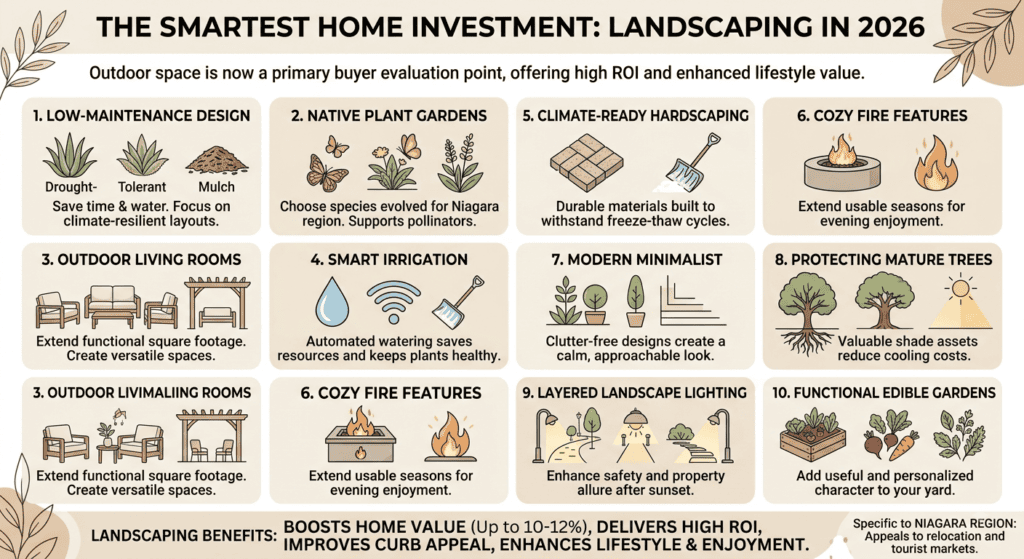
Below are the ten trends delivering the strongest return on investment for homeowners this year. Some are big renovation projects. Others cost very little and can be done over a weekend. All of them are grounded in what buyers, appraisers, and landscape designers are actually prioritizing in 2026 – not just what looks good on a design blog.
1. Low-Maintenance, Climate-Resilient Design
The single biggest shift in landscaping this year isn’t a specific plant or material – it’s a philosophy. Homeowners and buyers alike are gravitating toward yards that look cared for without demanding constant attention.
Homes marketed with “low-maintenance yard” language are attracting more interest and selling faster, particularly among first-time buyers and busy professionals who want a nice outdoor space without a second job maintaining it. That means:
- Drought-tolerant plant beds instead of thirsty, high-fuss flower gardens
- Automated irrigation instead of hand-watering
- Mulched beds that suppress weeds naturally
- Simple, uncluttered layouts instead of dozens of small planting zones
For a Niagara property, this looks like swapping out an overgrown, high-maintenance garden bed for a simplified layout with drought-tolerant landscaping that still looks lush from May through October, without you standing outside with a hose every evening in July.
2. Native Plant Gardens
Native plants are having a real moment, and it’s easy to see why once you understand the math. Because they evolved in this exact climate and soil, these species generally need less watering, less fertilizer, and far less pest management than imported ornamentals – and they still deliver a serious visual upgrade.
For homeowners in the Niagara Region, that means species like black-eyed Susan, New England aster, butterfly milkweed, blue vervain, and red osier dogwood, all of which thrive in the Lake Erie Lowlands ecoregion that covers Niagara Falls, St. Catharines, and the surrounding area. These plants also support local pollinators, which is increasingly something buyers notice and appreciate, especially younger buyers who care about sustainability.
Trend scoring from industry research consistently ranks native plant gardens among the highest-value, lowest-maintenance landscaping choices available this year.
3. Outdoor Living Rooms
If there’s one trend doing the most heavy lifting for resale value in 2026, it’s the outdoor living space. Buyers are increasingly treating a well-designed patio, deck, or covered lounge area as functional square footage – almost like an additional room, just outside.
The National Association of Realtors reports that outdoor living improvements recover 60% to 80% of their cost at resale. That includes:
Outdoor Kitchens and Dining Areas
Built-in grills, prep counters, and durable outdoor dining sets turn a backyard into a genuine entertaining space rather than just a patch of grass behind the house.
Covered, Multi-Season Patios
In Southern Ontario, where chilly spring nights and early fall evenings are the norm, covered patios and three-season lounges with roll-down screens are becoming standard requests. Pergolas built to handle snow loads and patios with built-in heaters extend the usable season well past summer.
Comfortable, Weatherproof Seating
Simple additions like durable outdoor furniture and shade structures make an outdoor room feel finished and lived-in, which matters far more to buyers than a bare concrete slab ever will.
The homes that get this trend right treat the backyard as a genuine extension of the floor plan rather than an afterthought tacked onto the back of the house. That might mean lining up a set of patio doors with the main seating area, choosing furniture that can stay outside through a Niagara summer without fading or warping, or adding a pergola that ties the new space visually back to the architecture of the house itself. Buyers notice when an outdoor room feels intentional versus when it feels like leftover space with a table dropped on it.
4. Automated Watering Technology
Technology has quietly moved outdoors, and it’s paying off. A smart irrigation system adjusts watering automatically based on rainfall and soil moisture, which cuts water waste and keeps a lawn healthy without babysitting a sprinkler timer all summer.
With municipal water rates climbing and unpredictable rainfall becoming the norm, this upgrade signals something important to a buyer: the property won’t need expensive irrigation rework anytime soon. That’s a meaningful selling point, especially for larger lots common throughout Niagara-on-the-Lake, Fort Erie, and Thorold.
5. Sustainable, Freeze-Thaw-Ready Hardscaping
Hardscaping remains one of the strongest value-adding categories in landscaping, but the materials being chosen in 2026 are smarter than they used to be. Natural stone walkways, exposed aggregate, and permeable pavers are dominating projects this year, largely because they solve a real problem: Ontario’s brutal freeze-thaw cycles and road salt exposure chew through poorly-installed surfaces within a few years.
Exposed aggregate, for example, is trending specifically because it’s slip-resistant, durable, and doesn’t look generic – and when it’s installed correctly with air-entrained concrete over a properly compacted base, it can last for decades in a Niagara winter. Permeable materials also help manage stormwater runoff, which is becoming a bigger consideration as extreme weather events increase across the region.
The takeaway for homeowners: hardscaping is worth the investment, but only when it’s built to survive an Ontario winter. A beautiful patio that heaves and cracks after two seasons doesn’t add value – it becomes a red flag during a home inspection.
6. Fire Features and Cozy Extended-Season Additions
Fire features have moved from luxury add-on to near-standard expectation in backyard design. Gas fire tables, fire pits, and fire-and-seating walls that double as wind protection are showing up constantly in 2026 backyard projects across Southern Ontario.
The appeal is practical as much as aesthetic. A fire feature extends the number of months a backyard actually gets used, which directly supports the “backyard as functional square footage” argument buyers are increasingly making. A firepit surrounded by simple stone seating is a modest project that photographs beautifully in listing photos and creates an emotional pull that’s hard to replicate with plants alone.
7. Modern Minimalist Layouts
Overgrown, cluttered yards with a dozen competing planting zones are falling out of favor. In their place: clean lines, balanced plant groupings, and open, uncluttered layouts that feel calm rather than chaotic.
This trend matters for resale because it’s easy for a buyer to picture themselves maintaining a minimalist yard. A wildly personalized garden – however much a current owner loves it – can actually narrow the buyer pool, since it signals more upkeep and a taste that might not match the next owner’s. Restraint, done well, tends to outperform excess when it comes to appraised value.
8. Protecting Established Trees
It’s easy to overlook, but a healthy, established tree is one of the single highest-value assets on a residential lot. A mature shade tree on the south or west side of a home doesn’t just look good – it can meaningfully reduce cooling costs in summer and adds a level of maturity to a property that no amount of new planting can fake overnight.
If your lot already has healthy mature trees, the highest-ROI move in 2026 isn’t replacing them – it’s protecting their root zones during any hardscaping or renovation work, and pairing them with lower, complementary plantings underneath rather than tearing them out for a “clean slate.”
9. Layered Outdoor Lighting
Low-voltage path lighting, uplighting on trees and architectural features, and app-controlled fixtures are transforming how yards function after sunset. Warm, layered lighting that highlights key features – rather than one bright floodlight – reads as more upscale and makes a property feel safer and more finished.
Lighting is also one of the more affordable trends on this list, and it pairs well with almost everything else here. It’s often best planned early, before patios and gardens are finished, so wiring and fixture placement don’t become an afterthought.
10. Edible and Functional Landscaping
Small vegetable beds, herb gardens, and fruit-bearing shrubs tucked into an otherwise ornamental yard are having a resurgence. Compact raised beds with herbs like basil, along with easy perennial additions like strawberries or tomatoes, add a lived-in, functional character to a property that resonates with a growing number of buyers who want their outdoor space to do more than just look pretty.
This isn’t about converting a backyard into a farm. A few well-placed raised beds near the kitchen or patio door strike the right balance between function and polish.
What Actually Hurts Property Value: Landscaping Choices to Avoid
Not every outdoor upgrade pays you back, and some can actively work against a sale. A few consistent patterns show up across appraiser and agent research:
- Elaborate water features and koi ponds – These narrow the buyer pool and come with ongoing maintenance most buyers don’t want to inherit.
- In-ground pools in most Canadian markets – Pools often return well under half of their installation cost and can be a liability for families with young children.
- Highly personalized garden structures – A yard designed entirely around one owner’s specific hobbies or tastes can make it harder for a buyer to picture the space as their own.
- Overgrown or neglected beds – A yard that looks abandoned raises questions about how well the rest of the house has been maintained, even if the interior is spotless.
- Gravel-only yards with no softening plantings – Without greenery to break it up, an all-hardscape yard can read as harsh or unfinished rather than low-maintenance.
If your yard has any of these features and you’re planning to sell, it’s often more cost-effective to simplify than to renovate further. Removing a struggling water feature or clearing an overgrown bed can do more for your sale price than adding something new.
Landscaping ROI: What the Numbers Actually Say
It helps to see the return on investment broken down by project type, since not every upgrade delivers the same payoff.
| Landscaping Project | Typical ROI at Resale |
| Standard lawn care and maintenance | Over 200% |
| Outdoor living area (patio, deck, kitchen) | 60%–80% |
| Front-yard refresh (mulch, edging, foundation planting) | High relative to low cost |
| Professional design upgrade (average to excellent) | 10%–12% added home value |
| In-ground swimming pool | Around 55%–60% |
The pattern here is consistent: the basics – a healthy lawn, clean edges, fresh mulch, and a clear path to the front door – deliver disproportionate value relative to what they cost. Most of a landscape’s resale impact happens in the first ten seconds of a buyer’s drive-by, before they’ve even parked the car. A house that doesn’t pass that initial glance rarely gets the in-person showing where the rest of the property has a real chance to sell itself.
Prioritizing by Budget: Where to Start If You Can’t Do Everything
Most homeowners aren’t tackling every trend on this list in one season, and you don’t need to. Here’s how to prioritize based on what you have to spend, so your money goes toward the improvements with the strongest payoff first.
Under $500: Quick Front-Yard Wins
This tier is about cleanup, not construction, and it’s where the highest return-per-dollar consistently shows up. Refresh mulch in existing beds, sharpen the edges along walkways and driveways, trim overgrown shrubs away from windows, and clear any winter debris or dead plant material. A healthy, freshly mowed lawn with clean edges does more for a buyer’s first impression than almost anything else on this list, and it costs almost nothing beyond your own time or a single service visit.
$500 to $5,000: Targeted Upgrades
At this level, you can afford to make a real dent in one or two trend categories. A small native plant bed near the entryway, basic low-voltage path lighting, a simple firepit with stone seating, or an automated watering controller retrofit are all realistic projects in this range. This is also the sweet spot for correcting problem areas – removing an overgrown or dying water feature, replacing patchy lawn sections with new sod, or adding foundation plantings that frame the front door.
$5,000 and Up: Structural Projects
Larger budgets open the door to the projects with the biggest resale impact: a properly built patio or deck with a covered seating area, a full hardscaping renovation with premium paving materials, or a coordinated backyard redesign that combines a full seating and dining area with updated planting beds. These projects take more planning and should start with a site visit, since the base preparation and drainage work underneath the visible finish is what determines whether the investment lasts fifteen years or falls apart in three.
Whatever tier you’re working in, the order matters. Fix the basics first. A stunning patio surrounded by dead grass and overgrown beds won’t read as impressive – it’ll just draw attention to the neglect around it.
A Season-by-Season Landscaping Plan for Niagara Homeowners
Ontario’s climate means timing matters almost as much as which trends you choose. Here’s how to sequence a property value-focused landscaping plan across the year in the Niagara Region.
Spring: Cleanup and Foundation Work
As soon as snow clears, focus on lawn repair, bed edging, mulch refresh, and clearing any winter debris. This is also the ideal window to plant native perennials and shrubs before summer heat sets in. If winter left junk, branches, or old materials behind, getting them hauled away early makes the rest of the season’s work easier – a fast garbage and yard debris removal service can clear the way before planting begins.
Summer: Outdoor Living and Hardscaping
Summer is patio and hardscape season. Because Niagara summers bring real heat, this is also when low-water plantings and automated watering prove their worth, keeping beds healthy without daily watering.
Fall: Planting and Prep for Winter
Fall is an excellent time to plant trees and shrubs, since cooler air and warm soil help root systems establish before the ground freezes. It’s also the right time to winterize irrigation lines and outdoor lighting systems.
Winter: Protection and Planning
Once snow arrives, the priority shifts from planting to protecting hardscaping and plant beds from salt damage and heavy snow loads, while keeping driveways and walkways clear and safe. Reliable winter maintenance protects the investment you made the rest of the year – a professional snow removal service keeps hardscaping and walkways from taking unnecessary damage during freeze-thaw cycles.
Common Mistakes Homeowners Make When Landscaping for Resale
Even well-intentioned projects can miss the mark. These are the most frequent missteps we see on properties across Niagara Falls, St. Catharines, and Welland:
- Skipping the base work. A gorgeous patio built on a shallow, poorly compacted base will heave and crack within a couple of Ontario winters. Proper depth and drainage matter more than the material itself.
- Overplanting. Cramming too many species into one bed looks impressive for a season, then turns into an overgrown mess by year two. Simpler, well-spaced layouts age better.
- Ignoring irrigation until it’s too late. Retrofitting automated watering equipment after hardscaping is finished is far more expensive than planning it in from the start.
- Choosing trend-only features. A hyper-trendy feature that doesn’t suit the home’s architecture or the owner’s lifestyle can look dated within a few years and won’t earn back its cost.
- DIY-ing complex drainage or tree work. Grading mistakes can send water toward a foundation instead of away from it, which is a far costlier problem to fix later than the landscaping itself.
DIY vs. Professional Landscaping: What’s Worth Hiring Out
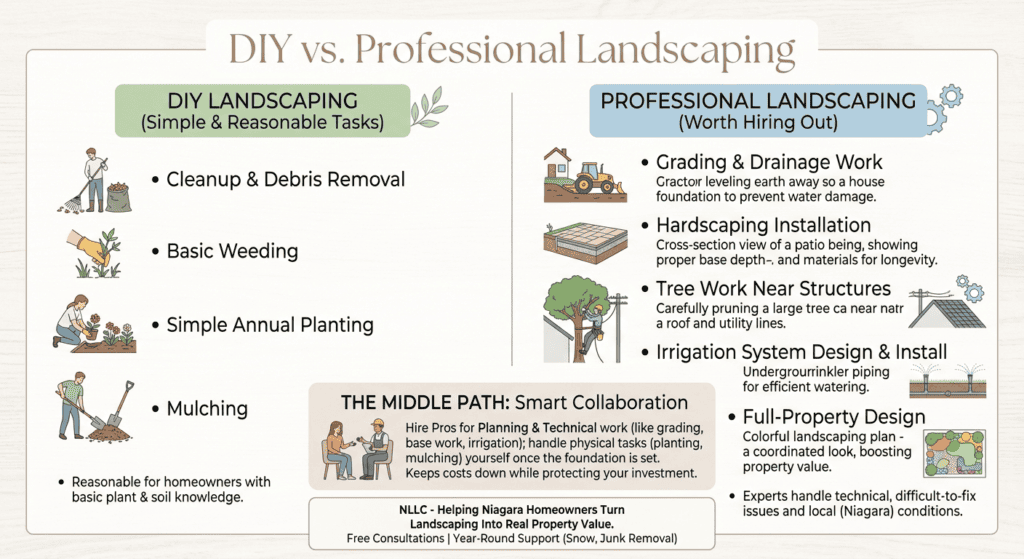
Not every project needs a professional crew. Cleanup, mulching, basic weeding, and simple annual planting are all reasonable DIY tasks if you already understand the basics of spacing and soil.
Where professional help consistently pays for itself:
- Grading and drainage work, where a mistake can affect your foundation
- Hardscaping installation, where base depth and materials determine whether a patio lasts five years or twenty-five
- Tree work near structures, utility lines, or property boundaries
- Full-property design, where a coordinated plan avoids the “randomly grown” look that undercuts what a buyer is willing to pay
- Irrigation system design and installation
A professional who understands the Niagara Region’s soil conditions, frost depth, and freeze-thaw behaviour will typically specify plantings and materials that perform across multiple seasons rather than needing correction every year.
There’s also a middle path worth considering: hiring a professional for the planning and the technical parts of a project, then handling the physical planting or mulching yourself once the layout, base work, and irrigation lines are in place. This approach keeps costs down while still protecting the parts of the project that are genuinely difficult to fix after the fact, like grading, drainage, and hardscape base depth. It’s a common approach among homeowners who enjoy the hands-on side of gardening but don’t have the equipment or experience for excavation and drainage work.
How NLLC Helps Niagara Homeowners Turn Landscaping Into Real Property Value
At NLLC, we work with homeowners and property managers across Niagara Falls, St. Catharines, Welland, Fort Erie, Niagara-on-the-Lake, Thorold, and Port Colborne to build outdoor spaces that do more than look good for one season – they hold up, and they pay off. Our team handles everything from routine lawn care and seasonal cleanups to full landscaping projects designed around the trends and ROI data covered in this guide.
Because we also offer garbage and junk removal and snow removal across the Niagara Region, we can support your property through every season, not just the one where the flowers are blooming. That means your investment stays protected in July and in January.
If you’re planning to sell soon, staying long-term, or simply want a yard that finally works for you instead of against you, our team can walk your property and put together a plan built around what actually adds value in your specific neighborhood. Get in touch with our team for a free consultation, or explore our full range of landscaping and lawn care services to see where to start.
Final Thoughts
Landscaping trends that increase property value in 2026 share one thing in common: they’re not just about looking good in a listing photo. They’re about creating a yard that functions well, holds up through an Ontario winter, and appeals to the widest possible range of future buyers – while also making your own day-to-day life outside a little better right now.
You don’t need to chase every trend on this list at once. Start with the basics – a healthy lawn, clean edges, and a well-defined entryway – then layer in the bigger projects, like a backyard seating area or updated hardscaping, as your budget allows. Done thoughtfully, and built to survive a Niagara winter, your landscaping can become one of the highest-returning investments on your entire property.
If you’re ready to put a plan together for your home, contact NLLC for a free quote, or browse our landscaping services to see the work we do across Niagara Falls, St. Catharines, Welland, and the surrounding communities.
Frequently Asked Questions
Do landscaping upgrades really increase home value in Ontario?
Yes. National survey data shows landscaping and outdoor entertaining areas can add an average of 10% to a property’s value, and research from Virginia Tech found that moving from average to excellent landscape design can lift value by 10% to 12%. The exact number depends on the quality of the work and the local market, but the trend holds consistently across Ontario, including throughout the Niagara Region.
What’s the single best landscaping project if I’m planning to sell?
Basic, consistent lawn care and maintenance delivers the highest return relative to cost, often recovering more than 200% of what’s spent. For bigger projects, backyard living areas like patios and covered seating typically recover 60% to 80% of their cost while also making the home more appealing to live in right now.
Are Ontario-native species actually better for Niagara properties?
Generally, yes. Because they’re adapted to the local Lake Erie Lowlands climate and soil, they typically need less watering, less fertilizer, and less pest management than imported ornamentals, while still supporting local pollinators and looking attractive throughout the growing season.
How much should I budget for landscaping before listing my home?
There’s no single number that fits every property – it depends on lot size, existing tree condition, irrigation, drainage, and whether the work is a cleanup versus a full renovation. A site visit from a professional landscaper is the most reliable way to get an accurate scope and budget for your specific property.
Is DIY landscaping enough, or should I hire a professional?
DIY works well for cleanup, mulching, and simple planting. Hardscaping, grading, drainage, and full-property design are generally worth hiring out, since mistakes in those areas – like a poorly compacted base or incorrect grading – cost far more to fix later than they would have cost to do properly the first time.
Does landscaping matter if my home already looks nice from the street?
Even homes with a strong first impression can lose ground if the landscaping looks dated or high-maintenance to today’s buyers. Trends shift, and features that were popular a decade ago – like elaborate water features or dense, high-maintenance garden beds – can now work against a sale rather than for it.
What landscaping features should I avoid before selling?
Elaborate water features, in-ground pools in most markets, overly personalized garden structures, and neglected or overgrown beds are the most common value-detractors. Simplifying an over-designed yard is often more effective than adding something new.
How does winter affect landscaping value in the Niagara Region?
Ontario’s freeze-thaw cycles and road salt exposure are hard on hardscaping and plant beds. Materials that aren’t installed correctly – like concrete without a properly compacted base – can crack or heave within a couple of seasons. Reliable winter maintenance, including proper snow removal, helps protect the landscaping investment made the rest of the year.