Cleaning a home and cleaning a business might look similar from the outside – someone shows up with a mop, a vacuum, and a bucket of supplies. But underneath that surface, residential vs commercial cleaning are two very different services, built around different goals, different standards, and completely different pressures.
Homeowners want comfort. Businesses need compliance. A missed spot on a kitchen counter is an inconvenience at home; a missed spot in a food-prep area or a medical office can be a health code violation. Understanding these differences matters whether you’re a homeowner deciding what kind of service to book, a small business owner comparing quotes, or a property manager in Niagara Falls, St. Catharines, or Welland juggling both residential units and commercial tenants.
This guide breaks down exactly how residential and commercial cleaning differ – in scope, equipment, scheduling, cost, and standards – plus how to know which one your space actually needs. We’ll also cover current 2026 Ontario pricing for both, so you know what to expect before you request a quote.
It’s a mistake plenty of business owners and homeowners make without realizing it: booking whichever cleaning company answers the phone first, without checking whether that company actually specializes in the type of space being cleaned. A residential cleaner who’s spent years perfecting a cozy, homeowner-friendly routine may not have the equipment, insurance, or training to take on a 5,000-square-foot warehouse. And a commercial cleaning crew built for overnight office resets might feel like overkill – and cost like it, too – for a three-bedroom bungalow. Getting this distinction right from the start saves time, money, and a lot of frustration on both sides of the arrangement.
What Is Residential Cleaning?
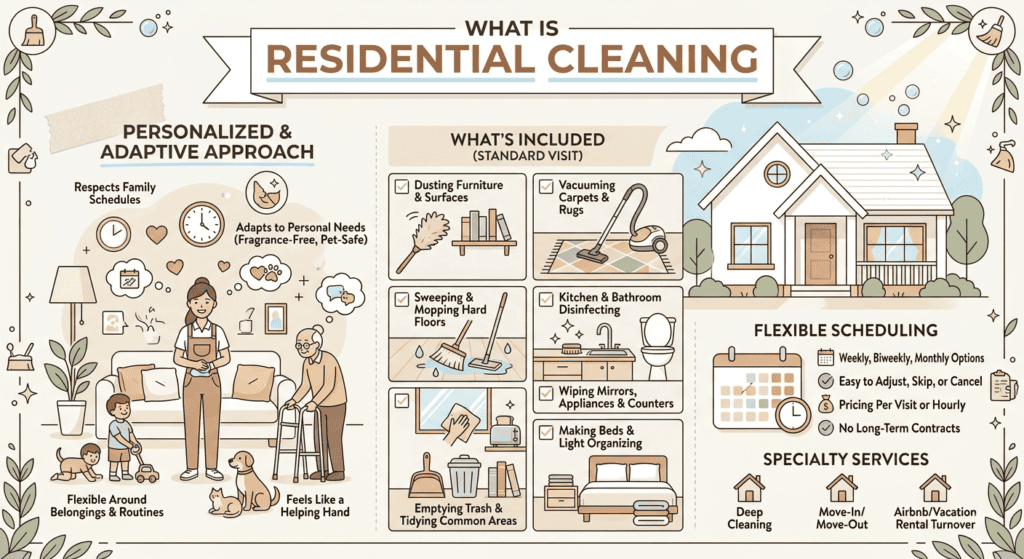
Residential cleaning covers private homes, condos, and apartments. It’s built around comfort, presentation, and the everyday habits of the people living there. A residential cleaner works around a family’s schedule, respects personal belongings, and adjusts to preferences – some homeowners want fragrance-free products because of allergies, others want pet-safe cleaners because of a dog or cat in the house.
This personal, adaptive approach is really what sets residential cleaning apart at its core. No two homes are cleaned exactly the same way, because no two households live exactly the same way. A cleaner working in a home with young kids might prioritize disinfecting toys and high-touch surfaces. A cleaner working in a home with an elderly resident might move more carefully around mobility aids or medical equipment. That flexibility is a feature, not a limitation – it’s what makes residential cleaning feel less like an inspection and more like a helping hand.
What’s Included in Residential Cleaning
A typical residential visit covers:
- Dusting furniture, shelves, and accessible surfaces
- Vacuuming carpets and rugs
- Sweeping and mopping hard floors
- Cleaning and disinfecting kitchens and bathrooms
- Wiping down mirrors, counters, and appliance exteriors
- Emptying trash and tidying common areas
- Making beds and light organizing
Beyond the standard visit, most residential cleaning companies also offer deep cleaning, move-in/move-out cleaning, and Airbnb turnover cleaning as add-on or specialty services, since homes go through different life stages that call for different levels of attention.
How Residential Cleaning Is Scheduled
Residential cleaning is almost always flexible. Homeowners book weekly, biweekly, or monthly visits, and can usually adjust, skip, or cancel a booking with a few days’ notice. Pricing is typically per visit or hourly, and there’s rarely a long-term contract involved – it’s a relationship you can scale up or down as life changes.
What Is Commercial Cleaning?
Commercial cleaning covers offices, retail stores, warehouses, medical clinics, restaurants, and any other space used for business. The goal shifts from comfort to compliance: a clean commercial space protects employee health, meets safety regulations, and shapes how clients and customers perceive the business the moment they walk through the door.
Anyone comparing office cleaning services Niagara Falls businesses currently rely on will notice the scope tends to be far more standardized than residential work. That’s intentional. A business needs consistency – the same washrooms cleaned to the same standard every single visit, regardless of which technician is on shift that day. Homeowners can tolerate some variation from week to week; a medical clinic or a food-service business generally cannot, since inconsistent cleaning can translate directly into compliance risk or a failed inspection.
What’s Included in Commercial Cleaning
Commercial cleaning tends to be broader in scope and more standardized than residential work. A typical commercial service agreement includes:
- Floor care (vacuuming, mopping, stripping and waxing hard floors)
- Washroom sanitation and restocking supplies
- Break room and kitchen cleaning
- Garbage and recycling removal
- Disinfecting high-touch surfaces like door handles, light switches, and shared equipment
- Window and glass cleaning
- Dusting workstations, boardrooms, and common areas
- Specialty services like carpet extraction, floor waxing, or post-event cleanup
Some industries need even more – medical offices require specific disinfection protocols, food service spaces need compliance with health authority standards, and industrial facilities may involve hazardous waste handling that residential cleaners simply aren’t trained or licensed for.
How Commercial Cleaning Is Scheduled
Commercial cleaning usually runs on a formal service agreement rather than a casual booking. Many businesses schedule cleaning after hours or overnight to avoid disrupting staff and customers, and service frequency ranges from daily janitorial visits for high-traffic offices to a few times a week for smaller spaces. Agreements typically spell out scope, frequency, response times, and pricing upfront, which protects both the business and the cleaning company from misunderstandings down the road.
This formality also gives businesses something residential clients rarely need: a documented service history. If a health inspector asks how often washrooms are sanitized, or if a lease requires proof of ongoing janitorial service, a written agreement and a consistent visit log make that easy to produce. Homeowners almost never need this level of documentation, which is one more reason the two service types are structured so differently from the outset.
How They Compare, Side by Side
| Residential Cleaning | Commercial Cleaning | |
| Client | Homeowner or tenant | Business owner or property manager |
| Goal | Comfort and presentation | Compliance, hygiene, and professional image |
| Scheduling | Flexible, daytime, casual booking | Formal contract, often after-hours |
| Equipment | Consumer-grade tools and products | Industrial-grade equipment, EPA-registered disinfectants |
| Standards | Homeowner preference | Health, safety, and industry-specific compliance |
| Staffing | Often one cleaner or a small team | Trained, bonded, and insured crews |
| Typical Ontario cost | $30–$55/hour or $120–$350/visit | $0.08–$0.25/sq ft or $30–$60/hour per cleaner |
2026 Pricing in Ontario
Residential cleaning in Ontario generally runs $30 to $55 per hour, or $120 to $350 for a flat-rate visit on a standard home, with deep cleans and move-out cleans priced higher. Commercial cleaning is usually quoted differently – either by square footage or by a flat monthly contract. Current 2026 Ontario benchmarks put general office cleaning at roughly $0.08 to $0.25 per square foot per service, or $30 to $60 per hour per cleaner, with small offices under 1,000 square feet typically landing between $100 and $500 per month and mid-sized offices in the $500 to $2,000 per month range. Larger facilities, or spaces with stricter sanitation needs like clinics and food-prep areas, land toward the higher end of these ranges because the work takes longer and requires different products and training.
Frequency has a bigger impact on commercial pricing than it does on residential pricing. A business cleaned five days a week generally pays less per visit than one booking a single weekly service, since the space stays under control and never needs a heavier reset.
A few other factors shift commercial pricing that don’t apply much to residential quotes. The number of washrooms matters more than total square footage in many cases, since washrooms are the most labour-intensive area per square foot in any commercial space. Industry type plays a role too – a standard professional office costs less to clean than a medical clinic or food-service kitchen, since those spaces require specific disinfection products and, in some cases, staff trained to specific health authority standards. And building access can quietly affect price as well: a downtown office with limited parking and strict security check-in procedures often costs more to service than a suburban office with an open loading area, simply because it takes cleaning staff longer to get in and out.
For homeowners, the biggest cost driver remains simple: home size and how long it’s been since the last cleaning. There’s rarely a compliance layer sitting on top of a residential quote the way there almost always is for a commercial one.
Why Equipment and Products Differ
Residential cleaners typically work with consumer-grade tools – the kind of vacuum, mop, and all-purpose cleaner you’d find in any hardware store. That’s appropriate for a home’s scale and the softer surfaces found in most living spaces.
Commercial cleaning calls for a different toolkit entirely. Industrial vacuums, floor scrubbers, electrostatic sprayers, and EPA-registered disinfectants are built to cover large square footage quickly while meeting the sanitation standards many industries are legally required to follow. A commercial cleaning company also needs training that goes beyond general tidying – handling cleanrooms, medical facilities, or industrial equipment requires knowledge that a typical residential cleaner simply isn’t trained for.
The scale difference alone explains a lot of this. A residential cleaner might spend two hours in a 1,500-square-foot home with a mop, a vacuum, and a few spray bottles. A commercial crew tackling a 10,000-square-foot warehouse or a multi-floor office building needs equipment that can cover that ground efficiently – ride-on floor scrubbers, backpack vacuums, and pressure washers for exterior areas. Trying to service a commercial space with residential-grade tools isn’t just slower, it often produces inconsistent results, since consumer equipment simply isn’t built for that kind of continuous, heavy-duty use.
Staffing, Insurance, and Accountability
This is one of the most overlooked differences between the two services. Commercial cleaning companies are almost always bonded and insured, which protects a business if something is damaged or goes missing during a cleaning visit. Residential cleaning can vary – some companies carry full insurance, while independent or informal cleaners may not, which shifts the financial risk of any accident back onto the homeowner.
Staffing structure also differs in ways that affect day-to-day service. Commercial contracts often assign a dedicated crew or account manager to a site, so the same faces show up consistently and know the space well – which fixture squeaks, which door needs extra care, which areas need more frequent attention. Residential cleaning can work the same way with an established company, but informal arrangements sometimes mean a different person shows up each visit, which makes consistency harder to guarantee.
Training requirements scale with the complexity of the job. A commercial cleaner working in a medical office or industrial facility typically needs training in handling specific chemicals, understanding WHMIS (Workplace Hazardous Materials Information System) labelling, and following site-specific safety protocols. A residential cleaner’s training tends to focus more on general best practices – safe use of household products, respecting a homeowner’s space, and following a consistent room-by-room checklist that covers everything from the kitchen to the bedrooms without missing a step.
If you’re a business owner, it’s worth confirming bonding and insurance coverage before signing any commercial cleaning contract. If you’re a homeowner working with an independent cleaner rather than an established residential cleaning company, it’s worth asking the same question, since the stakes are lower but not zero.
Which One Do You Actually Need?
For most people, the choice is obvious: a private home needs residential cleaning, and a business needs commercial cleaning. But a few situations blur the line, and it’s worth knowing which side of that line your space falls on.
- Home-based businesses: If you run a business out of your home – a salon, a small clinic, a daycare – you likely need commercial-grade cleaning for the business portion of the space, even though the rest of the home is residential.
- Mixed-use properties: Buildings with ground-floor retail and residential units above often need both services running on separate schedules.
- Airbnb and short-term rentals: These sit closer to residential cleaning in scope, but the frequency and turnaround speed often resemble a commercial-style contract.
- Property managers overseeing multiple units: Managing both tenant-occupied residential units and shared commercial or common spaces usually means coordinating two different service types under one roof.
- Renovated or newly built spaces: A freshly renovated home or a newly built commercial unit both need a specialized one-time reset before regular service begins – the scope leans closer to deep cleaning than either standard category, but the underlying space (home vs. business) still determines which team and which products are the right fit.
- Seasonal or event-based needs: A homeowner hosting a large holiday gathering, or a business preparing for a product launch or open house, sometimes needs a one-time service that’s more thorough than their usual routine – worth flagging to your cleaning company ahead of time so they can scope it properly.
If you’re managing a mixed-use or multi-unit property, the smartest move is talking to a cleaning company that offers both service types, so scheduling and billing stay simple instead of juggling two separate vendors. A professional cleaning company Welland or Niagara Falls property managers already work with for one service can often extend the same reliability to the other, which cuts down on the number of vendors, invoices, and site visits you need to coordinate every month. Fewer vendors also means fewer chances for something to fall through the cracks between two companies pointing fingers at each other over a missed spot.
Cleaning Industry Trends Shaping 2026
A few shifts are worth knowing about if you’re comparing quotes or planning a long-term cleaning arrangement this year. Analysts project the global cleaning services market will approach $330 billion by the end of 2026, and interestingly, residential cleaning is currently growing faster than commercial cleaning, even though commercial still represents the larger overall pool of spending. Busy household schedules are keeping demand for home cleaning steady, while niche commercial services – post-construction cleanup, healthcare facility sanitization, and specialty surface care – are opening up new revenue streams on the business side.
Sustainability has become a real factor in both markets, not just a marketing buzzword. More homeowners and businesses are specifically requesting eco-friendly products, and some are willing to pay a premium for green cleaning practices. Hybrid work models have also reshaped commercial cleaning demand: offices that used to need daily service five days a week now sometimes need a lighter, more flexible schedule that flexes around which days staff are actually in the building.
Labour remains one of the biggest pressures across the industry. Wages have been rising as cleaning companies compete for reliable staff, and high turnover means more time and money spent on training. This is part of why working with an established, well-staffed cleaning company – rather than a single independent cleaner – tends to produce more consistent long-term results for both homeowners and businesses. Companies that invest in retaining experienced staff are generally better positioned to deliver the same quality of service visit after visit, which matters just as much for a family’s living room as it does for a business’s boardroom.
Common Mistakes When Choosing a Cleaning Service
- Assuming a residential cleaner can handle a commercial job. Without the right equipment, insurance, or training, this often leads to inconsistent results and compliance gaps.
- Overpaying for commercial-grade service at home. A private residence rarely needs industrial equipment or a formal contract – that’s paying for scale you don’t need.
- Skipping the insurance question. Whether hiring residential or commercial, always confirm bonding and insurance before work begins.
- Not clarifying scope upfront. “Cleaning” means something different to every company – get the task list in writing, especially for commercial agreements.
- Choosing based on price alone. The cheapest quote sometimes reflects fewer tasks, lower-grade products, or uninsured staff – all of which can cost more down the line.
- Underestimating frequency needs for a business. A retail space with heavy foot traffic that’s only cleaned once a week will show wear far faster than one cleaned daily, even if the per-visit price looks cheaper on paper.
- Ignoring industry-specific requirements. Medical offices, food-service kitchens, and childcare facilities often have cleaning and disinfection standards set by health authorities – hiring a general cleaner without confirming they understand those requirements can create liability issues down the road.
Benefits of Hiring Professionals for Either Service
Whether it’s a home or a business, professional cleaning brings a few consistent advantages: trained staff who follow a checklist instead of working from memory, access to products and equipment that go beyond what’s available at a retail store, insurance that protects you if something goes wrong, and – maybe most importantly – time back in your week that would otherwise go toward scrubbing floors or wiping down a boardroom table.
For businesses specifically, a clean space also does quiet work on reputation. Employees tend to feel more comfortable and productive in a well-maintained office, and clients notice a spotless lobby or retail floor even if they never mention it out loud. Facility managers also gain a practical benefit: consistent professional cleaning tends to extend the life of flooring, upholstery, and fixtures, since dirt and grime left to build up over time can cause surfaces to wear out faster than they should.
Homeowners see a similar payoff on a smaller scale. Regular professional cleaning protects the value of a home’s finishes – countertops, grout, and hardwood floors all last longer when they’re properly maintained rather than left to accumulate buildup between occasional deep cleans. And for households juggling work, kids, and everything else on a weekly calendar, the time saved by outsourcing cleaning often outweighs the cost many times over. It’s an investment that pays back in hours reclaimed, not just in cleaner floors.
Why Niagara Homeowners and Businesses Choose NLLC
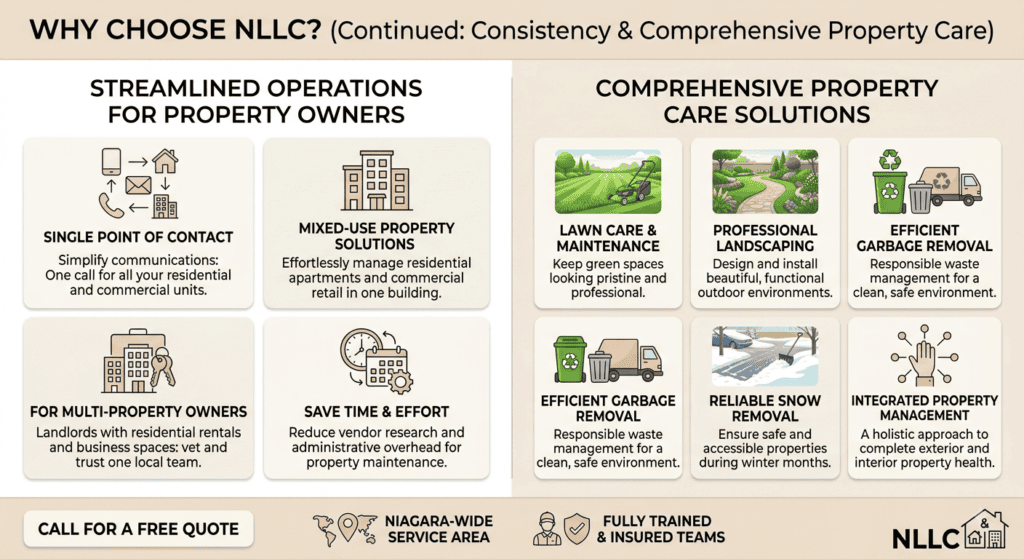
NLLC (Niagara Landscaping, Lawn Care & Cleaning) offers both residential and commercial cleaning across Niagara Falls, St. Catharines, Welland, Fort Erie, Niagara-on-the-Lake, Thorold, and Port Colborne, which means you don’t need to manage two separate vendors if your property spans both categories.
This dual capability matters more than it might seem at first glance. A local landlord who owns a residential rental and a small retail unit downtown, for example, doesn’t need to research, vet, and manage two entirely different cleaning companies – one call covers both. The same goes for a property manager overseeing a mixed-use building, or a homeowner running a small business who wants their entire property, residential and commercial portions alike, held to a consistent standard.
Our cleaning division includes:
- Residential cleaning for regular, weekly, or biweekly home visits
- Deep cleaning for seasonal resets and neglected spaces
- Move-in / move-out cleaning for tenants, landlords, and homeowners
- Airbnb cleaning services with fast, reliable turnovers
- Commercial cleaning and janitorial services for offices, retail, and industrial cleaning needs
- Post-construction cleaning for freshly renovated homes and businesses
- Window cleaning, disinfection, and specialized cleaning for specific requirements
Every job – home or business – is handled by a trained, insured team working from a clear checklist, so results stay consistent no matter which service you book. We also offer lawn care, landscaping, garbage removal, and snow removal, so property owners managing multiple service needs can rely on one local team for it all.
Not sure which type of cleaning your space needs? Contact NLLC for a free quote, and our team will walk you through the right option based on your property and budget.
Frequently Asked Questions
What is the main difference between residential and commercial cleaning?
Residential cleaning focuses on comfort and presentation in private homes, while commercial cleaning focuses on compliance, hygiene standards, and professional image in business spaces. Commercial cleaning also typically involves industrial-grade equipment, formal contracts, and bonded, insured crews, whereas residential cleaning tends to be more flexible and personalized to a household’s routine.
Is commercial cleaning more expensive than residential cleaning?
It depends on the space. Residential cleaning is usually priced per visit or hourly, generally $30 to $55 per hour in Ontario. Commercial cleaning is often quoted by square footage, roughly $0.08 to $0.25 per square foot, which can be more or less expensive than residential pricing depending on the size, industry, and complexity of the space. A small office might actually cost less per month than a large home cleaned weekly, while a specialized facility like a medical clinic could cost significantly more.
Can the same company handle both residential and commercial cleaning?
Yes, many cleaning companies – including NLLC – offer both service types, which is especially useful for property managers or mixed-use buildings that need both under one contract. Working with a single provider for both also tends to simplify invoicing and scheduling compared to managing two separate vendors.
How often should a commercial space be cleaned?
This depends on foot traffic and industry. High-traffic offices and retail spaces often need daily cleaning, while smaller professional offices may only need service two or three times a week. Medical and food-service spaces typically require more frequent, specialized cleaning to meet compliance standards, and some industries are also subject to periodic inspections that make consistent documentation important.
Do residential cleaners need insurance?
It’s strongly recommended. While not all residential cleaners carry insurance, hiring one who does protects you if something is damaged or an accident happens during a cleaning visit. Established residential cleaning companies are generally insured; some independent cleaners may not be, so it’s worth asking directly before booking.
What should I ask before signing a commercial cleaning agreement?
Confirm the exact scope of work, cleaning frequency, insurance and bonding coverage, response time for issues, and how pricing is structured (hourly, per square foot, or flat monthly). Getting this in writing avoids disputes later and gives you something concrete to reference if service quality slips.
Does a home-based business need commercial cleaning?
If part of your home is used for business – a salon chair, a small clinic room, a daycare space – that portion often benefits from commercial-grade cleaning and disinfection standards, even though the rest of the home stays on a residential schedule. It’s worth discussing this split scope directly with your cleaning provider so both parts of the property get the right level of attention.
Final Thoughts
The difference between residential vs commercial cleaning comes down to purpose and scale. One is about comfort in a private space; the other is about compliance and professional image in a business space. Knowing which category your property falls into – or when it falls into both – makes it much easier to choose the right service, avoid overpaying, and get consistent results every time.
It’s also worth remembering that the right choice isn’t always permanent. A home-based business might start out needing only residential cleaning, then grow into a space that requires commercial-grade attention. A commercial tenant might downsize into a smaller office where a simpler, more residential-style approach suddenly makes more financial sense. Revisiting the decision every year or two – especially if your space, staff, or foot traffic has changed – helps make sure you’re not overpaying for service you’ve outgrown, or underpaying for a level of cleanliness your space now actually needs.
If you’re weighing your options for a home, a business, or a property that includes both, NLLC’s team can help you figure out exactly what’s needed. Reach out for a free quote, and we’ll build a cleaning plan that fits your space and your budget.
\