If you have ever put off cleaning the gutters for “just one more season,” skipped a lawn care visit because the budget felt tight, or told yourself you would deal with that cracked walkway “after winter,” you are not alone. Almost every homeowner, landlord, and business owner in Niagara Falls, St. Catharines, Welland, and the surrounding towns has done the same thing at some point. It feels harmless in the moment. A skipped task here, a delayed repair there – what’s the worst that could happen?
As it turns out, quite a lot.
The hidden costs of ignoring property maintenance rarely show up right away. They build quietly in the background – inside your walls, under your soil, along your roofline, and in the fine print of your insurance policy – until one day they surface all at once, usually at the worst possible time and for far more money than the original fix would have cost. A skipped gutter cleaning becomes a foundation repair. A delayed snow-clearing service becomes a lawsuit. An unkempt lawn becomes a lower offer on your home. A missed Airbnb turnover becomes a one-star review that tanks your bookings for months.
This guide breaks down exactly what happens when property maintenance gets pushed to the bottom of the to-do list – the financial multipliers, the legal exposure, the insurance risks, and the resale value hit – and what Niagara property owners can do about it. Whether you manage a single-family rental, a commercial plaza, a vacation rental, or your own home, understanding these hidden costs is the first step toward avoiding them.
Why Homeowners and Property Managers Delay Maintenance
Before getting into the numbers, it’s worth understanding why maintenance gets deferred in the first place. It rarely happens because people don’t care about their property. It happens because of very human, very understandable patterns.
The Psychology of “It Can Wait”
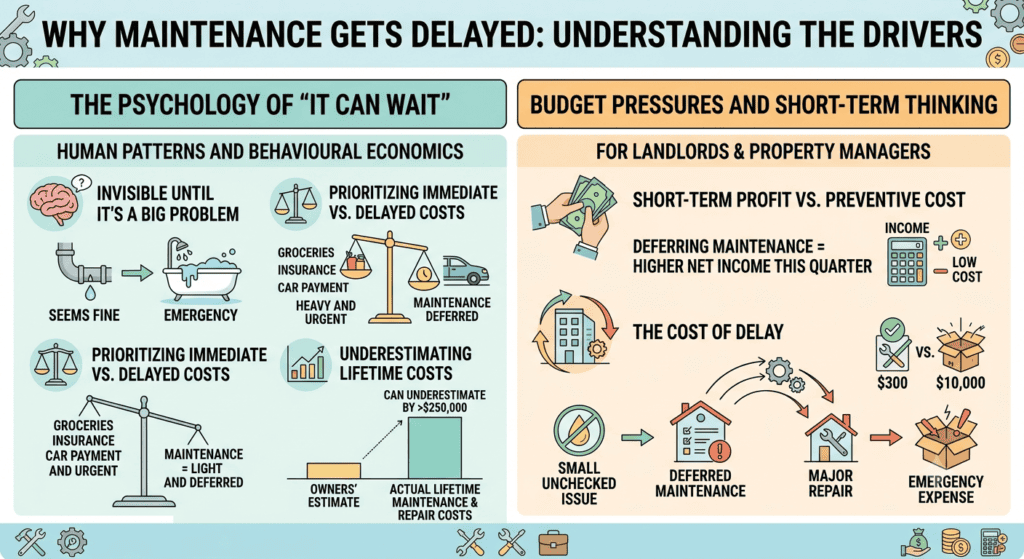
Most maintenance tasks are what behavioural economists call “invisible until they aren’t.” A slightly clogged gutter doesn’t look dangerous. A lawn that’s a little overgrown doesn’t feel urgent. Because the consequences of skipping these tasks are delayed and uncertain, our brains treat them as lower priority than immediate expenses like groceries, insurance premiums, or a car payment. Researchers who study home maintenance behaviour describe this as a form of “if-then” thinking that most people simply aren’t trained to do – we’re wired to respond to what’s in front of us, not to model out what a small problem could become six months from now.
This is compounded by a second factor: many owners genuinely underestimate what property upkeep costs over the life of a home or building. Recent consumer research has found that homeowners can underestimate their lifetime maintenance and repair bill by well over $250,000, which helps explain why routine maintenance so often gets pushed aside in favour of costs that feel more immediate.
Budget Pressures and Short-Term Thinking
For landlords and commercial property managers, the pressure is different but just as real. Every dollar spent on preventive maintenance is a dollar that isn’t showing up as net income this quarter. It’s tempting to defer a $300 inspection when the building “seems fine.” The problem is that this kind of short-term thinking almost always costs more in the long run – and it’s precisely the pattern that turns manageable maintenance items into expensive emergencies.
The Financial Multiplier Effect: How Small Problems Become Big Bills
This is the part that surprises most property owners: deferred maintenance doesn’t just cost a little more later. It compounds, often dramatically.
The 1-to-4 Rule (and Worse)
Industry data on residential repairs consistently shows that every dollar of maintenance put off today can turn into four dollars or more in repair costs down the road, depending on the system involved and how long the problem is left unaddressed. Some facility management studies place the multiplier even higher – with deferred maintenance costs compounding by roughly 7% for every year a repair is delayed, and total cost escalation reaching anywhere from 5 to 25 times the original prevention cost once a problem becomes an emergency.
Put simply: the hidden costs of ignoring property maintenance are not linear. They accelerate.
Real Examples: From a Small Fix to a Five-Figure Emergency
Consider a few realistic scenarios that mirror what maintenance professionals see every year:
- A homeowner skips a routine plumbing inspection to save a couple hundred dollars. Weeks later, a slow leak inside a wall goes unnoticed until water stains appear on the ceiling below. What started as a simple inspection and pipe seal has now become a full remediation job involving drywall replacement, flooring repair, and possible mold treatment – often landing in the $5,000 to $8,000 range.
- An HVAC filter that’s never changed causes the system to run inefficiently for years, quietly losing 2 to 3% efficiency annually. Eventually, the compressor fails outright. A $50 part that was never replaced turns into a $4,000+ compressor replacement.
- A homeowner ignores a small roof leak because “it’s not that bad yet.” By the time it’s addressed, the fix has grown from a few hundred dollars into a $15,000 job involving structural repair, insulation replacement, and interior finishing.
None of these are worst-case, scare-tactic examples. They are the ordinary, predictable outcome of what happens when small maintenance items are pushed off, month after month, until they can’t be ignored anymore. Recent industry research puts the average deferred home repair at more than $5,600 to resolve – a number that keeps climbing as contractor rates and material costs rise across Ontario.
Structural and System Damage That Compounds Over Time
Some parts of a property are especially vulnerable to the compounding effect of neglect. If you own or manage a property in the Niagara Region, these are the systems worth watching most closely.
Roofs, Gutters, and Foundations
Clogged gutters are one of the most underestimated maintenance issues in residential and commercial properties alike. When gutters back up, water doesn’t drain away from the building – it pools at the foundation, seeps into basements, and gradually undermines the structural integrity of the property. Clean, functional gutters are estimated to protect as much as 10% of a home’s total value simply by preventing this kind of foundation damage. The link between gutter cleaning and foundation damage is one of the clearest examples in this entire guide of how a small, cheap task prevents an enormous, expensive one – and it’s a significant amount of equity riding on a task that typically takes an afternoon.
HVAC and Plumbing Systems
Mechanical systems fail faster and more expensively when they’re neglected. A furnace or air conditioner that never gets serviced works harder than it needs to, burns more energy, and eventually breaks down well before its expected lifespan. The same is true for plumbing – small leaks, worn seals, and aging fixtures rarely announce themselves loudly. They just get worse, quietly, until the day they don’t.
Landscaping and Drainage Issues
This is one area where Niagara property owners sometimes underestimate the risk. Poor grading, overgrown root systems near foundations, and neglected drainage swales can direct water toward a building instead of away from it – a problem that gets worse every season it’s left unaddressed. Even something as simple as spring landscaping done incorrectly can change how water flows toward a foundation, increasing flood risk in ways most owners never anticipate until there’s standing water in the basement.
Insurance Risks: When Your Claim Gets Denied
Perhaps the most painful hidden cost of ignoring property maintenance is the one that shows up exactly when you need help the most: at claim time.
What Counts as “Lack of Maintenance” in Ontario
Most home and commercial insurance policies in Ontario exclude damage caused by normal wear and tear or a documented lack of maintenance. That means if an adjuster determines that a water leak, roof failure, or structural issue developed gradually because routine upkeep was skipped, the claim can be denied outright – leaving the property owner to cover the full cost out of pocket. Water damage claims are particularly vulnerable to this kind of denial, since insurers frequently argue that damage resulted from a long-term, unaddressed leak rather than a sudden, covered event like a burst pipe.
Ontario has seen this play out at scale. Insured damage from severe weather across Canada topped several billion dollars in recent years, and as claim volumes climb, insurers are applying more scrutiny – not less – to whether a property was reasonably maintained before the loss occurred.
How to Protect Yourself with Documentation
The good news is that this particular hidden cost is largely preventable. Insurance and legal professionals consistently recommend the same thing: keep dated records of every maintenance visit, inspection, and repair. Roof inspections, plumbing servicing, gutter cleanings, furnace tune-ups, and lawn and landscape maintenance schedules all count as evidence that a property was cared for. If a claim is ever disputed, having a documented, professional maintenance history is often the single strongest piece of evidence an owner can present.
This is one of the most practical reasons to work with a professional maintenance provider rather than handling everything on an ad-hoc, whenever-I-get-to-it basis – you end up with a paper trail that protects you, not just a property that looks better.
Legal and Liability Exposure in the Niagara Region
Beyond insurance, there’s a second layer of hidden cost that many property owners don’t think about until it’s too late: legal liability.
Snow, Ice, and the Occupiers’ Liability Act
Winter in the Niagara Region isn’t optional, and neither is your legal responsibility to manage it. Under Ontario’s Occupiers’ Liability Act, anyone who owns, occupies, or controls a property has a duty to take reasonable steps to keep the premises safe – including clearing snow and ice from walkways, entrances, and parking areas within a reasonable time after a snowfall. Many municipalities also have their own bylaws requiring snow and ice removal from sidewalks within a set window, often 24 hours, after accumulation. Failing to meet that standard doesn’t just create a hazard – it creates direct legal exposure.
Slip-and-Fall Costs for Landlords and Business Owners
The financial stakes here are significant. Slip-and-fall settlements and judgments in Ontario can range anywhere from $25,000 into the hundreds of thousands of dollars, depending on the severity of the injury. Liability doesn’t only fall on the property owner, either – the law has been amended to extend responsibility to any contractor hired to manage snow and ice removal, meaning both the property owner and the maintenance company can be named in a claim if the job isn’t done properly and on schedule.
For landlords, commercial property managers, and business owners across Niagara Falls, St. Catharines, and Welland, this is one of the clearest examples of how a “minor” maintenance gap – an icy walkway left unattended for a day too long – can turn into a six-figure legal and financial problem. Having a documented, professional service log for snow and ice removal is one of the most effective protections a property owner can have if a claim is ever filed – and it’s the clearest way to limit snow removal liability in Ontario before a bad fall ever happens.
The Curb Appeal Connection to Home Value
Not every hidden cost shows up as a repair bill or a legal notice. Sometimes it shows up as a lower number on a sale offer, and the relationship between curb appeal and resale value is one of the most consistently documented patterns in real estate research.
How Neglected Landscaping Lowers Offers
First impressions happen at the curb, not the front door. Buyers and their agents form an opinion about how well a property has been cared for before they ever step inside, and an overgrown lawn, patchy grass, or neglected garden beds signal exactly the kind of deferred maintenance that makes buyers nervous about what else might have been skipped. Real estate research consistently shows that homes with strong curb appeal sell for meaningfully more than comparable homes nearby – and that gap widens even further in slower markets, where buyers have more properties to compare and less patience for visible neglect.
The ROI of Professional Lawn Care and Landscaping
The flip side of this is genuinely good news for property owners: landscaping and lawn care deliver some of the best returns of any property investment. Realtor surveys have found that the vast majority of real estate professionals believe good landscaping increases a home’s value by at least 5%, with many estimating the impact at 15% or more for well-executed, mature landscaping. Simple, routine upkeep – mowing, edging, trimming, fresh mulch – regularly recoups close to its full cost when a home sells, making it one of the lowest-risk investments a property owner can make. For Niagara homeowners weighing whether ongoing lawn care and landscaping is “worth it,” the answer, backed by consistent industry data, is almost always yes.
Commercial Property Impact: NOI, Cap Rates, and Tenant Turnover
For commercial property owners, the hidden costs of ignoring property maintenance don’t stop at repair bills – they hit the bottom line in ways that show up directly on a balance sheet.
How Deferred Maintenance Shrinks Property Value
Escalating repair costs eat directly into net operating income (NOI), which is the primary driver of how commercial properties are valued. But there’s a second, less obvious hit: properties with visible deferred maintenance are appraised at higher capitalization rates, because buyers and lenders perceive them as higher risk. A modest shift from a 6% cap rate to an 8% cap rate on a property generating $500,000 in annual NOI can reduce the property’s valuation by well over $2 million – a loss driven entirely by maintenance neglect, not by market conditions. This kind of exposure is exactly why commercial property maintenance needs to be treated as a capital protection strategy, not a discretionary expense.
Tenant Retention and Vacancy Costs
Tenants notice maintenance quality just as quickly as buyers do. When common areas, landscaping, snow removal, or building systems are inconsistently maintained, tenant satisfaction drops – and with it, renewal rates. Every vacancy created by a frustrated tenant leaving early comes with real costs: lost rent during the turnover period, marketing and leasing fees, and the administrative time required to find a replacement. For commercial and multi-unit property owners across the Niagara Region, consistent professional maintenance is often cheaper than the alternative of managing turnover after turnover.
Airbnb and Short-Term Rentals: Cleanliness as Revenue
If you operate a short-term rental in the Niagara Region – a market with steady year-round tourist traffic thanks to Niagara Falls – cleanliness isn’t a maintenance category. It’s your revenue engine.
Why Cleanliness Reviews Make or Break Bookings
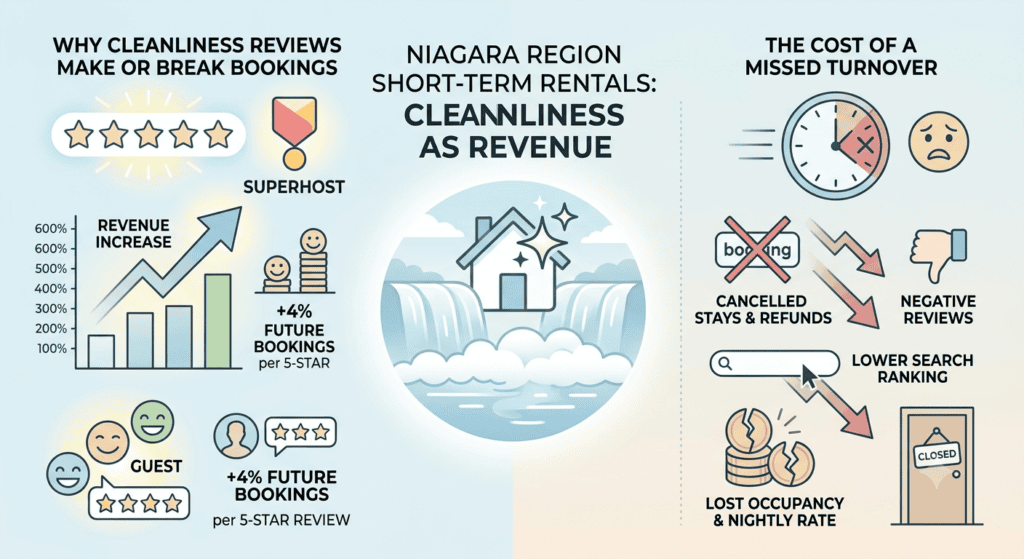
Cleanliness is the single most reviewed category on Airbnb, and it’s the most common reason hosts lose their star rating and their Superhost status. The financial impact is dramatic: moving a listing from a two-star to a four-star rating has been shown to increase revenue by as much as 600%, and each additional five-star review can boost future bookings by more than 4%. Listings that consistently earn Airbnb’s top-tier recognition for cleanliness and overall guest satisfaction can command more than double the revenue of comparable, unlabeled listings.
The Cost of a Missed Turnover
A single missed or rushed Airbnb cleaning turnover can trigger a cancelled stay, a refund, and a negative review that lingers on your listing for months – undermining search ranking at exactly the moment new guests are deciding whether to book. For hosts managing multiple properties or juggling back-to-back check-ins, inconsistent cleaning isn’t just a guest experience problem. It’s a direct, measurable hit to occupancy and nightly rate.
Junk, Clutter, and Waste: The Overlooked Maintenance Cost
Not every maintenance issue involves a system failure. Sometimes the hidden cost is sitting in the garage, the backyard, or a forgotten storage room.
Pest Infestations and Fire Hazards
Accumulated junk, old furniture, and construction debris create ideal conditions for pests – rodents and insects are drawn to clutter because it offers shelter and, often, food sources. Left unaddressed, an infestation can spread into walls and insulation, turning a simple junk removal job into a full pest remediation and repair project. Cluttered garages, basements, and storage areas also create fire hazards, particularly when flammable materials are stored near heat sources or electrical panels.
When to Call for Garbage & Junk Removal
Regular garbage and junk removal isn’t glamorous, but it’s one of the simplest ways to prevent a whole category of expensive problems before they start. Whether it’s post-renovation debris, old furniture, or general clutter that’s built up over years, clearing it out protects both the property and the people using it.
Seasonal Maintenance Checklist for Niagara Properties
Because the Niagara Region experiences four distinct seasons, maintenance needs shift throughout the year. Here’s a practical, season-by-season checklist.
Spring
- Inspect the roof and gutters for winter damage
- Check grading and drainage around the foundation
- Begin regular lawn care and landscaping to prevent early-season overgrowth
- Inspect exterior siding, walkways, and steps for cracks from freeze-thaw cycles
Summer
- Maintain consistent lawn mowing and landscaping upkeep
- Trim trees and shrubs away from the roofline and siding
- Inspect and service HVAC systems ahead of peak cooling demand
- Schedule Airbnb and rental cleaning turnovers on a consistent cycle
Fall
- Clean gutters thoroughly before leaves finish falling
- Schedule a furnace inspection before the heating season begins
- Complete a fall cleanup, including leaf removal and garden bed preparation
- Arrange garbage and junk removal for any debris built up over the year
Winter
- Set up a reliable snow removal schedule for walkways, driveways, and parking areas
- Confirm salting and de-icing coverage to reduce slip-and-fall risk
- Check for ice dams forming on the roofline
- Monitor pipes in unheated areas to prevent freezing
Building a Maintenance Strategy That Actually Works
Understanding the hidden costs of ignoring property maintenance is only useful if it leads to a plan. The good news is that a workable preventive maintenance plan doesn’t need to be complicated – it just needs to be consistent.
DIY vs. Professional Maintenance
Some tasks are reasonable to handle yourself – light yard work, basic inspections, minor cleanup. But many of the highest-risk categories covered in this guide (snow and ice management, gutter and roof work, structural inspections, and consistent short-term rental turnovers) carry real safety and liability risk when done inconsistently or without the right equipment. A missed step on a ladder or an under-cleared walkway can cost far more than the service itself would have.
Why a Single Provider Model Saves Money
One of the most effective ways property owners in the Niagara Region reduce their maintenance risk is by consolidating services under a single, reliable provider rather than juggling multiple contractors, schedules, and invoices. Managing five separate vendors for lawn care, snow removal, cleaning, landscaping, and junk removal means five separate points of failure – five chances for a task to be forgotten, delayed, or done inconsistently because no single company sees the full picture of the property.
When those services are coordinated through one team instead, nothing falls through the cracks between providers. A single point of contact means faster scheduling, more consistent quality standards, and – just as importantly – a unified, documented service history that protects the owner with insurers and, if it ever comes to it, in court. That documentation is one of the most underrated benefits of professional maintenance: it turns “we think this was maintained” into a verifiable record with dates, service notes, and photos.
There’s also a practical cost argument for the single-provider model. Bundled service agreements are typically priced more efficiently than piecing together the same work through separate one-off contractors, and a provider who already knows the property’s layout, drainage patterns, and problem areas can often catch small issues – a struggling patch of lawn, an early sign of drainage trouble, a section of walkway that ices over first – before they become the kind of expensive surprise this guide has been describing.
This is exactly the kind of coordinated approach that NLLC (Niagara Landscaping, Lawn Care & Cleaning) provides for homeowners, landlords, and commercial property managers across Niagara Falls, St. Catharines, Welland, Fort Erie, Niagara-on-the-Lake, Thorold, Port Colborne, and the wider Niagara Region. Whether a property needs a single service or a full year-round plan covering every season outlined above, working with one trusted team removes the guesswork – and the risk – from property upkeep.
Common Mistakes Property Owners Make
- Waiting for something to look bad before addressing it. By the time damage is visible, the underlying problem has usually existed for a long time.
- Treating maintenance as optional during tight budget periods. This is exactly when deferred costs compound the fastest.
- Not keeping records. Without documented maintenance history, insurance claims and liability disputes become far harder to win.
- Assuming snow removal is “good enough” without a written service agreement. Verbal arrangements don’t hold up well if a slip-and-fall claim is filed.
- Underestimating landscaping’s role in resale value. Many sellers spend heavily on interior renovations while ignoring the exterior first impression that shapes a buyer’s opinion before they even walk in.
- Letting Airbnb cleaning slip during busy booking periods. This is precisely when consistency matters most for maintaining ratings.
- Ignoring clutter and junk buildup. It seems cosmetic until it becomes a pest or fire safety issue.
Conclusion: Protect Your Property Before the Bill Comes Due
The hidden costs of ignoring property maintenance rarely announce themselves in advance. They build quietly – behind drywall, underneath a lawn, along an icy walkway – until they surface as a repair bill, a denied insurance claim, a lawsuit, or a disappointing sale offer. The encouraging part is that every single one of these outcomes is preventable with consistent, professional upkeep.
For homeowners, landlords, and business owners across Niagara Falls, St. Catharines, Welland, Fort Erie, Niagara-on-the-Lake, Thorold, Port Colborne, and the greater Niagara Region, that means treating maintenance as a protective investment rather than an optional expense. Whether it’s a single home or a growing rental portfolio, professional property management in Niagara Falls and the surrounding area starts with exactly the kind of consistent upkeep this guide has covered. Whether it’s regular lawn care and landscaping, reliable residential and commercial cleaning, dependable snow and ice removal, or clearing out junk and garbage buildup, a coordinated maintenance plan protects both the property and the people responsible for it.
NLLC has built its services around exactly this kind of coordinated approach, serving properties across the Niagara Region so owners don’t have to juggle multiple contractors or wonder whether anything has been missed. If your property could use a maintenance check-up – or if you’re simply tired of wondering what’s being deferred – reach out to the NLLC team today for a free consultation.
Frequently Asked Questions
1. What are the biggest hidden costs of ignoring property maintenance?
The largest hidden costs typically come from compounding repair expenses (small issues becoming major ones), denied insurance claims, legal liability from slip-and-fall incidents, reduced resale value, and lost rental or Airbnb income from poor upkeep.
2. How much more does deferred maintenance cost compared to preventive care?
Depending on the system involved, deferred repairs can cost anywhere from four times to more than twenty times what preventive maintenance would have cost, according to industry benchmarks on residential and commercial properties.
3. Can my home insurance claim really be denied because of a maintenance issue?
Yes. Most Ontario home insurance policies exclude damage from normal wear and tear or a documented lack of maintenance. Insurers frequently investigate whether a loss developed gradually before approving or denying a claim.
4. Who is responsible for snow removal on a rental property in Ontario?
Generally, the landlord or property owner is responsible for snow and ice removal on rental properties, though the specific arrangement can vary by lease agreement. Regardless of who performs the work, the property owner typically retains liability under the Occupiers’ Liability Act.
5. Does landscaping really affect how much a home sells for?
Yes. Multiple industry studies show that strong curb appeal and well-maintained landscaping can increase a home’s perceived value by 5% to 15% or more, and homes with strong curb appeal tend to sell faster and for higher offers than comparable, poorly maintained properties.
6. How often should gutters be cleaned to prevent damage?
Most professionals recommend cleaning gutters at least twice a year – typically in spring and fall – with more frequent cleaning if the property has significant tree coverage.
7. What should I do if I don’t have time to manage all these maintenance tasks myself?
This is exactly the situation professional property maintenance companies are built for. A single provider that handles landscaping, cleaning, snow removal, and junk removal can keep a property protected year-round without the owner needing to coordinate multiple contractors.
8. How do I get started with a maintenance plan for my property?
The easiest first step is a property assessment. Contact NLLC to discuss a maintenance plan tailored to your property type, whether it’s a single-family home, rental unit, Airbnb, or commercial building.