Have you ever spent an entire Saturday scrubbing your house from top to bottom, only to look around a few days later and wonder why it doesn’t feel clean? You’re not imagining it, and you’re definitely not alone. Across Niagara Falls, St. Catharines, Welland, and the rest of the Niagara Region, homeowners are putting in real effort every week and still ending up with streaky windows, sticky counters, or a house that smells like cleaning product instead of actually being clean.
Small, easy-to-miss habits – the order you clean rooms in, the amount of product you use, the cloth you grab without thinking – quietly work against you. Over time, these small mistakes add up to wasted hours, damaged surfaces, germs that never actually leave your home, and higher maintenance costs when things wear out faster than they should.
This guide breaks down the 15 most common cleaning mistakes homeowners make, explains exactly why each one backfires, and walks you through the professional way to fix it. Whether you’re cleaning your own home every week or trying to figure out when it’s time to bring in a professional residential cleaning team, this is the roadmap.
Think about the last time you cleaned your kitchen from top to bottom. You probably wiped the counters, ran a vacuum over the floor, and maybe scrubbed the sink until it shone. A day or two later, though, the counter feels tacky again, dust reappears on the baseboards, and that “clean” smell has faded into something closer to stale. That gap between how a home looks right after cleaning and how it actually performs a few days later is almost always a technique problem, not an effort problem – and it’s exactly what this guide is designed to close.
Why Cleaning Technique Matters More Than Cleaning Frequency
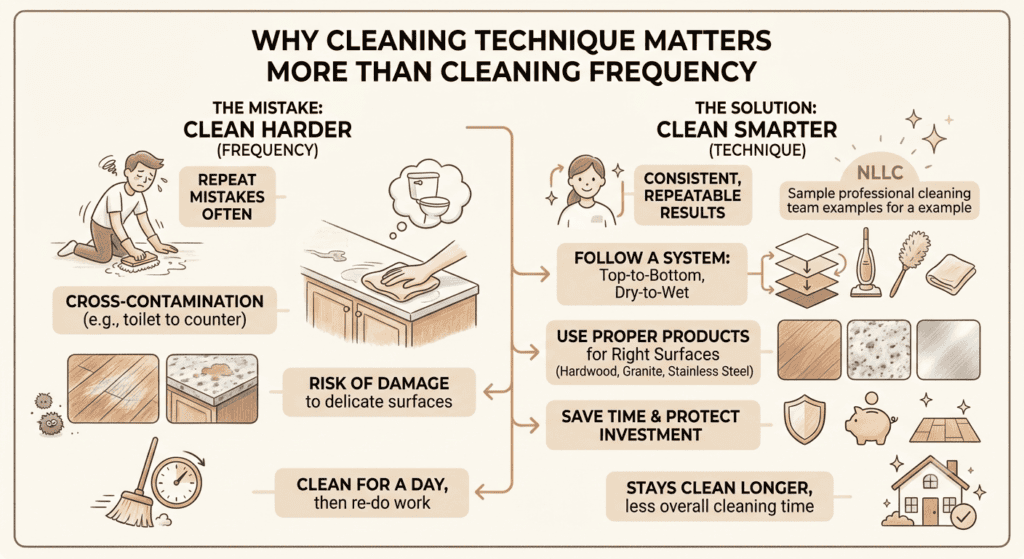
It’s tempting to think the solution to a messy home is simply cleaning more often. Vacuum twice a week instead of once. Wipe the counters three times a day. Scrub harder. But homeowners who clean the most aren’t always the ones with the cleanest homes – because frequency without proper technique just means repeating the same mistakes more often.
Cleaning harder vs. cleaning smarter
Cleaning harder usually means more scrubbing, more product, and more time. Cleaning smarter means following a sequence and a system so that every pass actually accomplishes something instead of undoing the last step. A homeowner who wipes down the bathroom counter with the same cloth used on the toilet handle isn’t being lazy – they simply haven’t been shown the system that professionals use every day.
How proper technique saves time and protects your home
Working top to bottom, using the right product for the right surface, and letting products sit for their intended contact time all sound like small details. In practice, they’re the difference between a task that needs to be redone in two days and one that holds up for a full week. Proper technique also protects your investment: hardwood floors, granite counters, and stainless steel appliances are expensive to replace, and the wrong cleaner can shorten their lifespan considerably.
Why professional cleaners follow structured systems
Professional cleaning teams, including the crews at NLLC, don’t clean randomly. They follow a set sequence – top to bottom, dry to wet, high-touch to low-touch – because that sequence has been tested to produce consistent, repeatable results. That’s the real difference between a home that looks clean for a day and one that stays clean.
There’s also a financial angle homeowners rarely think about. Every time the wrong product is used on a delicate surface, or a tool is left dirty long enough to cause damage, that mistake shortens the lifespan of something expensive to replace – hardwood flooring, natural stone counters, upholstery, even the vacuum itself. A structured system isn’t just about a cleaner-looking home today; it’s about protecting the investment you’ve already made in your house. Homeowners who switch from a “clean harder” mindset to a “clean smarter” one typically report spending less time cleaning overall, not more, because they stop redoing work that a better sequence would have gotten right the first time.
Top 15 Cleaning Mistakes Homeowners Make
Here are the cleaning mistakes homeowners make most often, along with the professional fix for each one.
1. Cleaning From the Floor Up Instead of Top Down
Why dust falls onto already-clean surfaces
If you vacuum first and then dust your shelves, blinds, and ceiling fan afterward, you’ve just undone your own work. Dust, crumbs, and debris fall downward. Clean the floor first and dust top surfaces after, and everything you knocked loose lands right back on the floor you just finished.
The professional cleaning sequence
Professionals always work top to bottom and left to right in a single room: ceiling fans and light fixtures first, then shelves and countertops, then furniture, and floors dead last. This way, gravity is working with you instead of against you, and you only need to vacuum or mop once per room.
2. Using Too Much Cleaning Product
Sticky residue attracts more dirt
More soap doesn’t mean more clean – it usually means a sticky film left behind that actually attracts dust and dirt faster than a bare surface would. This is especially common with floor cleaners and all-purpose sprays, where homeowners assume a heavier application will lift more grime.
More product doesn’t mean better cleaning
Cleaning products are formulated with a specific concentration in mind. Doubling up doesn’t double the cleaning power; it just leaves more residue that needs to be rinsed away, and if it isn’t rinsed properly, that residue becomes a magnet for the very dirt you were trying to remove.
Follow manufacturer instructions
Always check the dilution ratio on the label. If a product is meant to be diluted with water, skipping that step wastes product, can damage certain finishes, and often makes cleaning harder, not easier.
3. Mixing Household Cleaning Chemicals
Dangerous combinations
This is one of the cleaning mistakes homeowners make that carries real safety risk, not just a wasted afternoon. Mixing bleach with ammonia-based cleaners produces toxic chloramine gas, and mixing bleach with acidic products like vinegar or certain toilet bowl cleaners produces chlorine gas. Sodium hypochlorite, the active ingredient in chlorine bleach, reacts with ammonia, drain cleaners, and other acids. Even using one product shortly after another on the same surface, without rinsing in between, can trigger a reaction.
Safety risks
Mixing bleach with ammonia creates chloramine gases that can cause coughing, shortness of breath, chest pain, wheezing, nausea, watery eyes, and irritation of the throat, nose, and eyes, and in serious cases it can lead to pneumonia and fluid in the lungs. These aren’t rare, extreme reactions – they happen in ordinary homes, often when someone tries to boost a cleaner’s strength by combining products they assume are compatible.
Safe alternatives experts recommend
The safest rule is simple: never mix cleaning products, period. Use one product, rinse the surface with water, and let it dry before applying a different product. Store bleach, ammonia-based cleaners, and acidic cleaners in separate areas so they’re never grabbed together by accident, and always keep the original labels intact so you know exactly what’s in each bottle.
4. Using One Cloth Throughout the Entire House
Cross-contamination between rooms
Wiping the kitchen counter, then the bathroom sink, then the coffee table with the same cloth spreads bacteria from room to room instead of removing it. This is one of the most overlooked cleaning mistakes homeowners make because the cloth still looks clean, even when it’s carrying germs from surface to surface.
Color-coded microfiber cloth system
Professional cleaners solve this with a color-coded system: one color for kitchens, one for bathrooms, one for general living spaces, and one for glass and mirrors. This keeps bacteria from bathroom and kitchen surfaces from ever touching the areas your family spends the most time in.
Best practices for different areas
Wash microfiber cloths separately from towels, since lint transfers easily and reduces their effectiveness. Microfibre cloths generally need to be replaced every three to six months, or sooner if they start fraying or no longer pick up dirt effectively.
5. Ignoring High-Touch Surfaces
Light switches, door handles, cabinet pulls, remote controls
Most weekly cleaning routines focus on visible surfaces – counters, floors, tables – while skipping the spots people actually touch the most throughout the day. Light switches, doorknobs, and countertops should be cleaned regularly and after having visitors in your home.
Frequently missed germ hotspots
Light switches, door handles, cabinet and drawer pulls, remote controls, faucet handles, and stair railings are touched dozens of times a day but wiped down far less often than they should be. Because high-touch surfaces are more likely to spread germs, high-traffic areas may need more frequent cleaning or disinfecting in addition to regular cleaning. Building a quick “high-touch pass” into your routine – a two-minute sweep of these specific spots – closes a gap that most households don’t even realize exists.
A good habit is to pair this pass with something you already do daily, like tidying the kitchen after dinner or getting the kids ready for bed. Keep a single all-purpose wipe or a spray bottle and cloth within easy reach so the high-touch pass takes seconds rather than becoming its own separate chore. Families with young children, or anyone in the household who’s more likely to get sick, benefit the most from this extra layer, since germs on shared surfaces are one of the most common ways illness spreads between family members.
6. Forgetting to Clean Your Cleaning Tools
Vacuum filters, mop heads, sponges, brushes
It sounds counterintuitive, but the tools you clean with can be dirtier than the surfaces you’re cleaning. A vacuum with a clogged filter loses suction and blows fine dust back into the air. A mop head that hasn’t been washed in weeks is dragging old bacteria across every floor it touches.
Dirty tools spread bacteria instead of removing it
Cleaning experts recommend replacing mop heads every three to six months, especially if they’re used regularly on high-traffic areas, and washing them in the washing machine to keep them clean between replacements. Sponges are worse: they should be swapped out every one to two weeks because they soak up everything, including germs, and shouldn’t be used any longer than that. Vacuum filters need attention too – washable filters should generally be cleaned every one to three months, with non-washable filters replaced according to manufacturer recommendations.
A useful rule of thumb: if a tool touches dirt, moisture, and bacteria all day and never fully dries out, it needs a replacement schedule, not just an occasional rinse.
It helps to keep tool maintenance visible instead of relying on memory. A simple approach is to write the replacement date on a piece of masking tape stuck to the mop handle or sponge caddy, or set a recurring reminder on your phone for the first of each month. Rinsing a mop head or brush with hot water after every use, wringing it out completely, and letting it air dry fully before storing it also slows bacterial growth between full washes – a damp tool left balled up in a closet is one of the fastest ways to turn a cleaning tool into a bacteria incubator.
7. Using the Wrong Cleaner on Delicate Surfaces
Granite, hardwood, stainless steel, glass, electronics
Not every surface can handle the same cleaner. Granite countertops can be etched by acidic cleaners like vinegar or lemon-based products. Hardwood floors can warp or dull when soaked with too much water or the wrong cleaning agent. Stainless steel scratches easily with abrasive powders, and glass and electronics are especially vulnerable to moisture damage.
Surface-specific cleaning tips
Use a pH-neutral cleaner made specifically for stone on granite and marble. Stick to a slightly damp microfiber mop and a hardwood-specific cleaner on wood floors. Clean stainless steel in the direction of the grain with a soft cloth. Use a dedicated glass cleaner on windows and mirrors, and for electronics, always apply cleaner to the cloth rather than the screen itself.
8. Letting Stains Sit Too Long
Why fresh stains are easier to remove
The longer a spill sits, the deeper it works into carpet fibers, grout lines, or upholstery. Fresh stains can often be lifted with just water and light blotting; stains that have had days to set usually require stronger products or professional treatment.
Preventing permanent damage
Certain stains – red wine, coffee, pet accidents – can cause permanent discoloration if left untreated for more than a day or two, especially on light-coloured carpet or fabric.
Quick response tips
Blot, don’t rub, to avoid spreading the stain or pushing it deeper into the fibers. Use cold water first on most organic stains, since hot water can set proteins like blood or dairy into the material.
9. Skipping Hidden Areas During Routine Cleaning
Baseboards, ceiling fans, under furniture, behind appliances, air vents
Weekly cleaning tends to cover the same visible surfaces every time, which means baseboards, the tops of door frames, behind the refrigerator, and inside air vents can go months without attention.
Why these areas affect indoor air quality
Dust that collects in these hidden zones doesn’t just sit there quietly – it gets stirred up by foot traffic, ceiling fans, and HVAC systems and recirculates through the air you breathe. For households with allergies or asthma, this buildup can be a real contributor to symptoms, even when the rest of the home looks spotless.
10. Vacuuming Too Quickly
Proper vacuum speed
Rushing a vacuum across the carpet in one fast pass looks productive but leaves embedded dirt and dust behind. Vacuums are designed to lift debris gradually as the brush roll agitates the fibers; moving too fast doesn’t give that process time to work.
Multiple passes for high-traffic areas
Slow, overlapping passes – and at least two passes over high-traffic areas like hallways and entryways – pull out significantly more dirt than a single quick sweep.
Carpet lifespan benefits
Ground-in dirt acts like sandpaper on carpet fibers every time someone walks across it. Thorough, unhurried vacuuming removes that grit and meaningfully extends the life of your carpet.
11. Spraying Cleaner Directly Onto Electronics or Glass
Moisture damage
Spraying cleaner directly onto a TV screen, laptop, or window can send liquid into seams, vents, or window frames where it causes streaking, mold growth, or in the case of electronics, real damage to internal components.
Streaks
Direct spraying on glass also tends to leave uneven residue, because the product pools in some spots and evaporates before you can wipe it in others.
Proper application methods
Spray the cleaner onto a microfiber cloth first, then wipe the surface. This gives you full control over how much product touches the surface and eliminates the risk of liquid pooling in electronics or window seals.
12. Not Following Product Dwell Time
Why disinfectants need time to work
Spraying a disinfectant and wiping it off immediately feels efficient, but it usually means the product never actually killed anything. A dwell time, also known as contact time, is the amount of time a disinfectant must remain visibly wet on a surface to effectively kill a specific pathogen, and it can range anywhere from 30 seconds to 15 minutes depending on the product.
Cleaning vs. disinfecting
These are two different jobs. Cleaning with soap and water physically removes dirt and most germs. Disinfecting is a separate step that uses a chemical product to kill the germs left behind – and it only works if the surface is cleaned first and then kept wet for the full dwell time listed on the label.
Reading product labels correctly
Every EPA-registered disinfectant label specifies a contact time that must be followed to achieve the pathogen reduction claimed on the packaging. If a spray or wipe dries out before that time is up, the surface needs to be reapplied rather than simply wiped away.
13. Waiting Too Long Between Deep Cleaning Sessions
Dirt buildup
Regular weekly cleaning handles surface-level mess, but it doesn’t reach everywhere. Baseboards, behind appliances, inside cabinets, grout lines, and window tracks accumulate buildup that a normal routine simply doesn’t touch.
Hidden bacteria
The longer these areas go untouched, the more bacteria, mold, and allergens they can harbor – often without any visible sign until the buildup is significant.
Seasonal deep cleaning recommendations
A practical approach for most Niagara Region households is a full deep clean at least once per season – four times a year – with an additional deep clean before major holidays or gatherings. Homes with pets, young children, or allergy sufferers often benefit from a deep clean every two to three months instead.
14. Cleaning Windows in Direct Sunlight
Why streaks appear
Cleaning windows on a hot, sunny afternoon feels like good timing, but it works against you. Sunlight heats the glass and causes cleaning solution to dry almost instantly, leaving streaks behind before you’ve had a chance to wipe it evenly.
Best weather and timing
Overcast days, or early morning and evening hours, give you more time to work the solution across the glass and buff it dry without the sun racing ahead of you.
Professional window-cleaning advice
Professional window cleaners use a squeegee technique in overlapping, top-to-bottom strokes and wipe the blade after every pass, which avoids the streaking that spray-and-wipe methods often leave behind – especially on larger window panes common in Niagara-on-the-Lake and Fort Erie homes.
15. Trying DIY Cleaning Hacks Without Verification
Social media myths
Social media is full of cleaning “hacks” – mixing vinegar with dish soap for an all-purpose spray, using baking soda on every surface, or combining hydrogen peroxide with other household chemicals. Some of these are genuinely useful; others can damage surfaces or, in the worst cases, create dangerous chemical reactions.
Potential surface damage
Vinegar-based hacks, for example, can etch natural stone and dull hardwood finishes over time, even though they’re marketed as “natural” and therefore assumed to be harmless.
When professional products are safer
If a hack claims to disinfect, remove tough stains, or work on multiple surface types at once, it’s worth checking whether it’s backed by an actual cleaning authority before trying it – or simply using a purpose-built product designed and tested for that specific job.
Professional Cleaning Habits That Keep Homes Cleaner Longer
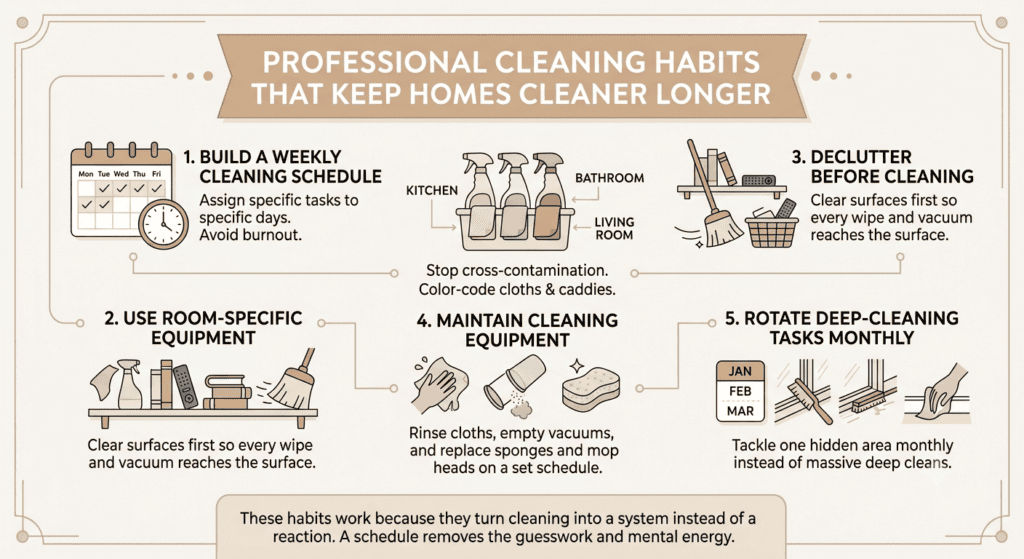
Fixing individual mistakes is a great start, but the homeowners with consistently clean homes usually share a few structural habits:
- Build a weekly cleaning schedule. Assigning specific tasks to specific days prevents the “clean everything at once” burnout that leads to shortcuts.
- Use room-specific tools. A color-coded cloth and dedicated cleaning caddy for each area of the home stops cross-contamination before it starts.
- Declutter before cleaning. Clearing counters and floors first means every wipe and vacuum pass actually reaches the surface instead of going around objects.
- Maintain cleaning equipment. Rinse cloths, empty vacuum canisters, and replace sponges and mop heads on a set schedule instead of waiting until they look dirty.
- Rotate deep-cleaning tasks monthly. Instead of one massive deep clean, tackle one hidden area – baseboards one month, window tracks the next – so the workload never piles up.
These habits work because they turn cleaning into a system instead of a reaction. Reactive cleaning – where you only clean once a room starts to look messy – means you’re always playing catch-up, and catch-up cleaning is exactly where shortcuts like skipping dwell time, grabbing whatever cloth is nearest, or using extra product to “speed things up” tend to creep in. A schedule removes the guesswork. Once cleaning specific rooms on specific days becomes routine, the whole process takes less mental energy and less time, and the mistakes covered earlier in this guide become much less likely to happen in the first place.
When It’s Time to Call Professional Residential Cleaning Services
Even with the best system, there are moments when a professional residential cleaning service makes more sense than tackling it alone. Common situations include:
- Move-in or move-out cleaning, where a property needs to meet a strict standard for new tenants, buyers, or a landlord inspection
- Seasonal deep cleaning, covering the hidden areas that weekly routines don’t reach
- Post-renovation cleanup, where fine dust and debris settle into every surface, vent, and crevice
- Busy families who simply don’t have the hours in a week to keep up with a full cleaning system
- Allergy concerns, where professional-grade equipment and HEPA filtration make a measurable difference in air quality
- Large homes, where square footage alone makes a thorough weekly clean unrealistic without help
- Preparing for guests or special events, when a home needs to look its best on a tight timeline
For homeowners across Niagara Falls, St. Catharines, Welland, Thorold, Fort Erie, Port Colborne, and Niagara-on-the-Lake, NLLC’s residential cleaning team handles exactly these situations, using the same top-to-bottom, high-touch-first system outlined above.
There’s also a middle ground many homeowners overlook: a recurring professional visit every few weeks to handle the deep-cleaning tasks that fall outside a normal weekly routine, while you keep up with day-to-day tidying yourself. This hybrid approach tends to work well for busy households in the Niagara Region who want a genuinely clean home without committing to full-service cleaning every single week. It also gives homeowners a chance to see the professional system in action – the sequencing, the product choices, the attention to high-touch surfaces – which often carries over into how they clean between visits.
Conclusion
The biggest cleaning mistakes homeowners make aren’t usually about effort – they’re about technique. Cleaning from the wrong direction, using too much product, mixing chemicals that were never meant to be combined, reaching for one cloth for the whole house, and skipping the high-touch surfaces people touch dozens of times a day all quietly undercut the work you’re already putting in.
The fix isn’t to clean harder. It’s to clean the way professionals do: top to bottom, with the right tool and the right product for each surface, following label instructions instead of guesswork, and building in a regular deep-cleaning rhythm instead of waiting until things get out of hand.
If you’d rather hand the whole system over to people who do this every day, NLLC’s residential cleaning team serves homes across Niagara Falls, St. Catharines, Welland, and the wider Niagara Region – bringing the same professional techniques covered in this guide to every visit.
Ready for a home that’s actually clean, not just tidied up? Request your free quote from NLLC today and let our team handle the details.
Frequently Asked Questions
How often should homeowners deep clean their homes?
Most homes benefit from a full deep clean once per season – about four times a year – with additional attention before holidays or major gatherings. Homes with pets, young children, or allergy sufferers often do better with a deep clean every two to three months.
What’s the biggest mistake people make while cleaning?
Skipping high-touch surfaces and not following proper technique – like cleaning top to bottom or letting disinfectants sit for their full dwell time – tends to have the biggest impact on how clean a home actually feels day to day.
Is using more cleaning solution better?
No. More product usually means more residue left behind, which can attract dirt faster than a properly diluted, correctly applied cleaner.
How often should microfiber cloths and mop heads be washed?
Microfiber cloths should be washed after each use and replaced roughly every three to six months. Mop heads should be laundered regularly and replaced every three to six months as well, depending on how often they’re used.
Should every room have separate cleaning cloths?
Yes. Using dedicated cloths for kitchens, bathrooms, and living spaces prevents bacteria from one room being spread to another during routine cleaning.