The First Five Minutes Decide Your Star Rating
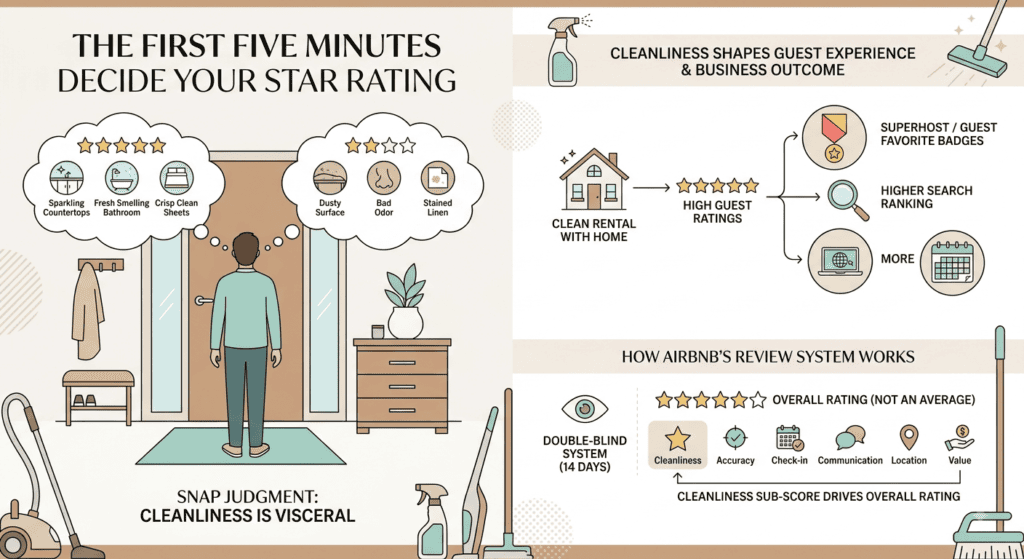
A guest unlocks the door, rolls their suitcase into the entryway, and takes one long look around before they’ve even set their bag down. In that first glance, they’re already forming an opinion about your listing – and that opinion is almost never about the throw pillows or the artwork on the wall. It’s about whether the countertops look wiped, whether the bathroom smells fresh, and whether the sheets look like they were actually changed. That snap judgment, made in under a minute, is the single biggest factor in whether your Airbnb earns a five-star review or a lukewarm three.
Cleanliness isn’t just one line item on a guest’s checklist. On Airbnb, it’s a dedicated rating category that guests score every single stay, and it quietly shapes almost everything else about how your listing performs – your search ranking, your eligibility for badges like Superhost and Guest Favorite, and ultimately, your booking calendar. Hosts across the Niagara Region are discovering that Airbnb cleaning isn’t a task to check off between guests; it’s the operational backbone of a profitable short-term rental.
This guide walks through exactly why cleanliness drives guest reviews, what Airbnb’s rating system actually measures, the turnover mistakes that quietly tank scores, and the practical systems that turn a good listing into a five-star, badge-holding one. Whether you self-manage a single unit in Niagara Falls or run a growing portfolio across the region, the goal here is the same: fewer surprises for your guests, and fewer sleepless nights for you.
Understanding How Airbnb’s Review System Actually Works
Before diving into cleaning strategy, it helps to understand what’s actually being measured. Airbnb’s review system is double-blind – both host and guest have 14 days after checkout to submit a review, and neither can see what the other wrote until both have submitted or the window closes. Once both reviews are in (or the deadline passes), they publish simultaneously. This design exists to reduce retaliatory reviews, but it also means guests are typically writing their review with a fresh, unfiltered memory of their stay – cleanliness issues included.
Guests rate their overall stay on a scale of one to five stars, and separately, they rate six specific sub-categories: cleanliness, accuracy, check-in, communication, location, and value. Here’s the detail that trips up a lot of hosts – the overall star rating is not an average of those six sub-scores. It’s its own independent judgment call. But in practice, cleanliness has an outsized influence on that overall number, because it’s the most visceral, hardest-to-ignore signal a guest experiences. A slightly awkward check-in process is forgivable. A hair on the pillow usually isn’t.
Why Cleanliness Carries More Weight Than Its Single Category Suggests
Airbnb doesn’t publish per-category ratings to guests browsing your listing – they only see the overall star average and the written reviews. But hosts can see their category breakdown in their Performance dashboard, and property managers who track this data closely have noticed a consistent pattern: a dip in the cleanliness sub-score almost always drags the overall rating down with it, even when every other category scores well. That’s because cleanliness issues tend to show up in the written review too, which shapes how future guests interpret your star rating before they even book.
The Data: What Recent Numbers Say About Cleanliness and Reviews
The connection between cleanliness and guest satisfaction isn’t a guess – it’s backed by measurable patterns across the short-term rental industry.
- Industry data compiled from Airbnb reviews shows that listings following a structured, repeatable cleaning process see roughly 94% of reviews land in the four- or five-star range. That remaining 6% represents a meaningful share of dissatisfied guests across millions of global stays – and cleanliness is consistently cited as the top driver of negative feedback.
- A large majority of travelers say cleanliness directly influences whether they’ll book with a host again, which means a single bad turnover doesn’t just cost you one review – it can cost you a repeat guest and every referral that guest might have sent your way.
- Cleanliness is one of the most common reasons guests give for leaving a critical review of an otherwise well-located, well-priced property, according to turnover-management platforms that analyze guest feedback at scale.
- One widely cited industry statistic found that a majority of travelers say they wouldn’t stay at a property with visible cleanliness issues, regardless of how good the photos looked during booking.
What’s notable is what the data does not show a strong link to: the price of your cleaning fee. Research analyzing hundreds of thousands of North American listings found virtually no correlation between what a host charges for cleaning and how guests actually rate cleanliness – a $30 cleaning fee and a $250 cleaning fee produced nearly identical cleanliness scores. Guests aren’t judging whether the clean was “worth the price.” They’re judging whether the space was clean, full stop. That’s an important mental shift for hosts: spending more on cleaning doesn’t automatically buy a better score. Spending smart, with a consistent process, does.
How Cleanliness Connects to Airbnb’s Superhost and Guest Favorite Badges
If you’ve ever wondered why some Niagara-area listings seem to stay booked nearly year-round while comparable properties sit empty, badges are usually part of the story. Airbnb rewards consistently well-reviewed hosts with visible status markers that guests actively filter by – and cleanliness sits at the center of qualifying for both.
Superhost Status
Superhost is evaluated quarterly, on a trailing 365-day basis, across an entire host account. To qualify, hosts generally need to maintain an average rating around 4.8 or higher, a response rate of 90% or above, a cancellation rate under 1%, and a minimum number of completed stays. Because the status applies account-wide, one poorly cleaned property in a multi-listing portfolio can jeopardize the badge across every unit a host manages – which is exactly why professional property managers treat cleaning consistency as a non-negotiable operational standard, not a nice-to-have.
The Guest Favorite Badge
Introduced more recently, the Guest Favorite badge works differently – it’s awarded at the individual listing level rather than the host level, based on ratings, review volume, and reliability. To even be considered, a listing typically needs an overall rating near 4.9 and a minimum handful of reviews, with the highest-performing listings maintaining scores in the top 1 to 10 percent of eligible properties. Because a rating of 4.9 essentially requires near-unanimous five-star reviews, even a small handful of four-star ratings caused by an inconsistent clean can knock a otherwise excellent listing out of contention. Cleanliness and accuracy are the two categories most likely to single-handedly sink an otherwise glowing set of reviews.
For Niagara hosts competing in a market that welcomes more than 12 million visitors a year, that badge visibility genuinely matters. A badge tells a scanning guest, in a single glance, that a listing is a safe, predictable choice – and predictability is exactly what converts a browser into a booking.
First Impressions: What Guests Actually Notice Within Minutes
Guests form an impression of your space within the first few minutes of walking through the door, long before they’ve unpacked or settled in. Understanding what they’re actually scanning for helps you prioritize your cleaning time where it counts most.
Visual Cues That Register Immediately
- Floors and entryways – scuff marks, dust along baseboards, or debris just inside the door set a negative tone before a guest has even put their bags down.
- Countertops and surfaces – crumbs, sticky residue, or water rings are some of the most commonly mentioned complaints in negative reviews.
- Bathrooms – this is the single highest-scrutiny room in any rental. Guests check the toilet, the shower grout, the mirror, and the trash can within seconds of entering.
- Bedding – freshly laundered, wrinkle-free linens signal a professional operation. A guest running a hand across the sheets and feeling anything less than crisp is an immediate red flag.
The Odor Test
Smell is one of the most underrated factors in guest satisfaction, and one of the easiest to get wrong. A property that looks spotless but smells musty, smoky, or like heavy cleaning chemicals can still generate a lukewarm review. The goal isn’t to mask odors with heavy fragrance – over-perfumed units get their own complaints – but to eliminate the source: stale air, damp towels left in a hamper, or pet dander trapped in soft furnishings. Airing out the unit between the final walkthrough and guest arrival, when weather allows, makes a measurable difference.
The Real Financial Cost of a Poor Cleanliness Score
It’s tempting to think of a single lukewarm review as a minor bruise that heals over time. In practice, the financial impact compounds in ways that are easy to underestimate.
It suppresses your search visibility. Airbnb’s search algorithm weighs guest ratings heavily when deciding which listings to surface first. A dip in your cleanliness or value score doesn’t just sit quietly on your listing page – it can push you further down the results, meaning fewer guests ever see your property in the first place. Fewer impressions lead directly to fewer clicks, fewer inquiries, and fewer bookings, all traceable back to a handful of turnovers that didn’t meet standard.
It closes the door on badge-driven bookings. A meaningful share of guests actively filter their search for Superhost or Guest Favorite listings, treating the badge as a shortcut for trustworthiness in an unfamiliar city. Losing that badge because of an avoidable cleanliness slip means losing access to that entire filtered pool of guests, some of whom will never even see your listing as an option.
It erodes repeat bookings and referrals. Returning guests and word-of-mouth referrals are some of the most valuable, lowest-cost sources of bookings a host can have – they arrive with built-in trust and typically book faster with less back-and-forth. A guest who leaves disappointed over cleanliness rarely returns, and they’re unlikely to recommend the property to friends or family planning a Niagara trip.
It increases the odds of costly disputes. Cleanliness complaints sometimes escalate into refund requests or formal complaints through Airbnb’s resolution process. Beyond the financial hit of a partial refund, resolving these disputes eats into a host’s time and can leave a lasting mark on the account’s standing.
Compare that cumulative cost against the price of a reliable, professional turnover process, and the math tends to favor consistency every time. A well-run cleaning system isn’t an expense that eats into margin – it’s what protects the margin a well-priced, well-located Niagara property has already earned through its listing and marketing.
What “Hotel-Level Clean” Actually Means to Guests
Hosts often hear the phrase “hotel-level clean” without a clear sense of what it actually requires in practice. It isn’t about luxury finishes or five-star amenities – it’s about the absence of anything that reminds a guest someone else recently occupied the space. That means no stray hairs on bathroom tile, no faint smell lingering from a previous guest’s cooking, and no half-used toiletries left behind in a cabinet. It means fresh, unwrinkled linens on every bed and towels that smell like laundry detergent rather than a damp hamper. Guests aren’t consciously cataloguing each of these details – they’re simply absorbing a general sense of whether the space feels genuinely reset for them, or merely tidied up. That distinction, subtle as it sounds, is usually what separates a four-star stay from a five-star one.
The Anatomy of a Professional Airbnb Turnover
A structured Airbnb cleaning process is what separates hosts who get consistent five-star reviews from those who get an unpredictable mix of great and mediocre ones. Below is the kind of room-by-room structure that professional turnover teams use to make sure nothing gets missed, regardless of who’s doing the cleaning that day.
1. Pre-Clean Walkthrough
Before any cleaning starts, a quick walkthrough confirms the checkout and next check-in times, checks for damage or missing items, and flags anything unusual so it can be addressed immediately rather than discovered by the next guest.
2. Strip, Collect, and Launder
- Strip every bed completely and start laundry immediately – linens should never be reused between guests, even if they look unused.
- Collect all towels, bath mats, and washcloths.
- Gather trash from every room, bathroom, and outdoor area, and replace every liner.
3. Kitchen Deep-Clean
- Wipe down all countertops, backsplash, and cabinet fronts.
- Clean inside the microwave, wipe down the stovetop, and check the refrigerator for anything left behind.
- Run and unload the dishwasher, and hand-wash anything left in the sink.
- Restock dish soap, sponges, and dishwasher pods.
4. Bathroom Sanitization
- Scrub the toilet, tub, shower, and sink thoroughly, paying close attention to grout and corners.
- Polish the mirror and any glass surfaces streak-free.
- Restock toilet paper (at least two rolls per bathroom – one on the holder, one visible), hand soap, and fresh towels.
5. High-Touch Surface Sanitization
Remote controls, light switches, door handles, and thermostats are touched by every single guest and skipped by rushed cleaners more often than any other item on a checklist. These get wiped down on every turnover without exception.
6. Living and Sleeping Areas
- Vacuum and, where needed, mop all flooring.
- Dust visible surfaces, shelving, and light fixtures.
- Check under beds and between cushions for items left behind by the previous guest.
- Reset furniture to its staged position and fluff pillows.
7. Final Staging and Photo Verification
Professional turnover teams finish with a final staged walkthrough and photograph the completed space – partly for the host’s peace of mind, and partly as documentation in case a damage or cleanliness dispute ever comes up later. For same-day turnovers especially, this final photo step lets a host confirm remotely that the unit is genuinely guest-ready.
Realistic Time Expectations
A standard turnover for a two-bedroom vacation rental typically takes between 1.5 and 2.5 hours when a full checklist is followed properly; larger three- to four-bedroom properties can take 2.5 to 4 hours. Hosts running same-day turnovers – an 11 a.m. checkout followed by a 3 p.m. check-in, for example – often find that window far too tight to manage personally alongside a job or other properties, which is exactly the scenario where a dedicated turnover cleaning team earns its fee.
Common Cleaning Mistakes That Quietly Damage Reviews
Most negative cleanliness reviews aren’t caused by one dramatic failure – they’re caused by small, repeatable oversights that guests notice even when hosts don’t.
- Skipping high-touch surfaces. Remote controls, light switches, and door handles are touched constantly and cleaned rarely by rushed cleaners.
- Leaving supplies understocked. A missing roll of toilet paper or an empty soap dispenser can undo an otherwise excellent clean – guests rarely mention supplies when everything’s stocked, but they almost always mention it when something’s missing.
- Reusing linens between stays. Even when bedding looks untouched, guests can tell, and this is one of the fastest ways to trigger a cleanliness complaint.
- Ignoring odor sources. A visually spotless unit that smells stale from damp towels or trapped pet dander still reads as “not clean” to an arriving guest.
- Rushing same-day turnovers without a checklist. Memory fails under time pressure, especially during peak season when a cleaning team is juggling several properties in a single day.
- Forgetting outdoor spaces. A dirty front door handle – the very first thing a guest touches – or a rain-soaked, undried patio cushion sets a poor tone before a guest even steps inside.
- Skipping the deep-clean schedule. Standard turnovers don’t cover everything. Carpets, upholstery, and appliance interiors need a scheduled deep clean every few months, or after a set number of turnovers, to avoid gradual buildup that a quick clean won’t catch.
Building a Repeatable System: DIY vs. Professional Cleaning Services
Every host eventually hits a decision point: keep cleaning the property personally, or bring in a professional team. There’s no universally right answer, but there is a clear tipping point.
Hosts managing one or two turnovers a month can often keep cleaning manageable on their own, provided they follow a consistent, written checklist every time – not just when it’s convenient. But once bookings climb to two, three, or four turnovers a week, cleaning stops being a quick task and starts becoming a part-time job layered on top of everything else running a rental requires: guest messaging, pricing adjustments, maintenance calls, and compliance paperwork.
This is where a professional vacation rental cleaning service genuinely pays for itself. A dedicated turnover crew works from your booking calendar rather than your memory, follows a fixed checklist on every visit regardless of who’s on shift that day, restocks supplies from a maintained inventory, and can send photo verification the moment a unit is guest-ready – which matters enormously for same-day turnovers where a host can’t physically be on-site to check.
For hosts across Niagara Falls, St. Catharines, Welland, and the wider Niagara Region, NLLC’s Airbnb cleaning servicesare built around exactly this kind of reliability: a consistent, professional turnover process designed to protect your cleanliness rating and keep your calendar full, rather than a one-off clean that varies depending on who shows up. You can see the full scope of what’s covered on our services page, and if you’re managing a portfolio that also needs seasonal grounds care or snow clearing between bookings, our landscaping and snow removal teams operate on the same reliability standard.
Local Context: Cleanliness Compliance for Niagara Region Hosts
Cleanliness expectations for Niagara hosts don’t exist in isolation from the region’s regulatory environment, and it’s worth understanding both sides together. Niagara Falls regulates short-term rentals as Vacation Rental Units under its municipal by-law framework, and operating without the correct license carries serious financial risk – fines for non-compliance can reach tens of thousands of dollars for repeat violations, alongside daily penalties for unlicensed listings. As of January 1, 2026, the Ontario Fire Code also requires carbon monoxide alarms in all homes, including short-term rentals, positioned near sleeping areas and on every floor regardless of whether that floor has a bedroom.
None of this replaces the need for a spotless turnover, but it’s a reminder that professionalism in short-term rental hosting is increasingly measured on multiple fronts at once – licensing, safety compliance, and cleanliness all feed into the same guest impression of whether a property is being run responsibly. A licensed, safety-compliant property that’s also immaculately cleaned is the combination that earns repeat bookings and strong word-of-mouth in a tourism market as competitive as Niagara’s, which welcomes well over 12 million visitors annually.
Seasonal Considerations for Niagara Hosts
Niagara’s tourism season creates cleaning pressure that’s different in summer than in winter, and hosts who plan around it tend to protect their ratings more consistently.
- Peak summer season brings back-to-back bookings and frequent same-day turnovers, leaving little room for error and making a professional cleaning partner especially valuable.
- Winter months bring their own challenges – salt and slush tracked in from driveways and walkways, damp entryway mats, and the need for thorough floor care to avoid a grimy first impression. Pairing your cleaning schedule with reliable snow and ice removal around the property keeps entryways looking as good as the interior.
- Shoulder seasons are the ideal window for the deeper cleaning tasks a standard turnover doesn’t cover – carpet shampooing, upholstery cleaning, and appliance deep cleans that keep your property performing at a five-star standard year-round.
Turning Clean Turnovers Into Better Reviews: Practical Tips
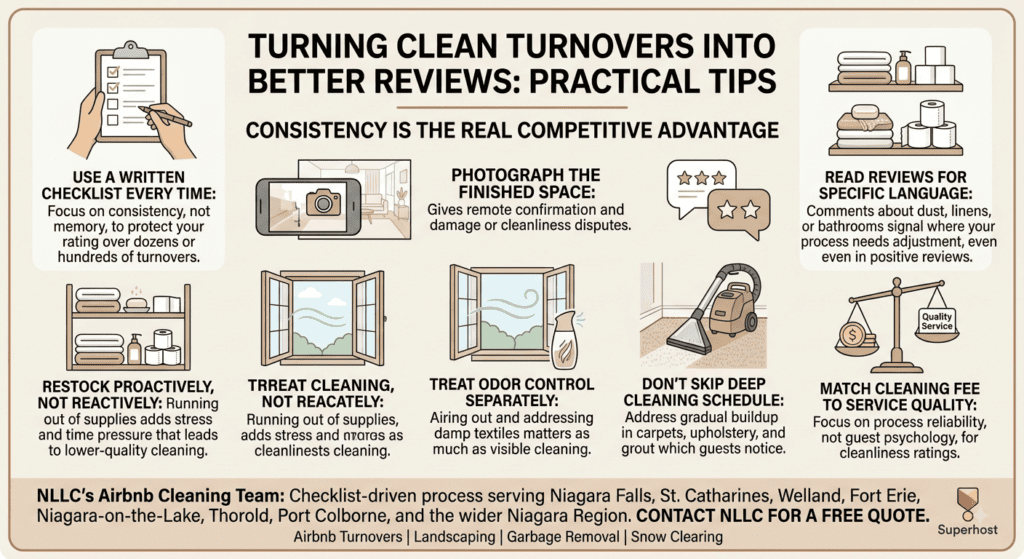
- Use a written checklist every single time, regardless of who’s cleaning. Consistency, not memory, is what protects your rating over dozens or hundreds of turnovers.
- Photograph the finished space after every clean. It gives you remote confirmation the unit is guest-ready and protects you if a damage or cleanliness dispute ever arises.
- Read every review for cleanliness-specific language. Comments about dust, linens, or bathroom cleanliness are the clearest signal of where your process needs adjustment, even in an otherwise positive review.
- Restock proactively, not reactively. Running out of a supply mid-turnover adds stress and time pressure that leads to rushed, lower-quality cleaning.
- Treat odor control as its own checklist item, separate from visible cleaning – airing out the space and addressing damp textiles matters as much as wiping a counter.
- Don’t skip the deep clean schedule. Carpets, upholstery, and grout build up gradually in ways a standard turnover won’t fully address, and guests notice the cumulative effect even if they can’t name the cause.
- Match your cleaning fee to service quality, not guest psychology. Since cleanliness ratings don’t correlate strongly with what you charge, focus your energy on process reliability rather than price positioning.
Conclusion: Consistency Is the Real Competitive Advantage
The hosts who consistently earn five-star reviews and badges like Superhost or Guest Favorite aren’t necessarily spending more money than everyone else – they’re running a more consistent process. Airbnb cleaning done right isn’t about one heroic deep clean before a big weekend; it’s a repeatable system followed on every single turnover, whether that’s your fifth booking or your five-hundredth. Guests reward predictability, and predictability starts in the entryway, the bathroom, and the bedsheets.
If managing that consistency alongside everything else short-term rental hosting demands – guest messaging, compliance paperwork, seasonal property care – is starting to feel like more than one person can reliably handle, that’s exactly the gap a professional cleaning partner is built to close. NLLC’s Airbnb cleaning team serves hosts throughout Niagara Falls, St. Catharines, Welland, Fort Erie, Niagara-on-the-Lake, Thorold, Port Colborne, and the wider Niagara Region, with a checklist-driven process built to protect your ratings turnover after turnover.
Ready to stop worrying about your next cleanliness review? Contact NLLC today for a free quote, or explore our full range of property care services – from Airbnb turnovers to landscaping, garbage removal, and snow clearing – all backed by the same reliable, professional standard.
Frequently Asked Questions
How often should an Airbnb be professionally cleaned? Every single guest turnover requires a full clean, but properties also benefit from a scheduled deep clean every three to four months, or after roughly fifteen to twenty turnovers, to address buildup in carpets, upholstery, and appliances that standard cleaning doesn’t fully reach.
Does a higher cleaning fee lead to better cleanliness reviews? Not according to the data. Research comparing listings with very different cleaning fees found almost no correlation between the fee amount and the actual cleanliness score guests gave. What drives the rating is the consistency of the cleaning process itself, not the price tag attached to it.
What’s the difference between Superhost and the Guest Favorite badge? Superhost is evaluated quarterly across a host’s entire account and rewards overall hosting performance, including response rate and cancellation rate. The Guest Favorite badge is awarded at the individual listing level based on ratings, review volume, and reliability, and typically requires a rating near 4.9, which leaves very little room for cleanliness-related complaints.
Can one bad cleaning review really affect my search ranking? Yes. Airbnb’s search algorithm weighs guest ratings heavily, and a lower cleanliness or value score can reduce how often your listing appears in search results, which directly affects how many bookings you receive.
Should I clean my Airbnb myself or hire a professional service? For one or two turnovers a month, self-cleaning with a strict checklist is manageable. Once you’re handling several turnovers a week, especially same-day ones, a professional turnover service becomes far more reliable than trying to personally manage cleaning around guest messaging, pricing, and maintenance.
What do guests notice first when they walk into a rental? Floors, countertops, and the bathroom are the first things guests visually scan, followed almost immediately by whether the space smells fresh. These first-impression details carry disproportionate weight in the review a guest eventually leaves.
Are short-term rental cleaning standards different from regular house cleaning? Yes. Turnover cleaning has to meet a hotel-level standard within a tight time window, follow a repeatable checklist regardless of who’s cleaning, and include restocking guest supplies – tasks that go well beyond a typical residential clean.
Does cleanliness affect my Municipal Accommodation Tax or licensing status in Niagara Falls? No, cleanliness and municipal licensing are separate requirements, but both reflect the same underlying standard of running a professional, well-managed short-term rental. Staying licensed and maintaining consistent cleanliness together protect both your legal standing and your guest ratings.