Walk into any business and you know within seconds whether it’s well run. You don’t need to see the financials or meet the manager – the floors, the front desk, and the washroom tell you almost everything. That snap judgment happens in under ten seconds, and it sticks. Yet cleaning is often the first thing businesses cut corners on, treating it as an afterthought instead of a core part of how the business runs.
This is exactly where scheduled janitorial services come in. Rather than calling a cleaner when the office “looks bad” or scrambling before a client visit, scheduled janitorial services build cleanliness into the rhythm of your business – daily, weekly, or monthly, on a plan that matches how your space actually gets used. For business owners and facility managers across Niagara Falls, St. Catharines, Welland, and the wider Niagara Region, this shift from reactive to proactive cleaning is quickly becoming a competitive advantage, not just a housekeeping task.
In this guide, we’ll break down what scheduled janitorial services actually involve, why they matter more than most business owners realize, what’s happening in the cleaning industry right now, and how to build a cleaning plan that protects your health, your reputation, and your bottom line.
What Are Scheduled Janitorial Services?
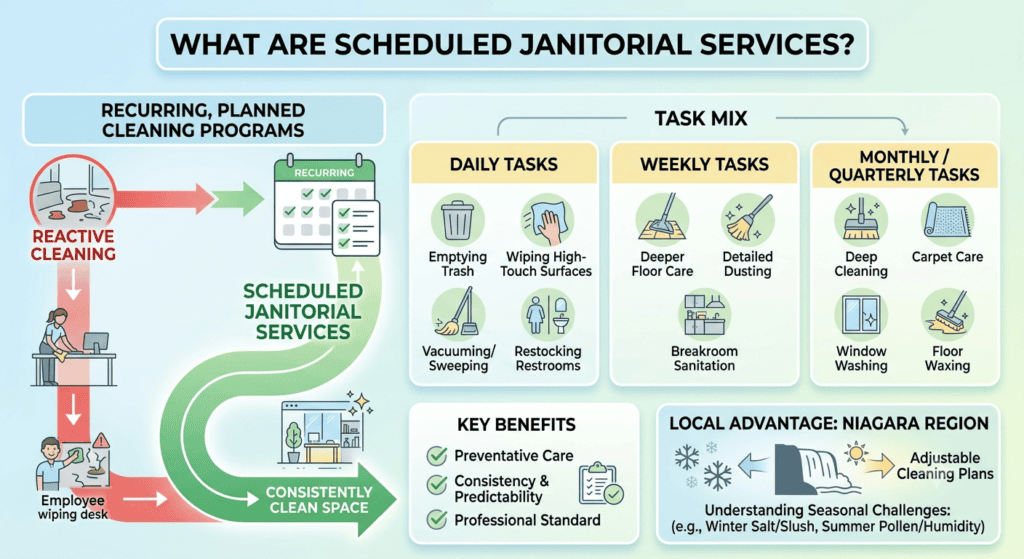
Scheduled janitorial services are recurring, planned cleaning programs designed around a business’s specific size, industry, and foot traffic – as opposed to one-off or emergency cleanings booked only when something looks visibly dirty. Instead of reacting to a mess, a scheduled program prevents one from building up in the first place.
A typical program includes a mix of:
- Daily tasks – emptying trash, wiping high-touch surfaces, vacuuming or sweeping floors, restocking restrooms
- Weekly tasks – deeper floor care, detailed dusting, breakroom sanitation
- Monthly or quarterly tasks – deep cleaning, carpet care, window washing, floor waxing
The defining feature isn’t just frequency – it’s consistency. The same checklist, the same standard of care, every single visit. That predictability is what separates a professional janitorial contract from a one-time deep clean or an employee wiping down a desk between meetings.
For businesses in the Niagara Region, this typically means partnering with a local commercial cleaning provider who understands seasonal challenges – salt and slush tracked in during winter, pollen and humidity in summer – and who can adjust the cleaning plan accordingly rather than applying a generic checklist year-round.
The Real Cost of Skipping Regular Cleaning
Many business owners underestimate just how expensive “we’ll clean when it’s needed” really is. The costs aren’t always obvious on a balance sheet, but they show up in absenteeism, turnover, lost sales, and even legal exposure.
Illness and Absenteeism
Offices are germier than most people assume. Research from the University of Arizona has repeatedly found that the average office desk carries far more bacteria per square inch than a toilet seat, with phones, keyboards, and shared surfaces acting as reservoirs for bacteria that spread quickly once one person in the office gets sick. Without regular disinfection, these surfaces stay contaminated indefinitely.
The downstream effect is measurable. Industry data shows that <cite index=”13-1″>workplace cleanliness directly affects cognitive performance, focus, and morale, and clean workplaces reduce illness-related absenteeism, which is estimated to cost U.S. employers over $225 billion annually</cite>. In one documented case, <cite index=”14-1″>a mid-sized office that implemented a reliable janitorial service saw absenteeism drop by 20% within six months</cite>, alongside fewer employee complaints about allergies and air quality.
For a small or mid-sized Niagara business, even a modest reduction in sick days adds up quickly – fewer missed shifts, fewer scrambles to cover work, and a team that’s simply more present.
Lost Productivity
Cleanliness isn’t just about germs – it affects how people think and work. Cluttered or visibly dirty environments have been shown to reduce cognitive focus significantly, making it harder for employees to concentrate on tasks that require sustained attention. When a workspace feels neglected, people notice, and it shapes how much care they put into their own work.
There’s also a morale dimension. Employees consistently rank their physical work environment among the top factors affecting job satisfaction, and a well-maintained space signals that ownership actually invests in the people who work there. That signal matters more than most managers give it credit for, particularly in a tight labour market where retention is a real concern.
Damage to Reputation
For customer-facing businesses, the stakes are even higher. Research in consumer psychology shows that <cite index=”25-1″>people form lasting judgments about a business within the first seven seconds of arrival</cite>, and cleanliness is one of the loudest signals in that window. A separate industry survey found that <cite index=”29-1″>74% of people develop a negative impression of a business due to unclean restrooms alone</cite> – a single overlooked area can undo everything else a business gets right.
This “halo effect” cuts both ways. Businesses that present a spotless, well-kept environment are perceived as more trustworthy and higher quality across the board, even in areas customers can’t actually verify, like food safety in a kitchen they never see. A tidy space earns the benefit of the doubt. A neglected one loses it instantly – and word travels fast through online reviews.
Legal and Liability Risks
There’s also a liability dimension business owners often overlook. Slip-and-fall incidents from wet or dirty floors, mold complaints in poorly maintained washrooms, and pest issues tied to inconsistent trash management can all expose a business to legal claims and insurance headaches. A documented, recurring cleaning schedule doesn’t just prevent these problems – it also gives a business a clear record showing reasonable care was taken, which matters if an incident ever does occur.
The ROI of Scheduled Janitorial Services: A Simple Way to Think About It
Business owners often treat cleaning as a pure cost line rather than an investment, but the math tends to favour a consistent program once you factor in what irregular cleaning actually costs elsewhere in the business.
Consider a small office with 15 employees. If inconsistent cleaning contributes to even one or two extra sick days per employee per year – a conservative estimate given the research on illness-related absenteeism – that’s 15 to 30 lost workdays annually, plus the ripple effect of colleagues covering gaps and projects slipping behind schedule. Add in the cost of periodic deep cleans needed to undo months of neglected buildup, which typically run far higher than routine maintenance would have cost over the same period, and the “savings” from skipping regular service start to disappear quickly.
There’s a revenue side to the equation too. A single client visit that’s derailed by a messy reception area or an unpleasant restroom can be the difference between winning and losing a contract, particularly in service industries where trust is part of what’s being sold. Scheduled janitorial services aren’t just protecting appearances – they’re protecting deals, retention, and the everyday productivity that keeps a business running smoothly.
Room-by-Room: What a Thorough Cleaning Plan Actually Covers
It helps to see what a scheduled program looks like at the level of individual spaces rather than as an abstract checklist:
Entrances and lobbies – glass doors and windows kept streak-free, floor mats vacuumed or shaken out, floors swept and mopped, and clutter cleared so the first thing a visitor sees is intentional, not accidental.
Private offices and workstations – desks and shared equipment wiped down, trash emptied, floors vacuumed, and keyboards, phones, and other high-touch items disinfected on a rotating basis rather than left untouched for weeks.
Restrooms – cleaned and restocked daily at minimum, with fixtures disinfected, floors mopped, and mirrors and countertops wiped, since this is consistently the space customers and employees judge most harshly.
Breakrooms and kitchenettes – countertops sanitized, appliances wiped down inside and out, sinks cleaned, and trash managed frequently enough that odors never become a distraction.
Common areas and hallways – floors maintained on a rotation appropriate to foot traffic, with periodic attention to baseboards, light fixtures, and vents that get overlooked in day-to-day cleaning.
Conference and meeting rooms – tables and chairs wiped, floors vacuumed, and glass surfaces cleaned so the space is always ready for a client meeting on short notice.
Seasonal Cleaning Considerations for Niagara Region Businesses
A cleaning plan that works in July won’t necessarily work in January, and businesses in the Niagara Region deal with a genuinely wide seasonal range.
Winter (December–March): Salt, slush, and melting snow get tracked in constantly, which means entrance mats and floors need more frequent attention to prevent buildup, staining, and slip hazards. This is also peak cold and flu season, making high-touch disinfection especially important.
Spring (April–June): Pollen and outdoor allergens make their way indoors through open doors and HVAC systems, and dust that accumulated over winter becomes more visible once natural light increases – a good stretch for scheduling a deeper seasonal clean.
Summer (July–September): Higher humidity can affect air quality and encourage mold or mildew in poorly ventilated areas like restrooms and breakrooms, while increased foot traffic from tourism-driven business (particularly around Niagara Falls) puts extra strain on entrances and common areas.
Fall (October–November): Leaves and debris get tracked indoors, and businesses often use this stretch to schedule deeper cleans – carpet care, window washing, vent cleaning – before winter weather makes outdoor-facing maintenance harder.
A provider familiar with the region will typically build these seasonal shifts directly into the recurring schedule rather than treating them as separate, one-off requests.
Top Reasons Businesses Need Scheduled Janitorial Services
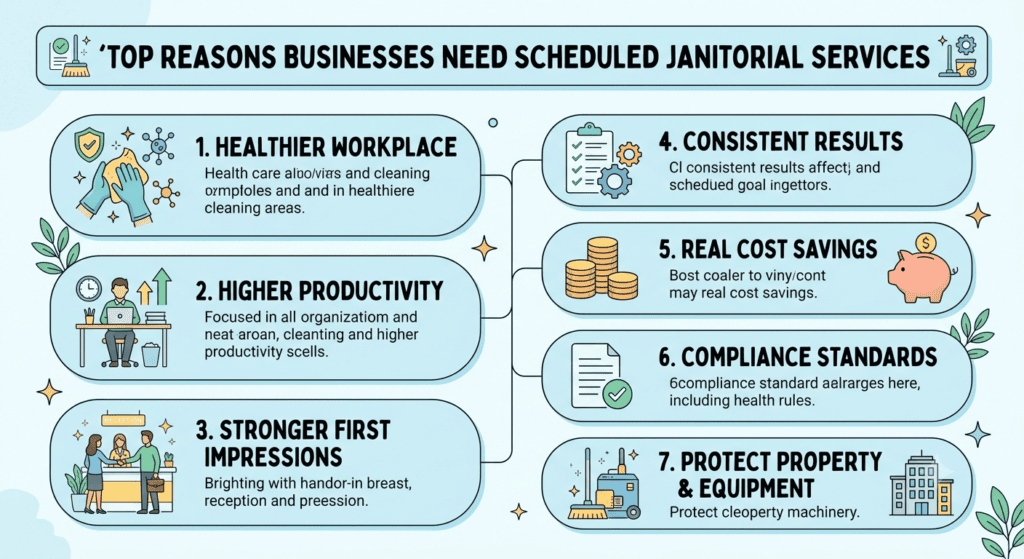
Once you understand what’s at stake, the case for scheduled janitorial services becomes less about tidiness and more about risk management. Here’s what a consistent cleaning program actually protects.
1. A Healthier Workplace, Every Day
Regular disinfection of high-touch points – door handles, light switches, shared equipment, breakroom surfaces – interrupts the transmission cycle that lets illness spread through an office. This matters most during cold and flu season, but the benefit compounds year-round: fewer sick days, fewer flare-ups of allergies from dust and airborne particles, and a workplace that simply feels safer to be in.
2. Higher Employee Productivity
A clean, organized environment reduces distraction and mental clutter. Employees spend less time hunting for a clean spot to eat lunch, less energy tuning out a messy breakroom, and more focus on the actual work in front of them. Over a full year, that adds up to meaningful gains in output – without changing anything about how the team itself operates.
3. Stronger First Impressions With Clients and Customers
Whether it’s a retail storefront, a medical clinic, or a corporate office, the state of your entrance, floors, and washrooms is often the deciding factor in whether a first-time visitor trusts your business. A scheduled program ensures those areas are always presentation-ready – not just on the days you remember to tidy up before a big meeting.
4. Consistent, Predictable Results
One-off cleanings are inconsistent by nature – quality depends on who shows up and how rushed they are that day. A recurring contract with a documented checklist means the same standard is applied every visit, so you’re never left wondering whether the office will look right for tomorrow’s client walkthrough.
5. Real Cost Savings Over Time
It’s counterintuitive, but paying for regular maintenance is usually cheaper than paying for periodic deep cleans. Dirt, grime, and bacteria that sit for weeks or months become much harder – and more expensive – to remove. Carpets that are vacuumed weekly last longer than carpets left until visibly soiled. Floors that are maintained routinely need far less aggressive (and costly) restoration work down the line.
6. Compliance With Health and Safety Standards
Businesses in healthcare, food service, education, and childcare face specific hygiene obligations, and even standard offices have general duty obligations under provincial workplace safety legislation to maintain a reasonably clean and hazard-free environment. A documented, scheduled cleaning program gives you a paper trail that demonstrates due diligence if it’s ever questioned.
7. Protection for Property and Equipment
Floors, carpets, upholstery, and fixtures all degrade faster when dirt and grime are allowed to accumulate. Grit tracked in on shoes acts like sandpaper on hard flooring; dust buildup can affect HVAC efficiency and equipment lifespan. Routine care is one of the simplest ways to extend the life of a commercial property’s finishes and reduce long-term capital repair costs.
Industry Trends Shaping Commercial Cleaning in 2026
The janitorial and commercial cleaning industry has changed considerably in the past few years, and the trends shaping it in 2026 are worth understanding if you’re evaluating providers or building a cleaning budget.
Recurring Contracts Are Now the Norm, Not the Exception
The commercial segment of the cleaning industry has grown substantially as more organizations shift away from ad-hoc cleaning toward long-term recurring agreements. <cite index=”2-1″>This growth is being driven largely by rising demand for sanitation, hygiene, and workplace security across healthcare, corporate, and educational spaces</cite>. Business owners increasingly see cleaning as infrastructure – something to budget for consistently, not something to handle reactively.
Green and Eco-Friendly Cleaning Is Now Expected
Clients and employees alike are paying closer attention to what’s being used to clean the spaces they occupy. Low-VOC, plant-based, and third-party-certified green products have moved from a niche request to a standard expectation, particularly in offices, schools, and healthcare settings where indoor air quality is a growing concern.
Technology Is Changing How Cleaning Gets Scheduled and Managed
Digital scheduling, online booking, and automated service reminders have become common across the industry, making it far easier for businesses to manage recurring contracts without the back-and-forth of phone calls and manual rebooking. This shift also improves accountability – providers using service-tracking tools can show exactly when and what was cleaned.
Specialized Cleaning Niches Are Growing Fastest
Beyond general janitorial work, categories like post-construction cleanup, healthcare-compliant sanitation, and short-term rental turnover cleaning are seeing outsized growth as businesses look for providers who understand the specific standards of their industry rather than a one-size-fits-all approach.
Facility Managers Are Increasing Cleaning Budgets
Perhaps the clearest signal of where the industry is headed: a growing share of facility managers report plans to increase their cleaning budgets rather than trim them, even in a cautious economic climate. That’s a meaningful shift from the old mindset of cleaning as a discretionary expense to cut first – it’s increasingly viewed as core operational spending, on par with utilities or maintenance, because the downstream costs of skimping on it are now better understood and better documented than they were even a few years ago.
How Often Should a Business Be Professionally Cleaned?
There’s no single answer – the right frequency depends on foot traffic, industry, and how the space is used. As a general guide:
| Business Type | Recommended Frequency |
| Standard offices | Daily to 3x/week |
| Retail stores | Daily |
| Medical/dental clinics | Daily, with disinfection between patients |
| Restaurants & food service | Daily, with kitchen deep cleans weekly |
| Schools & daycares | Daily, with deep cleans during breaks |
| Warehouses & industrial | 2–3x/week, with monthly deep cleans |
| Property common areas | Daily to weekly, depending on unit count |
High-traffic areas – entrances, restrooms, breakrooms – generally need daily attention regardless of industry, while private offices and storage areas can often be handled on a lighter weekly rotation.
What’s Typically Included in a Scheduled Janitorial Program
A well-structured plan usually breaks tasks into three tiers:
Daily:
- Sweeping, mopping, and vacuuming floors
- Emptying and sanitizing trash bins
- Wiping down high-touch points like door handles and light switches
- Restroom cleaning and restocking
- Breakroom and kitchenette sanitation
Weekly:
- Detailed dusting of surfaces, desks, shelves, and furniture
- Window and glass surface cleaning
- Deeper floor treatment in high-traffic zones
Monthly or Quarterly:
- Deep cleaning of carpets and upholstery
- Floor waxing or stripping and resealing
- Disinfection of shared equipment and surfaces
- Detailed cleaning of vents, blinds, and fixtures
A trustworthy provider will build this schedule around an initial walkthrough of your space rather than applying a generic template, since a busy retail floor and a quiet professional office have very different cleaning needs even if they’re the same square footage.
Common Mistakes Businesses Make With Commercial Cleaning
Even businesses that care about cleanliness often undermine their own efforts. Watch for these patterns:
- Relying on staff to clean between “real” cleanings. Employees have their own jobs to do, and asking them to also maintain the office pulls focus from actual work while rarely meeting a professional standard.
- Booking cleaning only when something looks visibly dirty. By the time dirt is visible, bacteria and allergens have already been accumulating for weeks.
- Ignoring restrooms and breakrooms. These are the areas customers and employees judge most harshly, yet they’re often the first to get skipped in a rushed cleaning.
- Hiring uninsured or unvetted cleaners to save money. A cleaning-related accident or damage claim with no insurance backing it can cost far more than the savings ever justified.
- No documented checklist. Without a written standard, quality varies wildly from visit to visit and there’s no way to verify what was actually done.
- Treating cleaning as one-size-fits-all. A medical clinic, a warehouse, and a retail boutique all have different risk profiles and touchpoints – the cleaning plan should reflect that.
- Switching providers frequently. Constantly changing cleaning companies to chase a slightly lower price disrupts consistency and often costs more in the long run, since a new provider needs time to learn a space’s specific quirks and trouble spots before results stabilize.
How to Choose the Right Janitorial Service Provider
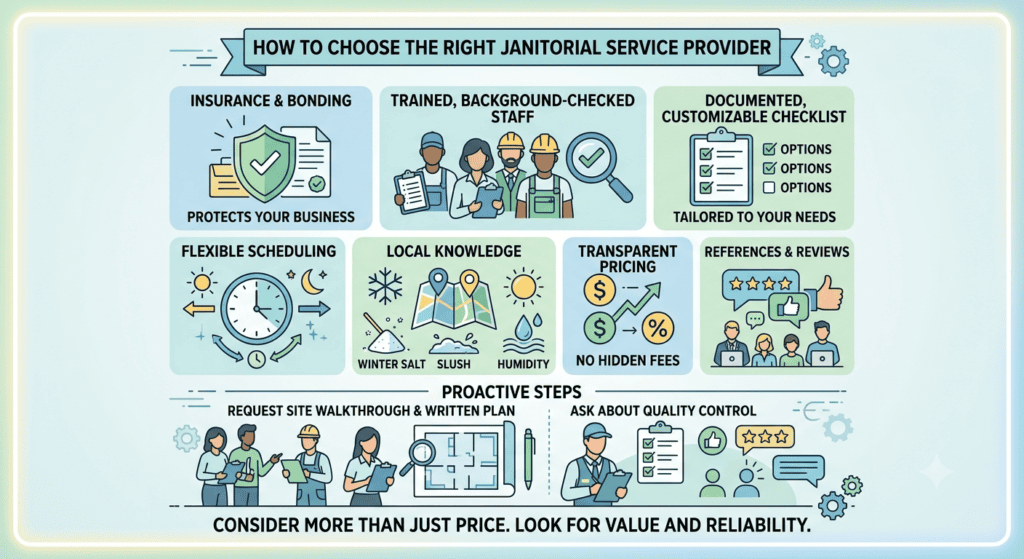
When evaluating a commercial cleaning company, look for:
- Proper insurance and bonding – protects your business if something goes wrong
- Trained, background-checked staff – especially important if cleaners will have after-hours access
- A documented, customizable checklist – not a vague promise of “we’ll clean everything”
- Flexible scheduling – daytime, evening, or after-hours options that fit your operating hours
- Local knowledge – a provider familiar with your region understands seasonal challenges like winter salt and slush or summer humidity
- Transparent pricing – clear quotes without hidden fees for “extras” that should be standard
- References or reviews from similar businesses in your industry
Asking a potential provider to walk your space and provide a written plan – rather than a flat quote over the phone – is one of the fastest ways to separate serious operators from the rest. It’s also worth asking how the provider handles quality control: do they conduct spot checks, gather client feedback, or use any form of service verification? A provider who can answer that clearly is typically one who takes the recurring relationship seriously, rather than treating each visit as an isolated transaction.
Price matters too, but it shouldn’t be the only factor. The cheapest quote often comes from providers cutting corners on staff training, insurance, or the number of hours actually spent on-site – corners that tend to show up later as inconsistent results or, worse, liability exposure if something goes wrong on your property.
Why Niagara Region Businesses Choose Local, Scheduled Janitorial Services
For businesses across Niagara Falls, St. Catharines, Welland, Fort Erie, Niagara-on-the-Lake, Thorold, Port Colborne, and the broader Niagara Region, working with a local provider brings advantages a national chain often can’t match – faster response times, familiarity with local building types, and a team that’s invested in the community’s reputation, not just a service contract.
Niagara Landscaping, Lawn Care & Cleaning (NLLC) builds janitorial programs around each business’s actual size, industry, and schedule rather than applying a generic package. Their janitorial services cover daily, weekly, and monthly cleaning for offices, retail stores, clinics, schools, and more, with fully insured and trained staff, flexible contracts with no long-term lock-in, and the option to bundle in disinfection, carpet care, or window cleaning as needed.
Beyond interior cleaning, NLLC also handles garbage and junk removal for businesses that need bulk waste or construction debris cleared, and snow removal to keep parking lots and walkways safe through Niagara winters – practical for property managers who’d rather coordinate one trusted team than juggle multiple vendors. You can see the full range of services on their services page, and read what other local businesses have said about working with the team on the testimonials page.
Getting started is straightforward: an initial walkthrough of your space, a custom checklist built around your foot traffic and industry, and a schedule that fits how your business actually operates – daytime, evening, or after-hours. Businesses ready to stop reacting to mess and start preventing it can request a free quote through the contact page to get a personalized janitorial plan built around their space.
Final Thoughts
Cleaning isn’t the most glamorous part of running a business, but it’s one of the few areas where consistent, modest investment pays off in nearly every direction at once – fewer sick days, sharper focus, stronger first impressions, and property that holds its value longer. The businesses that treat cleanliness as infrastructure, not an afterthought, are the ones that consistently look – and run – like they have their act together.
None of this requires a massive overhaul. Most businesses don’t need to reinvent how they operate – they just need a documented plan, a provider who shows up reliably, and the discipline to stick with a schedule instead of waiting for a problem to appear before acting. Once that rhythm is in place, cleanliness stops being something you think about at all, which is exactly the point.
If your business is still relying on ad-hoc cleaning or an overstretched employee wiping down the breakroom between meetings, it may be time for a real plan. Reach out to NLLC for a free walkthrough and a janitorial schedule built specifically around how your Niagara Region business operates.
Frequently Asked Questions
1. What’s the difference between janitorial services and commercial cleaning?
The terms are often used interchangeably, but janitorial services usually refer to the recurring, routine upkeep of a facility – trash, floors, restrooms, touchpoints – while commercial cleaning can also include larger one-time projects like post-construction cleanup or deep carpet restoration. Most providers offer both under one umbrella.
2. How much do scheduled janitorial services cost?
Pricing depends on square footage, frequency, and the scope of tasks involved. Most providers offer a free walkthrough and custom quote rather than a flat rate, since a daily office contract and a weekly retail contract have very different costs.
3. Can janitorial schedules be adjusted after the contract starts?
Yes – reputable providers build in flexibility, since business needs change with seasons, staffing levels, and foot traffic. Look for a provider who offers flexible contracts without long-term lock-in.
4. Do small businesses really need scheduled cleaning, or is that just for large offices?
Small businesses arguably benefit more, since a single dirty restroom or cluttered entrance is more noticeable in a smaller space and has an outsized impact on how customers perceive the whole business.
5. What’s included in a standard janitorial visit?
Typically: floor care (sweeping, mopping, vacuuming), trash removal, restroom cleaning and restocking, dusting, and disinfection of high-touch surfaces. Deeper tasks like carpet cleaning or window washing are usually scheduled less frequently.
6. How do I know if my current cleaning schedule is enough?
If you notice recurring complaints about restrooms, visible dust buildup between cleanings, or an uptick in employee sick days, it’s worth reassessing frequency with your provider or requesting a walkthrough for a fresh recommendation.
7. Is it worth bundling janitorial services with other property services like snow or garbage removal?
For many property managers and business owners, yes – consolidating with one provider simplifies scheduling, billing, and communication, and often comes with better overall pricing than managing separate vendors.
8. How far in advance should a business set up a janitorial contract?
There’s no strict timeline, but businesses often reach out after a specific trigger – a new office move, an uptick in client visits, or dissatisfaction with an existing provider. Reaching out early for a walkthrough gives more flexibility in choosing a start date and schedule.