
If you manage a building in Niagara Falls, St. Catharines, Welland, or anywhere else across the Niagara Region, you’ve probably asked yourself this question more than once: are we cleaning enough, or are we just spending money out of habit?
It’s a fair question. Cleaning contracts are one of those recurring costs that rarely get a second look once they’re set up. But the truth is, how often should commercial buildings be cleaned isn’t something you set once and forget. It changes as your business changes – more foot traffic, a new tenant, flu season, a renovation, longer hours. A schedule that made sense two years ago might be leaving your building under-cleaned today, or you might be paying for visits you don’t actually need.
Professional cleaning isn’t just about making a lobby look nice for a Tuesday morning showing. It affects how healthy your employees are, how customers judge your business in the first ten seconds of walking in, and how long your floors, carpets, and HVAC systems last before they need expensive replacement. A 2026 industry report on facility trends put it plainly: businesses are now expected to provide healthier indoor environments, not just tidy-looking ones, and that shift is changing how often professional cleaning actually needs to happen.
There is no single answer that fits every building. An office with 20 people working 9-to-5 has very different needs than a 24-hour warehouse or a busy restaurant on Lundy’s Lane. This guide walks through exactly what determines cleaning frequency, what the recommended schedules look like by building type, and how to know when your current plan isn’t cutting it anymore.
Think of this less as a rulebook and more as a diagnostic tool. By the end, you should be able to look at your own building and say with confidence whether you’re cleaning too little, too much, or just about right.
Why Regular Commercial Cleaning Matters
Before getting into schedules and frequencies, it helps to understand why this decision carries more weight than most facility managers give it credit for.
Health & Hygiene
High-touch surfaces – door handles, light switches, breakroom counters, shared keyboards – collect bacteria fast. Research on workplace cleanliness has found that office desks, phones, and doorknobs can carry hundreds of times more bacteria than a toilet seat simply because nobody thinks to disinfect them the way they would a washroom. Without a consistent cleaning rhythm, those germs build up between visits and spread through a team in days.
This matters more in shared commercial spaces than people realize. A single sick employee touching a shared printer, a breakroom kettle, and a meeting room door handle can leave a trail across half the office before lunch. Daily disinfection of those specific touchpoints – not just a general wipe-down – is what actually interrupts that chain.
Employee Productivity
There’s a real, measurable cost to a dirty workplace. Some workplace studies have linked consistent professional cleaning routines to reductions in employee sick days of up to 30%, alongside noticeable improvements in reported job satisfaction. Beyond the obvious health angle, there’s a psychological cost too – cluttered, visibly dirty spaces force the brain to process disorder in the background, which quietly drains focus even when nobody consciously notices it.
Run the math on a mid-sized office and the numbers add up fast. A team of 50 employees who take even one and a half fewer sick days a year because of better hygiene represents tens of thousands of dollars in recovered productivity annually – often more than the entire cost of the cleaning contract itself. For a facility manager building a budget case, that ROI argument tends to land better with leadership than “it’ll look nicer.”
First Impressions
You never get a second chance at a first impression, and most customers form their opinion of a business within seconds of walking through the door. A retail showroom with dusty shelves or a clinic waiting room with stained carpet tells a visitor something about how the rest of the operation is run, whether that’s fair or not.
Asset Protection
Floors, carpets, and upholstery are expensive to replace. Dirt and grit act like sandpaper on hard flooring every time someone walks across it, and ground-in soil breaks down carpet fibers permanently if it isn’t extracted regularly. Routine professional cleaning is, in a very real sense, preventative maintenance for your building’s finishes – it’s far cheaper to maintain a floor than to refinish or replace one ahead of schedule.
Regulatory Compliance
Depending on your industry, cleaning isn’t just a best practice – it’s a legal obligation. Healthcare facilities answer to provincial health authority standards and infection control protocols. Restaurants and food service operations follow public health codes that dictate sanitation frequency in kitchens and washrooms. Falling behind on required cleaning documentation can mean fines, failed inspections, or worse during an outbreak investigation.
What Determines How Often a Commercial Building Should Be Cleaned?
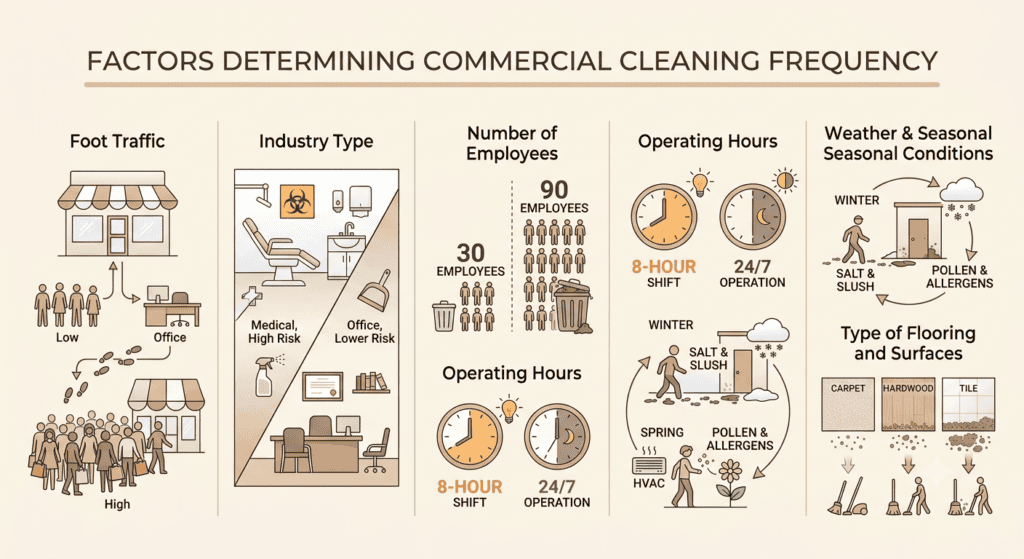
There’s no universal formula, but there are six factors that consistently drive the right frequency for any given building. Walk through these for your own space and you’ll have a much clearer picture of where you actually stand.
Foot Traffic
This is the single biggest variable. A small back-office suite with five employees and no visitors needs far less attention than a retail storefront seeing 300 customers a day. More people moving through a space means more dirt tracked in, more surfaces touched, and faster wear on flooring.
Industry Type
A medical clinic and a law office might be the same square footage, but their cleaning needs aren’t remotely comparable. Healthcare settings deal with bodily fluids and infection control risk. Restaurants deal with grease, food debris, and pest pressure. Industry risk profile changes everything about frequency, products used, and documentation required.
Number of Employees
More people on-site means more washroom usage, more breakroom mess, more trash generated, and more surfaces touched throughout the day. A building that goes from 30 employees to 90 employees needs its cleaning schedule re-evaluated, not just scaled up casually.
Operating Hours
A facility running one eight-hour shift has a very different rhythm than one running around the clock. Extended operating hours mean less downtime for cleaning crews to work without disrupting business, and they also mean faster accumulation of dirt, grease, and wear – which is exactly why updated commercial kitchen exhaust standards now require monthly cleaning for any operation running more than 16 hours a day, regardless of what fuel type they use.
Weather & Seasonal Conditions
Niagara Region winters bring road salt, slush, and mud straight through your front entrance for months at a time. That means entryway mats and hard flooring near doors need far more frequent attention from December through March than they do in July. Spring brings pollen and allergens that settle into HVAC systems and upholstery. Smart facility managers adjust their cleaning calendar seasonally instead of running the same plan year-round.
Type of Flooring and Surfaces
Carpet, hardwood, tile, polished concrete, and vinyl all wear differently and collect dirt differently. Light-colored carpet in a high-traffic lobby will show soil far faster than dark tile in a back hallway, which means frequency should be set by surface and zone, not as one blanket number for the whole building.
Putting These Factors Together
In practice, no single factor decides your schedule on its own. A small medical office has low foot traffic but high industry risk, which pushes frequency up despite the modest headcount. A warehouse might have moderate traffic but very long operating hours, which pushes dust and grime accumulation up faster than the headcount alone would suggest. The right approach is to score your building against each of these six factors, then let the highest-risk factor set your floor for minimum frequency – you can always layer additional services on top, but you shouldn’t let a low-traffic score talk you out of the cleaning a higher-risk factor actually demands.
Recommended Professional Cleaning Frequency by Building Type
Here’s where the general principles turn into practical numbers. These ranges reflect current industry standards, including ISSA and CDC environmental cleaning guidance, adjusted for what’s realistic for small and mid-sized commercial buildings across the Niagara Region.
Office Buildings
- Daily – Trash removal, washroom sanitation, and high-touch surface disinfection (door handles, light switches, shared equipment) for any office with regular daily occupancy.
- 3–5 times per week – Vacuuming, mopping, and breakroom cleaning for low-to-medium traffic offices that don’t justify daily full-service visits but still need consistent upkeep.
- Weekly deep cleaning – Detailed dusting, glass cleaning, and upholstery attention layered on top of the daily routine.
A useful baseline from recent industry guidance: standard commercial offices should expect cleaning five days a week for occupied floors as a starting point, then scale up or down from there based on headcount and visitor volume.
For context, a 15-person professional office with no regular client visits might comfortably run on three cleanings a week, while a 60-person open-concept office with a steady stream of visitors and meetings will lean toward daily service to keep washrooms and breakrooms from falling behind between visits. The deciding factor is almost always washroom usage and breakroom volume, not square footage.
Retail Stores
- Daily cleaning – Floors, fitting rooms, checkout counters, and entryways all need daily attention given constant customer contact.
- Frequent disinfecting – High-touch surfaces like POS terminals, door handles, and shopping cart handles need disinfection multiple times throughout the day, not just once at closing.
Retail spaces in malls and plazas across Niagara Falls and St. Catharines see some of the highest foot traffic of any commercial category, which is exactly why daily cleaning is treated as a baseline, not a luxury, for this sector. A storefront that sees a few hundred visitors a day accumulates tracked-in dirt, fingerprints on glass, and fitting room mess at a pace that simply outruns any schedule lighter than daily.
Healthcare Facilities
- Multiple cleanings per day – Waiting rooms, exam rooms, and washrooms typically need cleaning between patient turnovers, not just once daily.
- Strict sanitation requirements – Healthcare environments operate under documented infection-control protocols that specify exact disinfectant contact times, surface categories, and staff training requirements – this isn’t a space where “looks clean” is good enough.
Educational Institutions
- Daily – Classrooms, hallways, washrooms, and cafeterias need daily cleaning during the school year given the volume of students moving through shared spaces.
- Holiday deep cleaning – Winter break, March break, and summer are the windows when schools schedule floor stripping, carpet extraction, and other deep-clean tasks that can’t happen while classes are in session.
Warehouses
- Weekly maintenance – Office areas, breakrooms, and washrooms attached to a warehouse operation typically need weekly servicing.
- Monthly deep cleaning – Warehouse floors, loading dock areas, and high shelving need monthly attention to control dust accumulation, especially in facilities running forklifts or other equipment that kicks up debris.
Restaurants & Cafes
- Multiple cleanings daily – Dining areas, washrooms, and food prep surfaces need cleaning continuously throughout service, not just at open and close.
- Scheduled deep cleaning – Kitchen exhaust systems fall under fire-code cleaning schedules that range from monthly to annual depending on cooking volume and equipment type, and grease buildup that gets missed is a documented fire hazard, not just a cosmetic issue.
Restaurant fire data tells a sobering story here – most restaurant kitchen fires start in the cooking area, and failure to properly clean exhaust systems is consistently flagged as one of the largest preventable contributing factors.
Apartment & Multi-Tenant Buildings
- Common area cleaning – Hallways, mailrooms, and shared amenity spaces typically need daily-to-weekly attention depending on unit count and tenant traffic.
- Elevator sanitation – High-touch buttons and rails in elevators warrant daily disinfection, particularly in larger buildings with dozens of daily trips.
- Lobby maintenance – As the first thing visitors and prospective tenants see, lobbies typically get the most frequent attention of any common area.
For a 40-unit building, that often means daily lobby and elevator attention, two to three times weekly for hallways and stairwells, and weekly attention for less-trafficked common areas like laundry rooms or mailrooms. Property managers across the Niagara Region often underestimate how much winter salt and slush gets dragged into entryways and elevators between November and March, which is exactly the season when these common areas need the most frequent attention, not the least.
Common Mistakes Facility Managers Make With Cleaning Schedules
Even experienced facility managers fall into a few predictable traps when setting up a cleaning plan. Watching for these can save both money and headaches.
Treating the Whole Building as One Zone
Applying a single cleaning frequency to an entire building ignores the reality that a lobby, a washroom, and a back-office storage room have completely different traffic and risk levels. Zone-based scheduling – where high-traffic areas get daily attention and low-traffic areas get weekly – almost always delivers better results for the same budget than a flat, building-wide frequency.
Setting the Schedule Once and Never Revisiting It
A cleaning contract signed three years ago for a 25-person office doesn’t automatically still make sense once that office grows to 50 people, adds a second shift, or starts hosting regular client meetings. Schedules need a periodic review, ideally tied to any significant change in occupancy or business operations.
Confusing Cleaning With Disinfecting
Wiping a surface removes visible dirt. Disinfecting kills the pathogens that cause illness. These are different tasks requiring different products and different contact times, and a schedule that only accounts for general cleaning frequency without specifying disinfection frequency for high-touch surfaces is missing a critical piece.
Ignoring Seasonal Demands
Running an identical schedule in July and January means either under-cleaning during salt and slush season or over-cleaning during a quieter summer stretch. Building seasonal adjustments into the plan from the start avoids both problems.
Choosing Frequency Based on Price Alone
The cheapest cleaning quote is often cheap because the frequency or scope has been trimmed down, not because the provider found a more efficient way to deliver the same service. A lower-cost plan that doesn’t actually match your building’s traffic and risk profile usually ends up costing more in the long run through premature flooring wear, increased sick days, or compliance issues.
Commercial Cleaning Schedule Breakdown
Once you know your building type and traffic level, the next step is breaking tasks down by how often they actually need to happen. Most well-run facilities layer five tiers of cleaning on top of each other.
Daily Tasks
- Trash removal from all bins and disposal areas
- Restroom sanitization, including restocking supplies
- Vacuuming carpeted areas, especially entryways and high-traffic zones
- Mopping hard floors
- High-touch surface disinfection (door handles, light switches, elevator buttons, shared equipment)
Weekly Tasks
- Glass cleaning on interior doors, partitions, and low windows
- Dusting of surfaces, shelving, and furniture
- Breakroom cleaning, including appliance exteriors and counters
- Upholstery maintenance such as vacuuming chairs and couches
Monthly Tasks
- Floor polishing or buffing to maintain shine and protective coatings
- Window cleaning, interior and accessible exterior glass
- Vent cleaning to clear dust buildup from supply registers
Quarterly Tasks
- Carpet extraction to pull deep-set soil and allergens out of fibers
- Pressure washing of exterior walkways, entrances, and loading areas
- Deep sanitation of areas not covered in daily disinfecting routines
Annual Tasks
- Floor refinishing or stripping and resealing
- HVAC vent and duct cleaning to support indoor air quality
- Exterior building wash to remove grime, mildew, and seasonal staining
This layered structure is exactly why a “weekly cleaning” plan and a “daily cleaning” plan aren’t really two different products – they’re the same framework with different combinations of tiers turned on, built around your building’s actual risk and traffic profile.
Signs Your Commercial Building Needs More Frequent Cleaning
Even a well-designed schedule needs the occasional reality check. These are the signals that your current frequency is falling behind your building’s actual needs:
- Lingering odors that return within hours of cleaning, often a sign that surfaces or HVAC filters need more frequent attention, not just stronger products.
- Dirty entryways with built-up grime, salt residue, or mud tracked in well before the next scheduled visit.
- Overflowing trash that’s full before the next pickup, meaning bin capacity or pickup frequency hasn’t kept pace with occupancy.
- Dust accumulation visible on surfaces, vents, or shelving between cleanings.
- Employee complaints about washroom conditions, breakroom cleanliness, or general tidiness – this is often the first warning sign long before it shows up anywhere else.
- Increased sick days, particularly clusters of illness moving through a team in the same week, which often points back to high-touch surfaces that aren’t being disinfected often enough.
- Stained carpets that don’t lift with routine vacuuming and need professional extraction sooner than the standard quarterly cycle.
If two or three of these show up consistently, it’s time to revisit your cleaning frequency rather than just asking your existing crew to work faster during the same visits.
Benefits of Hiring Professional Commercial Cleaners
Plenty of businesses try to handle cleaning in-house, especially when they’re small. But there’s a reason most growing operations eventually shift to a dedicated commercial cleaning partner.
- Consistent results – Professional crews follow documented checklists and protocols, so quality doesn’t depend on which staff member happened to have time that day.
- Professional equipment – Commercial-grade vacuums, floor machines, and extraction equipment do a measurably better job than consumer-grade tools, particularly on carpet and hard floor maintenance.
- Cost savings – Protecting flooring, upholstery, and fixtures through regular professional care costs far less than premature replacement.
- Healthier workplace – Trained crews know which surfaces need disinfecting versus simple cleaning, and they use the right contact times and products for each.
- Longer-lasting assets – Routine professional maintenance extends the life of carpet, hard flooring, and finishes well beyond what ad-hoc or in-house cleaning typically achieves.
There’s also a growing expectation among Niagara Region tenants and customers around environmentally responsible cleaning. More businesses across Ontario are asking their cleaning providers about eco-certified products, partly for indoor air quality and partly because sustainability now factors into how tenants and clients judge a building. Working with a provider who understands both the health side and the environmental side of modern commercial cleaning gives you flexibility most in-house teams simply can’t match.
How to Choose the Right Cleaning Schedule
Pulling all of this together, here’s a practical process for landing on the right frequency for your specific building.
Assess Traffic
Start by counting – employees, daily visitors, deliveries. This single number does more to set your baseline frequency than almost any other factor.
Evaluate Business Type
Match your schedule to your industry’s actual risk profile. A healthcare office and a professional services office of the same size should not be on the same cleaning plan.
Consider Budget
More frequent cleaning costs more, but under-cleaning costs you in other ways – sick days, premature flooring replacement, lost business from a poor first impression. Think of cleaning frequency as a budget allocation decision, not just a line-item expense.
Schedule Seasonal Deep Cleaning
Build winter salt and slush season, spring allergy season, and post-renovation cleanup into your calendar in advance rather than reacting to it after the mess has already accumulated.
Work with a Customized Cleaning Plan
The most reliable way to land on the right frequency is a walkthrough with a professional cleaning provider who can assess your specific layout, traffic patterns, and risk areas – rather than applying a generic template that doesn’t account for how your building is actually used.
Current Trends Shaping Commercial Cleaning Frequency in 2026
Cleaning frequency decisions aren’t made in a vacuum, and a few shifts happening across the industry right now are worth factoring into your own plan.
Flexible, data-driven schedules are replacing fixed templates. Facility managers are increasingly tracking actual occupancy and usage patterns rather than locking into a fixed weekly schedule set years ago, which means cleaning frequency is becoming something reviewed quarterly rather than something decided once and forgotten.
Indoor air quality has joined surface cleanliness as a priority. With employees spending the bulk of their day indoors, HVAC maintenance, filter changes, and vent cleaning are increasingly treated as part of the core cleaning program rather than a separate maintenance task handled by someone else.
Green cleaning has moved from a nice-to-have to an operational standard. Across Ontario, more building owners are asking providers about EcoLogo or Green Seal certified products, partly for occupant health and partly because sustainability now factors into tenant expectations and procurement decisions. This doesn’t change how often you clean, but it does change what your cleaning provider should be using when they show up.
Technology is supporting consistency, not replacing people. Robotic floor scrubbers and digital quality-assurance reporting are becoming more common in larger facilities, helping providers prove that scheduled visits are actually happening and meeting standard – but trained cleaning staff remain essential for the judgment calls that automated equipment can’t make.
For a facility manager in the Niagara Region, the practical takeaway is this: the days of a flat, one-size-fits-all monthly contract are fading. Buildings that adjust frequency based on real usage data, seasonal demands, and occupant feedback are the ones getting the most value out of their cleaning budget.
Conclusion
Every commercial building has its own rhythm, and that rhythm is exactly what should drive your cleaning schedule. A quiet professional office, a 24-hour warehouse, and a busy restaurant kitchen all need fundamentally different approaches, and the right frequency comes down to occupancy, industry risk, and how your space is actually used day to day – not a generic template pulled off a price sheet.
Investing in a properly scheduled professional cleaning plan does more than keep your building looking presentable. It protects your floors, carpets, and fixtures from premature wear, supports a healthier environment for your employees and customers, and helps you avoid the kind of compliance headaches that come from falling behind on required sanitation standards.
If you’re managing a commercial property anywhere across Niagara Falls, St. Catharines, Welland, Fort Erie, Niagara-on-the-Lake, Thorold, Port Colborne, or the wider Niagara Region and you’re not sure whether your current cleaning frequency actually matches your building’s needs, NLLC offers free walkthroughs to assess your space and build a customized commercial cleaning plan around your real traffic, industry, and budget. Request your free quote today and find out what the right schedule actually looks like for your building.
Frequently Asked Questions
How often should offices be professionally cleaned?
Most offices need daily attention to washrooms, trash, and high-touch surfaces, with three to five visits per week being typical depending on headcount and visitor traffic. Weekly deep cleaning covering dusting, glass, and upholstery rounds out a standard office plan.
Is weekly commercial cleaning enough?
For very low-traffic spaces, weekly cleaning alone might cover general tidiness, but washrooms and high-touch surfaces almost always need more frequent attention than once a week, regardless of how quiet the building seems. Weekly-only schedules are rarely sufficient as a standalone plan for any actively occupied commercial space.
How often should carpets be professionally cleaned?
Most commercial carpets benefit from professional extraction every three to six months, with high-traffic areas like entrances and hallways needing it closer to the three-month mark and low-traffic private offices able to stretch toward six months.
What is included in commercial deep cleaning?
A deep clean typically goes beyond daily and weekly maintenance to include carpet extraction, floor stripping and refinishing, vent and HVAC component cleaning, pressure washing of exterior areas, and detailed sanitation of zones that don’t get daily attention, like storage rooms or high shelving.
How do I know if my building needs daily cleaning?
If your space sees regular daily foot traffic from employees, customers, or visitors – or operates in a higher-risk category like healthcare, food service, or education – daily cleaning of washrooms, trash, and high-touch surfaces is generally the appropriate baseline, even if other tasks are scheduled less frequently.
Does cleaning frequency affect commercial cleaning pricing in Ontario?
Yes, frequency is one of the primary factors in commercial cleaning pricing, along with square footage, the specific services included, and the products used. More frequent visits typically reduce the cost per visit since crews are maintaining rather than restoring a space.
Should cleaning schedules change with the seasons in the Niagara Region?
Yes. Winter brings road salt and slush that demands more frequent entryway and hard floor attention, while spring and summer bring pollen, humidity, and outdoor pressure-washing needs. A good cleaning plan adjusts seasonally rather than running identically all year.
Can a cleaning schedule be adjusted after it’s set up?
Absolutely, and it should be reviewed periodically. Occupancy changes, seasonal shifts, renovations, or a change in business hours are all good reasons to revisit frequency with your cleaning provider rather than sticking with a plan that no longer matches how the building is actually used.
Are monthly cleanings ever enough for a commercial building?
Monthly cleaning alone is rarely sufficient for any actively occupied commercial space. It works as a layer for tasks like floor polishing or vent cleaning, but washrooms, trash, and high-touch surfaces need far more frequent attention in almost every building type.
What’s the difference between cleaning, sanitizing, and disinfecting?
Cleaning removes visible dirt and debris from a surface. Sanitizing reduces germs to a safe level as defined by public health standards. Disinfecting kills a broader range of pathogens and typically requires the product to sit on the surface for a specific contact time to work properly. A complete cleaning schedule should specify which of these three is happening at each step, not just assume one covers all three.
How does a professional cleaning company decide on the right frequency for my building?
A reputable provider starts with an in-person walkthrough to assess traffic patterns, layout, flooring types, and any industry-specific risk factors, then builds a tiered schedule combining daily, weekly, monthly, and seasonal tasks around what they find – rather than applying a generic package regardless of the building’s actual needs.
Does a small office really need professional cleaning, or can staff handle it?
Staff can usually manage light tidying day to day, but washroom sanitation, floor care, and high-touch disinfection are best handled by a trained crew with commercial-grade products and equipment. Even small offices tend to see noticeably better hygiene outcomes once professional cleaning is brought in, partly because it happens consistently regardless of how busy the team gets.