Most people assume cleaning is cleaning. Wipe a counter, vacuum a floor, empty a bin – how different can it really be?
Pretty different, actually.
If you’ve ever hired a house cleaner to tidy up your office, or asked a janitorial company to quote a one-bedroom condo, you already know something felt off. The pricing didn’t match. The equipment looked wrong. Maybe the results just weren’t what you expected. That’s because residential vs. commercial cleaning aren’t two versions of the same job – they’re two completely different disciplines, built around different spaces, different risks, and different expectations.
Homes are about comfort. A cozy living room, a spotless kitchen counter, a bathroom that smells like it just came out of a magazine. Businesses are about something else entirely: health compliance, liability, first impressions, and keeping dozens (sometimes hundreds) of people safe every single day. Mixing the two up doesn’t just look unprofessional – it can cost you money, hurt your reputation, or in a business setting, create real safety and legal exposure.
The commercial cleaning industry has grown into a serious operation. Contract cleaning services alone brought in a combined revenue share of $221.2 million in the commercial segment in 2026, and much of that growth is being driven by the need for stronger sanitation, hygiene, and workplace security across healthcare, corporate, and educational spaces. On the flip side, more homeowners than ever are outsourcing their household cleaning too, with recurring residential cleaning services becoming a normal part of managing a home rather than an occasional luxury.
So whether you’re a homeowner in St. Catharines trying to figure out how often you actually need a deep clean, or a business owner in Niagara Falls wondering if your current cleaning setup is cutting it, this guide breaks down exactly what separates residential and commercial cleaning – and how to choose the right one for your property.
What Is Residential Cleaning?
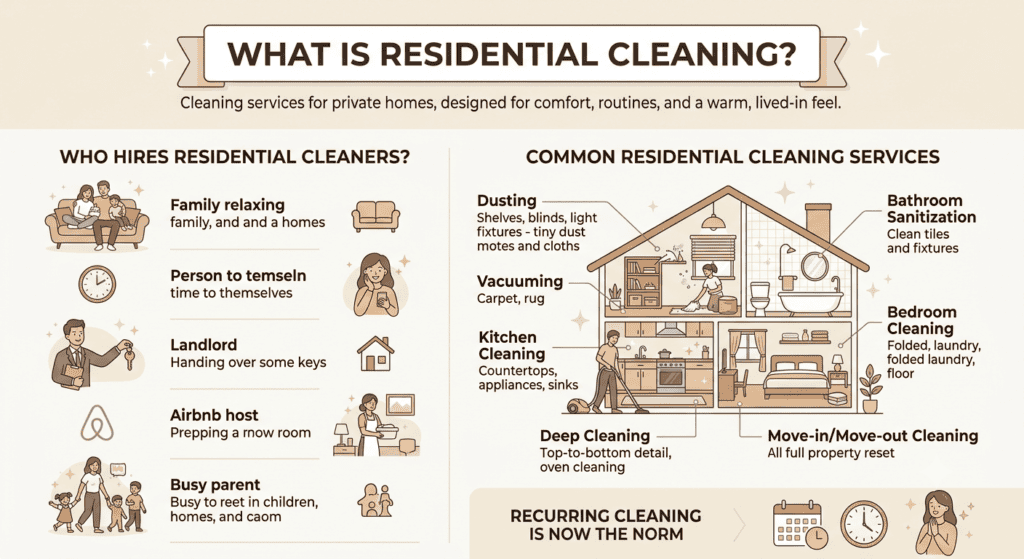
Residential cleaning is exactly what it sounds like: cleaning services designed for private homes. It’s built around comfort, personal routines, and the day-to-day rhythm of family life. The goal isn’t just “clean” in a clinical sense – it’s clean in a way that feels warm, lived-in, and welcoming.
Who typically hires residential cleaners?
- Homeowners who want a consistent, tidy home without spending their weekends scrubbing
- Renters who want help keeping up with regular chores
- Landlords preparing a property between tenants
- Airbnb and short-term rental hosts who need fast turnovers between guests
- Busy families juggling work, school, and everything in between
Common residential cleaning services include:
- Dusting – shelves, baseboards, blinds, light fixtures, and furniture
- Vacuuming – carpets, rugs, and hard floors throughout the home
- Kitchen cleaning – countertops, appliances, sinks, and cabinet fronts
- Bathroom sanitization – toilets, tubs, showers, mirrors, and sinks
- Bedroom cleaning – dusting, vacuuming, and general tidying
- Deep cleaning – a more thorough, top-to-bottom clean covering areas that don’t get touched weekly, like behind appliances or inside ovens
- Move-in/move-out cleaning – a full reset of a property before new occupants arrive or after previous ones leave
One thing that’s changed in recent years is how normal recurring cleaning has become. It’s no longer just something people book before a holiday party or a big family visit – a large share of households now use recurring cleaning services as part of their regular routine, treating a clean home the same way they treat lawn care or grocery delivery: a scheduled part of life, not a special occasion.
That shift matters, because it means residential cleaning companies are increasingly expected to offer flexible, dependable, ongoing service – not just one-off appointments.
What Makes a Good Residential Cleaning Service?
Not all residential cleaning is created equal. A good residential cleaner pays attention to the small details that make a house feel genuinely cared for – not just wiped down. Think fresh, streak-free mirrors, properly fluffed cushions, and a kitchen that smells clean rather than just looks it. The best residential cleaning companies also build a relationship with each household, learning preferences over time: which products you’re comfortable with around pets or kids, which rooms need extra attention, and which days work best around your schedule. That level of personalization is one of the biggest reasons homeowners stick with the same cleaning company for years rather than shopping around every few months.
What Is Commercial Cleaning?
Commercial cleaning is a different animal altogether. Instead of cleaning for comfort, it’s cleaning for compliance, safety, and professional presentation. The stakes are higher because the spaces are shared by employees, customers, patients, or students – sometimes hundreds of people passing through in a single day.
Types of commercial properties that require commercial cleaning include:
- Offices – where a clean, organized workspace directly affects employee morale and productivity
- Retail stores – where first impressions with customers can make or break a sale
- Medical facilities – where sanitation isn’t optional, it’s a health and legal requirement
- Warehouses – large industrial spaces with unique dust, debris, and safety concerns
- Industrial buildings – facilities that often deal with heavier soil, machinery, and specialized waste
- Educational institutions – schools and daycares where germ control is a daily priority
Each of these property types comes with its own set of specialized cleaning requirements. A medical office, for example, needs disinfection protocols that go well beyond a general wipe-down. A warehouse needs floor care equipment strong enough to handle industrial dust and heavy foot traffic. A school needs a cleaning schedule that works around class hours without disrupting students.
This is also where the industry has been growing fastest. Healthcare, corporate offices, and educational spaces are driving much of the current demand for commercial cleaning, largely because sanitation and workplace safety have become non-negotiable expectations rather than nice-to-haves. At the same time, niche categories like post-construction cleaning have become a bigger part of the commercial cleaning world, as more businesses renovate or build out new spaces and need a specialized deep clean before opening their doors.
The Growing Scope of Commercial Cleaning
Commercial cleaning has expanded well beyond simple janitorial work. Many companies now offer a full menu of services under one contract: interior and exterior window washing, parking lot sweeping, upholstery cleaning, waste management, and even landscaping in some cases. This “one vendor for everything” approach has become popular with facility managers who don’t want to juggle five different contractors for five different tasks. It also gives businesses more consistent pricing and accountability, since a single provider is responsible for the overall condition of the property rather than passing blame between separate vendors when something falls through the cracks.
Residential vs. Commercial Cleaning: 10 Major Differences
At a glance, here’s how the two compare:
| Residential Cleaning | Commercial Cleaning |
| Cleaning private homes | Cleaning business facilities |
| Smaller spaces | Large buildings |
| Household equipment | Industrial-grade equipment |
| Flexible schedules | After-hours or scheduled maintenance |
| Comfort-focused | Health, safety & compliance focused |
| Light foot traffic | Heavy foot traffic |
| Personalized cleaning | Standardized cleaning protocols |
| Basic cleaning products | Professional-grade disinfectants |
| Individual homeowners | Business owners & facility managers |
| Weekly/Bi-weekly | Daily, weekly, or customized contracts |
A few of these differences deserve a closer look.
Scale and scope is probably the most obvious difference. A residential cleaner might spend two to three hours in a 1,500-square-foot home. A commercial cleaning team might be responsible for tens of thousands of square feet across multiple floors, requiring an entirely different level of planning, staffing, and equipment.
Standardization is another big one. Residential cleaning is personalized – every home has its own quirks, preferences, and priorities, and a good residential cleaner adapts to that. Commercial cleaning, on the other hand, runs on standardized protocols. Facility managers need consistency: the same result every time, regardless of which cleaner is on shift that day. That consistency is exactly what separates a reliable janitorial services provider from one that leaves clients guessing.
Client relationship also looks different. Residential cleaning is usually a relationship with a single homeowner or family. Commercial cleaning contracts typically involve facility managers, property owners, or business operators who are managing cleaning as part of a much bigger operational picture – budgets, compliance audits, tenant satisfaction, and more.
Contract structure is worth mentioning too. Residential cleaning is often booked on a pay-per-visit or simple recurring basis, with minimal paperwork involved. Commercial cleaning, by contrast, usually runs on a formal service contract that spells out scope of work, frequency, pricing, insurance coverage, and performance expectations. This matters because businesses need documentation for budgeting, vendor management, and sometimes even liability protection – none of which a homeowner typically has to think about when booking a cleaner for their living room.
Equipment Used in Residential vs. Commercial Cleaning
Walk into most homes and you’ll find a standard upright or canister vacuum, a mop and bucket, some microfiber cloths, and a handful of all-purpose cleaning sprays. That’s genuinely all a home needs. Residential spaces are smaller, foot traffic is lighter, and the wear and tear on floors and surfaces is far less intense.
Commercial spaces need something else entirely.
- Household vacuum vs. industrial vacuum – commercial-grade vacuums are built to handle large square footage, heavier dirt loads, and daily use without breaking down
- Floor scrubbers – used in warehouses, retail stores, and large office buildings to clean and polish hard floors efficiently
- Carpet extractors – deep-clean commercial carpet in high-traffic areas like lobbies and hallways, removing embedded dirt that a household vacuum simply can’t reach
- Electrostatic sprayers – apply disinfectant evenly across surfaces, including hard-to-reach areas, which is especially important in medical and food-service environments
- Commercial disinfectants – stronger, hospital-grade or EPA-registered products designed to kill a broader range of bacteria and viruses than typical household cleaners
- Floor polishing machines – maintain the shine and durability of commercial flooring, especially in retail and lobby areas where appearance matters
Why does this level of equipment matter so much? Because businesses are dealing with far more foot traffic, far more surface area, and far higher expectations around hygiene and safety. A home doesn’t need an electrostatic sprayer. A dental office does.
Technology is also reshaping commercial cleaning in ways that residential cleaning hasn’t caught up to yet. Commercial cleaning has become increasingly technology-focused, with AI-powered robots and data-driven software now supplementing (not replacing) cleaning teams in larger facilities. Autonomous floor scrubbers and robotic vacuums are becoming more common, allowing cleaning crews to focus their time on detailed, hands-on work while machines handle repetitive floor maintenance. It’s a trend worth knowing about if you’re a facility manager comparing vendors – a company investing in this kind of equipment is usually investing in consistency, too.
How to Evaluate a Commercial Cleaning Vendor’s Equipment
If you’re comparing commercial cleaning companies, it’s fair to ask what equipment they actually use on site – not just what services are listed on their website. A vendor using outdated or residential-grade tools on a large commercial property is a sign they may struggle to keep up with the space’s real demands. Ask about the age and maintenance of their machines, whether their disinfectants are EPA-registered, and how they handle equipment sanitation between job sites (to avoid cross-contamination, especially important for medical or food-service clients). A company that can answer these questions clearly is usually one that takes the operational side of cleaning seriously, not just the marketing side.
Cleaning Standards and Safety Requirements
This is where residential and commercial cleaning really part ways.
In a home, the standard is simple: does it look, feel, and smell clean? There’s no regulatory body inspecting your bathroom grout. In a commercial setting, the standard is entirely different – cleanliness is tied directly to health, safety, and sometimes legal compliance.
Commercial cleaning standards typically address:
- Workplace hygiene – keeping shared spaces sanitary for employees who spend 40+ hours a week there
- High-touch surface disinfection – door handles, light switches, elevator buttons, and shared equipment need regular disinfecting, not just occasional wiping
- Employee health – reducing the spread of illness in a shared workspace protects productivity and reduces sick days
- Customer safety – retail stores, restaurants, and medical offices all have a duty of care to the public who walk through their doors
- Industry-specific sanitation standards – healthcare facilities, for example, follow far stricter disinfection protocols than a typical office
A properly run commercial cleaning protocol usually follows a two-step process: cleaning hard surfaces first with a neutral cleaner to remove dirt and grime, then applying an EPA- or CDC-registered disinfectant to restrooms, break rooms, and other high-touch points. That level of process is standard in commercial cleaning and essentially unheard of in a residential setting.
This is also why commercial cleaning contracts increasingly emphasize verified, consistent service. Clients – especially facility managers – expect their cleaning vendor to be able to demonstrate exactly how they handle compliance, not just assume the job is “getting done.” A lobby that looks great on Monday and neglected by Thursday isn’t just an inconsistency issue; in a commercial setting, it’s a red flag for health risk and liability.
A quick real-world example: a medical office and a standard corporate office might both look “clean” at a glance, but the medical office is held to a far stricter standard behind the scenes. Exam rooms need to be disinfected between every patient, waiting room surfaces need frequent attention throughout the day, and certain areas may require color-coded cleaning tools to prevent cross-contamination between zones. A corporate office simply doesn’t carry that same level of daily risk, which is exactly why “commercial cleaning” isn’t one single standard – it flexes based on the industry and the risk involved.
How Often Should Residential and Commercial Properties Be Cleaned?
Cleaning frequency is another area where the two diverge sharply – and getting it wrong in either direction (too little, or paying for more than you need) costs you.
Residential Cleaning Frequency
- Weekly – ideal for busy households, families with kids or pets, or anyone who wants a consistently tidy home
- Bi-weekly – a popular middle ground for smaller households or people who keep up with light cleaning themselves
- Monthly – works for lower-traffic homes or as a supplement to your own regular cleaning
- Seasonal deep cleaning – a thorough clean a few times a year, tackling things like baseboards, window tracks, and behind appliances
Commercial Cleaning Frequency
- Daily office cleaning – trash removal, surface wiping, and restroom sanitation for spaces with regular foot traffic
- Weekly deep cleaning – more thorough attention to detail beyond daily maintenance
- Monthly floor maintenance – stripping, waxing, or polishing depending on the flooring type
- Periodic carpet cleaning – deep extraction cleaning to maintain appearance and air quality
- Restroom sanitization – often needs to happen multiple times a day in high-traffic commercial spaces
- Window cleaning – scheduled based on building type, location, and appearance standards
One trend worth watching in 2026 is a shift away from rigid, one-size-fits-all cleaning schedules toward more flexible plans matched to actual occupancy. Instead of cleaning an office at the same fixed frequency regardless of how many people are actually using the space, more facility managers are reviewing their cleaning scope and adjusting it based on real usage patterns. It’s a smart way to control costs without sacrificing quality – and it’s worth asking about if you’re evaluating a commercial cleaning company.
A practical tip: if you’re a business owner unsure how often you actually need service, start with a walkthrough audit. Track which areas get dirty fastest (usually restrooms, break rooms, and entryways) versus areas that stay relatively clean between visits (private offices, storage rooms). A good commercial cleaning provider will help you build a schedule around actual wear patterns instead of guessing, which often ends up saving money compared to a blanket daily-everywhere approach.
Which Service Is Right for Your Property?
Still not sure which one applies to you? Here’s a quick gut-check.
Choose residential cleaning if:
- You own a home
- You need recurring housekeeping to keep up with day-to-day life
- You need move-in/move-out cleaning for a property transition
- You’re a landlord or Airbnb host who needs turnovers handled reliably
Choose commercial cleaning if:
- You own a business
- You manage an office and want a consistently professional space
- You operate a retail store and need to keep it customer-ready
- You manage a warehouse or industrial facility
- You need ongoing janitorial services for a shared or public space
If you’re managing both – say, a home and a small business – it’s worth working with a company that genuinely understands both sides, rather than trying to force a residential cleaner into a commercial role (or vice versa).
A Note on Green Cleaning for Both Property Types
Eco-friendly cleaning has moved from a niche request to a mainstream expectation in both residential and commercial settings. Homeowners are increasingly asking for non-toxic products, especially in households with young kids, pets, or family members with allergies or sensitivities. Businesses are seeing similar demand, particularly from employees and customers who care about indoor air quality and sustainability. The difference is that commercial green cleaning has to meet the same disinfection standards as traditional products – it’s not enough for a cleaner to simply be “natural,” it still has to be effective against the bacteria and viruses relevant to that industry. A good cleaning provider, residential or commercial, should be able to explain which green products they use and why those products still meet the cleanliness standard the space requires.
Why Businesses Should Never Rely on Residential Cleaning for Commercial Spaces
This is the part a lot of business owners overlook, especially when they’re trying to save money. Hiring a residential cleaner – or worse, having staff clean the space themselves – to handle a commercial property might seem like a reasonable shortcut. It almost never is.
- Productivity – a poorly cleaned workspace leads to more sick days, lower morale, and a less focused team
- Professional appearance – customers, clients, and visitors notice cleanliness immediately, and it shapes their first impression of your business
- Health standards – residential cleaners typically aren’t trained in commercial-grade disinfection protocols, which matters enormously in offices, retail spaces, and especially medical or food-service environments
- Liability – if someone gets sick, slips on an improperly cleaned floor, or is exposed to a hazard because of inadequate cleaning, the business – not the cleaner – usually carries the legal risk
- Equipment limitations – a residential cleaner simply doesn’t have access to industrial floor scrubbers, carpet extractors, or commercial-grade disinfectants needed for larger spaces
- Business reputation – online reviews matter more than ever, and a large majority of consumers read reviews before choosing a local business; a dirty or poorly maintained space is one of the fastest ways to tank your reputation
- Long-term maintenance savings – professional commercial cleaning actually protects your investment in flooring, furniture, and fixtures, extending their lifespan and avoiding costly premature replacement
None of this is meant to knock residential cleaners – they’re excellent at what they do. The point is that commercial spaces have different risks, different traffic, and different legal exposure, and cutting corners here tends to cost far more down the line than it saves upfront.
Consider a common scenario: a small retail shop owner decides to save money by having an employee handle cleaning after closing, using basic household supplies picked up from the grocery store. It works fine for a few weeks. Then flu season hits, the store starts getting slower foot traffic because the floors look dull and worn, and a customer slips near a spill that wasn’t cleaned properly. Suddenly the “savings” from skipping a commercial cleaning contract are dwarfed by lost sales, a potential liability claim, and the cost of professional floor restoration. This is exactly the kind of situation a properly scoped commercial cleaning plan is designed to prevent.
Why Choose The N LLC for Commercial Cleaning?
At The N LLC, we understand that a business can’t afford to treat cleaning as an afterthought. Our team brings experienced cleaning professionals to every job, backed by flexible cleaning schedules that work around your operating hours instead of disrupting them. We offer eco-friendly cleaning options for businesses that want to meet sustainability goals without compromising on results.
Whether you need office cleaning, retail cleaning, or post-construction cleaning after a renovation or new build, we build customized cleaning plans around your specific space and industry – not a generic checklist. And because we serve Niagara Falls, St. Catharines, Welland, Fort Erie, Niagara-on-the-Lake, Thorold, Port Colborne, and the wider Niagara Region, you get a local team that shows up reliably and knows the area.
If your current cleaning setup feels inconsistent, or you’re not sure your provider is actually meeting commercial standards, it’s worth a second look.
Conclusion
Residential and commercial cleaning aren’t interchangeable – they’re built for entirely different purposes. Residential cleaning is about comfort, personalization, and keeping a home feeling warm and lived-in. Commercial cleaning is about health compliance, consistency, and protecting a business’s reputation and liability. Choosing the right one for your property isn’t just a matter of preference – it directly affects hygiene, safety, and how long your space actually lasts before things start to wear down.
At the end of the day, the smartest move is to stop thinking of “cleaning” as one generic service and start thinking about what your specific space actually needs. A homeowner and a facility manager are solving two very different problems, even if the end goal – a clean, healthy space – looks similar on the surface. Matching the right type of service to the right property is what actually delivers results, protects your investment, and saves you from costly mistakes down the road.
If you’re a homeowner in the Niagara Region looking for reliable, recurring residential cleaning, or a business owner who needs a commercial cleaning partner that actually understands compliance and consistency, The N LLC is here to help. Contact us today for a customized cleaning plan built around your property, your industry, and your schedule.
Frequently Asked Questions
Can residential cleaners clean commercial buildings?
Technically, yes – but it’s not recommended for most businesses. Residential cleaners typically aren’t trained in commercial-grade disinfection protocols, don’t have access to industrial equipment, and aren’t set up to handle the scale or compliance needs of a commercial space. For anything beyond a very small home-based office, a commercial cleaning company is the safer choice.
Is commercial cleaning more expensive than residential cleaning?
Generally, yes, because commercial cleaning covers larger spaces, requires industrial-grade equipment, and follows stricter health and safety protocols. That said, pricing depends heavily on square footage, cleaning frequency, and the specific services needed, so it’s worth getting a customized quote rather than assuming a flat rate. Many commercial cleaning companies also offer tiered contracts, so a small retail shop won’t pay the same rate as a multi-floor office building – the key is matching the scope of service to your actual space and traffic.
What equipment do commercial cleaners use?
Commercial cleaners typically use industrial vacuums, floor scrubbers, carpet extractors, electrostatic sprayers, floor polishing machines, and professional-grade disinfectants – equipment designed for larger spaces and heavier daily use than what’s needed in a typical home.
How often should an office be professionally cleaned?
Most offices benefit from daily cleaning of high-traffic areas like restrooms, break rooms, and entryways, combined with weekly deep cleaning and monthly floor maintenance. The right frequency depends on your office size, occupancy, and industry.
What’s included in commercial cleaning services?
Commercial cleaning typically includes surface disinfection, floor care, restroom sanitation, trash removal, window cleaning, and carpet maintenance. Specialized industries, like healthcare or food service, may require additional disinfection protocols on top of standard service.
Is commercial cleaning worth it for small businesses?
Yes. Even small businesses benefit from professional commercial cleaning, since it protects employee health, improves customer impressions, and reduces the risk of liability issues. Many commercial cleaning companies offer flexible, scaled-down plans specifically designed for smaller spaces and budgets.

One Response