
If you have ever walked into your own office on a Monday morning and noticed the coffee station is sticky, the wastebaskets are overflowing, and the meeting room still smells like last Thursday’s lunch, you already know why this guide exists. A clean office is not a luxury. It is one of the cheapest, easiest ways to protect your team’s health, your company’s reputation, and your bottom line.
This guide walks you through a complete office cleaning checklist for Canadian businesses, broken down by daily, weekly, monthly, and seasonal tasks. Whether you run a small accounting firm in St. Catharines, a busy medical clinic in Niagara Falls, or a warehouse office in Welland, you will find a practical schedule you can start using today. We will also cover what commercial cleaning actually costs in Ontario in 2026, the areas most businesses forget to clean, and how to know when it is time to bring in professional help.
Why Office Cleanliness Is More Than Appearance
It is tempting to think of cleaning as something you do just before a client visits. But the research tells a different story. Cleanliness affects four things that matter to every business owner: employee health, productivity, customer impressions, and workplace safety.
Start with health. Researchers at the University of Arizona found that the average office desk carries more than 400 times the bacteria found on a typical toilet seat. Keyboards, phones, and shared equipment are constantly touched and rarely disinfected, which makes them ideal places for germs to hang around and spread from one person to the next.
That matters for your bottom line, too. A commercial cleaning resource covering the Lower Mainland notes that the average Canadian employee takes between five and seven sick days a year, a pattern that costs Canadian businesses billions in lost productivity across the country every year. Regular cleaning will not eliminate every cold or flu season, but it does reduce how far germs travel between desks.
Productivity is the next piece. A Staples survey found that 94% of workers reported feeling more productive in a clean workspace, and 77% said they produced higher-quality work in a clean environment. Separate research from HLW International found that employees in clean, well-maintained offices were 12% more productive and reported higher job satisfaction. Even something as simple as clutter has a measurable cost: one analysis found that disorganization causes employees to spend an average of 4.3 hours a week searching for misplaced items, which adds up to nearly three weeks of lost productivity per employee every year.
Then there is the first impression. Clients and job candidates form an opinion about your business within seconds of walking through the door. A dusty reception desk or a grimy washroom sends a message about how much attention your company pays to detail, whether that message is fair or not.
Finally, cleaning protects your investment. Furniture, flooring, and carpet all wear out faster when dirt and grit are allowed to grind into surfaces day after day. A basic office cleaning checklist is a low-cost way to stretch the life of assets you have already paid for.
Why Every Canadian Office Needs an Office Cleaning Checklist
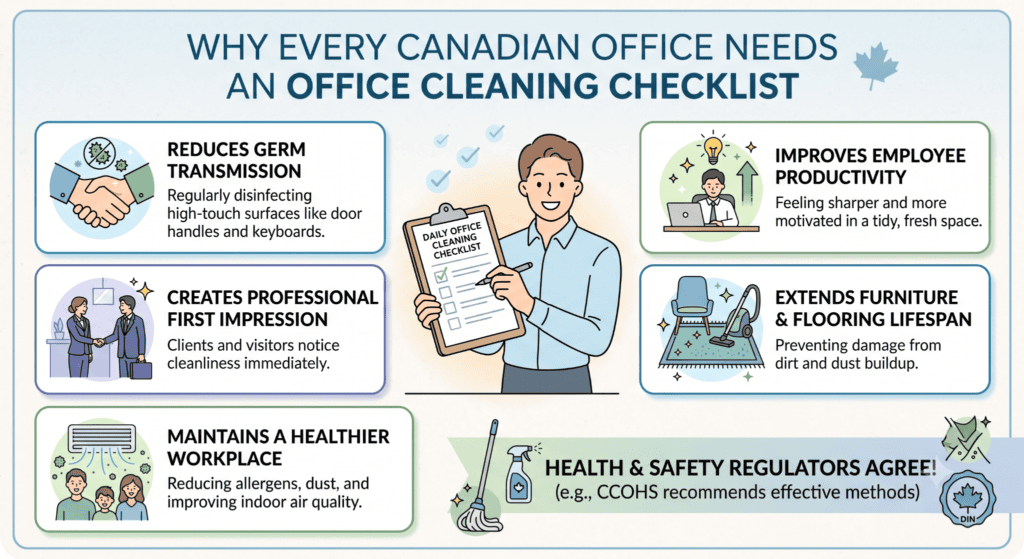
A checklist turns cleaning from a vague good intention into a repeatable system. Without one, cleaning tasks tend to happen only when something looks obviously dirty, which means the things that matter most – disinfecting high-touch surfaces, cleaning air vents, deep-cleaning carpets – get skipped entirely.
Here is what a structured office cleaning checklist gives you:
- Reduces germ transmission. Regular disinfection of shared surfaces such as door handles, light switches, and keyboards limits how far illness spreads through a team.
- Improves employee productivity. As covered above, employees consistently report feeling sharper and more motivated in a clean space.
- Creates a professional first impression. Clients, vendors, and interviewees notice cleanliness before they notice almost anything else.
- Extends furniture and flooring lifespan. Routine care prevents the kind of buildup that causes permanent damage.
- Helps maintain a healthier workplace overall. Good hygiene practices reduce allergens, dust, and the kind of indoor air quality issues that can trigger headaches and respiratory irritation.
Health and safety regulators back this up directly. Canada’s Centre for Occupational Health and Safety notes that damp cleaning methods, like wet cloths and mops, are more effective at collecting and containing particles than dry methods such as dusting and sweeping, and recommends using disinfectants that carry a Drug Identification Number, since that number confirms the product is approved for use in Canada.
How Often Should Different Areas of an Office Be Cleaned?
Not every part of your office needs the same level of attention. Here is a realistic frequency guide based on how heavily each area is used and how quickly it collects dirt or germs.
| Area | Recommended Frequency |
| Reception | Daily |
| Workstations | Daily |
| Washrooms | Multiple times daily |
| Kitchen / Break Room | Daily |
| Meeting Rooms | Daily or after each use |
| Floors | Daily |
| Windows (interior) | Monthly |
| Carpets | Quarterly |
| Air Vents | Every 3 to 6 months |
Some of this frequency is not just best practice – it is a legal requirement in parts of Canada. CCOHS confirms that toilet facilities must be kept clean, sanitary, and well-maintained, with regular cleaning schedules required, and some jurisdictions, including federal workplaces and Quebec, mandating daily cleaning. If your business operates in shifts, CCOHS also recommends cleaning high-touch surfaces at least once per day, with cleaning every two to three hours in higher-traffic environments.
Daily Office Cleaning Checklist
Daily tasks are the backbone of a healthy workplace. These are the jobs that stop dirt and germs from building up in the first place.
Reception Area
- Empty trash bins
- Sanitize the reception desk and counter surfaces
- Clean entrance glass and door panels
- Vacuum entrance mats to remove tracked-in debris
- Disinfect door handles and push plates
The reception area is the first thing anyone sees when they walk into your building, so it deserves daily attention even on quiet days. A five-minute reset each morning keeps first impressions consistent.
Employee Workstations
- Dust desks and monitor stands
- Disinfect keyboards, mice, and phone handsets
- Wipe down shared equipment such as printers and photocopiers
- Empty individual waste bins
- Straighten cables and clear obvious clutter
Workstations are where germs concentrate the most, since the same surfaces get touched dozens of times a day by the same person, and occasionally by coworkers borrowing a stapler or dropping off paperwork.
Meeting Rooms
- Wipe down tables after every use
- Sanitize remote controls, video conferencing equipment, and light switches
- Organize chairs and push them back in
- Clean whiteboards and remove old markers
- Vacuum or spot-clean floors
Meeting rooms are used by more people, more often, than almost any other space in the building, which makes them a priority for a between-meeting wipe-down.
Washrooms
- Clean and disinfect toilets and urinals
- Sanitize sinks, faucets, and countertops
- Refill soap dispensers
- Replace paper towels or check hand dryers
- Mop floors
Washrooms are the one area where Canadian occupational health rules are strictest, and for good reason – they are also the area most likely to affect how clients and employees judge your overall standard of hygiene.
Kitchen and Break Room
- Clean countertops and tables
- Empty and reload the dishwasher
- Sanitize appliance handles, microwave interiors, and coffee machine touchpoints
- Remove garbage and replace liners
- Refill supplies such as napkins and dish soap
Weekly Office Cleaning Checklist
Weekly tasks address the buildup that daily cleaning does not fully catch.
Work Areas
- Dust shelves, cabinet tops, and window sills
- Clean partitions and cubicle walls
- Wipe down chairs, including armrests
- Clean light switches and remove fingerprints from walls and doors
Floors
- Deep vacuum carpeted areas, including under desks
- Mop hard floors with an appropriate cleaner
- Edge vacuum along baseboards where dust collects
- Spot-treat any new carpet stains before they set
Glass and Windows
- Clean interior windows
- Wipe glass partitions and conference room walls
- Polish mirrors in washrooms
- Clean glass on interior doors
Kitchen
- Clean out the refrigerator, tossing expired items
- Deep clean the microwave interior
- Descale or wipe down the coffee machine
- Wipe cabinet fronts and handles
Monthly Office Cleaning Checklist
Monthly tasks catch the things that hide from a quick daily wipe-down.
- Clean ceiling vents and air diffusers
- Wipe down baseboards throughout the office
- Vacuum or spot-clean upholstered furniture
- Clean interior window frames and tracks
- Dust and wipe blinds
- Complete high dusting on shelving, light fixtures, and door frames
- Organize and tidy storage areas
- Clean light fixtures and replace bulbs as needed
- Perform a deeper restroom cleaning, including grout and fixtures
Quarterly and Seasonal Office Cleaning Tasks
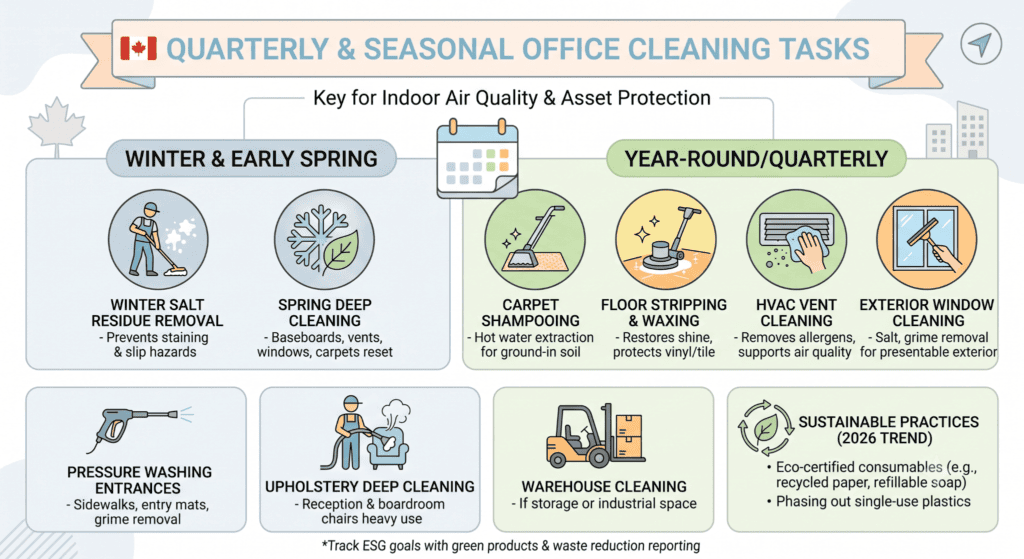
This is where a lot of Canadian businesses fall behind, since these tasks are easy to postpone. They also happen to matter most for indoor air quality and long-term asset protection.
- Carpet shampooing. Deep carpet extraction removes ground-in soil that vacuuming alone cannot lift. For most Ontario offices, hot water extraction once or twice a year is the standard recommendation.
- Floor stripping and waxing. Vinyl and tile floors benefit from periodic stripping and rewaxing to restore shine and protect the surface underneath.
- HVAC vent cleaning. Dust and allergens build up inside ductwork over months, and cleaning vents on a seasonal basis supports better indoor air quality.
- Exterior window cleaning. Salt spray, road grime, and winter weather leave exterior glass looking dull; a seasonal cleaning keeps your building presentable from the outside in.
- Pressure washing entrances. Sidewalks, entry mats, and building exteriors collect grime that regular mopping cannot touch.
- Upholstery deep cleaning. Reception seating and boardroom chairs see heavy use and benefit from a professional deep clean a few times a year.
- Warehouse cleaning, if your business includes storage or industrial space.
- Winter salt residue removal. Anyone running a business in the Niagara Region knows what winter road salt does to entryway flooring. A dedicated late-winter cleaning session prevents long-term staining and slip hazards.
- Spring deep cleaning. A full reset after winter – baseboards, vents, windows, and carpets all at once – sets the tone for the rest of the year.
Industry analysts covering commercial cleaning trends for 2026 point out that sustainability is becoming part of this seasonal planning too. One industry report notes that offices are increasingly prioritizing eco-certified consumables such as recycled paper and refillable soap, along with suppliers who can demonstrate ethical sourcing, while single-use plastics are being phased out of cleaning operations. If your business is tracking ESG goals, ask your cleaning provider whether they can supply green cleaning products and report on waste reduction.
Office Areas That Are Commonly Forgotten
Even businesses with a solid daily routine tend to miss the same handful of spots. These are worth adding to your checklist specifically because they are high-touch and low-visibility.
- Door handles and push bars
- Elevator buttons
- Printer and photocopier control panels
- Coffee machine buttons and handles
- Light switches
- Telephones and headsets
- Stair railings and handrails
- Keyboard trays and desk drawer handles
- Behind and underneath office furniture
- Air vents and returns
CCOHS specifically flags this category of surface in its guidance on infection control, listing light switches, door handles, control buttons, counters, tabletops, chairs, railings, and payment devices among the high-touch surfaces most likely to spread illness if left uncleaned. If your cleaning checklist does not name these items specifically, they tend to get skipped.
Cleaning Supplies Every Office Should Have
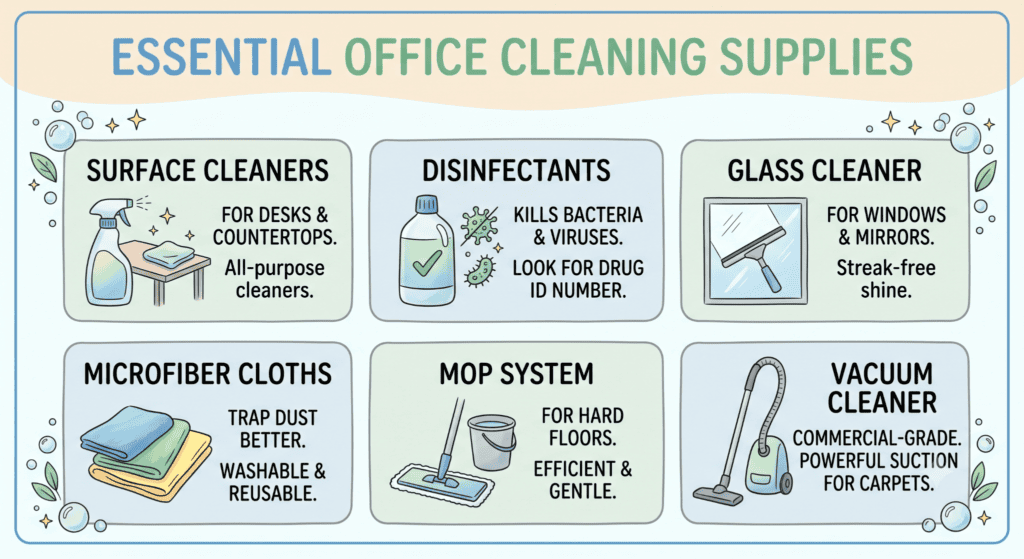
A good cleaning routine depends on having the right supplies on hand, whether your team handles daily upkeep in-house or you rely on a contracted cleaning company for the heavier work.
Surface Cleaners General-purpose cleaners for desks, countertops, and non-porous surfaces.
Disinfectants Look for products carrying a Drug Identification Number, since that confirms Health Canada has approved the product for disinfecting use.
Glass Cleaner For windows, mirrors, and interior partitions.
Microfiber Cloths These trap more dust and bacteria than paper towels and can be washed and reused.
Vacuum Cleaner A commercial-grade vacuum with strong suction handles carpet and mat cleaning far better than a household model.
Mop System A proper bucket-and-mop or flat mop system for hard floors.
Garbage Liners Sized correctly for your bins, so they do not tear under normal use.
Gloves and PPE CCOHS recommends wearing appropriate gloves whenever working with cleaning or disinfecting products, since no single glove material resists every chemical, and some products can dissolve certain glove materials, allowing the product to reach the skin.
Signs Your Office Needs Professional Cleaning
Sometimes an in-house routine simply cannot keep up. Here are the warning signs worth watching for:
- Dust that reappears within a day or two of cleaning
- Lingering odours in carpets, washrooms, or break rooms
- Carpets that look dingy no matter how often they are vacuumed
- Stained or worn-looking upholstered furniture
- Bins that overflow before the next scheduled pickup
- A noticeable rise in employee sick days
- Windows and glass that always look smudged
- Washrooms that never quite feel clean
Any one of these on its own might be a one-off. Several of them together usually mean it is time to bring in outside help, either for a one-time deep clean or an ongoing commercial cleaning contract.
Benefits of Hiring a Professional Office Cleaning Company
There is a real difference between an employee wiping down a desk on their lunch break and a trained cleaning crew running a structured program.
- Consistent cleaning. A contracted schedule means the work happens whether or not someone remembers to do it.
- Better equipment. Commercial-grade vacuums, extraction machines, and floor buffers do a more thorough job than consumer tools.
- Trained professionals. Cleaning staff know how to handle different surfaces, chemicals, and equipment safely and effectively.
- Flexible schedules. Evening or weekend service means cleaning happens without disrupting your workday.
- Improved workplace hygiene overall. A professional janitorial program covers the full checklist, not just the visible spots.
- Long-term cost savings. Protecting flooring, furniture, and carpet from premature wear ultimately costs less than early replacement.
If you are weighing the cost of outsourcing against handling cleaning internally, current Ontario market data gives a useful benchmark. Recent pricing guides put the average commercial office cleaning cost in Canada at $0.10 to $0.25 per square foot for recurring service, or $30 to $60 per hour per cleaner. For a smaller operation, one Ontario guide estimates office cleaning starting around $250 a month for a small office under 1,000 square feet on a weekly schedule, with mid-size offices of 1,000 to 2,500 square feet typically running $450 to $850 a month on three to five visits a week. Larger facilities scale accordingly, with one estimate for a mid-sized office putting daily janitorial service for a 3,000 to 5,000 square foot office between $800 and $2,500 a month depending on scope.
Those numbers are a helpful starting point, but every quote should be based on an actual walkthrough of your space, not a generic online calculator.
Common Mistakes Businesses Make With Office Cleaning
Even businesses that care about cleanliness tend to fall into the same traps. Watching for these can save you money and prevent bigger problems down the road.
Treating cleaning as a once-a-week catch-up. Cramming everything into a single Friday session might make the office look fine for the weekend, but it does nothing to control germs that build up Monday through Thursday. Daily upkeep of high-touch surfaces matters more than one long weekly session.
Skipping the areas nobody sees. Behind the photocopier, under the reception desk, and inside air vents are easy to ignore because nobody is looking at them. These spots are exactly where dust, allergens, and pests tend to collect over time.
Using the wrong products on the wrong surfaces. Glass cleaner on wood furniture, or an all-purpose spray on electronics, can cause damage instead of preventing it. Match the product to the surface, and when in doubt, check the manufacturer’s cleaning recommendations.
Assuming cleaning and disinfecting are the same thing. CCOHS makes a clear distinction here: cleaning removes dirt and debris from a surface, but it does not necessarily destroy the pathogens on it. Disinfecting is a separate step, and surfaces need to be cleaned before they are disinfected, since leftover dirt can block a disinfectant from reaching the germs underneath.
Forgetting to budget for seasonal tasks. Many businesses have a daily and weekly routine down but never get around to carpet extraction, HVAC cleaning, or exterior window washing because nobody owns that part of the calendar. Building these into an annual plan, rather than leaving them as an afterthought, keeps them from being skipped year after year.
Choosing the lowest-cost cleaning quote without checking the scope. A bid that comes in well below every other quote often means something has been left out, whether that is insurance coverage, supplies, or specific tasks. Ontario commercial cleaning pricing guides consistently warn that a quote 30 to 40 percent below market usually points to unlicensed labour, a scope that quietly shrinks after signing, or high staff turnover that leaves your office without a consistent cleaning team.
How to Choose the Right Commercial Cleaning Company
Once you have decided to bring in professional help, the provider you choose matters as much as the checklist they follow. Here is what to look for:
- A written scope of work. Ask for a detailed list of exactly what will be cleaned and how often, not a vague promise of “full office cleaning.” This protects you if tasks start disappearing from the routine after the contract is signed.
- Proof of insurance and WSIB coverage. In Ontario, a legitimate commercial cleaning company should carry general liability insurance and WSIB clearance. This protects your business if a cleaner is injured on your property.
- References and reviews. A company with a track record of long-term clients is a better sign than flashy marketing. Ask how long their average client relationship lasts.
- Flexibility around your schedule. Whether you need after-hours cleaning, weekend service, or daytime touch-ups for a client-facing space, your provider should be able to work around your business, not the other way around.
- Transparency on supplies and consumables. Clarify upfront whether paper products, soap, and liners are included in the price or billed separately, since this is a common source of surprise costs.
- A genuine local presence. A company based in the Niagara Region and familiar with local businesses will understand seasonal challenges like winter salt damage and spring pollen buildup better than a national franchise managing your account from another province.
Printable Office Cleaning Checklist
Use the table below as a simple, bookmarkable version of everything covered in this guide. Print it, laminate it, or pin it to the break room wall so your team always knows what needs attention and when.
| Task | Daily | Weekly | Monthly | Quarterly | Completed |
| Empty trash bins | ✔ | ||||
| Disinfect door handles & light switches | ✔ | ||||
| Wipe down desks & keyboards | ✔ | ||||
| Clean washrooms | ✔ | ||||
| Restock kitchen supplies | ✔ | ||||
| Vacuum entrance mats & high-traffic floors | ✔ | ||||
| Deep vacuum carpets | ✔ | ||||
| Clean interior windows & glass | ✔ | ||||
| Wipe partitions & light switches | ✔ | ||||
| Clean fridge & coffee machine | ✔ | ||||
| Dust ceiling vents & light fixtures | ✔ | ||||
| Clean blinds & window tracks | ✔ | ||||
| Deep clean upholstery | ✔ | ||||
| Shampoo carpets | ✔ | ||||
| Strip and wax hard floors | ✔ | ||||
| Clean HVAC vents | ✔ | ||||
| Wash exterior windows | ✔ |
Final Thoughts
Consistency beats the occasional deep clean every time. A business that cleans thoroughly once a quarter but ignores daily upkeep will always look and feel less professional than one that follows a structured office cleaning checklist all year round. The goal is not perfection on any single day – it is a routine that keeps dust, germs, and clutter from ever getting the chance to pile up.
If you would rather hand this off to a team that already knows the routine, NLLC provides commercial cleaning services throughout the Niagara Region, including Niagara Falls, St. Catharines, Welland, Fort Erie, Niagara-on-the-Lake, Thorold, and Port Colborne. We build a cleaning schedule around your space, your industry, and your budget, so you get a consistently clean office without adding another task to your own to-do list.
Ready for a cleaner, healthier workplace? Request a free quote from NLLC today and let us build a custom cleaning schedule for your Niagara Region business.
Frequently Asked Questions
How often should an office be professionally cleaned?
Most offices benefit from professional cleaning at least two to three times a week for general upkeep, with daily service recommended for high-traffic or client-facing businesses. Deeper tasks like carpet shampooing and HVAC cleaning are usually scheduled quarterly.
What should be cleaned daily in an office?
Washrooms, kitchens, high-touch surfaces like door handles and light switches, trash removal, and floor care in high-traffic areas should all happen every day.
What is included in commercial office cleaning?
A standard commercial cleaning contract typically covers washrooms, kitchens, garbage and recycling, floor care, and touchpoint disinfection, with add-on services like carpet extraction or window washing priced separately.
How long does office cleaning take?
This depends heavily on square footage and layout. A small office might take a cleaner one to two hours per visit, while a larger multi-floor space could require a full crew working several hours each evening.
What’s the difference between regular and deep office cleaning?
Regular cleaning maintains day-to-day hygiene: floors, washrooms, surfaces, and garbage. Deep cleaning tackles the things regular visits do not reach, such as baseboards, vents, under furniture, and carpet extraction, and is usually scheduled quarterly or before a major event.
How often should carpets be professionally cleaned?
Most Ontario businesses schedule professional carpet extraction once or twice a year, though high-traffic offices may need it quarterly to prevent permanent soiling.
Should office desks be disinfected every day?
Yes. Given how much bacteria accumulates on shared surfaces like desks, keyboards, and phones, a daily wipe-down with an appropriate disinfectant is one of the simplest ways to reduce illness in the workplace.
Why is office cleaning important for employee health?
Regular cleaning reduces the spread of germs on shared surfaces, improves indoor air quality by removing dust and allergens, and creates an environment where employees are less likely to get sick and more likely to feel comfortable and focused.s.

One Response