
When business owners think about boosting productivity, they usually reach for the obvious levers first: better software, leaner processes, more training, tighter management. Those things matter. But there’s a factor that gets overlooked far more often than it should, and it’s sitting right under everyone’s feet and fingertips every single day – the physical condition of the workplace itself.
A dusty vent, a sticky breakroom counter, a bathroom that never quite smells clean, a carpet with three-year-old coffee stains – none of these seem like they should matter much on their own. But add them up across a forty-hour work week, and they start to chip away at focus, morale, and health in ways that show up directly on the bottom line. Employees notice a dirty environment even when they don’t say anything about it, and that silent noticing has a cost.
This is where professional cleaning services earn their keep. A properly maintained commercial space isn’t just about looking presentable for the client walking through the front door. It’s about protecting the people who spend the majority of their waking hours inside that building – their health, their concentration, and their sense of being valued by their employer.
In this guide, we’ll walk through the research and the real-world experience behind why workplace cleanliness affects performance, which areas of a commercial building matter most, how often different businesses should schedule professional cleaning, and how to choose the right commercial cleaning company for a business in the Niagara Region – whether that’s an office in downtown St. Catharines, a retail storefront in Niagara Falls, or a warehouse in Welland.
Why Workplace Cleanliness Has a Direct Impact on Productivity
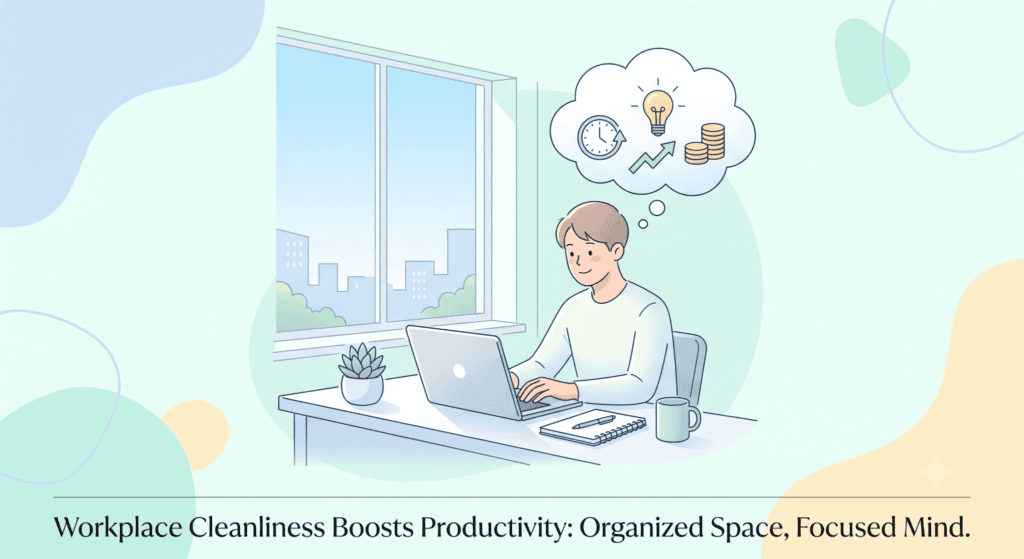
Most business owners intuitively understand that a messy storefront can turn away customers. Fewer stop to consider that the same principle applies internally. Employees form impressions of their workplace just like customers do, and those impressions shape how engaged, careful, and motivated they feel while doing their jobs.
There’s also a straightforward psychological connection between environment and performance. People tend to mirror the standards set around them. A workspace that’s cluttered, dusty, or visibly neglected sends an unspoken message that quality and attention to detail aren’t priorities – and that message can bleed into how employees approach their own work. On the flip side, a well-maintained space signals that standards matter, which tends to reinforce more careful, focused work habits.
The connection between clean workplaces and productivity isn’t just a hunch, either. Research into indoor air quality and worker performance – discussed in more detail below – has repeatedly found measurable links between environmental conditions and cognitive output. And the health data on absenteeism, which we’ll also cover, shows that unclean environments carry a real financial cost through sick days and reduced output.
That’s why the most useful way to think about professional cleaning services is as a business investment rather than a routine overhead expense. A cleaning contract isn’t just paying someone to empty the garbage bins. It’s protecting employee health, supporting focus and morale, extending the life of furniture and flooring, and shaping how clients and job candidates perceive the business the moment they walk in. Framed that way, the return on a consistent commercial cleaning program becomes much easier to see.
Fewer Germs Mean Fewer Sick Days
If there’s one area where the case for professional cleaning is hardest to argue with, it’s illness prevention. Offices are, in practice, shared surfaces multiplied by dozens of hands.
The numbers here are more striking than most people expect. Independent hygiene studies have found that a typical office desk carries far more bacteria than a toilet seat, and that keyboards and phones – the objects employees touch most throughout the day – are consistently identified as the biggest germ transfer points in a workplace. The Centers for Disease Control and Prevention estimates that contact with contaminated surfaces contributes to a large share of everyday infections, since people touch dozens of shared objects every minute without thinking about it.
This matters because those germs don’t stay put. A single employee who comes in with a cold can pass it along to a meaningful share of their coworkers within just a few hours through shared surfaces like door handles, coffee machines, and shared keyboards. Multiply that by an entire flu season, and it’s easy to see how quickly workplace illness compounds.
Professional disinfection breaks this cycle in a way that occasional wiping down by staff simply can’t match. Commercial cleaners use hospital-grade disinfectants, correct dwell times, and consistent schedules – factors that matter far more than most people realize when it comes to actually killing bacteria and viruses rather than just moving them around.
The payoff is lower absenteeism. In Ontario, employees are entitled to unpaid, job-protected sick leave under the Employment Standards Act, and many workplaces offer additional paid sick time on top of that. Every one of those days taken adds up in lost output, and in team members picking up the slack for an absent colleague – which itself can lower morale and increase burnout risk. Businesses that keep their high-touch surfaces disinfected on a regular schedule tend to see fewer of these disruptions, particularly during the fall and winter months when respiratory illnesses spread fastest. Business continuity during cold and flu season is one of the most practical, easiest-to-measure returns a company gets from investing in professional cleaning.
Better Indoor Air Quality Helps Employees Stay Focused
Air quality is one of the least visible factors affecting workplace performance – and one of the most consequential.
Dust, allergens, and fine airborne particles build up gradually in any commercial space, especially around HVAC vents, carpets, and upholstered furniture. Employees exposed to poor indoor air quality over time report more headaches, allergy flare-ups, fatigue, and difficulty concentrating. What makes this especially relevant for employers is that the effects aren’t just anecdotal.
Researchers at the Harvard T.H. Chan School of Public Health tracked more than 300 office workers across six countries and found measurable, same-day drops in cognitive performance tied to indoor air pollution levels. Response times slowed as fine particulate matter (PM2.5) concentrations rose, and higher indoor carbon dioxide levels – a marker of poor ventilation – were linked to slower reaction times and reduced accuracy on cognitive tests. In an earlier related study from the same research group, cognitive function scores roughly doubled when participants worked in environments with enhanced ventilation compared to conventional office conditions. In other words, the air employees breathe at their desks has a direct, measurable relationship with how sharply they think.
Professional cleaning plays a meaningful role here. Regular dusting, vacuuming with HEPA-filtration equipment, and periodic HVAC vent cleaning all reduce the volume of particulates circulating through a building. Commercial cleaners also know which surfaces trap allergens – carpets, fabric chairs, blinds – and clean them on a schedule that prevents buildup rather than waiting until dust is visible to the naked eye. The result for employees is fewer headaches, fewer allergy symptoms, and a workspace that supports rather than undermines mental sharpness throughout the day.
A Clean Workspace Reduces Stress and Mental Clutter
There’s a well-documented relationship in environmental psychology between physical clutter and mental clutter. Visual disorder competes for the brain’s limited attention, and every stray item in a person’s field of view is something the brain has to process and then consciously ignore. Multiply that across a cluttered desk, a messy shared kitchen, or overflowing bins, and it’s easy to see how a disorganized environment quietly drains cognitive energy that could otherwise go toward actual work.
Employees working in organized, clean spaces generally report feeling calmer and more in control of their day. That’s not a coincidence – a tidy environment removes a low-grade, constant source of visual noise, which frees up attention for the tasks that actually matter. Clearer surroundings tend to support clearer thinking, better task-switching, and fewer of the small mental interruptions that add up over a workday.
This is one of the more underappreciated reasons professional cleaning services pay off. It’s not only about hygiene – it’s about removing friction. When common areas are consistently tidy and surfaces are clear, employees spend less mental energy filtering out distractions and more energy actually focused on their work.
Professional Cleaning Boosts Employee Morale
Employees notice when their employer invests in the physical environment they work in every day – and they notice just as clearly when that investment is missing.
A well-maintained workplace sends a message: management cares about the people who work there, not just the output they produce. That feeling of being valued is closely tied to motivation. Employees who feel respected by their workplace environment tend to be more engaged, take more pride in their own work, and are less likely to look for reasons to leave.
This connects to something bigger than cleanliness on its own – workplace culture. A positive culture doesn’t start with a mission statement on the wall; it starts with the physical experience of showing up every day. Clean, comfortable, well-kept spaces are part of the foundation that positive culture gets built on top of. Businesses that neglect this piece often find that no amount of team-building events or perks fully compensates for a workplace that feels run-down or neglected on a daily basis.
The connection between a clean workplace and higher job satisfaction shows up consistently in employee feedback across industries. It’s a low-cost, high-impact lever – and one that’s entirely within an employer’s control, unlike many of the bigger factors that drive engagement.
Cleaner Offices Improve Efficiency Throughout the Workday
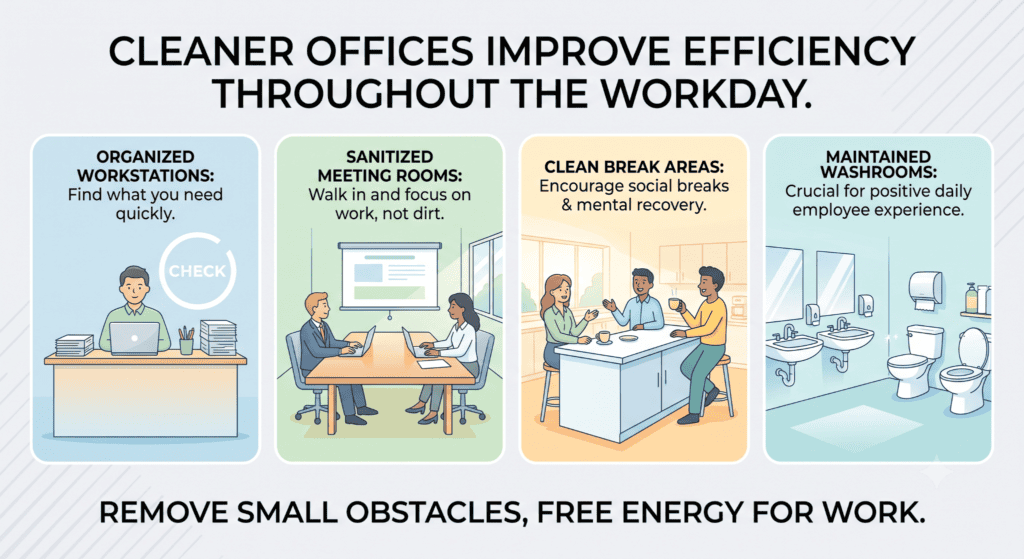
Beyond health and morale, a clean workplace removes small but real obstacles to getting work done smoothly.
Organized workstations mean less time spent hunting for documents, supplies, or equipment, and fewer interruptions caused by clutter creeping into shared spaces. Sanitized meeting rooms mean employees can walk into a client call or team meeting without wiping down a table first or worrying about lingering odours. Clean kitchens and break roomsencourage employees to actually take their breaks in shared spaces rather than avoiding them – which supports better mental recovery during the day and reduces the isolating habit of eating alone at a desk.
Restrooms deserve special mention here. Poorly maintained washrooms are consistently one of the top complaints employees raise about their workplace, and they have an outsized effect on how people feel about their employer overall. A washroom that’s stocked, sanitized, and well-maintained is a small detail that carries a lot of weight in daily employee experience.
Taken together, these small frictions – a messy desk, a sticky table, an unstocked bathroom – cost more time and attention than most managers assume. Removing them through consistent professional cleaning frees employees to spend their energy on actual work rather than navigating around an unkept environment.
Areas That Matter Most for Employee Productivity
Not every part of a commercial space affects productivity equally. These are the areas that consistently make the biggest difference:
- Desks and workstations – the surfaces employees interact with most, and among the highest for bacteria accumulation
- Conference rooms – shared tables and equipment used by multiple teams and outside visitors throughout the day
- Reception areas – the first impression for clients, candidates, and vendors, and a space every employee passes through
- Kitchens and lunchrooms – shared appliances and countertops that see heavy daily use and are frequently under-cleaned
- Washrooms – consistently rated as one of the most important spaces for employee satisfaction
- Floors and carpets – trap dust, allergens, and bacteria that circulate into the air with every step
- High-touch surfaces – door handles, light switches, elevator buttons, shared phones
- Shared equipment – printers, photocopiers, coffee machines, and other communal tools
- Air vents and common areas – directly tied to indoor air quality and the cognitive effects discussed earlier
A thorough commercial cleaning program treats all of these as connected parts of one system, rather than cleaning only what’s most visible.
Why DIY Office Cleaning Isn’t Enough
Many small and mid-sized businesses start out having staff tidy up in between client visits, or hire a part-time cleaner without much structure. It’s an understandable instinct – it feels cheaper, and it avoids adding another vendor relationship. But it usually falls short in ways that become obvious over time.
Employees cleaning their own space, even with good intentions, don’t have commercial-grade equipment. A household vacuum doesn’t have the suction or filtration to properly extract dust and allergens from commercial carpet. Employees also generally don’t have access to proper disinfectants formulated to meet the contact times needed to actually kill bacteria and viruses – most all-purpose sprays need to sit on a surface for several minutes to be effective, and that’s rarely how they’re actually used in a rushed workday.
There’s also the matter of consistency. DIY cleaning tends to happen when someone remembers, not on a fixed schedule – which means the deepest cleaning tasks (vents, carpets, behind furniture) often get skipped entirely for months at a time. Professional commercial cleaning companies follow industry cleaning standards and structured schedules specifically designed to prevent that kind of drift, ensuring that every area gets attention on a predictable rotation rather than an ad hoc basis.
Perhaps most importantly, having employees split their attention between their actual job and cleaning duties is its own drag on productivity – the very thing a cleaning program is supposed to protect.
How Often Should Businesses Schedule Professional Cleaning?
There’s no single answer that fits every business, but a general framework looks like this:
Daily cleaning covers the basics: emptying trash, wiping down high-touch surfaces, vacuuming high-traffic areas, and sanitizing washrooms and kitchens. This is the baseline for any commercial space with regular foot traffic.
Weekly deep cleaning goes further – detailed dusting, cleaning glass and mirrors, sanitizing shared equipment, and addressing areas that don’t need daily attention but shouldn’t go untouched for long.
Monthly floor care includes tasks like buffing hard flooring, deep-scrubbing tile grout, and addressing wear patterns before they become permanent damage.
Quarterly carpet cleaning removes the deep-embedded dust, allergens, and stains that regular vacuuming can’t reach, and extends the usable life of commercial carpeting significantly.
Seasonal deep sanitization – typically timed around flu season and spring – covers vent cleaning, upholstery treatment, and a full top-to-bottom disinfection pass.
The right frequency for a given business depends on several factors: the number of employees using the space, the industry (a medical clinic has very different needs than a warehouse), how much customer traffic comes through, how many shared spaces exist, and seasonal risk factors like flu season. A commercial cleaning company that’s willing to assess these factors and build a custom schedule – rather than offering one flat plan for every client – is generally a better long-term fit.
Industries That Benefit Most from Professional Cleaning
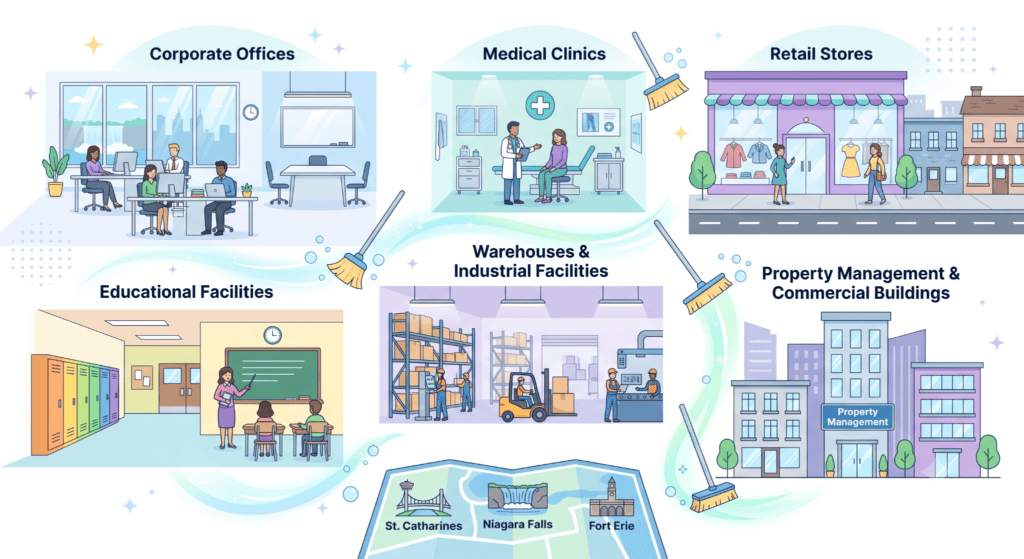
While every business benefits from a clean environment, some industries see an especially direct return:
- Corporate offices, where cognitive performance and focus directly affect output
- Medical clinics, where infection control isn’t optional and compliance standards are strict
- Retail stores, where cleanliness directly shapes the customer’s buying decision
- Educational facilities, where illness spreads quickly among students and staff alike
- Warehouses, where dust and debris create both health and safety hazards
- Industrial facilities, where specialized cleaning protects both equipment and worker safety
- Property management companies, who are responsible for the cleanliness of spaces they don’t personally occupy
- Commercial buildings with multiple tenants, where shared common areas need consistent upkeep
Across the Niagara Region – from office parks in Niagara Falls to retail strips in Welland and Fort Erie to multi-tenant commercial buildings in St. Catharines – these are exactly the types of businesses that see the clearest, most measurable benefit from a structured commercial cleaning program.
The Business ROI of Professional Cleaning
It’s worth stepping back and putting the financial case plainly, because the return on professional cleaning is more concrete than many owners expect.
Reduced absenteeism is the most direct line item. Fewer sick days translate into fewer disruptions, less overtime coverage, and steadier output across the team.
Higher productivity follows from the combination of better air quality, fewer distractions, and improved morale outlined above – each on its own has a modest effect, but together they compound.
Longer-lasting office furniture and flooring is an often-overlooked benefit. Carpet that’s professionally maintained on a regular schedule lasts substantially longer than carpet left to accumulate dirt and grit that grinds down fibres over time. The same logic applies to upholstery and hard flooring.
Better client impressions matter beyond the obvious first-visit effect – a consistently clean space builds ongoing trust with repeat clients and reinforces a brand’s attention to detail.
Improved employee retention ties back to the morale discussion above. Replacing an employee is expensive, and workplace environment is one of the factors – alongside pay, management, and growth opportunities – that influences whether people stay.
Lower maintenance costs over time round out the picture. Preventive cleaning catches small issues, like grout wear or HVAC buildup, before they become expensive repairs.
None of these returns show up as a single dramatic number on a balance sheet. But added together, they make professional cleaning one of the more reliably positive investments a business can make in its own operations.
Common Mistakes Businesses Make with Workplace Cleaning
Even businesses that recognize the value of a clean workplace often undercut their own efforts in a few predictable ways.
Treating cleaning as reactive instead of scheduled. Waiting until a space “looks dirty” before calling in a cleaning crew means the deeper problems – dust in vents, bacteria on high-touch surfaces, grime worked into carpet fibres – have already had weeks or months to build up. By the time something is visibly dirty, it’s usually been a health and productivity drag for a while.
Assuming all cleaning products are equally effective. Not every disinfectant kills the same range of bacteria and viruses, and many require several minutes of contact time to actually work. A quick wipe with the wrong product can leave a surface looking clean while doing almost nothing to reduce germ load.
Overlooking shared equipment and less obvious surfaces. Printers, coffee machines, elevator buttons, and light switches are touched constantly but rarely make it onto a basic cleaning checklist, even though hygiene research consistently ranks them among the dirtiest spots in any commercial space.
Cutting cleaning budgets during slow periods. It’s a common instinct to trim “non-essential” spending when revenue tightens, but reducing cleaning frequency tends to increase absenteeism and lower morale at exactly the moment a business can least afford either one.
Choosing the cheapest provider without checking standards. A lower quote often means less-trained staff, inconsistent scheduling, or corners cut on equipment and products. The cheapest bid on paper isn’t always the most cost-effective choice once absenteeism, turnover, and furniture wear are factored in.
Avoiding these mistakes is often less about spending more and more about spending more deliberately – building a consistent, well-scoped cleaning program instead of an inconsistent, reactive one.
Choosing the Right Commercial Cleaning Company
Not all cleaning providers are equal, and the difference shows up in results. When evaluating a commercial cleaning company, look for:
- Experience – a track record with businesses similar in size and industry to yours
- Customized cleaning plans – a willingness to build a schedule around your specific space and needs, rather than a one-size-fits-all package
- Trained staff – proper training on disinfection protocols, equipment use, and safety
- Eco-friendly products – cleaning solutions that protect employee health without sacrificing effectiveness
- Flexible scheduling – the ability to clean around your business hours without disrupting operations
- Quality assurance – regular inspections and a clear process for addressing feedback
- Insurance and certifications – proper liability coverage and any industry-specific certifications relevant to your sector
Businesses in the Niagara Region – including Niagara Falls, St. Catharines, Welland, Thorold, Fort Erie, Port Colborne, and Niagara-on-the-Lake – should also look for a provider that understands local business needs and can service the entire region reliably, rather than a national chain with limited local presence.
Conclusion
Clean workplaces aren’t a cosmetic detail – they’re a foundational part of how well a business runs. The research is consistent: air quality affects cognitive performance, germs on shared surfaces drive absenteeism, visual clutter adds to mental fatigue, and employees read the state of their environment as a signal of how much they’re valued. Put together, these factors make workplace cleanliness one of the more overlooked levers a business has for improving both employee wellbeing and operational output.
Professional cleaning services turn this from a guessing game into a managed, predictable part of running a business – handled by people trained to do it properly, on a schedule built around your specific space and industry. Rather than treating cleaning as a line item to minimize, it’s worth approaching it the way you’d approach any other investment in your team: as something that pays for itself through healthier, more focused, more satisfied employees.
If your business is in Niagara Falls, St. Catharines, Welland, or anywhere else across the Niagara Region and you’re ready to see what a properly maintained workplace can do for your team, NLLC (Niagara Landscaping, Lawn Care & Cleaning) offers customized commercial cleaning plans built around your schedule and your space. Request a free quote today and find out what a cleaner, healthier workplace could mean for your business.
Frequently Asked Questions
Does professional office cleaning improve employee productivity?
Yes. Studies on indoor air quality show measurable links between cleanliness-related factors like dust and ventilation and cognitive performance, while reduced germ exposure lowers sick days and keeps teams working at full strength.
How does workplace cleanliness reduce employee absenteeism?
Regular disinfection of high-touch surfaces like desks, keyboards, and door handles reduces the spread of bacteria and viruses between coworkers, which directly lowers the number of illness-related sick days across a team.
How often should commercial offices be professionally cleaned?
Most offices benefit from daily basic cleaning, weekly deep cleaning, monthly floor care, quarterly carpet cleaning, and seasonal deep sanitization, though the right frequency depends on employee count, industry, and foot traffic.
What areas should be cleaned most frequently in an office?
High-touch surfaces (desks, phones, door handles, shared equipment), washrooms, and kitchens need the most frequent attention since they see the heaviest daily use and the highest germ accumulation.
Is commercial cleaning worth the investment for small businesses?
Yes. Even small businesses see returns through reduced absenteeism, longer-lasting furniture and flooring, and stronger client impressions, often making professional cleaning more cost-effective than DIY approaches over time.
How does indoor air quality affect employee performance?
Research from Harvard’s T.H. Chan School of Public Health found that higher indoor particulate matter and CO2 levels were linked to slower response times and reduced accuracy on cognitive tests among office workers.
What’s the difference between routine cleaning and deep cleaning?
Routine cleaning covers daily and weekly tasks like trash removal, surface wiping, and vacuuming, while deep cleaning addresses less frequent but essential tasks like carpet extraction, vent cleaning, and behind-furniture detailing.
Can professional cleaning improve employee morale and retention?
Yes. Employees consistently associate a well-maintained workplace with feeling valued by their employer, which supports higher engagement, job satisfaction, and retention over time.

One Response