If you host on Airbnb, you already know the truth every experienced host learns the hard way: guests forgive a lot of things, but they rarely forgive a dirty rental. You can have gorgeous photos, a perfect location two minutes from the Falls, and a listing description that reads like a five-star resort brochure. None of that matters if a guest walks in and finds a hair in the shower drain or a sticky kitchen counter. That one moment can undo everything else you worked for.
This is why a solid Airbnb cleaning checklist isn’t just a nice-to-have for hosts in the Niagara Region – it’s the single biggest lever you have over your review score, your search ranking, and ultimately your income. Whether you’re renting out a condo in downtown Niagara Falls, a lakeside property in Niagara-on-the-Lake, or a family home in St. Catharines or Welland, the cleaning standard guests expect in 2026 is closer to a boutique hotel than a spare bedroom.
In this guide, we’ll walk through exactly what a proper Airbnb cleaning checklist looks like room by room, how Airbnb’s own enhanced cleaning process works, what it actually costs to get this right, and how local Niagara hosts are protecting their ratings – and their bookings – with a repeatable system. This is the same standard our team at NLLC applies to every short-term rental turnover we handle across Niagara Falls, St. Catharines, Welland, Fort Erie, Niagara-on-the-Lake, and Thorold.
Why Cleanliness Makes or Breaks Your Airbnb Rating
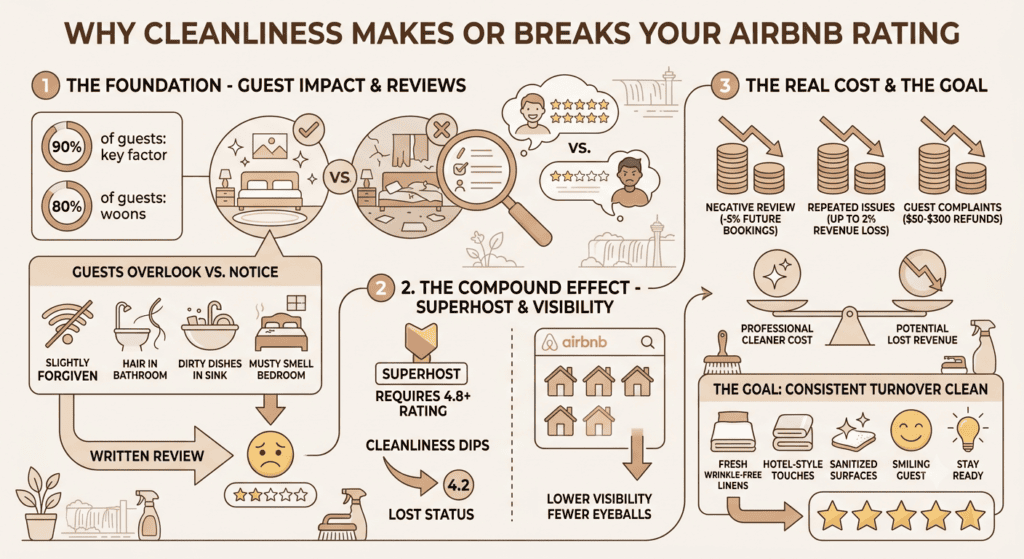
Cleanliness isn’t just one star category among five on your Airbnb listing – it’s the one that guests weigh the heaviest, whether they realize it or not. Industry survey data shows that roughly 90% of guests across Airbnb and Booking.com say cleanliness is a key factor in deciding where to stay, and cleanliness is consistently the most cited category in negative Airbnb reviews. Guests may forgive a slow Wi-Fi connection or a quirky parking situation, but hair in the bathroom, dirty dishes left in the sink, or a musty smell in the bedroom will almost always end up in the written review.
There’s also a compounding effect that a lot of new hosts underestimate. Superhost status requires an overall rating of 4.8 or higher, and cleanliness is one of the most common reasons hosts fall short of that bar. Once your cleanliness score dips, Airbnb’s search algorithm can quietly push your listing further down the results page, which means fewer eyes on your property before a guest even gets to your photos.
The Real Cost of a Bad Cleanliness Review
The financial impact of a poor cleaning experience is bigger than most hosts assume. Around 92% of guests say cleanliness directly influences whether they’ll book with a host again, which makes it as much a retention strategy as a hygiene standard. A single cleanliness-related negative review can reduce future bookings by roughly 5%, and a pattern of ten such reviews can shave close to 2% off total revenue for a property. On top of that, cleaning-related guest complaints – think a refund for a genuinely dirty unit – typically cost hosts anywhere from $50 to $300 per incident, which is often more than the cost of just hiring a professional cleaner in the first place.
Put simply: a rushed or inconsistent turnover clean doesn’t just risk one bad review. It risks a slow, quiet decline in your visibility, your booking rate, and your nightly price over time.
What Niagara Guests Expect in 2026
Niagara is one of the busiest tourism corridors in Ontario, pulling in more than 12 million visitors a year between the Falls, the wine region, and the Niagara-on-the-Lake theatre and dining scene. That volume means guests are comparing your property against dozens of other options in the same few kilometres – and most of them have stayed in a hotel recently enough to know what “clean” is supposed to feel like.
Today’s short-term rental guest expects a full reset between stays, not just a tidy-up. That means fresh, wrinkle-free linens, a bathroom that smells like nothing at all (not perfume, not must), a kitchen with no crumbs or sticky residue, and floors that look and feel freshly cleaned underfoot. Guests are also increasingly used to seeing hotel-style touches, like neatly folded towels or turned-down bedding, and they notice when those small details are missing. If your listing photos show a bright, spotless space, your actual turnover clean has to live up to that promise every single time – not just for the photoshoot.
Understanding Airbnb’s 5-Step Enhanced Cleaning Process
Airbnb doesn’t leave cleaning standards entirely up to guesswork. The platform maintains a five-step enhanced cleaning process that was originally developed with cleaning and hygiene experts, and it’s still the backbone of what a compliant, guest-ready turnover looks like in 2026. Building your own Airbnb cleaning checklist around these five steps keeps you aligned with what Airbnb itself recommends, and it gives your cleaning team – whether that’s you or a hired crew – a consistent structure to follow every time.
Step 1: Prepare
Before any actual cleaning starts, open windows or turn on fans to ventilate the space, gather your approved cleaning products and disinfectants, and make sure your equipment (vacuum, mop, cleaning cart) is stocked and in working order. This is also the moment to start laundry – stripping beds and starting linens in the wash early keeps your turnover moving instead of stalling at the end.
Step 2: Clean
This is the physical removal of dust, dirt, and debris – sweeping, vacuuming, mopping, wiping down every hard surface with soap and water, and washing dishes and laundry on the highest heat setting the fabric or material allows. This step gets the space visibly clean before any disinfecting happens, since sanitizer doesn’t work as well on a surface that’s still covered in grime.
Step 3: Sanitize
High-touch surfaces get special attention here: door handles, light switches, remote controls, faucet handles, and appliance handles. These are consistently flagged as the most commonly missed spots in short-term rentals, and guests are far more likely to touch a remote control or a doorknob than they are to notice most other details in a room. Disinfectant needs to sit for the amount of time listed on the product label before being wiped or left to air-dry – rushing this step defeats the purpose of following an enhanced cleaning protocol at all.
Step 4: Check
Once the bulk of the cleaning is done, walk back through every room with your checklist in hand. This is where a lot of turnovers fall apart under time pressure – a cleaner who’s running behind schedule is far more likely to skip this review pass, and it’s exactly the step that catches a hair on the bathroom floor or a smudge on the mirror before a guest does.
Step 5: Reset
The final step is restocking and resetting the space for the next arrival: fresh linens on every bed, clean towels in the bathroom, toiletries and paper products topped up, and cleaning tools themselves washed and put away so nothing contaminates the freshly sanitized rooms. A quick final walkthrough, ideally with a 30-minute buffer before guest check-in, gives you room to catch anything unexpected before your guest walks through the door.
The Ultimate Airbnb Cleaning Checklist (Room by Room)
A good Airbnb cleaning checklist only works if it’s specific enough that anyone – you, a family member, or a hired cleaner – can follow it without guessing. Here’s a room-by-room breakdown that covers what actually gets checked by picky guests, based on the most common cleanliness complaints hosts see in negative reviews.
Kitchen Cleaning Checklist
The kitchen is one of the fastest places for a listing to lose its 5-star shine, mostly because grease and food residue hide in spots that are easy to skip.
- Wash, dry, and put away all dishes, cutlery, and cookware – nothing left in the sink or dishwasher
- Wipe down countertops, backsplash, and the stovetop, including underneath burner grates
- Clean inside and outside of the microwave, including the turntable
- Wipe down the fridge inside and out, and check for leftover food or expired condiments
- Empty and wipe out the coffee maker or kettle
- Clean the sink and polish the faucet to remove water spots
- Sweep and mop the floor, paying attention to corners and under cabinets
- Take out all trash and reline bins with fresh bags
- Restock basics like dish soap, paper towels, and coffee or tea if you provide them
- Wipe down small appliance handles and cabinet pulls, which are high-touch surfaces guests notice
Bathroom Cleaning Checklist
Bathrooms are the single most scrutinized room in any short-term rental. A guest who finds a hair in the shower or a ring around the tub will assume the rest of the property wasn’t cleaned properly either, even if everything else is spotless.
- Scrub and disinfect the toilet, inside and out, including the base and behind it
- Clean the shower or tub thoroughly, removing soap scum, hair, and any mildew from grout lines
- Wipe down the sink, counter, and faucet, and polish the mirror streak-free
- Replace all towels and bath mats with fresh, unstained ones – white linens are one of the strongest visual signals of cleanliness for guests
- Restock toilet paper, hand soap, and any shampoo or toiletries you provide
- Check the exhaust fan and light fixtures for dust
- Empty and wipe down the trash bin
- Do a final sweep for stray hairs on the floor, in corners, and around the toilet base
Bedroom Cleaning Checklist
Guests judge the bedroom almost entirely by how the bed looks and feels, so this room rewards attention to detail more than almost any other space in the home.
- Strip and remake every bed with fresh, wrinkle-free linens
- Fluff and arrange pillows neatly, and check for stains on pillowcases and duvet covers
- Dust all surfaces, including nightstands, headboards, and lamp shades
- Vacuum under the bed and in closets, and check for items left behind by previous guests
- Wipe down light switches, door handles, and remote controls
- Check closet hangers are in place and drawers are empty and clean
- Open windows briefly to air out the room before guests arrive, if weather allows
Living Room and Common Areas
- Vacuum or sweep and mop all flooring, including under furniture
- Dust surfaces, shelves, picture frames, and electronics
- Wipe down remote controls, light switches, and any shared touch points like thermostats
- Fluff and straighten couch cushions and throw blankets
- Check for crumbs or debris in couch cushions
- Clean glass surfaces like coffee tables or TV screens
- Empty any trash bins and reset decorative items to their original placement
Entryway and Exterior
First impressions start before a guest even opens the door, and this is one of the most overlooked parts of any Airbnb cleaning checklist.
- Sweep the porch, walkway, deck, or driveway and clear away leaves or debris
- Wipe down the front door and door handle
- Check that outdoor lighting is working, especially for evening check-ins
- Make sure house numbers or unit signage are visible and clean
- In winter, clear snow and ice from walkways and steps – a slip-and-fall hazard is both a safety issue and a fast way to earn a bad review
Laundry Room and Hampers
- Wash all used linens, towels, and bathmats on the highest appropriate heat setting
- Wipe down the inside and outside of hampers or laundry baskets
- Wipe the top of the washer and dryer, and clean out the lint trap
- Wash cleaning rags and mop heads separately from guest linens
Commonly Missed Spots
Even experienced cleaners run out of time and skip the same handful of spots. Build these into your checklist specifically, since they’re the details that quietly damage a guest satisfaction score even when the rest of the unit looks great: remote controls, light switches, door and cabinet handles, faucet handles, baseboards, ceiling fan blades, and the tops of picture frames or door frames where dust settles unnoticed.
Building a Repeatable Turnover Cleaning Schedule
A checklist only works if it fits inside the actual time you have between guests. This is where a lot of hosts run into trouble – not because they don’t know what needs cleaning, but because they underestimate how long it takes to do it properly.
As a general guide, a studio or one-bedroom unit with one bathroom typically takes 1.5 to 2 hours for an experienced solo cleaner, a two-bedroom unit runs closer to 2.5 to 3 hours, and larger three- or four-bedroom homes can take 3 to 5 hours depending on the number of bathrooms. These numbers assume a single cleaner working alone; with two people, turnover time roughly halves. Always build in a buffer of at least 30 minutes before your guest’s scheduled check-in for a final walkthrough, since unexpected issues – a stain that needs extra attention, a supply that’s run low – come up more often than hosts expect.
Same-Day Turnover Risks
Same-day turnovers, where one guest checks out and another checks in on the same calendar day, carry the highest risk of anything going wrong. One late checkout, a messier-than-usual guest, or a cleaner running behind schedule can cascade into a delayed check-in, which is consistently one of the most complained-about experiences on the platform. If your listing accepts same-day bookings, confirm your cleaner’s availability the night before and have a backup plan – a second cleaner on call, or a friend or family member who can step in – for the days it doesn’t go smoothly.
Supplies and Restocking
A well-stocked cleaning cart saves real time on every single turnover. Keep a dedicated kit with all-purpose cleaner, bathroom disinfectant, glass cleaner, a mop and bucket, microfiber cloths, rubber gloves, a vacuum in good working order, and trash bags sized for your bins. Track consumables like toilet paper, hand soap, dish soap, and coffee separately so you’re never caught short mid-turnover, and keep backup linens on hand – most experienced hosts keep at least two to three sets per bed so a stained or damaged set doesn’t derail a same-day turnaround.
DIY vs. Hiring a Professional Cleaning Team
Cleaning your own rental works fine for hosts with one property and a flexible schedule, but it gets difficult fast once you’re managing multiple bookings, back-to-back turnovers, or a property you don’t live near. This is where a vacation rental cleaning service earns its cost. A dedicated Airbnb turnover cleaning team is trained for the speed, consistency, and accountability that short-term rentals demand – very different from a standard once-a-week residential clean, since a turnover has a hard deadline and zero room for a missed spot.
On the cost side, Airbnb cleaning fees in Canada generally track with what independent cleaners and small companies charge for a turnover: roughly $80 to $150 for a one-bedroom unit and $120 to $200 for a two-bedroom, with pricing usually built around a flat rate per turnover rather than an hourly charge. Flat-rate pricing tends to work better for hosts because it rewards the cleaner for efficiency instead of stretching out billable hours. When comparing quotes, always confirm whether laundry and restocking supplies are included in the price or billed separately, since that’s where quoted prices can quietly diverge.
Local Considerations for Niagara Region Hosts
Cleaning standards aren’t the only thing Niagara hosts need to stay on top of. The region’s short-term rental rules vary by municipality, and staying compliant protects the very listing you’re working so hard to keep spotless.
Licensing and Compliance Basics
Niagara Falls requires a Vacation Rental Unit licence for most short-term rentals, with an initial fee around $500 and a $250 annual renewal, and properties must sit within a Tourist, General Commercial, or Commercial zone rather than a standard residential area. The city also charges a Municipal Accommodation Tax on the total room rate, which Airbnb typically collects and remits automatically, though hosts remain responsible for accurate reporting. Niagara-on-the-Lake runs its own licensing system entirely separate from Niagara Falls, and St. Catharines has its own rules again – Ontario has no single province-wide short-term rental law, so every municipality in the region sets its own zoning, licensing, and tax requirements. If you’re hosting anywhere in Niagara, it’s worth confirming your specific municipality’s current bylaw directly, since fines for operating without a valid licence can run into the tens of thousands of dollars.
Seasonal Cleaning Challenges
Niagara’s tourist season creates its own cleaning pressures. Summer and early fall bring the highest turnover volume of the year, coinciding with wine country and Falls tourism at its peak, which means less margin for a slow or understaffed cleaning process. Winter turnovers bring a different challenge: road salt, slush, and grit get tracked in at the entryway fast, and walkways need to be cleared of snow and ice before every check-in, both for guest safety and because a snowy, unshoveled entrance is a poor first impression before a guest even reaches your door.
Common Cleaning Mistakes That Cost Hosts 5-Star Reviews
A few mistakes show up again and again in host cleaning routines, and they’re almost all fixable once you know to look for them.
Rushing the check step. When a turnover runs long, the final walkthrough is usually the first thing to get skipped – and it’s exactly the step that catches problems before a guest does.
Skipping high-touch surfaces. Remote controls, light switches, and door handles are easy to forget because they don’t look visibly dirty, but they’re some of the most-touched surfaces in the home and guests do notice fingerprints and residue on them.
Reusing stained or worn linens. Guests notice stains and wrinkles in bedding almost immediately, and it’s one of the fastest ways to undercut an otherwise clean-looking room.
Underestimating turnover time. Booking same-day turnovers without a realistic time buffer is one of the most common causes of delayed check-ins, which frustrates guests before they’ve even seen the space.
Ignoring odour. A musty or stale smell is one of the top cleanliness complaints in negative reviews, and it’s often caused by damp towels left in a hamper, closed-up rooms with no airflow, or lingering cooking smells that never got ventilated out.
Not having a written checklist at all. Relying on memory instead of a documented process means quality varies from turnover to turnover, especially if more than one person ever cleans the property.
How Professional Cleaners Help You Consistently Earn 5-Star Reviews
The hosts who consistently hold 4.9 and 5.0 ratings almost always have one thing in common: a repeatable system, not just good intentions. That’s the real value professional Airbnb host cleaning tips and services bring to the table – consistency that doesn’t depend on how tired or rushed a cleaner happens to be on a given day.
What to Look for in a Cleaning Partner
Look for a team that works from a documented, room-by-room checklist rather than general tidying, offers flexible scheduling for tight same-day turnovers, communicates clearly when something needs your attention (a stain that won’t lift, a maintenance issue), and treats laundry and restocking as part of the job rather than an add-on. Photo verification of completed turnovers is a strong sign of a team that takes accountability seriously.
Why Niagara Hosts Choose NLLC
NLLC has built its reputation across the Niagara Region – Niagara Falls, St. Catharines, Welland, Fort Erie, Niagara-on-the-Lake, and Thorold – by treating every turnover as if it were preparing a home for the most detail-oriented guest imaginable, because eventually, it is. Our team follows a structured checklist for every property, restocks supplies as part of the service, and works around the tight windows that same-day Airbnb turnovers demand. Beyond cleaning, we also offer landscaping and lawn care, snow removal, and garbage and junk removal, which means Niagara hosts can cover the exterior upkeep that shapes a guest’s first impression through the same local team. You can see the full range of what we offer on our services page, and read what other property owners in the region have said about working with us on our testimonials page.
Conclusion & Next Steps
A great Airbnb cleaning checklist isn’t about perfectionism for its own sake – it’s about protecting the review score that drives your bookings, your search ranking, and your income. Guests are comparing your Niagara property against dozens of others within a short drive of the same attractions, and cleanliness is consistently the detail that decides whether they leave a 4-star review or a 5-star one.
If managing consistent, guest-ready turnovers across your Niagara Falls, St. Catharines, Welland, or Niagara-on-the-Lake property is starting to feel like a full-time job on top of hosting, you don’t have to handle it alone. Our team offers short-term rental cleaning Niagara hosts can count on for every turnover, built around the same checklist standards covered in this guide. Reach out through our contact page to get a quote, or explore our full cleaning services here to see how we can help keep your rental at 5 stars, turnover after turnover.
FAQs About Airbnb Cleaning Checklists
How long should an Airbnb turnover clean take? For an experienced solo cleaner, expect roughly 1.5 to 2 hours for a studio or one-bedroom unit, 2.5 to 3 hours for a two-bedroom, and 3 to 5 hours for larger three- or four-bedroom homes. Always build in a buffer before guest check-in.
What is Airbnb’s 5-step enhanced cleaning process? It’s Airbnb’s official cleaning framework: Prepare, Clean, Sanitize, Check, and Reset. It was developed with cleaning and hygiene experts and is designed to bring hotel-level consistency to short-term rental turnovers.
How much does professional Airbnb cleaning cost? In the Niagara Region, a standard turnover typically runs $80 to $150 for a one-bedroom and $120 to $200 for a two-bedroom, usually charged as a flat rate rather than hourly. Always confirm whether laundry and restocking are included.
What’s the biggest cleaning mistake that hurts Airbnb reviews? Skipping the final walkthrough under time pressure. It’s the step most likely to catch a hair in the bathroom, a stained pillowcase, or a lingering smell before a guest does.
Do I need a licence to run an Airbnb in Niagara Falls? Yes. Most short-term rentals in Niagara Falls require a Vacation Rental Unit licence and must sit within an approved commercial or tourist zone. Rules differ across Niagara-on-the-Lake, St. Catharines, and other municipalities, so it’s worth checking your specific city’s current bylaw.
Should I clean my Airbnb myself or hire a professional? It depends on your volume and schedule. One property with plenty of time between bookings can work fine as a DIY clean. Multiple listings, tight same-day turnovers, or a property you don’t live near are usually strong signs it’s time to bring in professional Airbnb cleaners.
What are the most commonly missed spots in an Airbnb clean? Remote controls, light switches, door and cabinet handles, faucet handles, baseboards, and ceiling fans. These high-touch or easy-to-overlook areas are frequently the difference between a good clean and a genuinely 5-star one.
How often should I do a deep clean versus a standard turnover clean? Most hosts pair a standard turnover checklist with a deeper clean every month or two, or after any extended guest stay, to catch things a quick turnover doesn’t reach – inside appliances, baseboards, window tracks, and upholstery.