Picture this: a potential tenant, a new commercial client, or a family booking a weekend Airbnb in Niagara Falls pulls out their phone and searches your property’s name. Before they call, before they tour, before they sign anything – they check your Google reviews first. If the top comment mentions a musty hallway, a dusty lobby, or a bathroom that “wasn’t what the photos showed,” that deal is often over before it started.
Cleanliness isn’t just about appearances anymore. It’s become one of the loudest signals in your online reputation, and it shows up in almost every review – good or bad. Property owners across St. Catharines, Welland, Niagara Falls, and the wider Niagara Region are starting to realize that a spotless property and a five-star Google profile aren’t two separate goals. They’re the same goal, viewed from two different angles.
This guide breaks down exactly how clean properties get better Google reviews, why that connection matters more in 2026 than it ever has before, and what property owners, landlords, and business operators in the Niagara Region can do about it – starting this week.
Why Google Reviews Matter More in 2026 Than Ever Before
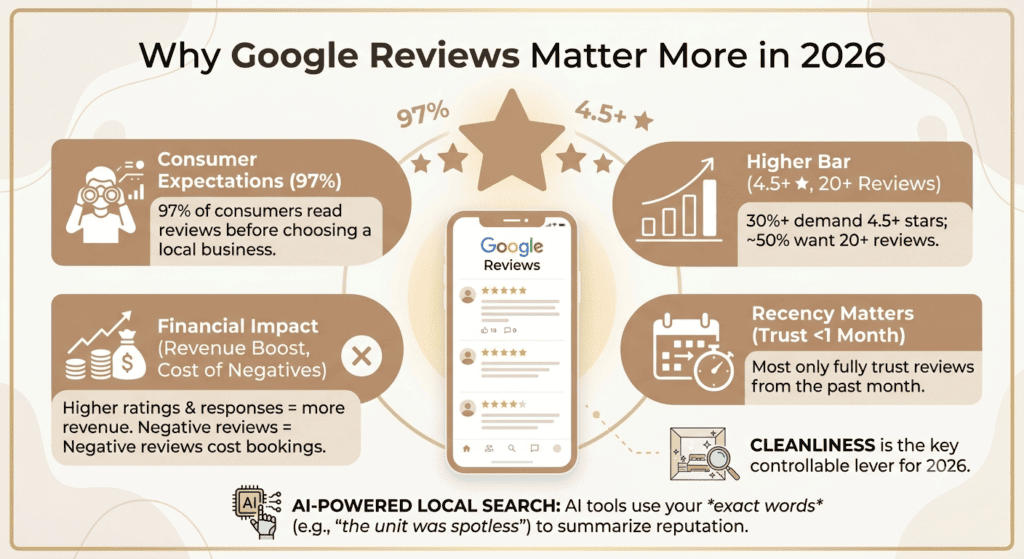
If you’ve felt like reviews carry more weight than they used to, you’re not imagining it. Recent industry survey data shows that 97% of consumers now read reviews before choosing a local business, and the share of people who say they “always” check reviews before browsing jumped from 29% to 41% in just twelve months. That’s a massive shift in a single year, and it means the days of a casual glance at your star rating are over. People are reading closely, comparing across multiple platforms, and forming an opinion about your property before they ever pick up the phone.
The bar has also gotten higher. Consumers now use an average of six different review sites before making a decision, and nearly a third of them say they won’t consider a business rated below 4.5 stars – almost double the share who said the same thing just a year earlier. Star ratings alone aren’t enough anymore, either. Roughly half of consumers won’t even consider a business with fewer than 20 reviews, no matter how high the rating looks.
Recency matters too. Most people say they only fully trust reviews written within the past month, and a large majority prioritize feedback from the last few months over anything older. A property that hasn’t collected a fresh review in six months can look stagnant next to a competitor with a steady trickle of recent, glowing comments – even if the older reviews were excellent.
There’s also a financial reality behind all of this. Properties and service businesses that actively respond to their reviews tend to see meaningfully higher revenue than those that ignore them, and each additional star on a review profile has been linked to measurable increases in bookings, leads, and conversions. On the flip side, a single bad review can be costly – some estimates suggest one negative review can quietly cost a business dozens of potential customers who simply move on to the next search result.
For property managers, landlords, Airbnb hosts, and commercial building owners in the Niagara Region, this isn’t abstract marketing theory. It’s the difference between a fully leased building with a waitlist and a property that sits listed for months. And more often than not, the fastest, most controllable lever you have to pull is cleanliness.
The Rise of AI-Powered Local Search
One more shift is worth noting for 2026: people aren’t only reading reviews directly on Google anymore. AI-driven search tools have surged as a discovery channel for local businesses, jumping from a small fraction of local searches to a significant share in a single year, according to recent local SEO research. These AI tools pull directly from review content – the specific language guests and tenants use – to summarize a business’s reputation before a person even lands on a website or Business Profile. That means the actual wording inside your reviews matters more than ever. A review that says “the unit was spotless and smelled fresh” carries different weight, in an AI-summarized world, than a generic “good experience, would recommend.” Consistently clean properties tend to generate the specific, descriptive language that both human readers and AI tools latch onto.
The Direct Link Between Cleanliness and Star Ratings
What Guests and Tenants Actually Say in Reviews
Read through a stack of negative reviews for any residential, commercial, or short-term rental property, and a pattern emerges almost immediately. Complaints rarely start with “the price was too high” or “the location was inconvenient.” They start with something visible, physical, and immediate: a stained carpet, a dusty vent, a sticky countertop, a bathroom that didn’t match the listing photos.
Research into short-term rental reviews backs this up in a concrete way. One industry study found that 97% of guests consider cleanliness the single most important factor in their overall satisfaction – ahead of amenities, location, and even price. Academic research analyzing thousands of guest reviews has similarly identified unclean rooms, unwashed bedding, and lingering odours as some of the most consistently mentioned reasons guests refuse to recommend a property to others. Cleanliness isn’t one factor among many. In review after review, it’s the factor.
The same pattern holds true for commercial and residential property management, even though the language is different. Tenants don’t usually write “the lobby wasn’t vacuumed” as a throwaway line – they lead with it, because it colours everything else about how they perceive the building. A dirty entryway suggests deferred maintenance. A grimy shared kitchen suggests a landlord who doesn’t check in. A property that smells clean and looks cared for, on the other hand, quietly earns trust before a single word is exchanged.
The Psychology of “First Impression” Cleanliness
Here’s something property owners often underestimate: people judge cleanliness within seconds, and that judgment is emotional before it’s rational. A prospective tenant walking into a building doesn’t run a white-glove test on the baseboards. They notice the smell, the lighting, whether the glass doors are streaky, whether the welcome mat is worn and stained. That snap judgment then colours how they interpret everything else – including things that have nothing to do with cleaning, like noise levels or parking.
This is why “perceived” cleanliness matters almost as much as actual cleanliness. A property can be technically spotless and still feel dingy because of poor lighting or clutter, and a property that’s merely tidy can feel luxurious because of a fresh scent and polished fixtures. Property owners who understand this design their cleaning routines around what people notice first: entryways, high-touch surfaces, bathrooms, and anywhere natural light hits dust or streaks directly.
How Clean Properties Get Better Google Reviews
This is the heart of the matter, and it’s worth spelling out clearly: clean properties get better Google reviews because cleanliness removes the single biggest source of friction between a good experience and a great one. When nothing is wrong, people default to praising what stood out – and a spotless, well-maintained space is one of the easiest things to praise.
Curb Appeal Sets the Tone Before Anyone Steps Inside
Before a tenant, buyer, or guest ever opens your front door, they’ve already formed an impression from the outside. An overgrown lawn, weeds pushing through a walkway, or a driveway buried in last week’s snow tells a visitor that maintenance here is inconsistent – and that assumption follows them inside, whether it’s fair or not. A trimmed lawn, clean walkways, tidy landscaping beds, and a driveway cleared promptly after a storm do the opposite. They signal “this property is looked after,” and that expectation carries through the entire visit.
This matters enormously in the Niagara Region, where seasonal extremes make curb appeal a moving target. A property that looks immaculate in July can look neglected in February if snow and ice aren’t cleared quickly, and a lush spring lawn can turn patchy and weedy by August without regular care. Property owners who treat landscaping and snow removal as part of their reputation strategy – not just a maintenance line item – tend to see it reflected directly in how guests and tenants describe the property online.
Spotless Interiors Turn Silent Tenants into Vocal Advocates
Most tenants and guests won’t leave a review just because everything was fine. Fine is forgettable. But a genuinely spotless space – one that smells fresh, has streak-free windows, and shows obvious attention to detail – gives people something specific to mention. “The unit was immaculate when we moved in” or “you could tell the cleaners actually cared” are the kinds of lines that show up in five-star reviews precisely because they stood out from the baseline expectation.
This is especially true for move-in and move-out situations, Airbnb turnovers, and commercial spaces that clients visit regularly. Each of these is a moment where cleanliness is scrutinized more closely than usual, and each is a moment where a well-executed clean converts a routine transaction into a review-worthy experience.
Consistency Beats One-Time Deep Cleans
One of the most common mistakes property owners make is treating cleaning as an event rather than a system. A single deep clean before a big showing or a new tenant’s move-in is good, but it only protects the first impression. Reviews get written throughout a tenancy or a stay, not just on day one, and a property that looks great in week one but slips by month three will collect exactly the kind of mixed reviews that damage overall ratings.
The properties that consistently earn strong reviews treat cleaning as a recurring, scheduled part of operations – with a set cadence for common areas, a reliable rotation for deeper tasks like carpet cleaning and window washing, and a fast response plan for anything unexpected, like a spill or graffiti. Consistency is what turns “we had a great cleaning company once” into “this property is always spotless,” and the second version is what shows up in reviews.
The Business Case: Revenue, Rankings, and Reputation
Star Ratings and Local Pack Rankings
Google doesn’t just show your star rating to shoppers – it factors reputation signals into how visible your business is in local search results and Google Maps in the first place. Listings with stronger, more recent, and more numerous reviews tend to perform better in the local map pack, the cluster of business listings that shows up above organic search results for “near me” style searches. For a property management company, cleaning business, or rental property competing for attention in a tourist-heavy market like Niagara Falls, that visibility difference can be the gap between a fully booked calendar and an empty one.
Revenue Impact of Better Reviews
The financial upside of strong reviews is well documented at this point. Businesses that actively manage and respond to their reviews report meaningfully higher revenue than those that don’t, and even a modest increase in average star rating has been linked to measurable revenue gains in local service industries. Conversion rates tend to peak in the 4.2 to 4.9 star range – interestingly, a perfect 5.0 rating with very few reviews can actually raise suspicion among savvy consumers, who increasingly expect a mix of detailed, specific, recent feedback rather than a flawless but thin profile.
For property owners, this translates into very practical outcomes: shorter vacancy periods, stronger negotiating position on rent or price, more inbound inquiries without additional ad spend, and a reputation that does some of the sales work automatically. Cleanliness, in this light, isn’t a cost centre. It’s one of the highest-leverage investments a property owner can make in their own marketing.
There’s a compounding effect here too. A property with a strong review history doesn’t just convert better today – it becomes easier to market tomorrow. Screenshots of five-star reviews strengthen listing pages, testimonials pages, and social proof across every channel a property owner uses to attract tenants or guests. A single well-maintained property, reviewed consistently over a year or two, can end up doing more organic marketing work than a paid ad campaign, simply because the proof is coming from real people rather than a business describing itself.
Common Cleanliness Mistakes That Tank Google Reviews
Even attentive property owners fall into predictable traps that quietly erode their review profile over time. Watch for these:
- Ignoring high-touch areas. Door handles, light switches, elevator buttons, and railings get touched constantly but are often skipped in a routine wipe-down, leaving them visibly grimy even when the rest of the space looks clean.
- Masking odours instead of removing them. Heavy air fresheners over a musty smell tend to make guests more suspicious, not less. People notice the difference between “fresh” and “covered up.”
- Letting outdoor spaces slide in winter. In the Niagara Region especially, an unshoveled walkway or an icy parking lot is one of the fastest ways to turn a good indoor experience into a one-star review about safety and neglect.
- Treating carpets and upholstery as “later” tasks. Stains and matted carpet fibres are some of the most commonly mentioned complaints in negative reviews, yet they’re often the last item on a cleaning checklist.
- Skipping post-construction or renovation cleanup. Dust from a recent renovation project settles into vents, corners, and fixtures for weeks if it isn’t professionally addressed, and tenants notice immediately.
- No system for garbage and clutter. Overflowing bins, especially in shared commercial or multi-unit residential spaces, create an instant impression of neglect regardless of how clean the rest of the building is.
- Inconsistent standards between visits. A property that alternates between spotless and merely “okay” creates unpredictable experiences, and unpredictability shows up in review language like “hit or miss.”
A Property Owner’s Cleaning Checklist for 5-Star Reviews
Residential Properties
For landlords and residential property managers, the priority areas are the ones tenants interact with daily: entryways, kitchens, bathrooms, and shared laundry or storage spaces. A move-in clean should go well beyond a surface wipe-down – baseboards, inside cabinets, behind appliances, and window tracks are where lingering grime becomes obvious to a new tenant within their first hour in the unit. Between tenancies, a full reset that includes carpet cleaning and a deep bathroom scrub protects both the unit’s condition and the review that eventually gets left about it.
Commercial Properties
Commercial spaces face a different kind of scrutiny. Clients, customers, and employees all form impressions of a business based partly on how clean the physical space is, and a neglected office or retail space can undercut an otherwise strong brand. Daily attention to entryways, washrooms, and shared kitchen areas matters most, paired with a regular deeper clean of carpets, upholstery, and windows. Janitorial consistency – the same standard, every visit – is what separates a business that “feels professional” from one that doesn’t.
Airbnb & Short-Term Rentals
Short-term rentals live and die by turnover quality, because every single guest is effectively a first impression and every stay generates a potential review. Fresh linens and towels for every booking, a genuinely streak-free bathroom, dust-free surfaces, and a final walkthrough before check-in are non-negotiable. Given how frequently cleanliness dominates negative review language in this category, hosts in tourist-heavy areas like Niagara Falls have the most to gain – and the most to lose – from getting this right consistently.
Seasonal (Snow & Landscaping) Considerations for Niagara Properties
Niagara’s climate means “clean” has to include the exterior, and it has to adapt with the seasons. Spring and summer call for tidy lawns, trimmed edges, and landscaping beds free of weeds and debris. Fall means leaf removal before it becomes a slippery hazard. Winter means fast, reliable snow and ice clearing on walkways, driveways, and parking areas – not just for appearance, but for the safety complaints that turn into one-star reviews fastest. Property owners who bundle interior cleaning with exterior property care tend to avoid the seasonal dip in reviews that catches less prepared competitors off guard every year.
How to Turn a Clean Property Into an Actual Google Review
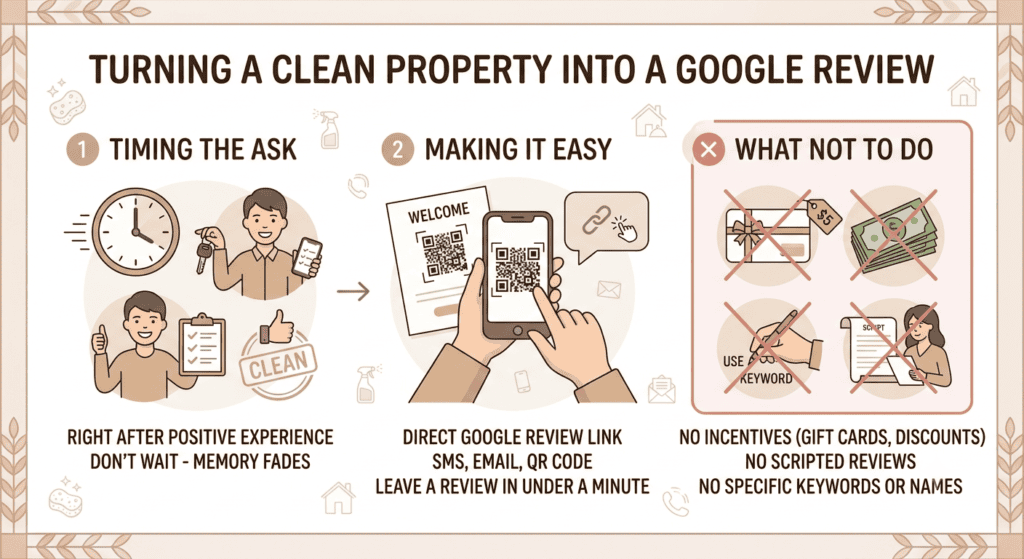
A spotless property creates the opportunity for a great review, but it doesn’t automatically produce one. Most satisfied tenants and guests simply move on with their day unless they’re asked. Turning that positive experience into a public review takes a deliberate, low-friction process.
Timing the Ask
The best moment to request a review is right after a positive experience has been delivered and acknowledged – not days later, when the memory has faded. For a cleaning or move-in scenario, that might mean asking once a tenant confirms the space looks great, or following up shortly after a completed job while the result is still fresh. Waiting too long consistently produces lower response rates, simply because people forget or lose the sense of urgency.
Making It Easy
Friction kills review requests. A direct link to your Google Business Profile review page – sent by text or email, or made available as a QR code on an invoice, welcome sheet, or business card – removes the multiple steps that cause people to abandon the process. The easier it is to leave a review in under a minute, the more likely a busy tenant or guest actually follows through.
What NOT to Do
Google has tightened its review guidelines, and property owners need to stay on the right side of them. Review requests should go to every eligible customer, not just the ones you’re confident will leave a glowing comment. Businesses should never offer discounts, gift cards, or other incentives in exchange for a review, never ask reviewers to mention specific staff names or keywords, and never set review quotas for employees. These practices aren’t just against the rules – they also tend to produce reviews that feel scripted, which savvy readers can spot immediately. A steady, honest flow of reviews collected the same way, every time, protects both your local search visibility and the credibility of the reviews you already have.
Responding to Reviews: The Other Half of the Equation
Collecting reviews is only half the strategy. How a property owner responds to them is just as visible – and just as influential – as the reviews themselves.
Responding to Positive Reviews
A short, genuine thank-you response to a positive review does more than acknowledge the reviewer. It signals to everyone else reading your profile that there’s a real person behind the business who pays attention. Mentioning something specific from the review – the unit, the season, the particular service – makes the response feel authentic rather than templated.
Responding to Negative Reviews Professionally
Negative reviews are uncomfortable, but they’re also an opportunity. A calm, non-defensive response that acknowledges the concern and offers a path to resolution – a phone call, a follow-up visit, a direct email – shows future readers that problems get addressed rather than ignored. Most consumers say they expect a response to reviews, and a business that never responds to criticism can look more evasive than a business that responds honestly and resolves the issue. The goal isn’t to win an argument in public; it’s to demonstrate, to everyone reading later, that your property takes feedback seriously.
Why Niagara Property Owners Trust NLLC With Their Reviews
At Niagara Landscaping, Lawn Care & Cleaning (NLLC), we’ve built our business around a simple idea: a well-maintained property earns its reputation one detail at a time. We provide residential and commercial cleaning services, including Airbnb and short-term rental cleaning, move-in/move-out cleaning, post-construction cleaning, and ongoing janitorial services, alongside lawn care and landscaping, garbage removal, and snow removal across Niagara Falls, St. Catharines, Welland, Fort Erie, Niagara-on-the-Lake, Thorold, Port Colborne, and the surrounding Niagara Region.
We work with landlords, property managers, commercial building owners, and Airbnb hosts who understand that cleaning isn’t a maintenance afterthought – it’s directly tied to occupancy, tenant satisfaction, and the online reputation that brings the next client through the door. You can read what current and past clients say about working with us on our testimonials page, and browse more property care guides on our blog.
If your property’s Google reviews haven’t reflected the standard you’re aiming for – or if you simply don’t have the time to maintain that standard consistently across every unit, building, or listing – our team can help. Get in touch through our contact page or call us directly at +1 365 607 0015 for a free, no-obligation quote tailored to your property.
Frequently Asked Questions
Does cleanliness really affect my Google star rating? Yes. Cleanliness is one of the most frequently mentioned factors in both positive and negative reviews for residential, commercial, and short-term rental properties. Industry research shows cleanliness ranks as the top satisfaction factor for the large majority of guests and tenants, which means it directly shapes the language – and the star rating – people choose when leaving a review.
How often should a rental property be professionally cleaned to maintain good reviews? For long-term residential units, a full professional clean between tenants plus regular common-area maintenance is the baseline. For Airbnb and short-term rentals, every single turnover should include a full clean, since each guest represents a fresh opportunity for a review. Commercial spaces typically benefit from daily attention to high-traffic areas and a deeper clean on a weekly or biweekly schedule.
What’s the best time to ask a tenant or guest for a Google review? Right after a clearly positive moment – once a tenant has seen a freshly cleaned unit, or shortly after a guest checks out of a spotless short-term rental. Waiting too long reduces the chances they’ll follow through, simply because the specific details fade from memory.
Can I offer a discount in exchange for a Google review? No. Google’s guidelines prohibit incentivized reviews, and offering rewards for feedback can put your Business Profile at risk of penalties. The safer, more effective approach is to make leaving a review as easy as possible – a direct link or QR code – rather than incentivizing it.
Does landscaping and snow removal actually influence Google reviews, or just interior cleaning? Curb appeal sets expectations before anyone steps inside, and in the Niagara Region, seasonal upkeep like snow and ice removal directly affects safety and first impressions. Reviews frequently mention exterior conditions, especially when a walkway or parking area wasn’t cleared promptly.
How should I respond to a negative review about cleanliness? Respond promptly, acknowledge the specific concern without being defensive, and offer a concrete next step – a re-clean, a phone call, or a refund where appropriate. A thoughtful public response reassures future readers even more than the original review discouraged them.
Is it worth hiring a professional cleaning company just to improve my reviews? For most property owners, yes. A professional cleaning company brings consistency that’s hard to maintain with ad hoc or in-house cleaning, especially across multiple units or a busy short-term rental calendar. Since consistency is what separates properties with strong review histories from those with mixed ones, professional cleaning often pays for itself through reduced vacancy and stronger inbound leads.
How many Google reviews does my property need before it starts helping my visibility? There’s no hard cutoff, but a meaningful share of consumers won’t seriously consider a business with fewer than 20 reviews, regardless of the star rating. Building toward that threshold with a steady, honest review-request process is a realistic near-term goal for most property owners.
Final Thoughts
The connection between a spotless property and a strong Google review profile isn’t a marketing trick – it’s simply what happens when the physical experience of a space matches or exceeds what people expect. Property owners in the Niagara Region who treat cleaning, landscaping, and snow removal as an ongoing investment in reputation – rather than a reactive chore – consistently see it reflected in the reviews that shape their next booking, lease, or sale.
If you’re ready to stop guessing about what your next review will say, NLLC is here to help you build a property that earns five stars on its own. From routine cleaning to seasonal property care, our team keeps your space – and your reputation – looking its best, year-round.