
Picture this: it’s the first week of December, the Niagara sky has turned that heavy shade of grey that only means one thing, and your phone won’t stop buzzing with alerts about an incoming lake-effect snow band. You reach for your phone to call a snow removal company, only to hear the same sentence from four different businesses in a row: “Sorry, we’re fully booked for the season.”
This isn’t a rare story. It’s the reality for thousands of homeowners and business owners across St. Catharines, Niagara Falls, Welland, and the rest of the Niagara Region every single year. Snow removal planning is one of those tasks that feels easy to put off in September, when the leaves are just starting to turn and the driveway is still bone dry. But the moment the first real storm hits, the businesses that waited are scrambling, paying premium emergency rates, or worse, dealing with a snow-covered walkway that turns into a liability nightmare.
At NLLC (Niagara Landscaping, Lawn Care & Cleaning), we watch this pattern repeat every fall. Properties that lock in their winter service in September and October sail through the season with predictable costs and prompt response times. Properties that wait until the snow is already falling end up on waiting lists, paying more, or handling the mess themselves. This guide walks through exactly why snow removal planning needs to start well before winter arrives, what’s shaping this coming season in the Niagara Region, and how to make sure your property, whether it’s a single-family home or a busy commercial plaza, is protected before the first flake falls.
Why Snow Removal Planning Can’t Wait Until Winter
The Booking Crunch Is Real
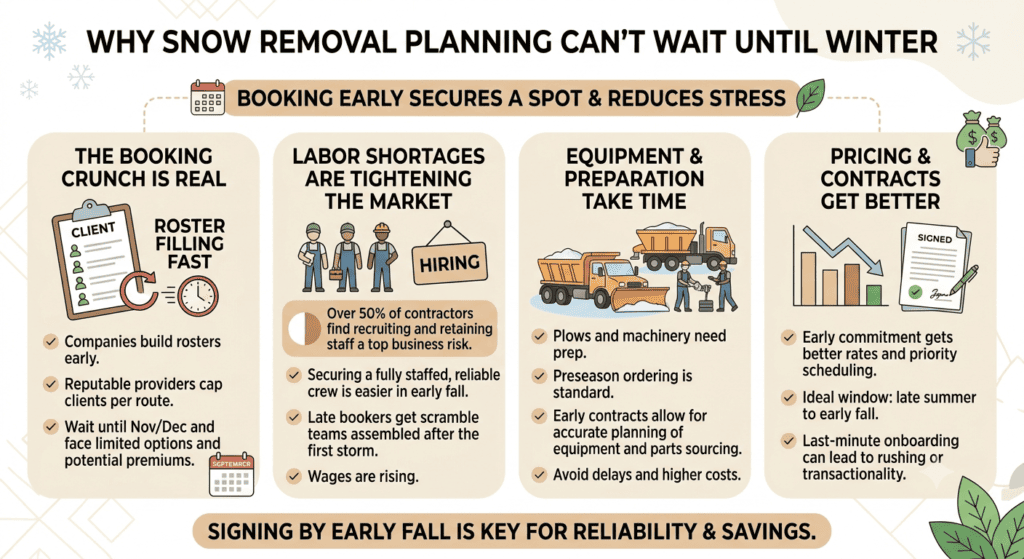
Every fall, snow removal companies across Ontario go through the same cycle. They spend late summer and early fall building out their client rosters, mapping efficient plow routes, and assigning crews to specific neighborhoods and commercial zones. Once that roster fills up, it fills up. Reputable snow removal contractors intentionally cap the number of driveways, parking lots, and walkways they take on per route because overloading a route means slower response times for everyone on it.
That means snow removal planning done in September or early October gives you access to a spot on that roster while it still has room. Wait until November or December, and you’re choosing from whoever has capacity left, which is often a smaller, less established operation or a company charging a premium for last-minute onboarding.
Labor Shortages Are Tightening the Market
This isn’t just a supply-and-demand story about trucks and plows. The landscaping and snow removal industry across North America is dealing with a genuine labor crunch heading into this winter. Industry reporting shows that <cite index=”42-1″>more than half of contractors identify recruiting and retaining staff as a top business risk for the year, right alongside economic uncertainty and rising material costs</cite>. On top of that, <cite index=”42-1″>a majority of contractors plan to raise wages this year, with a large share planning increases of four percent or more</cite>, which naturally puts upward pressure on service pricing as the season goes on.
For property owners, this translates into a simple truth: the earlier you sign, the more likely you are to get a fully staffed, reliable crew rather than a scramble team assembled after the first storm. Companies that already have your property under contract in September have the runway to hire, train, and schedule properly. Companies you call in December are trying to squeeze you into an already-stretched operation.
Equipment Doesn’t Appear Out of Thin Air
Plows, salt spreaders, skid steers, and snow blowers all need to be serviced, repaired, and sometimes replaced before the season starts. Preseason ordering has become standard practice for operators with steady service contracts, because waiting until the first snowfall to source parts or new equipment often means longer wait times and higher prices. A company that has already locked in its client list by early fall can plan its equipment needs accurately. A company still trying to figure out how many properties it’s servicing in November is guessing.
Pricing Gets Better the Earlier You Commit
Snow removal pricing in Ontario generally follows the same pattern as most seasonal services: early commitment gets better rates. Nationally, <cite index=”46-1″>the ideal window to book a snow removal contract is late summer to early fall, when contractors still have availability and are willing to offer better pricing, more flexible contract terms, and priority scheduling</cite>. Waiting until later in the season <cite index=”46-1″>increases the risk of limited availability or higher costs</cite>, and by the time snow is actually falling, most contractors are focused on execution, not onboarding new clients.
Commercial property owners see this pattern too. One landscaping company put it plainly: <cite index=”51-1″>signing a commercial snow and ice contract before October 1 guarantees a property a spot on the priority list for the entire season, while a contract signed during a storm watch tends to be a rushed, purely transactional agreement rather than a real partnership</cite>. That difference matters more than it sounds. A company that signs you in July or August has time to walk your property, map out plow routes, and identify problem areas like drainage issues or awkward corners before there’s any pressure. A company signing you mid-storm doesn’t have that luxury.
What This Winter Looks Like for the Niagara Region
The Big Climate Story: A Strong El Niño Is Building
If you’ve been paying attention to the weather headlines this year, you’ve probably noticed a shift in the conversation. After a stretch of La Niña winters, forecasters are now tracking a significantly different pattern for the upcoming season. <cite index=”21-1″>NOAA declared an El Niño Advisory in July, and forecasters expect the event to keep strengthening with a high probability of continuing well into the following spring</cite>. Multiple forecasting groups are now describing this as a potential “Super El Niño,” among <cite index=”26-1″>the strongest events on record based on sea surface temperature anomalies in the Central and Eastern Equatorial Pacific</cite>.
For a homeowner in Niagara Falls or a property manager in St. Catharines, the natural question is: what does that actually mean for my driveway this winter?
What El Niño Typically Means for Southern Ontario
El Niño winters have a well-documented general pattern in North America. <cite index=”35-1″>The northern tier of the continent, running from the Pacific Northwest through the Upper Midwest and Great Lakes, typically runs warmer and drier than average during El Niño winters, because the polar jet stream tends to stay bottled up further north in Canada</cite>. That could suggest a milder season is coming for Niagara.
But it’s not that simple, and this is exactly why snow removal planning shouldn’t be based on hoping for a quiet winter. Regional forecasts specific to Central Canada complicate the picture. One early outlook notes that <cite index=”30-1″>Ontario and Quebec are most commonly expected to run warmer than average during El Niño winters, though precipitation can swing between drier and near-normal conditions depending on how strong the event ends up being</cite>. And because Niagara sits right along Lake Ontario and Lake Erie, the region has its own microclimate that doesn’t always follow the broader continental pattern.
Lake-Effect Snow Doesn’t Care About El Niño Averages
This is the detail that matters most for anyone in the Niagara Region. Even in a broadly milder El Niño winter, the Great Lakes remain a wildcard. One regional outlook specifically flagged this risk for Southern Ontario, warning residents to <cite index=”29-1″>winterize for lake-effect snow, since the region can still see heavy, wet snowfall, and property owners should make sure roofs and gutters can handle sudden, heavy loads of precipitation</cite>.
Lake-effect snow bands form when cold air moves across the relatively warmer water of Lake Erie or Lake Ontario, picking up moisture and dumping it as intense, hyper-localized snowfall once it reaches land. These bands can drop a foot of snow on one side of the Niagara Region while leaving a neighborhood twenty minutes away with barely a dusting. It’s one of the reasons average seasonal snowfall statistics can be misleading for anyone trying to predict their own property’s winter. A “milder than average” winter forecast for Ontario as a whole can still include two or three lake-effect events intense enough to bury a driveway overnight.
Cold Snaps and Polar Vortex Disruption Are Still on the Table
Even with a strong El Niño setting up, long-range forecasters are watching another wildcard: the polar vortex. Recent analysis points to <cite index=”34-1″>an above-normal chance of a disruption, or even a full collapse, of the polar vortex this winter, which tends to unlock colder air and increased snowfall potential across the United States, Canada, and parts of Europe</cite>. A weakened polar vortex earlier in the year has already been flagged as a warning sign for the coming season by multiple meteorological outlets.
What this means in practical terms is that “El Niño winter” doesn’t automatically mean “easy winter.” It means a winter with more variability and larger swings between mild stretches and sudden, sharp cold snaps with heavy snow. For property owners, that variability is precisely the scenario where having a locked-in seasonal contract, rather than scrambling to find same-day help during a surprise storm, pays off.
The Bottom Line for Niagara Property Owners
Regardless of which long-range outlook proves most accurate, the responsible move is the same: plan as if this winter could bring a serious event, because in the Niagara Region, it usually does. Snow removal planning isn’t about predicting the exact number of storms. It’s about making sure that whenever those storms arrive, whether it’s one heavy lake-effect dump in January or a string of smaller events through February, your property already has a crew assigned to it.
Understanding Your Snow Removal Options in Niagara
Seasonal Contracts vs. Per-Visit Pricing
One of the first decisions in snow removal planning is choosing between a seasonal contract and per-visit or per-event pricing. Both models exist for good reason, and the right one depends on your risk tolerance and budget preferences.
A seasonal contract provides a flat rate for the entire winter, covering every qualifying snow event regardless of how many storms actually hit. This model gives you budget certainty. You pay the same amount whether the season brings two storms or twenty. It’s the preferred choice for most commercial properties and many homeowners who want to remove the guesswork from winter budgeting entirely.
Per-visit pricing, on the other hand, charges you only when service is actually performed. This can work well in a lighter snow year, but it also means your costs are unpredictable, and in a season shaping up with the kind of variability this year’s forecasts suggest, that unpredictability can add up fast.
What Snow Removal Actually Costs in the Niagara Region Right Now
Current data gives a useful range for what property owners across the region and comparable markets are paying this season. For residential driveways, <cite index=”2-1″>homeowners in the Niagara Falls area typically pay between forty and one hundred fifty dollars per visit for driveway and sidewalk snow clearing</cite>, with <cite index=”2-1″>one-time service commonly running sixty to one hundred twenty dollars per hour</cite>. On a seasonal basis, broader Ontario and North American pricing data shows <cite index=”8-1″>seasonal contracts generally ranging from roughly three hundred to one thousand dollars or more, depending on property size, expected snowfall, and the specific services included</cite>.
Commercial properties see a wider range depending on size and complexity. <cite index=”2-1″>Commercial snow removal for parking lots and entrances typically runs one hundred fifty to three hundred dollars or more per visit, or is billed hourly for larger sites</cite>, while <cite index=”2-1″>ice management and de-icing services usually cost ninety to one hundred eighty dollars per hour, or are priced per application based on surface area and the materials used</cite>. For larger commercial contracts on a seasonal basis, <cite index=”53-1″>rates commonly fall between two thousand and ten thousand dollars for the entire winter, depending on property size and scope</cite>.
These figures matter for snow removal planning because pricing tends to firm up, not soften, as the season progresses. Locking in a rate in September protects you from the price increases that often accompany peak-demand periods once the snow starts falling in earnest.
Residential Snow Removal: What Homeowners Should Expect
For most Niagara homeowners, snow removal planning comes down to protecting three areas: the driveway, the walkway, and the entrance to the home. A standard service typically includes clearing all three after a qualifying snowfall, often triggered once accumulation reaches a set depth, commonly two inches. Some homeowners also add salting or ice melt application, particularly for steps and entryways where slips are most likely.
It’s worth having a direct conversation with any snow removal contractor about the specifics before signing anything. A good quote should clearly define the trigger depth for service, exactly which areas are included, whether de-icing is a separate charge, and how repeat storms within the same day or week are billed. These details matter far more than the headline price, because a cheap quote that doesn’t cover de-icing or repeat visits during a multi-day storm can end up costing more than a slightly higher all-inclusive contract.
Commercial and Multi-Residential Snow Removal: Higher Stakes, More Planning
Commercial properties, condominium corporations, and multi-residential buildings carry a heavier burden when it comes to winter maintenance, both operationally and legally. A parking lot that isn’t cleared before employees or customers arrive isn’t just an inconvenience, it’s a liability exposure and, potentially, lost business. Property managers overseeing these sites need snow removal planning that accounts for response time guarantees, documented service logs, and a contractor with adequate insurance coverage.
Commercial snow and ice management providers serving the region describe offering <cite index=”16-1″>proactive, full-service snow and ice management for commercial properties of every size, using late-model plows and heavy-duty equipment to keep sites safe, accessible, and open for business throughout the winter</cite>. That kind of full-season reliability is exactly what a rushed, last-minute contract can’t guarantee.
The Legal Side of Snow Removal in Ontario
Why Liability Should Be Part of Your Snow Removal Planning
This is the part of winter maintenance that too many property owners overlook until it’s too late. Ontario’s Occupiers’ Liability Act places real legal responsibility on property owners and occupiers to keep their premises reasonably safe for anyone who enters, and that duty of care extends directly to snow and ice conditions.
Under the Act, <cite index=”65-1″>occupiers must clear snow and salt icy walkways in winter to reduce the risk of slips and falls, with the standard of care varying depending on the category of person entering the property</cite>. Guests, customers, and anyone entering with permission are owed the highest level of care, which means a business with regular foot traffic carries significant responsibility for keeping its property safe throughout the winter season.
The 60-Day Notice Rule Every Property Owner Should Know
In late 2020, Ontario passed Bill 118, the Occupiers’ Liability Amendment Act, which specifically changed how snow and ice injury claims work. Under this amendment, <cite index=”63-1″>anyone injured due to snow or ice as a result of another party’s negligence must put the property owner or occupier on notice within sixty days of the date of the injury, rather than the standard two-year limitation period that applies to most other injury claims</cite>. This notice requirement applies not just to the property owner but also extends to <cite index=”62-1″>any independent contractor employed by the occupier to remove snow or ice on the premises during the period when the injury occurred</cite>.
What this means practically is that if you hire a snow removal contractor, that contractor can be named directly in a claim, and so can you. The shortened notice window is meant to protect property owners and contractors from stale claims where evidence has degraded, but it doesn’t reduce the underlying duty to maintain a safe property in the first place.
Hiring a Contractor Doesn’t Erase Your Responsibility
This is a critical point that often gets misunderstood. Many property owners assume that once they’ve signed a contract with a snow removal company, all liability shifts to that company. That’s not accurate. Legal analysis of recent Ontario case law makes clear that <cite index=”70-1″>building owners cannot simply delegate their liability to a snow removal contractor and walk away, since hiring a contractor reduces risk but does not eliminate the owner’s obligation to ensure the contractor is competent, insured, and performing to an appropriate standard of care</cite>. Documentation matters enormously here. If a claim is filed, <cite index=”70-1″>you need to be able to prove your contractor actually performed the work, when they performed it, and exactly what they did, and the specific terms of your snow removal contract, including response time and accumulation trigger, become evidence in any resulting litigation</cite>.
This is precisely why snow removal planning should never be treated as a simple transaction. Choosing a contractor who provides documented, GPS-tracked, time-stamped service records isn’t a luxury add-on. It’s a genuine layer of legal protection for your property.
Courts Have Already Weighed In
Real cases illustrate how this plays out. Recent legal commentary on Ontario winter maintenance disputes notes that <cite index=”77-1″>a property owner was found liable after a tenant slipped in a driveway near a basement apartment entrance, because the owner had not cleared the property of ice and snow for several days following a heavy storm that created freezing rain</cite>. Even where a contractor is involved, <cite index=”77-1″>courts have shown that the property owner will not necessarily be found completely free of liability, with responsibility often split between the owner and the contractor depending on the circumstances</cite>.
For homeowners and business owners alike, the takeaway is simple: a snow removal contract is not just a convenience, it’s part of a legal risk management strategy. Planning for it early, with a contractor who documents their work and responds promptly, is one of the most effective ways to reduce your exposure before winter even starts.
Building a Snow Removal Plan for Your Property
Step One: Assess Your Property’s Specific Needs
Every property is different. A single-family home with a short driveway has very different snow removal needs than a commercial plaza with a large parking lot, multiple entrances, and constant customer traffic. Start by walking your property and identifying every area that needs to be kept clear, driveways, walkways, front steps, fire exits, accessibility ramps, and any areas prone to ice buildup due to drainage or shade.
Step Two: Decide on Your Trigger Depth and Service Frequency
Trigger depth refers to how much snow needs to accumulate before your contractor is dispatched. Common triggers range from one to three inches. A lower trigger depth means more frequent visits and generally a higher cost, but it also means snow never has time to compact into the dense, icy layers that are far harder to remove and far more dangerous to walk on. Deciding this in advance, rather than during a storm, keeps expectations clear on both sides.
Step Three: Clarify De-Icing and Salt Application
Snow removal and ice management are related but distinct services, and not every quote includes both by default. Ask specifically whether salting or de-icing is included in your seasonal rate or billed separately per application. Given how often Niagara winters swing between freezing and thawing, ice management is arguably just as important as the snow clearing itself for preventing slip-and-fall incidents.
Step Four: Confirm Insurance and Documentation Practices
Before signing with any provider, confirm they carry adequate liability insurance and ask how they document completed service. Given what Ontario’s Occupiers’ Liability Act requires of property owners, a contractor who can provide time-stamped service logs gives you real protection if a dispute ever arises.
Step Five: Lock In Your Contract Before October
Based on everything the data shows about booking windows, labor availability, and pricing trends, the ideal window for finalizing a snow removal contract in the Niagara Region is late summer through the end of September. This gives your contractor time to walk your property, plan efficient routes, and build your service into their operational schedule before demand peaks.
Common Mistakes Property Owners Make With Snow Removal Planning
Waiting for the first snowfall to start looking for a contractor. By the time snow is actually on the ground, the best local providers are already booked, and you’re left choosing from limited, often more expensive, options.
Assuming a verbal agreement or a handshake deal is enough. Without a written contract specifying trigger depth, response times, and included services, disputes over what was or wasn’t covered become far more likely, and far harder to resolve.
Ignoring de-icing until there’s already a problem. Snow that isn’t treated with salt or ice melt can refreeze overnight into a much more dangerous hazard than the original snowfall.
Assuming hiring a contractor removes all personal liability. As covered above, Ontario law still expects property owners to exercise reasonable oversight, even after a contractor is engaged.
Choosing the cheapest quote without checking what’s actually included. A low per-visit rate that excludes de-icing, walkways, or repeat storms within the same day can end up costing significantly more than an all-inclusive seasonal contract.
Not confirming insurance coverage. Hiring an uninsured or underinsured snow removal contractor leaves both the contractor and the property owner exposed if an accident occurs during service.
Benefits of Hiring a Professional Snow Removal Team
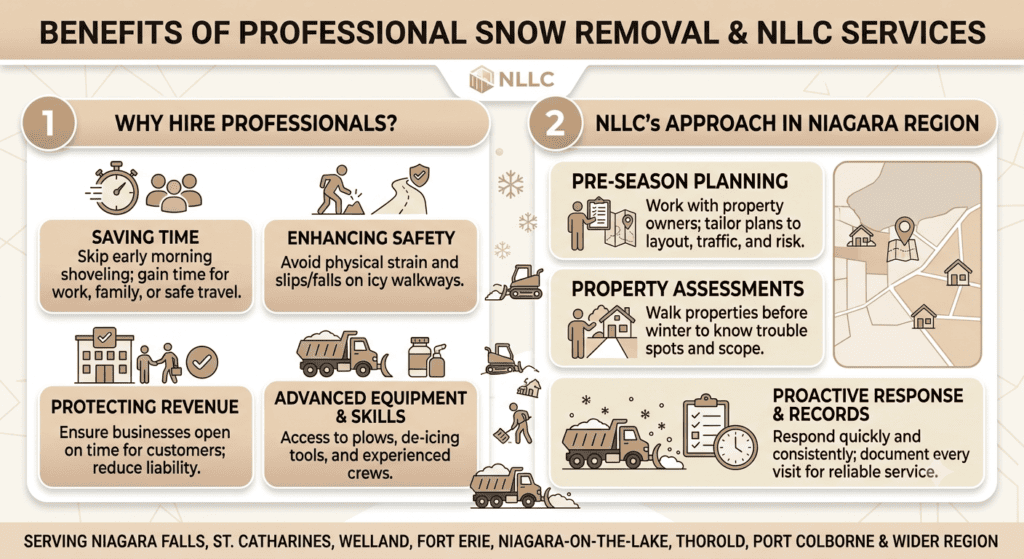
There’s a reason so many Niagara homeowners and business owners choose to bring in professionals rather than handling snow removal themselves. Time is the most obvious benefit. Clearing a driveway by hand before work, in the dark, after eight inches of overnight snowfall, is a genuinely difficult way to start any day, and it takes time away from work, family, or simply getting where you need to go safely.
Safety is just as significant. Snow shoveling is physically demanding work, and icy walkways create a real risk of slips and falls, not just for the person shoveling but for anyone who uses the property afterward. Many homeowners hire out this task not because they’re incapable of doing it themselves, but because they don’t want to be the sole backup plan every time a storm hits during a busy week.
For businesses, professional snow removal also protects revenue. A parking lot that isn’t cleared by opening time means customers who can’t get in, and in some cases, means direct liability exposure if someone is injured trying to reach the entrance. A dependable snow removal team, already locked in through a seasonal contract, removes that uncertainty entirely.
Finally, professional teams bring equipment most homeowners simply don’t have access to, from heavy-duty plows for larger driveways to specialized de-icing products designed for Ontario’s freeze-thaw cycles. That equipment, combined with experienced local crews who know how Niagara’s lake-effect weather behaves, makes a meaningful difference in both response time and quality of service.
How NLLC Approaches Snow Removal Across the Niagara Region
At NLLC, snow removal planning starts long before the first snowflake falls. Our team works with homeowners and businesses throughout Niagara Falls, St. Catharines, Welland, Fort Erie, Niagara-on-the-Lake, Thorold, Port Colborne, and the wider Niagara Region to build seasonal service plans tailored to each property’s specific layout, traffic patterns, and risk factors.
We walk every new property before the season begins, so our crews already know the trouble spots, the driveway slopes, the low-lying areas prone to ice, and the exact scope of what needs to be cleared, before the first storm ever arrives. That preparation is what allows us to respond quickly and consistently once winter weather hits, rather than scrambling to figure out a property’s needs mid-storm.
Whether you need residential driveway and walkway clearing, commercial parking lot and entrance management, or full ice management services alongside your snow removal, our team documents every visit so you have a clear record of the service performed throughout the season, giving you both reliable winter maintenance and an added layer of protection for your property.
Conclusion
Winter in the Niagara Region rarely follows a script. Even in a year shaped by a strong El Niño pattern that generally favors milder, drier conditions across much of Ontario, this region’s position along Lake Erie and Lake Ontario means lake-effect snow, sudden cold snaps, and genuine winter storms remain very much on the table. Add in a tightening labor market across the landscaping and snow removal industry, rising equipment costs, and Ontario’s real legal expectations around property maintenance, and the case for early snow removal planning becomes hard to ignore.
The properties that come through winter with the least stress aren’t the ones that get lucky with a quiet season. They’re the ones that treated snow removal planning as a late-summer task rather than a December emergency, locked in a contractor with a clear, documented contract, and let a professional team handle the unpredictability that Niagara winters reliably deliver.
If your driveway, walkway, or commercial property isn’t already covered for this coming winter, now is the time to change that. Reach out to NLLC today for a free, no-obligation quote, and let our team build a snow removal plan around your property before the first storm of the season arrives.
Frequently Asked Questions
When should I book snow removal service for my property in the Niagara Region?
The ideal window is late summer through early fall, ideally before the end of September. This gives contractors time to walk your property, plan routes, and lock in your spot before their client rosters fill up and pricing tends to rise closer to winter.
What’s the difference between a seasonal contract and per-visit snow removal pricing?
A seasonal contract charges one flat rate for the entire winter regardless of how many storms occur, giving you predictable budgeting. Per-visit pricing charges you only when service is performed, which can be cheaper in a light snow year but leaves your total costs unpredictable, particularly in a winter forecast to bring more variability than usual.
Am I still liable if I hire a snow removal contractor and someone slips on my property?
Yes, potentially. Ontario’s Occupiers’ Liability Act places a duty of care on property owners that isn’t automatically transferred to a contractor. Courts have found both the property owner and the contractor partially liable in past cases, depending on the specific circumstances and whether the contract’s terms were actually followed.
How much snow needs to fall before a snow removal company comes to clear my property?
This depends on your contract’s trigger depth, which is typically negotiated in advance. Common triggers range from one to three inches of accumulation, though this can be adjusted based on your property’s needs and how quickly you want service after a snowfall begins.
Does snow removal service include salting or de-icing?
Not always by default. It’s important to confirm this specifically with your contractor before signing, since de-icing is sometimes billed as a separate service or add-on rather than being automatically bundled into a standard snow clearing contract.
What happens if it’s an unusually mild winter and there’s very little snowfall?
If you’ve chosen a seasonal contract, you pay the agreed flat rate regardless of how many storms actually occur. If you’ve chosen per-visit pricing instead, you’ll simply pay less overall in a lighter snow year, though your total costs will be less predictable.
Is snow removal different for commercial properties compared to residential homes?
Yes. Commercial properties generally require faster response times, more documentation for liability purposes, and often more complex service, including large parking lots, multiple entrances, fire lane access, and accessibility ramps, in addition to standard snow and ice clearing.
What should I look for in a snow removal contract before signing?
Confirm the trigger depth for service, exactly which areas of your property are included, whether de-icing is part of the package or billed separately, how repeat storms within the same day or week are handled, and whether the contractor carries adequate liability insurance and documents completed visits.